
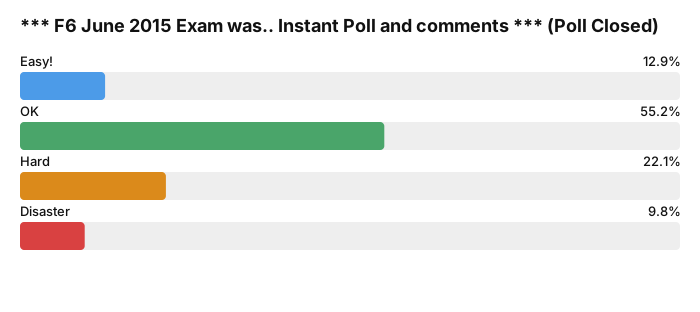
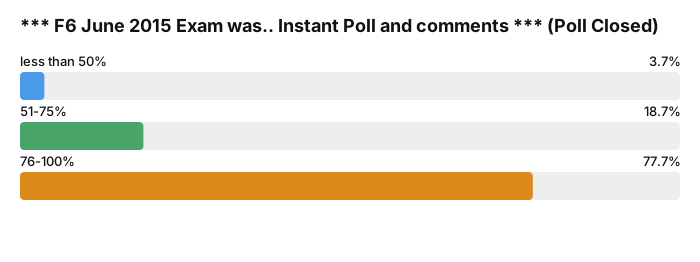
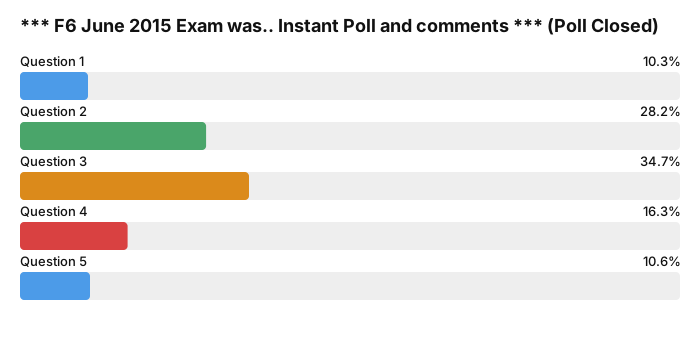
Please vote in our Instant Polls about the F6 June 2015 Exam.

@saajan said: f6 mcqs. 1. C 2. D 3. B 4. D 5. B 6. B 7.C 8.C 9.C 10. D 11. C 12. B 13. C 14. A 15. DDisagree with 3,4, 13, 14 Q3 - You can't restrict capital loss in current period but you can in future period. So I think technically you can carry forward the entire £6100 but the question is a bit unfair. Q4 - Still pretty sure this is B £299000 Q13 - The £50000/25% restriction does not apply to trading losses so the answer is £50000 +£24000 = £74000 Q14 - I think I remember something about balancing payments if your tax bill for the previous year was less then £1000 no balancing payments are necessary so the answer will be Nil
@chris165 said: Accounting period spans two tax years so you have to apportion appropriately: 4/12 * 23% * 1380000 + 8/12 * 21% * 1380000 That gives B: £299000U r right but it's not tax year it's financial yr 1/4/2013 to 31/3/2014 1/4/2014 to 31/3/2015
@gawcram said: Question 3 I think its A 23700- 10400( current yr loss) =13,300 Loss c/f (2300) =11,000(AE) Loss c/f 6100-2300= 3800This is what you would normally do to minimise tax but as the question is stated, £6100 is correct
@gawcram said: Q4 it's B and Q8 BQ8 no - because the cash released (£41000) is greater than the capital gain, there is no rollover relief available.
@chris165 said: Q8 no - because the cash released (£41000) is greater than the capital gain, there is no rollover relief available.I missed that.. :( u r right
@chris165 said: This is what you would normally do to minimise tax but as the question is stated, £6100 is correctCan u please explain a bit?
@gawcram said: Q 9 I think its BI thought it was B too. Because amendments and checks are allowed within 12 months of the submission of the self-assessment tax return.
@jayedchoudhury@hotmail.com said: I thought it was B too. Because amendments and checks are allowed within 12 months of the submission of the self-assessment tax return.Actually on second thoughts, I think this is wrong. Guess we'll find out when OT submits its suggested answers.
@se3addick said: Can anyone help with question 3, even now looking at the exam again I'm still not sure how to approach this one. I was working through the BPP revision kit, and don't recall seeing any questions like this so it threw me somewhat in the exam.I think q3 is quite straightforward, you need to compare what tax is being paying as self-employed to becomes limited. it all mentioned in question itself, since self-employed tax worked for you, you all need limited tax liabilities . 1 Corporation tax at 20% (100000*0.20)=£20000 2-Income tax(180000-10000pa)=8000*0.20=£1600 3-NIC class 1 pre employee 18000-7865*0.12=£1216 4-NIC class 1 sec employer 18000-7865*0.138=£1398 5-Dividens 31865*0.10=3186.5 8135*0.325=2643 Then you add them up and compare them to self-employed figure and state which one is more beneficial to taxpayer. I hope this will give you an idea
@haider85 said: I think q3 is quite straightforward, you need to compare what tax is being paying as self-employed to becomes limited. it all mentioned in question itself, since self-employed tax worked for you, you all need limited tax liabilities . 1 Corporation tax at 20% (100000*0.20)=£20000 2-Income tax(180000-10000pa)=8000*0.20=£1600 3-NIC class 1 pre employee 18000-7865*0.12=£1216 4-NIC class 1 sec employer 18000-7865*0.138=£1398 5-Dividens 31865*0.10=3186.5 8135*0.325=2643 Then you add them up and compare them to self-employed figure and state which one is more beneficial to taxpayer. I hope this will give you an ideaI had a different answer for this question as I had the director's salary as an allowable deduction from profits and also included the employer's annual exemption for class 1 secondary of £2,000.
 Former user11y ago#119
@accastudent1986 said: I had a different answer for this question as I had the director's salary as an allowable deduction from profits and also included the employer's annual exemption for class 1 secondary of £2,000.I agree with you. The original poster did not also gross up dividend and finally deduct the tax credit on dividend to calculate income tax payable. He also did not take into account the fact that part of the basic rate limit had been used up by the non-savings income.
Former user11y ago#120@chris165 said: I agree with them all except I don't know Q9If I may ask, why is question 1 C? Seems you have quite a good understanding of F6.