

Skip to contentSkip to search
Kaplan Publishing: Black Friday countdown

TX*** F6 June 2012 Exam was… Comments and Instant Poll ***

Oopentuition14y ago
Post your comments about June 2012 F6 exam.

?How did you do? What came up? How did this paper compare to previous exams?

Vote in our Instant Poll
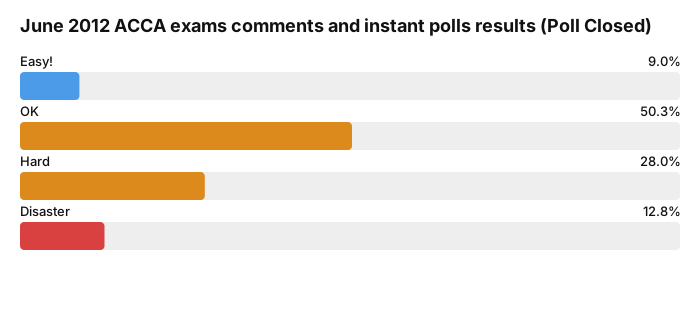
*** F6 June 2012 Exam was… Comments and Instant Poll *** poll results
Vvipulv14y ago#61
@Parallel Universe

Flat rate scheme :- Output (Sales) approx £59,000 @ 12% = £7,080.
Normal Method: Output £59,000/1.20 x 20 % = £9833
Less : Input approx £27,000/1.20 x 20% = £4500
VAT Payable £5,333, so Flick Pick was better off not registering for flat rate scheme as he would have to pay extra £1,747 .


This is exactly what I did!!! I thought too that flat rate scheme not beneficial but there are mix answers on here!
Ii-acca14y ago#62
Anyone remember for the last IHT question?
Nil band rate 325000+ 70% 325000
Life time chargable the one for daugter pet less the 6000 allowance
And the the one gift to son

Additional liabilities on death

The first one was exempt
Second one coverd with the nil rate band so was exemp

Death estate
2 properties
Car
Savings
Stocks
Less the morgage payment not the endowlent one
Less the loan dept not the worbal one
Then nil band rate analysis
40 % iht payable bythe representitive
Suffered childeren

Taper relief explanation with 80 percent discount

I dont remember the last part?
Anyone agreed with me?
Former userFormer user14y ago#63
@vipulv said:
@Parallel Universe

Flat rate scheme :- Output (Sales) approx £59,000 @ 12% = £7,080.
Normal Method: Output £59,000/1.20 x 20 % = £9833
Less : Input approx £27,000/1.20 x 20% = £4500
VAT Payable £5,333, so Flick Pick was better off not registering for flat rate scheme as he would have to pay extra £1,747 .


This is exactly what I did!!! I thought too that flat rate scheme not beneficial but there are mix answers on here!


I made a mistake in calculation slightly but the conclusion was the same that it was not beneficial.
Former userFormer user14y ago#64
were we suppose to apportion the salary in Q1? Because they did not mention anything about stoping emplyment.... and in Q2 was there any adjustment required for the office lease during adjusting profits? (for the first guy)
Nneilsolaris14y ago#65
@darshna11 said:
were we suppose to apportion the salary in Q1? Because they did not mention anything about stoping emplyment.... and in Q2 was there any adjustment required for the office lease during adjusting profits? (for the first guy)


Regarding question 1, I think they should have been much more clear. I assumed, looking how much time the partnership would consume, that they couldn't possibly do both, so I time apportioned the employment.

Regarding question two, I added on the depreciation and amortization, and subtracted the lease expense. I can't remember what the lease was, but supposing the lease was £x and length of lease is y years, then x - (2%*(y-1)*x). I've got a bad memory, and can never remember the numbers after the exam!
Former userFormer user14y ago#66
Both gifts were exempt during lifetime.
The 1st gift was was longer than 7 years, therefore it did not come to play after death scenario.
However , after death though, the 2nd gift was within 7 years period and could have been subject to IHT only for NRB (£220,000 - £325,000) to bring it down to NIL (it actually within 1-2 years) and not taper relief available either as was not for 3 years or longer, so then remainder of unused NRB i.e. £105,000 can be brought as a relief upon calculation of death estate, I think I have missed the 70% unused relief available from her husband, then again he gave the NRB for 2001 - 2002 was that to confuse us ?
Former userFormer user14y ago#67
I found Q4 a gift
Former userFormer user14y ago#68
I agree Q1 was a lot to cover , especially working out the partnership bit, so was Q4 with straddling on both companies, both were time consuming.

I suppose the rest of the questions were not as timed pressure, so it evens out.
Former userFormer user14y ago#69
Sorry Q2
Ii-acca14y ago#70
Okay how about chargable gain question first part one was stating resident and ordinary resident in uk and second one was the corporation
With the painting, i deduct the allowance of 10.600 then the calculate gain
Second one only warehouse and freeoffice building calculated gain

Third part only freeoffice building was available to ER relief with the 10 %

Next part i did without a rollover simply deduct costs and calculated the indexation cost and deduct it
Nneilsolaris14y ago#71
@artursaliasi said:
Both gifts were exempt during lifetime.
The 1st gift was was longer than 7 years, therefore it did not come to play after death scenario.
However , after death though, the 2nd gift was within 7 years period and could have been subject to IHT only for NRB (£220,000 - £325,000) to bring it down to NIL (it actually within 1-2 years) and not taper relief available either as was not for 3 years or longer, so then remainder of unused NRB i.e. £105,000 can be brought as a relief upon calculation of death estate, I think I have missed the 70% unused relief available from her husband, then again he gave the NRB for 2001 - 2002 was that to confuse us ?


The question after asked for the effect if she died 5 or 6 years later. Was I correct in saying that if she died 5 years later there would be no effect on the nil rate available (as PET was within 7 years of death), but if she died 6 years later, the PET would be more than 7 years ago, and therefore the death estate could benefit from the full allowance?
Former userFormer user14y ago#72
yup i also think Q1 should be more clear...well because nothing was mentioned, i took the whole amt. Hop they are linient in marking... Q2 i did the P-(P*9*2%) and then multiplied the amt by 12/16 then as it was a not included allowable expense, i deducted it frm the profits... Did anyone do something lyk dis? And in Q5 my nil rate band available was (325000-220000) + 70% of 325000 ..i reduced 220000 coz it was within 7 years..
Former userFormer user14y ago#73
i-acca said 15 minutes ago:
Okay how about chargable gain question first part one was stating resident and ordinary resident in uk and second one was the corporation
With the painting, i deduct the allowance of 10.600 then the calculate gain
Second one only warehouse and freeoffice building calculated gain

Third part only freeoffice building was available to ER relief with the 10 %

Next part i did without a rollover simply deduct costs and calculated the indexation cost and deduct it

_______________________________________________________________
This was the correct approach , don`t forget the one that did not qualify for ER you had to work out how much to tax at 18 % and and 28% considering the salary
JTjimmy t14y ago#74
Flat rate is NOT beneficial. The flat rate % is based on the GROSS turnover. This is the amount payable to HMRC. When you net off Input and Out put VAT, remember the figures included VAT! then this gave a lower tax payable!
Former userFormer user14y ago#75
jamesmichaeltucker said 1 minute ago:
Flat rate is NOT beneficial. The flat rate % is based on the GROSS turnover. This is the amount payable to HMRC. When you net off Input and Out put VAT, remember the figures included VAT! then this gave a lower tax payable!.

Yep : That is correct
Nneilsolaris14y ago#76
@artursaliasi said:
jamesmichaeltucker said 1 minute ago:
Flat rate is NOT beneficial. The flat rate % is based on the GROSS turnover. This is the amount payable to HMRC. When you net off Input and Out put VAT, remember the figures included VAT! then this gave a lower tax payable!.

Yep : That is correct


I reached that conclusion too.
Ttriniaccountant14y ago#77
This was much better than F5...though the lingering effects of frustration went into the exam with me...silly mistakes and all aside...it's a pass for me :) cause most marks are for formatting/workings not answer per se.

One thing...how do examiners expect us to be able to write so much for 3hrs back-to-back??? Writing hand started to get really tired in the exam and had to mentally PUSH myself to bear the pain and write...hope all was legible enuff! :)

Time for results now!
Thanks OT for all the help with F5&6 :)
Nneilsolaris14y ago#78
@triniaccountant said:
This was much better than F5...though the lingering effects of frustration went into the exam with me...silly mistakes and all aside...it's a pass for me :) cause most marks are for formatting/workings not answer per se.

One thing...how do examiners expect us to be able to write so much for 3hrs back-to-back??? Writing hand started to get really tired in the exam and had to mentally PUSH myself to bear the pain and write...hope all was legible enuff! :)

Time for results now!
Thanks OT for all the help with F5&6 :)


I agree, I noticed a blister appearing on my index finger for writing so much!
Former userFormer user14y ago#79
How did you tackle the furnished living accommodation on employment section?
benefit arising due to expensive accommodation (MV - £75,000) x 4%.

What about the furnitures supplied by the employer I think was approx 9K ? did any apply 20% to it? and on partnership his partner had an expensive car and he he was using for private journey and you had time apportion @ 10% to work out the capital allowance ?
Nneilsolaris14y ago#80
@artursaliasi said:
How did you tackle the furnished living accommodation on employment section?
benefit arising due to expensive accommodation (MV - £75,000) x 4%.

What about the furnitures supplied by the employer I think was approx 9K ? did any apply 20% to it? and on partnership his partner had an expensive car and he he was using for private journey and you had time apportion @ 10% to work out the capital allowance ?


I calculated the accommodation by the same method as you I think. Annual value, + (MV - £75,000) x 4%. I assumed it was the MV, because the property was acquired more than 6 years before being provided to employee (if I remembered that rule correctly).
Former userFormer user14y ago#81
Paper was damn easy.. Expecting above 75!
Former userFormer user14y ago#82
How did you tackle the furnished living accommodation on employment section?
benefit arising due to expensive accommodation (MV – £75,000) x 4%.

What about the furnitures supplied by the employer I think was approx 9K ? did any apply 20% to it? and on partnership his partner had an expensive car and he he was using for private journey and you had time apportion @ 10% to work out the capital allowance ?
I calculated the accommodation by the same method as you I think. Annual value, + (MV – £75,000) x 4%. I assumed it was the MV, because the property was acquired more than 6 years before being provided to employee (if I remembered that rule correctly).
____________________________
Off Course the annual value as well , but what about the furniture ?
Ii-acca14y ago#83
I thought it was the adding value so i add to cost of the property? Not a benefit for the employer? Unless if i read it correctly
Ttriniaccountant14y ago#84
No there was the property's annual value (which I now remember I didn't include :( ) then you add the MV (after 6yrs owned) -£75k) x4% (which I messed up n used 20%) <---That's additional benefit; then you add the 10% Furniture Benefit (cause that's the rate the employer gets it at)? Correct me if I'm wrong :( TriniA
Former userFormer user14y ago#85
Certainly including furniture made the question a bit spicy, it was the tricky, how do you classify this as an asset that was certainly adding value to the accommodation makes sense or does this qualify as an asset used by the employee as a benefit and apply 20% to it ?
Ii-acca14y ago#86
Well certainly dint remember i understand that wasvthe adding value to the property but i may have been mistaken as the exam was veeery long but if it is the case that was a furniture than it is a benefit to employee and should have been add 20 % of it. I guess i lost a mark there :(((
Former userFormer user14y ago#87
i did 20% on the furnishings
Former userFormer user14y ago#88
is terminal loss relief only on trading profits?
Former userFormer user14y ago#89
it depends , you can go back up to 3 years against total taxable profit and you can only carry forward against the trading profit
Former userFormer user14y ago#90
I meant against future trading profit