
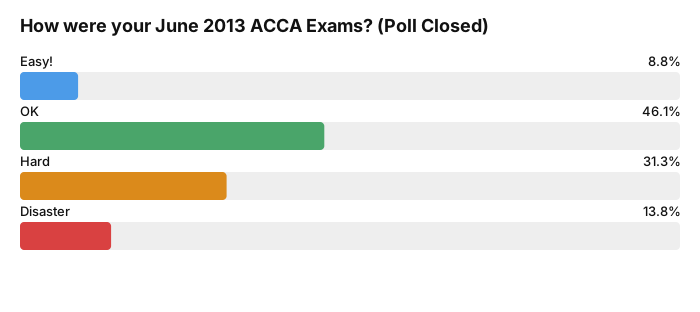
Post your comments about F4 June 2013 exam.
How did you do? How did this paper compare to previous exams?
Vote in our Instant Poll

 Former user13y ago#32
<cite>@whathaveidone said:</cite> I did the same as you Sangria £3000, £1500 and £500 but havent got a clue if it is right I think that was quite tricky :(I did the same Bribing Definition? bribing offences Receiving offering bribing foreign official corporate failure to prevent bribing DEFENCES special defences available for armed forces secret services Causation Link between the chain of events which caused the damage or loss but for Causation by fact- physical link between the breach and loss, But for the defendants actions , damage would not have occured Barnet vs chelsea Novus actus interveniens Act which break this link Natural event Third party- knighley vs jones Claimant- mckew vs holland lEGAL RELATIONS presunption rebuttal Domestic and social arrangements Commercial arrangements scenario questions 8- a)Suffiecint consideration- normal contractual obligations b) anticipatory breach market rule- sue for extra cost only 9 director removal- ordinary resolution court order- misconduct, indictable offence related to company running( cdda 1986), insider dealing could be charged 2) secretary dismissal- summary dismissal possible, gross misconduct. AOA not enforecable by third party , eley vs positive life company( no longer a director) change AOA- special resolution proper purpose court wont approve unless member competing member defrauding evident member defrauding 10) partenr ship cessation order- pay external debts first parner loans second members capital profit or loss divided as per agreement total debt- 9000+ 1000 assets - 5000 debt left- 5000 divided in the ratio 3000: 1500 : 500 as per agreement fingers crossed
<cite>@lfrancus said:</cite> I found this paper (F4 UK) farely easy compared to F5 and F9. just hope I can get I good mark out of it.Those were the papers i did i found the F9 was probably the easiest of all however, i doubt i passed any as ive been fighting a headache for the last two going on three weeks. so may have done one or two questions really good the rest i barely made out with.
Former user13y ago#36<cite>@angele1 said:</cite> neither did I see 'but for' rule... it is what? I have forgotten all the past cases names, I wrote only 2 or 3... is that sufficient to pass?case names went out the door when i was doing all the ones i did remember didnt relate to what was on the paper.
Former user13y ago#38<cite>@sangria9 said:</cite> My thoughts:) : Current outstanding balance is $10,000 ($9,000 to external users plus $1,000 to Ham). And Jo (? - who introduced capital only $1,000) can't be granted release from obligations. So all three partners should pay in total $5,000 according to their initial proportion (60%, 30%, 10%). What did you answer and what do you think??Dear Sangria I believe your answer is not correct. Since the partnership had been formed under the Partnership Act 1890, it was a mere General Partnership. In a General Partnership the partners are fully liable of the firm's debts and their liability is joint and several (apart from any provision and agreement between the parties). As a result the 3 partners are fully liable for the debts. What is your idea on this?
Former user13y ago#39<cite>@avnisapan said:</cite> Can anyone explain question 8 - removal of secretary/alteration of articles?Hey there, a. The secretary can be removed from the board. b. The secretary can be dismissed from his office without any notice. c. The articles cannot be changed in order to force the director to sell his shares. Because in this regard, the individual has not the capacity of an employee. He is having the capacity of a shareholder (a member of the company) and thus they cannot change the articles. Changing the articles is not in the benefit of the company and shareholders as a whole.
Former user13y ago#40<cite>@whathaveidone said:</cite> I did the same as you Sangria £3000, £1500 and £500 but havent got a clue if it is right I think that was quite tricky :(Hey there, Read my reply to Sangria. I think it helps you out.
Former user13y ago#41<cite>@faranjamal said:</cite> Its better to be pre-prepared :P I didn't do Q3 (didn't know anything) Messed up Q4 completely (so 0 marks) Q6 and Q7, i wrote very less detail So i think altogether it may barely be a pass :( About the last partnership Q. I think Jo was only liable to the amount of capital injected (She was a limited partner) The rest of the two would be Jointly and Severally Liable to contribute to the debt.None was a limited partner since the firm was formed under 1890 Act.
<cite>@yaserrasa said:</cite> Hey there, Read my reply to Sangria. I think it helps you out.Thanks... I think this is how I interpreted it... no limitation of liability for any of the partners - so Jo does have to pay an additional £500 to settle the outstanding debts of the partnership (as well as her £1000 capital). To be honest, I thought about this one for ages and then decided to go this way because the figures worked out easier (didn't think the examiner would use an example with odd amounts).
<cite>@whathaveidone said:</cite> Thanks... I think this is how I interpreted it... no limitation of liability for any of the partners - so Jo does have to pay an additional £500 to settle the outstanding debts of the partnership (as well as her £1000 capital). To be honest, I thought about this one for ages and then decided to go this way because the figures worked out easier (didn't think the examiner would use an example with odd amounts).Thats right as Jo is actively participating in the day to day activities of the business, he forfeits his limited liability status thus all partners are general and can be approached to pay debts.
Former user13y ago#46<cite>@sanjayk said:</cite> Bribery was new to the syllabus and hasn't appeared and was in an article on the acca website recently so so was obvious to come up. You should have studied it. Easy 10 marks.apparantly the question of the Partnership was a Direct copy from Mock exam no 3 question 10 in the 2011 revision kit only figures different ...
<cite>@yaserrasa said:</cite> Hey there, a. The secretary can be removed from the board. b. The secretary can be dismissed from his office without any notice. c. The articles cannot be changed in order to force the director to sell his shares. Because in this regard, the individual has not the capacity of an employee. He is having the capacity of a shareholder (a member of the company) and thus they cannot change the articles. Changing the articles is not in the benefit of the company and shareholders as a whole.you are wrong, refer to case law sidebottom v kershaw. Once a director is competing or being dishonest in the form of the case scenario, the other members could compel him to sell his shares because its for the best interest of the comany. However the situation in the Dafen Tinplate case is unlawful
<cite>@anny786 said:</cite> It was res ipa loquiter I completely left that Civil courts structure my mind went blank I wrote about county courts, hight Court magistrates and supreme Court. Q5 dividends what a mess Question about directors couldn't write much Scenario questions were probably the only good thing Overall it was very hard #you are wrong about your "novus actus interveniens" answer. The correct answer is Extra Damage caused by the 1. Claimant 2. Third Party 3. Natural event
<cite>@yaserrasa said:</cite> Dear Sangria I believe your answer is not correct. Since the partnership had been formed under the Partnership Act 1890, it was a mere General Partnership. In a General Partnership the partners are fully liable of the firm's debts and their liability is joint and several (apart from any provision and agreement between the parties). As a result the 3 partners are fully liable for the debts. What is your idea on this?No you are not right. she has the right answer. you are right in saying members cant limit their liability to a certain amount ( fixed amount) but they can divide profit and losses in proportion to their agreement. If you have BPP revision kit go to question 72 hope it make sense
Former user13y ago#51<cite>@beatleb said:</cite> That causation question was not a fair question! I looked all all my notes, no one mentions it anywhere........not even once was that term used anywhere.Come on everybody. We're trainee accountants and aren't expected just to parrot back the text book - this isn't A-levels. I'd not heard of causation before either, but it seems pretty obvious that it's got something to do with the cause - anybody who said something sensible should hope to get at least a point. 'But-for' was in my notes and I remember it from a lecture I heard so there's no excuse for point b), and they pretty much gave the answer for c) being that Novus Actus Intervenians means breaking the chain of causation. I reckon the examiner wants to see if people are able to think independently and come up with something logical - it's what we'll be expected to do in the world of work anyway, plus he's got to throw in some prizewinner questions to reward those people who read around, and not just one text book. There are no textbooks in the industry. Thoughts?
<cite>@vinai said:</cite> you are wrong, refer to case law sidebottom v kershaw. Once a director is competing or being dishonest in the form of the case scenario, the other members could compel him to sell his shares because its for the best interest of the comany. However the situation in the Dafen Tinplate case is unlawfulexactly, the duty of fiduciary was in breach and with the help of a court notice and special resolution, the articles could me changed and in result compelling the director to sell his shares
<cite>@vinai said:</cite> you are wrong, refer to case law sidebottom v kershaw. Once a director is competing or being dishonest in the form of the case scenario, the other members could compel him to sell his shares because its for the best interest of the comany. However the situation in the Dafen Tinplate case is unlawfulyes you are right AOA can be altered to force members to sell their shares in exceptional cases where members are competing against the company member defrauding well said
<cite>@andreasmacfarlane said:</cite> Come on everybody. We're trainee accountants and aren't expected just to parrot back the text book - this isn't A-levels. I'd not heard of causation before either, but it seems pretty obvious that it's got something to do with the cause - anybody who said something sensible should hope to get at least a point. 'But-for' was in my notes and I remember it from a lecture I heard so there's no excuse for point b), and they pretty much gave the answer for c) being that Novus Actus Intervenians means breaking the chain of causation. I reckon the examiner wants to see if people are able to think independently and come up with something logical - it's what we'll be expected to do in the world of work anyway, plus he's got to throw in some prizewinner questions to reward those people who read around, and not just one text book. There are no textbooks in the industry. Thoughts?well said Novus actus interveniens mainly 3 points Natural events action by claimant itself third party
<cite>@whathaveidone said:</cite> Thanks... I think this is how I interpreted it... no limitation of liability for any of the partners - so Jo does have to pay an additional £500 to settle the outstanding debts of the partnership (as well as her £1000 capital). To be honest, I thought about this one for ages and then decided to go this way because the figures worked out easier (didn't think the examiner would use an example with odd amounts).dont worry mate , you are absolutely right , i have checked the same question on BPP revision kit. even if its a General partnership, the profit and loss are allocate on the basis of profit sharing agreement if there is one. the order of paying debts 1) external debts - 9000 assets - 5000 external debts left - 4000 next one is to pay loan by a partner( internal debt) - 1000 no assets left , so it adds on to general debt total debt left- 4000+ 1000 = 5000 divided according to profit sharing ratio 1) 60%= 3000 2) 30%= 1500 3) 10% = 500 any one with this answer and good explanation is going to score 10 marks. its confirmed check BPP p& r kit question 72 or 73 hope it make sense
<cite>@vinai said:</cite> you are wrong about your "novus actus interveniens" answer. The correct answer is Extra Damage caused by the 1. Claimant 2. Third Party 3. Natural eventPraying for the best! Only our prayers can get us through this, let's pray for us all to pass with flying colours!
<cite>@andreasmacfarlane said:</cite> Come on everybody. We're trainee accountants and aren't expected just to parrot back the text book - this isn't A-levels. I'd not heard of causation before either, but it seems pretty obvious that it's got something to do with the cause - anybody who said something sensible should hope to get at least a point. 'But-for' was in my notes and I remember it from a lecture I heard so there's no excuse for point b), and they pretty much gave the answer for c) being that Novus Actus Intervenians means breaking the chain of causation. I reckon the examiner wants to see if people are able to think independently and come up with something logical - it's what we'll be expected to do in the world of work anyway, plus he's got to throw in some prizewinner questions to reward those people who read around, and not just one text book. There are no textbooks in the industry. Thoughts?I couldn't have put it better myself, that's definitely given me some comfort Thanks!
Former user13y ago#59Former user13y ago#60