FM*** ACCA Paper FM March 2019 Exam was.. Instant Poll and comments ***
Oopentuition_teamAdmin7y ago
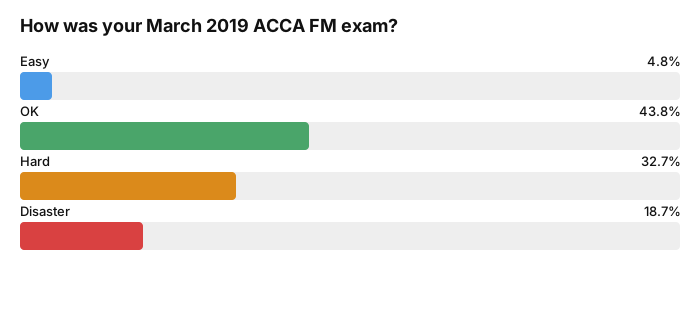
Vote in our Instant Polls about the ACCA Paper FM March 2019 Exam
Please post your comments below
JJennie7y ago#1
Ok so what did people think?
JJennie7y ago#2
My section c was very wordy - a 4 mark NPV, a PI decision, discussion but not calculation of EAB and real/money method and then 8 ratios and commentary around financing strategy. Had my extra 5 questions in section B. Finished in 2 hours
EErika7y ago#3
First time sitting CBE exam and did not like it more. But first time that I finished 45 mins earlier. Section A and Section B were quite difficult for me with many questions on fx hedging, FRAs, futures etc. Section B had more questions than usual. Section C, on the other hand was straightforward. First q was on calculating IRR with 11% and 20%. Second q, was on WC management with calculating many ratios and comment on their investment and financing policy. They were too conservative, in my opinion. The only difficult was with Cost of sales and credit sales, which were given separately. I calculated 80% of credit sales and used that figure to calculate the ratios for the inventory. Anybody did the same?
Sshiwani7y ago#4
Hey! Did anyone got the question about calculating NPV with gov. Subsidy? gov subsidy was non-taxable.
KKiran7y ago#5
I got the same questions. How much was your wacc? And what was your NPV?
MMark7y ago#6
Mine was "okay". I'll be disappointed if I haven't passed. One question's wording did annoy me though. There was a multiple choice question on market efficiency, and you had to select if some/all statements were true.
The first two statements appeared to be true, but the final statement was something like this:
"It is not possible to gain an advantage by insider trading when the market enforces a policy that companies must quickly release new information."
Now, in a perfect world that's true. But I opted for that to be not true; markets may well enforce the policy, that's not going to completely stop individuals/companies getting around it.
JJennie7y ago#7
I said that wasn't true as well
KKiran7y ago#8
How much was your wacc?
MMark7y ago#9
@erika21 I'm curious, why use 80% of Credit purchases for the ratios when cost of sales was given? For the ratios I used cost of sales (for both 20X8 and 20X7) except for Trade payable days where I used the respective credit purchases figures. I'll admit, perhaps I've missed an important piece of information in the question.
Either way, I also stated they were too conservative, and holding on to way too much WIP and finished goods. I also commented that they could have asked for longer credit terms with suppliers, and also improve their credit control due to the trade receivables being so high in 20X8 compared to 20X7.
EErika7y ago#10
There was something in the question that 80%of the credit purchases were spent of materials. That is why I used that figure. But not sure that this was correct at all.
JJennie7y ago#11
I used 80% usage for raw materials then cost of sales for other 2. I should have used credit purchases tho for payable oops. Also said conservative
JJennie7y ago#12
My other question was a 4 mark npv and a investment decision question using PI then a description of EAC and real/money method. Confident of a pass
GGayathri7y ago#13
I had lot of problems for section A and it was easy and I also had some theory questions which was little tricky. In section b problems where easy and theory was not so tricky than the section A. For section c I got a npv question and a question for calculating working capital ratios. The main problem for me in section c was the theory. I didn't understand what they want us to explain about..... Overall it was OK, hope I don't fail at 49 or 48???????
JJennie7y ago#14
My theory was around conservative/aggressive working capital and financing. Also discussion of EAC and real/money method
MMark7y ago#15
Bah, I must have missed that 80% materials line. Still, that should have only affected the ratios for Raw mats. Really hope I haven't royally cocked this one up!
MMark7y ago#16
Still on the subject of the working capital question, did anyone else recommend a JIT system?
EErika7y ago#17
Nope, you on the q with the ratios? I did not.
EErika7y ago#18
But is relevant. As they maintained high level of inventory and if the business nature does not require it, it is a very good comment.
EErika7y ago#19
I also remember a q for TERP, I got 6.60 for TERP and 5 for rights issue share price.
I also got 19% on the IRR q. Anyone else?
JJennie7y ago#20
I put the same for terp and issue. I understood the question just not written that way. Was 40p value per share which was 1.60. So 5 issue which then gave a terp of 6.60 and a 1.60 value
JJennie7y ago#21
My only irr it gave 4 npv and asked for most appropriate IRR
EErika7y ago#22
My q gave 7$ current share price, 1 for 4 rights issue and rights valuation of 0.4 $ per existing share.
IRR was on the q for 11% and 20%.
JJennie7y ago#23
Same terp question and same answer. Didn't get that IRR question
CCindy7y ago#24
Hi, any tips on how to hurdle the exam? I am opt to take FM this June.
AAnar7y ago#25
There was a couple of tricky questions.
One of them was in section A about market value of convertible bonds. The question was similar to September 2016 past exam question 11, with only major difference. Yesterday's question provided after-tax cost of debt, not before-tax cost of debt, if I remember correctly.
As far as I remember we always calculated the market value of such bonds using before-tax cost of debt. I do not know what was the intention of examiner to include trick in such a straightforward question. At the end I chose 130, but I am not sure, it could have been 138.
Another one was about asset valuation in section B, if I remember correctly. Asset valuation question included goodwill, which you do not see much in questions.
Section question C was full of tricks. 80% issue with credit purchases and cost of sales. I am not fully sure about my answers, could have lost precious points there. In my view, this was the case for most students.
Exam questions were not well spread, there was no WACC question and no receivable management, quite surprisingly.
For future exam-takers, Open Tuition materials and textbooks of learning providers, coupled with past exam questions are just enough to pass exam. But you have to study the whole syllabus. I would also suggest to practice in CBE mock answer sheets. I noticed that some of students thought that this works as Excel. There are some differences.
However, if you aim for high marks, these are not enough. Even if you do all past exam questions, CBE mock questions, you will see tricky questions. I hope that they will include section C inventory-related question in past exam paper in coming month.
BBrittany7y ago#26
Did anyone sit the paper exam ?
I struggled with the theory questions in both C sections and also the project specific cost of equity!
Nnim7y ago#27
Hi I had the same question. Do you remember how did you inflate sells prices? There were individual sell price and variable costs for each year.
JJennie7y ago#28
I had the asset valuation in B - was total assets minus liabilities then minus intangible as asset based tangible only. I actually forgot that then remembered on next question and put C which was 45 something. I had a b on cost of shares/preference shares and debt etc and the debt one felt like a trick the way it was worded
JJennie7y ago#29
I also had no receivable management theory or numerical. The 4 mark npv and inflated the sales by 4 and costs by 5 I think it was but accounting for 2 years of inflation in year 2 and so on

 Please post your comments below