
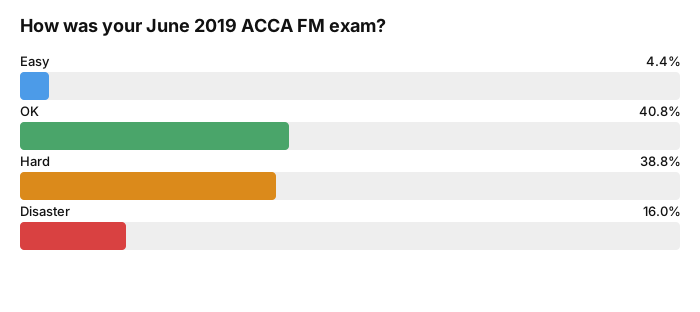
How was your FM exam? Please post your comments below, and vote in the Instant Poll
ACCA Forums
 Former user7y ago#61
@khilen said: My NPV question said that tax is paid “at the end of the year it relates to” - is that the same thing as tax is paid in arrears?that one confused me too.. but in NPV calculations, the cash flows are always year-end so I leave the taxes in the year (yr1/yr2/yr3/yr4). no yr5 so no arrears.
Former user7y ago#62@liamb said: I think the 100% allowance in first year just means you just calc whatever the tax rate was of the investment (like 15% of £600k) and use that as a positive cash flow in year one - which made my NPV positivehmmm I did opposite. I actually thought that the R&D and depreciation was mentioned just to fool you because the question gave profits/(loss) and said that they were already included in the profit/(loss) calculation so I just accounted for the 100% allowances in the first year ($600/4yrs *80%). I then tax the figures and discount them to get a negative NPV. I advice against the investment.
@xanpech said: I kind of felt the same way, did the BPP revision kit 3 times! And the past exam papers, but only 50/50 if I passed coz found section A and B harder than I expected and often you just have to get one thing wrong and lose the whole 2 marks. Most annoyingly I somehow had a blank on the price/earnings ratio question, then as soon as the exam was over I realized what I should have done and its not even a hard question, so I think it was partly exam stress getting to me aswell.It’s so frustrating isn’t it. I did about 8 past ACCA papers, 6 full mock exams and went through about 150 questions from the huge question bank, and still got stumped on a lot of questions that came up. ACCA really do make it so difficult and don’t provide the best resources to learn from. A lot of in depth knowledge I had didn’t get tested at all :( Fingers crossed we both did enough to pass :) good luck with your result!!
@liamb said: That working capital question screwed me too! I read it and thought ah nice easy marks, but couldnt get the quick ratio at allI know how to work the quick ratio out and still wasn’t getting the same answer as what they gave to work from :/ Baffling!
@ajaved5 said: I got that wrong, I started inflation at t1. What about the residual value undiscounted at 5%Inflating at T1 would be correct as far as I know. The figures they give are at today’s date so if it says £100 sales and 4% inflation T1 would be £100 + 4% then T2 would be £100 + 4% + 4% and so on.
@liamb said: I think the 100% allowance in first year just means you just calc whatever the tax rate was of the investment (like 15% of £600k) and use that as a positive cash flow in year one - which made my NPV positiveAhhh ok, I did that so hopefully my answer was correct :)
Former user7y ago#67@tonim said: I don’t understand why you would inflate the current year as Y1, the current price, are the prices that are actually being charged... inflation is an indication for future years, how much MIGHT be charged based on a future trend of increased prices.thats correct.
Former user7y ago#68@katie8223 said: Inflating at T1 would be correct as far as I know. The figures they give are at today’s date so if it says £100 sales and 4% inflation T1 would be £100 + 4% then T2 would be £100 + 4% + 4% and so on.Yes looking at the ACCA text, T1 is inflated
Former user7y ago#69@nella28 said: Yr0 in NOW- not inflated. YR1 onward are future days .
Former user7y ago#70@snell123 said: Would of given a slightly high cost of equity, but that’s not to say my answers was correctWhat did you get for the cash operating cycle ?the days
Former user7y ago#73@aliansari14 said: What did you get for the cash operating cycle ?the daysI got 58 days 40 days receiveables Less 30 days payable Plus 48 days inventory days Inventory 2.4 multiplied by 1.2 (growth) = 2.88 Cost of sales 18.3 multiplied by 1.2 = 21.96 2.88/21.96 multiplied by 365 = 48
@snell123 said: I got 58 days 40 days receiveables Less 30 days payable Plus 48 days inventory days Inventory 2.4 multiplied by 1.2 (growth) = 2.88 Cost of sales 18.3 multiplied by 1.2 = 21.96 2.88/21.96 multiplied by 365 = 48For the cash cycle didn't they say they were reducing the recievables days to 10 days? Thats why I got 28. I could be wrong though coz most ppl seem to have got 58.
Former user7y ago#75@xanpech said: For the cash cycle didn't they say they were reducing the recievables days to 10 days? Thats why I got 28. I could be wrong though coz most ppl seem to have got 58.Think they said reducing by 10 days but I could be wrong
Former user7y ago#77@keaney said: I got 58 days first then when I read over the question it asked for forecast figure not what was provided in statement of financial position given. So I would have adjusted the days by what was forecasted to achieve reduction of receivables by 10 days as well as payable and inventory to 30 as to meet their suppliers terms.Oh ok, what did you get then?
@snell123 said: I got 58 days 40 days receiveables Less 30 days payable Plus 48 days inventory days Inventory 2.4 multiplied by 1.2 (growth) = 2.88 Cost of sales 18.3 multiplied by 1.2 = 21.96 2.88/21.96 multiplied by 365 = 48
Former user7y ago#81