
Skip to content

ACCA Forums

FM*** ACCA Paper FM June 2019 Exam was.. Instant Poll and comments ***

Oopentuition_teamAdmin7y ago
How was your FM exam? Please post your comments below, and vote in the Instant Poll
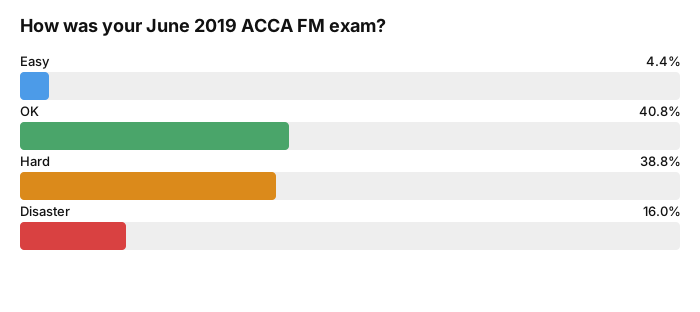
June 2019 ACCA FM exam — historical results
Former userFormer user7y ago#31
@xanpech said: I kind of felt the same way, did the BPP revision kit 3 times! And the past exam papers, but only 50/50 if I passed coz found section A and B harder than I expected and often you just have to get one thing wrong and lose the whole 2 marks. Most annoyingly I somehow had a blank on the price/earnings ratio question, then as soon as the exam was over I realized what I should have done and its not even a hard question, so I think it was partly exam stress getting to Yes the price to earnings one was tough - ended up getting 2231 or something like that but I’m sure I probably missed something out on the calculation
AAAli Ansari7y ago#32
I agree but they gave a debt to equity ratio also of 25% so instead of putting market values which they didn't give I I calculated WACC by taking the ratios 25(Vd)/25(Vd)+75(Ve) into the cost of debt and vice versa for equity , I got a WACC of 18. Something %
AAAli Ansari7y ago#33
I assumed this aswell and only adjusted the tax saving from dep'n in full and that related to first year ,then the remaining inflows were R & D's amortisation which was included I added it back because it's dep'n and also infact it's on the sunck cost , then the original depreciation was also added in calculating forcasting profits/losses so I added this back also since depreciation should be added back it's irrelevant, and that's it I discounted the Net cash flows at the rate , and got a Positive NPV ,and the number started with 9 something idk how many thousands
AAAli Ansari7y ago#34
For the cost of equity using the DGM I got 25. % Something also I think, don't remember the one with asset beta oh wait I think 8.something For section B , the working capital question went bad for me couldn't find the cash operating cycle days and quick ratio so I guessed,the other risk management and market value business valuations were simple but the thoery was abit tricky.
AAAli Ansari7y ago#35
For section A ,did anybody get that question which related to indivisble capital rationing where u had to to do trial and error method , The most maximum NPV according to the combination of projects under the capital required , I got the answer of 91000
JJohn7y ago#36
Did anyone get the question about “What are the relative merits of using DVM and CAPM for calculating cost of equity”? If so, what did people write?
JJohn7y ago#37
Also - there was a question on capital rationing that was divisible with mutually exclusive projects. BUT i had an issue and was baffled as one of the projects had a negative NPV so even though they had i think 40K left to invest, i didn’t include the project with the negative npv ???
JJohn7y ago#38
Just to confirm, i also added back the ammortisation cost of 200k? By dividing it by 4 years and added that back to each year ... ???
Ssoundarya7y ago#39
and what was your cost of debt??
Ssoundarya7y ago#40
i think you have to use the market values while regearing to the equity beta and i think take tax into consideration too
Ssoundarya7y ago#41
but they gave the mv of equity and debt tho???
Ssoundarya7y ago#42
gotta a question to talk about islamic finance equivalent for equity and messed up the spelling for musaraka and spelled it as musaraba lol my explaination for it was right tho will i lose market over that???
Ssoundarya7y ago#43
did anyone get npv for a machine which showed negative cash flow in first year i see now one talking about that and wacc and to find out cost of eq using divident growth model and capm
Ssoundarya7y ago#44
@snell123 said: Yes but there was a question before that were you had to work out the required return. It was something like current dividends value was 725m which equates to 14.5 per share with annual growth of 2.7% divided by share price of 65 then add the growth on
hi i had converted 2.7% into 3 so it'll still be valid right???
Former userFormer user7y ago#45
@wigjimin said: hi i had converted 2.7% into 3 so it'll still be valid right???
Would of given a slightly high cost of equity, but that’s not to say my answers was correct
Eemmag7y ago#46
I had section c, EOQ then aggressive vs conservative, hard capital rationing, long term vs short term debt, npv, ratios, explain roce and then projects to maximise npv that were divisible Hated most of a and b tho!
TToni7y ago#47
I also got the working capital which initially baffled me. When I reached the quick ratio question I couldn’t get an answer that was there, but then I re-read the question. It was asking for the quick ratio of the NEXT year, which included an additional debt of some sort. Using this information I got an answer. I got section C questions on CAMP and DGM which asked only for Merits and was worth 6 marks. I said that CAPM was universal for new project that companies are unfamiliar with because it looks at the current market and what the risk for a similar project it, which gives a good indication of how much the funding of such a project is currently costing. I went on the day that DGM was not as good as CAPM for the validation of projects, but it considered growth which should enable companies to consider future dividends for equity. I don’t know if I got any marks here. I also got the question on Islamic Financing and I panicked so listed 4 with explanations - Sukuk- debt finance (irrelevant but oh well), Mudaraba (shareholders and agents), Musharaka (joint venture) and Ijara (lease finance) I also explained the concept of Islamic financing and probably spent too much time on this question (but I was pretty proud as I’d been studying Islamic financing that morning). I also got the NPV question. I got a positive NPV. Depreciation calculation on a reducing balance at 25% works as follows: Y1) 1,000,000 * 25% = 250,000 allowance. Y2) (1,000,000 - 250,000) * 25% = X (don’t have a calculator). Your final allowance is calculated by deducting the scrap value from the remaining balance in Year 4 (from the question). This is your remaining WDA allowance, this is multiplied by the tax rate to give you the final benefit. The amount I got was significantly high. I also put the allowances in the years that they corresponded to, rather than the next year as it was in arrears... was this correct? I got a payback period of 3.25 years. I got this by doing a cumulative income chart and dividing the remaining negative balance by the total balance in year four. I said that the project should be accepted purely from a financial perspective, however as the directors had a two year maximum payback period and would automatically reject this project. On the next page I had to explain what they could do to improve their investment appraisal approach and I gave quite wishy washy answers on how they hadn’t considered new inflation rates and are likely to be outdate, that they shouldn't just be considering the payback period and that they may want to consider other methods such as IRR, RI, or ROCE. Please let me know if you disagree with my answers. It would be nice to know where I’m at. I got an awful section B foreign payments question which I pretty much just guessed! I was diagnosed with tendinitis is my writing arm on Monday and sat two exams. I’ll be so happy if I pass them given my amount of effort ?
Aajaved57y ago#48
@tonim said: I also got the working capital which initially baffled me. When I reached the quick ratio question I couldn’t get an answer that was there, but then I re-read the question. It was asking for the quick ratio of the NEXT year, which included an additional debt of some sort. Using this information I got an answer. I got section C questions on CAMP and DGM which asked only for Merits and was worth 6 marks. I said that CAPM was universal for new project that companies are unfamiliar with because it looks at the current market and what the risk for a similar project it, which gives a good indication of how much the funding of such a project is currently costing. I went on the day that DGM was not as good as CAPM for the validation of projects, but it considered growth which should enable companies to consider future dividends for equity. I don’t know if I got any marks here. I also got the question on Islamic Financing and I panicked so listed 4 with explanations - Sukuk- debt finance (irrelevant but oh well), Mudaraba (shareholders and agents), Musharaka (joint venture) and Ijara (lease finance) I also explained the concept of Islamic financing and probably spent too much time on this question (but I was pretty proud as I’d been studying Islamic financing that morning). I also got the NPV question. I got a positive NPV. Depreciation calculation on a reducing balance at 25% works as follows: Y1) 1,000,000 * 25% = 250,000 allowance. Y2) (1,000,000 - 250,000) * 25% = X (don’t have a calculator). Your final allowance is calculated by deducting the scrap value from the remaining balance in Year 4 (from the question). This is your remaining WDA allowance, this is multiplied by the tax rate to give you the final benefit. The amount I got was significantly high. I also put the allowances in the years that they corresponded to, rather than the next year as it was in arrears... was this correct? I got a payback period of 3.25 years. I got this by doing a cumulative income chart and dividing the remaining negative balance by the total balance in year four. I said that the project should be accepted purely from a financial perspective, however as the directors had a two year maximum payback period and would automatically reject this project. On the next page I had to explain what they could do to improve their investment appraisal approach and I gave quite wishy washy answers on how they hadn’t considered new inflation rates and are likely to be outdate, that they shouldn't just be considering the payback period and that they may want to consider other methods such as IRR, RI, or ROCE. Please let me know if you disagree with my answers. It would be nice to know where I’m at. I got an awful section B foreign payments question which I pretty much just guessed! I was diagnosed with tendinitis is my writing arm on Monday and sat two exams. I’ll be so happy if I pass them given my amount of effort ?
Section C DVM vs CAPM: I said how dvm considered growth and dividend and CAPM considered systematic and unsystematic risk, portfolio diversification, beta risk. Think the business in question went from one to to another, music player so CAPM was more relevant for specific cost rather then cost of capital. Islamic finance I wrote ljara (lease) that benefits eg no initial cost, repair cost to lease etc. And musharak, sure I spelt this wrong but explained venture capitalist and how they help with finance and received percentage of profit. Was payback not first converting profit into cf by dividing the depreciation each year and then doing cum cf? I got something like 3 year 8 month or 9 months. I was confused if I had to divide the .88 by 12 months to get the months. Project should be accepted from npv point and reject from payback point as over 2 year target but npv superior. They could improve their investment descion by using other investment appraisal methods irr, intergrating risk and uncertainty eg sentativity analysis. I also got the inflation rate out of date as historic average. The Npv question I didn’t understand the residual value was not discounted by 5% what did this mean? I put the tax and depreciation but one year in arrears. I inflated up the cf from year 1, should it have been year 2? Used money cost of capital. Section a and b was really hard so just guessed most of them. Hope to achieve a few good marks section C and section a and b to just bump be to 50!
FAfahad ali7y ago#49
Total risk is the sum of systematic risk and unsystemtic risk
TToni7y ago#50
@ajaved5 said:
On NPV cash flow, you inflate by the 4%. E.g £100 sales inflated at 4% would be Y2: 100 * 1.04 Y3: 100 * 1.04 * 1.04 Y4: 100 * 1.04 * 1.04 * 1.04 etc. You do not inflate year 1 as this is your base figure.
Aajaved57y ago#51
@tonim said: On NPV cash flow, you inflate by the 4%. E.g £100 sales inflated at 4% would be Y2: 100 * 1.04 Y3: 100 * 1.04 * 1.04 Y4: 100 * 1.04 * 1.04 * 1.04 etc. You do not inflate year 1 as this is your base figure.
I got that wrong, I started inflation at t1. What about the residual value undiscounted at 5%
MMariam7y ago#52
Pls what was npv value I got about 3m Did u add scrap value to d npv calculation I got 2yr 7month for payback cal. Pls what was NPV for that question
Xxanpech7y ago#53
@ajaved5 said: I got that wrong, I started inflation at t1. What about the residual value undiscounted at 5%
I also inflated from year 1, I think this is correct though? As the cash flows represent the end of each year and no inflation had been applied to any of the figures.
Aajaved57y ago#54
@xanpech said: I also inflated from year 1, I think this is correct though? As the cash flows represent the end of each year and no inflation had been applied to any of the figures.
I thought the same but I could be wrong, what would current/real terms mean?
Aajaved57y ago#55
@mareeam said: Pls what was npv value I got about 3m Did u add scrap value to d npv calculation I got 2yr 7month for payback cal. Pls what was NPV for that question
Yes would would need to add scrap value to the nav. Don’t remember my final answer.
TToni7y ago#56
Perhaps I was incorrect then. I’ve always considered the Y1 to be absolute and the inflation rates a forecast for the future.
TToni7y ago#57
I don’t understand why you would inflate the current year as Y1, the current price, are the prices that are actually being charged... inflation is an indication for future years, how much MIGHT be charged based on a future trend of increased prices.
JJohn7y ago#58
My NPV question said that tax is paid “at the end of the year it relates to” - is that the same thing as tax is paid in arrears?
Former userFormer user7y ago#59
hmmm I did opposite. I actually thought that the R&D and depreciation was mentioned just to fool you because the question gave profits/(loss) and said that they were already included in the profit/(loss) calculation so I just accounted for the 100% allowances in the first year ($600/4yrs *80%). I then tax the figures and discount them to get a negative NPV. I advice against the investment.
Former userFormer user7y ago#60
hmmmmmm
Topic lockedNew replies are closed.