
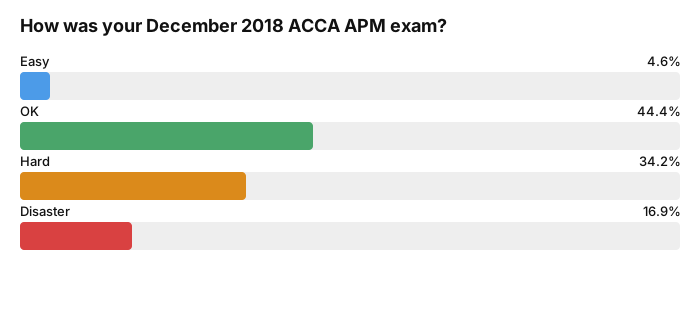
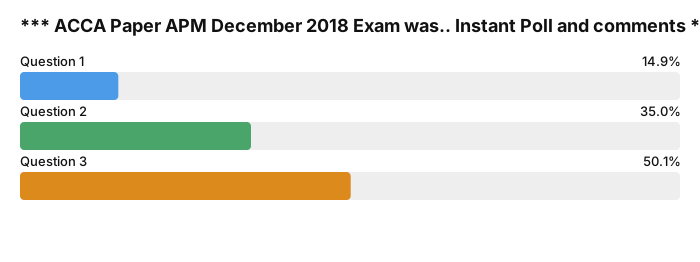
Please vote in our Instant Polls about the ACCA Paper APM December 2018 Exam
ACCA Forums
@ruthguy said: Found it ok actually - with the exception on Q3 which i didn't leave enough time for and completely did wrong (all the different risk preferences would have picked Green so god knows what probability table i did) struggled to explain the new performance measures against DMAIC as not really come up in my practise questions so not sure i will have scored high on exam technique there Q1 was ok though A little frustrating that we are told to memorise the models yet we were given them and also no EVA even though i spent ages revising it. I agree with the comments that it's an easy module to learn but then so confusing in the exam. personally i'd rather have more complicated models but with more straight forward questions as in real life if the board/senior manager asked me something in a confusing manner i'd ask them to elaborate and in my experience that's never been an issue so APM exam wording isn't really reflecting the real world! hopefully I've done enough as this was my last exam and i want my freedom back!! fingers crossed for everyone - roll on 13th Jan!@ruthguy..you can say that again! It is my last paper as well and I only just care about getting my freedom back now. Nothing more. I cannot be bothered to lose any more sleep over a straight-forward course content that is enjoyable and so easy to understand, but for some reasons, the examiner just prefers to take an unnecessarily convoluted approach to the questions. Does not make any sense and you are right about this never happening in the real world. I mean, what is wrong in just asking the questions in straight-forward and a clear manner? it shouldn't detract from the quality of the questions but rather add to it in my opinion as students are then focused on providing in-depth application of their knowledge to their answers, rather than wasting half the allocated question time figuring out the wordplay involved in the questions.
@kaffie said: @ruthguy..you can say that again! It is my last paper as well and I only just care about getting my freedom back now. Nothing more. I cannot be bothered to lose any more sleep over a straight-forward course content that is enjoyable and so easy to understand, but for some reasons, the examiner just prefers to take an unnecessarily convoluted approach to the questions. Does not make any sense and you are right about this never happening in the real world. I mean, what is wrong in just asking the questions in straight-forward and a clear manner? it shouldn't detract from the quality of the questions but rather add to it in my opinion as students are then focused on providing in-depth application of their knowledge to their answers, rather than wasting half the allocated question time figuring out the wordplay involved in the questions.@kaffie oh my word 100% - i mean to sit an exam with perfect knowledge and you can only score 25% and the rest is me bending to exam technique?!?! its ridiculous!! yeah if we were given clearer questions the standard of my essay answers would be some much better i could focus on grammar and articulation rather than the messy "trying to get to the point even though i don't know what the point is" current answers !!
@pmorehead said: Guys, are you absolutely sure about your maximax and maximin approach in Q3a? My understanding is that maximax and maximin should be used under conditions of uncertainty. Here probabilities were given (75%/25%). Therefore, EV is the right approach, isn't it? According to my calculations all 3 options were highly profitable reason being that development costs were treated as sunk costs, were not disclosed and could thus not be included in the profit calculations. As for directors it was clear they would go for the most profitable alternative whatever risk it takes to maximize their bonus (product 3 according to my calculations). However, development costs would have to be included to make a reasonable choice but were not disclosed. When it comes to employees, however, they would make their choice according to their main concerns e.g. job security and work safety as stated in the text. Profitability, if at all, would not be a major criteria for them. Therefore, using maximin or EV is according to my book somewhat flawed. Shareholders were risk neutral and therefore they would go for the most profitable solution all other risks being equal. I have the feeling that I might have overlooked something. But where?Even if probabilities are given, you can still use maximax and maximin. The idea is that risk-averse will want to avoid the worst possible outcome, even if this option doesn't have the highest EV and/or has a low probability. The risk-seekers will want to chance getting the highest possible outcome, even if this doesn't have the best EV and there's a low probability of them actually getting the best outcome. The problem with maximax and maximin is that they ignore probability and that's something you could then talk about in 3b. The scenario stated that a previous product launch had failed and employees had lost jobs as a result. Therefore employees would be worried about this happening again. While it's true all the products were profitable in both scenarios, you were only given the revenue and the direct cost per unit, so you didn't know what development costs and overheads these would need to cover, so it's possible that some of the products would not be profitable and the employees would want to avoid this scenario. And even a profit might not be enough, if the return on investment was less than the cost of capital. I didn't talk about all this in my answer, but it was why I chose the approach I did. If I had more time I would have included it but calculating the answers took most of the time in this question part.
@Nusrat_Hussain said: In 3rd question the probability has to apply to exchange rate and the resulting exchange rate was 2.1$K = 1$D. The approach I adopted to work out profitability on reporting currency of $D. If you select reporting currency on Rezolla as $D the there was no near to convert the value of unit cost was already in $D. This is what I believe! Request your commentsI calculated the revenues if the D$ strengthened, and if the D$ weakened, and then the costs if the D$ strengthened and if the D$ weakened. This gave 2 sets of profit figures for each product, allowing me to apply maximax and maximin, and then I used the 75% and the 25% to calculate the EV. I don't think you should apply the probability to work out an expected exchange rate, rather work through the 2 scenarios in isolation then apply the probability at the end.