
Skip to contentSkip to search
Kaplan Publishing: Black Friday countdown

AAA*** ACCA P7 June 2017 Exam was.. Instant Poll and comments ***

Oopentuition_teamAdmin9y ago

Please vote in our Instant Polls about the ACCA P7 June 2017 Exam
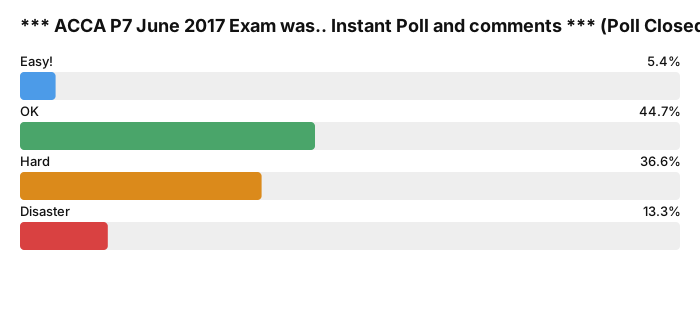
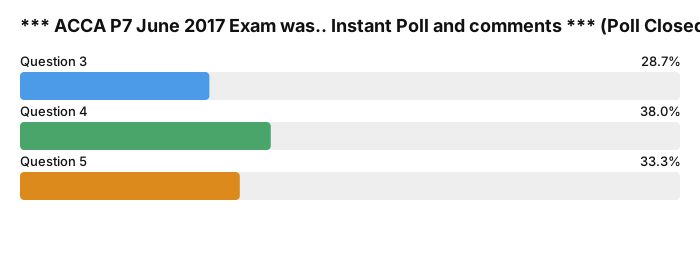
*** ACCA P7 June 2017 Exam was.. Instant Poll and comments *** poll results *** ACCA P7 June 2017 Exam was.. Instant Poll and comments *** poll results Post your comments about the ACCA P7 exam below (after 5pm UK)

DDetermined9y ago#31
Really? I disagree. Audit risk is a fundamental area in P7. The core of P7! Those type of questions have come up before. Ethics also. Plus professional issues.
Ssap9y ago#32
,was time pressured
Oomensa9y ago#33
I do believe that the paper was fair, I've seen tougher questions lately and this one really went relatively easy on the students. Q1 was about audit risk in acquisition of 3 subsidiaries during the year. I find business risks harder because they relate INDIRECTLY to the financial statements and I was hoping to see business risk in this attempt, since we had risk of material misstatement in the March 2017 attempt. Anyway, the question asked about audit risk for a group which acquired 3 subsidiaries during the year. Part a) One was Lilac and was a significant competent. Was present overseas but had same currency, so no translation risk. Adopted IFRS for the 1st time and had an internally generated brand name called 'Green Gadgets' valued at $10m by the management of Lilac themselves. As per IAS-38. internally generated brand names can not be capitalized but I believe from a group's perspective, it was purchased with acquisition of the subsidiary so its fine to recognize it. In 2nd subsidiary, shareholding was 58% but representation on Board was only 40% since the group was allowed only 2 directors out of 5. So for me, not enough voting rights, therefore this subsidiary was not to be consolidated. Third was a Software company. The only threat I could think of was Research and Development costs the subsidiary was said to be focused on.Rest related to part c. Part b) This part asked for audit procedures required for Brand Name in Lilac to be communicated to the component auditor Part c) This focused on ethical and professional matters since 3rd subsidiary wanted advice on merger and acquisition planning and selecting appropriate targets. There was also a support letter given by Cactus group for the acquisition to the subsidiary and the engagement partner of the component auditor required Going Concern working papers from group auditor but honestly, i don't believe that there was any going concern issue because the support letter was not in result of some operational or financial difficulty of the subsidiary. Q2 was about quality control and ethical matters where we were performing a post-issuance quality control review. Part a dealt with a scenario where test of controls were not performed at final audit and audit procedures 'limited' as a result, placing greater reliance on internal control. There was no record for meeting with audit committee to discuss the audit findings and the amendments were discussed orally with the Finance Director over the phone who then made the adjustments. Audit report was signed prior to receiving Chairman's Statement for review. There was a matter discussed in Emphasis of Matter para regarding a significant contingent liability, regarding which sufficient audit evidence was present in the file. I believe the treatment was correct, wonder what we were supposed to say about this? Part b was about ethical dilemma concerning 3 audit assistant. One sold training service to the client as all the assistants were encouraged by the audit manager to do so, with a cash reward promised in return. 2nd assistant had helped the Finance Director in designing inventory count controls with audit manager's approval and 3rd was re-engaged in the audit of the client, despite of the fact that she had just returned from a forensic audit assignment carried at the same client and the assistant worked closely with the internal audit team for 4 months
Oomensa9y ago#34
Q3 was again about professional matters and some KPIs. Part a was about an on going audit of a hospital where the audit staff had identified expired medicines in the inventory and saw the same medicines marked in a worksheet in possession of the Finance Controller. Upon request to see the worksheet, the Finance Controller refused to show it saying that you must have mistaken something else to the list of expired medicines. The next day the staff was threatened by the Finance Director to stop investigating something that does not concern them otherwise he will remove the staff from the premises. The next day, the expired inventories were physically gone (talk about misappropriation of asset) Part b had 2 parts, 1st one asked the difference between 'performance audit' and 'audit of performance information', whereas 2nd one asked for audit procedures required for the verification of 3 KPIs given in respect to the hospital I didn't attempt Q4 but as far as i remember, it required discussion upon valuation of inventories, impairment and warranty provision
Former userFormer user9y ago#35
Just a quick question. What examination procedures for performance information in Q3(c)?
Former userFormer user9y ago#36
What procedures did you answer for the performance indicators?
Oomensa9y ago#37
@ameera85 said: What procedures did you answer for the performance indicators?
Check nurse personnel files, obtain floor plan to identify rooms, check from billing ledger the average occupancy, check patient files/case files to identify revisits within 28 days Dont remember the rest
Oomensa9y ago#38
@scared123 said: Q5(i) - Materiality calculation - material. - IFRS 15 revenue shall be recognised only when the performance obligation has satisfied. Explain to the scenario that the risk and rewards of the goods have not arrived at the customers, no revenue shall be recognised, only deferred the income until the performance obligation has been satisfied with. - This might be the accounting policy for several years, comparative figures might also be misstated, shall discuss with those charged with governance should the adjustment being made in the opening retained earnings figures (IAS 8 retrospective adjustments for error) - Auditors shall also obtain the contract between the company and the customers to ensure the revised terms in the contract has been signed by the customers. -Discuss with those charged with governance the qualification of the auditor's report and also the wordings to be included. Some points I have included in my answer in Q5(ii) impact of the auditor's report if no adjustments would made will be:- - If material, but not pervasive, qualified 'except for' opinion. - If material and pervasive, adverse opinion. - Modification reasons and effect of the quantification effects to the FS in basis paragraphs - Immediately after Opinion paragraph - Finally, the client is a listed client, KAM paragraph shall be included as it is a requirement for all listed companies. If there is a significant matter which the auditor needs to communicate, then include the explanations in this paragraph. If no significant matters have found in the performing of the audit, shall included in the KAM paragraph stated that nothing have been found to be significant in performing the audit.
I don't think KAM was worth mentioning here. If the issue has formed a basis for qualification, it will be discussed in Basis for Qualified Opinion para, not in KAM Same goes for EoM. Any matter discussed in EoM does not become part of KAM
Former userFormer user9y ago#39
P7 June 2012 Qs1 (ditto copy)
Sschoolsin9y ago#40
I did Q1, 2, 3 and 5. A lot of ehtics and professional issues in this paper. Q1a was the most difficult. I left it to last and ran out of time listing audit risks, but got about 5 or 6 down. Fingers crossed.
IImran9y ago#41
Can someone verify. In question 3 part b, I differentiated saying performance audit is substantial audit whereas the other is limited assurance. One gives positive assurance and the other negative. Etc?
Ccheychey219y ago#42
Am I the only one who thought EOM should have been a KAM?
Jjelenaxm9y ago#43
Time was key issue here.Too many things to write about and explain. Q2 had very straightforward lack of procedures as well as ethical issues but needed to be explained well. I think Q1 had some overlapping since both Q 1 b) and c) answers were already supposed to be mentioned in q1a) since Lilac brand recognition and first time measurement is relevant audit risk and also in Snow component auditors competency may be questionable.Q4 should have all evidences listed and explained how to test it, I did this question first and it took a lot of my time even if it had only 20 points, so bad time management.Q5 review contract , check if any subsequent Anex or Acceptance confirmation from customer done, if not risk and rewards stay at seller so no revenue recognition.Only if contract had some preagreed penalties for customer for not accepting goods on time, those penalties could be charged.this is material but not pervasive,so except for paragraph,and prior to that communication to those charged with governance since listed entity has such body.All in all ,question is how marks are granted, even if I tried all 4 question,and did not skip to try and get any points ,still I may fail like past time for just below 50.this my second attempt, so I am skeptical , even if with reading your answers I see I have replied similarly.Goodluck to all
SSunU9y ago#44
@cheychey21 said: Am I the only one who thought EOM should have been a KAM?
You mean Q2 the EOM paragraph issue? I personally don't think so. KAM is determined when the matter has been communicated to charged with governance, then matters that requires significant attention during the audit - which they said the audit evidence has sufficient and appropriately obtained, does not pose any challenges to obtain the evidence, then the final KAM which is most significant in the current audit. I don't think KAM is suitable at this point.
SSunU9y ago#45
@omensa said: I don't think KAM was worth mentioning here. If the issue has formed a basis for qualification, it will be discussed in Basis for Qualified Opinion para, not in KAM Same goes for EoM. Any matter discussed in EoM does not become part of KAM
Hmm, yes definitely. You are right saying that the qualification of the matters will need to be explained in the Basis of opinion paragraph. My point here is that the client is LISTED, you can check under ISA 701 if not mistaken, it has become a requirement to include KAM paragraph, whether or not there is a matter that is significant to the audit. If yes, you communicate, the audit might be modified, but the matter included in the KAM is not discussed in respect of the modified opinion.
Mmuhammad9y ago#46
my question do we need to pass each question individually in SECTION-A in order to secure pass or let say if someone is scoring only 10 marks in Q1 but scoring 20 marks in Q2 & get in total 30 out of 60(Q1-35+Q2-25) in SECTIONA so would he/she still be consider as pass? or someone is failing in Q1 but is pass overall in SECTIONA & as well as in SECTIONB so would ACCA still fail him/her or pass. i hope you guys have understood my question. please advise all the best to everyone.
Former userFormer user9y ago#47
Sections don't matter, total from all sections should be equal 50 marks or above is considered passed.
Ffidget9y ago#48
You need 50 marks in total to pass. It doesn't matter which questions you get them from.
EEdel9y ago#49
Re: "What IS the difference between ‘performance audit’ and ‘audit of performance information?" Is described the difference between limited and reasonable assurance. negative v positive opinion and level of assurance provided. Q1 i found tough but assumed it was materialtiy of component auditors, the Year end consolidated dates not being co-terminus, accounting standards, ISA600, minority interest of acquisitions and their materiality, reliance on component auditors and assess them for their reliance, experience, qualifications and independence etc. Hopefully will get some marks anyway! Usually like audit report Q's but was unsure about the recognition of the revenue under IFRS 15 re the terms of the contract, was that terms spicifically re those 2 businesses contract or did it effect the revenue recognition! SO i skipped it and did Q3 instead! Q3 was easier to answer than it looks i think! Its always the same, matters to consider for any of them are their materiality to fin st's , the accounting standards, their risk of material misstatement and effect on audit report, then evidence is Q&A's , recalculations.....just did the same points for each part a,b and c but re-jigged to relate to each part! Here's hoping i passed this time!
Dderek6666c9y ago#50
What Q has the EOM where there was a contingent liability? For this I wrote that the EOM was not appropriate, and if the contingent liability was causing a going concern issue it should be disclosed under the basis of opinion under heading of Material Uncertainity in Relation to Going Concern and also mentioned in the KAM section of the audit report. Was a tough paper overall Q1 requirements were very vague, audit risk but caveat to say no need to mention disclosures which to me meant she wanted the audit risks just in relation to the audit planning stage not any ROMM risks caused by audit risk.
EEdel9y ago#51
I think that was Q2 as they said the report was unmodified but with an EOM paragraph, which means that its was unqualified but not unmodified , so maybe she was looking for that to be pointed out! If causing going concern issue it should be disclosed in EOM paragraph and KAM if listed co. It's so hard to know, but i think it was ok to mention ROMM caused by audit risk if it was material but just not talk about the element of whether to disclose it or not. There's so little time to even be able to contemplate whether or not to mention these things! This is my 3rd time sitting this paper and i hope it was the last!!!
RRoman9y ago#52
Unfortunately, I also mentioned that the basis for qualification should also be mentioned in KAM. This is wrong....see point b below. On the other hand, you don't lose points for stating wrong things... A matter giving rise to a qualified or adverse opinion in accordance with proposed ISA 705 (Revised),2 or the existence of a material uncertainty related to events or conditions that may cast significant doubt on the entity’s ability to continue as a going concern (hereinafter referred to as “material uncertainty”) in accordance with proposed ISA 570 (Revised),3 is by its nature a key audit matter. However, the auditor shall: (a) Report on these matter(s) in accordance with the applicable ISA(s); (b) Not describe these matter(s) in the Key Audit Matters section of the auditor’s report; and (c) Include a reference to the Basis for Qualified (or Adverse) Opinion or the Going Concern section(s) in the introductory language of the Key Audit Matters section. (Ref: Para. A44–A45)
AAimee9y ago#53
Q5 I did the adjustment for the revenue/receivables. (adj needed as risks & rewards not transferred according to contract) I also put that we needed to check whether the inventory had been removed from stock as it needed to be added back in at lower of cost & nrv. Qualified opinion if inventory still on stock list as material ($17m), not pervasive. Adverse opinion if inventory needed adding in as aggregate errors were then pervasive. Did anyone else do this or am I completely barking up the wrong tree?
Dderek6666c9y ago#54
That is the new change if its causing a going concern it no longer goes in EOM paragraph but goes into its own heading called material uncertainty related to going concern paragraph under the basis of opinion and is mentioned in the KAM section too if listed, I cant rem if it was listed or not. I presumed that's why they originally had the contingent liability as an Emphasis of Matter, a vague question that arguments can be made for different treatments. If everyone has another 45 mins in there we would probably all pass just goes to show they want to time pressure you to fail you. I had 15 mins to do my last question and could only write bullet points :(
Former userFormer user9y ago#55
Question 1 was very very difficult for me. i do not believe i identified enough Audit Risks. it was too long. Examiner needs to reassess question 1 especially given the many things that were required for the rest of the paper. Re the other sections, there was a lot to write in the time alloted. i hope the examiner takes this into consideration when grading because it was impossible to fully develop pointers during the time. i wrote my exam down to the wire. Fairly manageable paper. keeping my fingers crossed.
SSandhya9y ago#56
Hello guys, what did you do about that question with cost of inventory with labour rate in it. How did you deal with it ?
EEdel9y ago#57
For matters i said the materiality of the items, their accounting standards being handled correctly as per IAS 2 etc and the risk of them being materially misstated. For the evidence, that there should be a Q& A with management, copy of the records etc or where their assertions came from and re-calculations of them to confirm accuracy I did the same format for all 3 points, just amended for each situation.
AAccStudent9y ago#58
I wrote something along the lines of.. Performance audit -Higher assurance -Positive report/opinion -Required by regulations/stakeholders audit of performance information -Limited Assurance -Negative opinion -Not legal requirement It was just 3 marks so half a mark for each point was sufficient I thought.
AAccStudent9y ago#59
.
AAccStudent9y ago#60
The answer should be along the lines of revenue recognition, IFRS 15. When it should be recorded, if risk and reward not passed then revenue overstated, inventory understated.