
Skip to contentSkip to search
Kaplan Publishing: Black Friday countdown

APM*** ACCA P5 December 2017 Exam was.. Instant Poll and comments ***

Oopentuition_teamAdmin8y ago

Please vote in our Instant Polls about the ACCA P5 December 2017 Exam
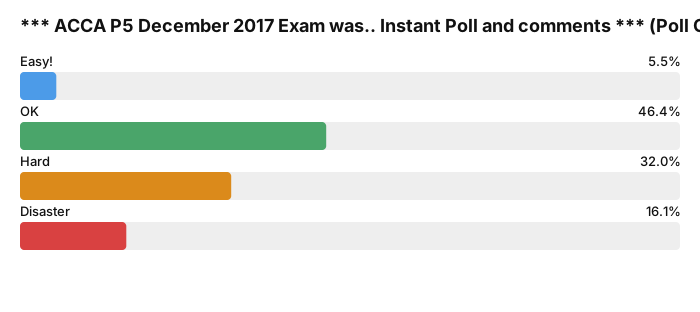
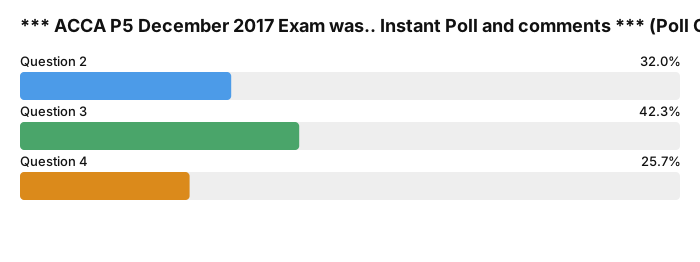
*** ACCA P5 December 2017 Exam was.. Instant Poll and comments *** poll results *** ACCA P5 December 2017 Exam was.. Instant Poll and comments *** poll results Post your comments about the ACCA P5 exam below (comments will open after 5pm UK)

AAnna8y ago#31
Also, what did you say in Q1 (c), (d)? How did you assess proposed measures in (b). Did you say what would be better? I said financial gearing is good, as they don’t want to have high debt and than that another value (was it net profit?) should be replaced with roe to motivate innovation and rd. For customer I said it should be market share and customer satisfaction with quality as brand awareness does not evaluate brand strength(CSF) For internal I got lost. I said GPM is bad kpi. It should better connect customer perspective and learning. So I said time to marketing new product was good KPI and % of returns or % of rejects should be used. For (c) I was trying to make some sense from those measures and recalculate as % of revenue from new products to total revenue. Not sure... which KPI did you select for this perspective ? It was stated max 2.
KKevin8y ago#32
I think I said gearing and profit margin bad at showing capital utilisation as gearing just shows the amount of debt relative to equity nothing about how it is utilised and profit margin just shows profit relative to revenue again nothing about how capital is utilised. Said roce would be better as shows how effectively capital employed is turned into profit. Said exactly same for brand awareness For c) I talked about life cycle costing and how cant determine the success of new products in introduction phase when revenue not at full potential and costs still high for establishing. Then noticed also in split out of costs the fixed costs of employee training had been included in cost of new products but these were fixed and so not relevant
Bbenjamincozoemena8y ago#33
Did question 1 require us to write a report or prepare a report. I didn't realise this until I finished my answers and no way to now include the To: , From: , Subject and Date ish. had to squeeze them in above the exam paper, I hope I get some mark there. however, the introduction was not done as there was no space for it and I couldn't just cancel my answers.
MMartin8y ago#34
Q1 Financial perspective - I also commented on ROCE being better at measuring overall objective. For GPM I suggested it should not be in internal business perspective but financial perspective, as a measure for sales department only. Customer perspective - I commented that market share and brand awarness were good measures, showing how exactly they link to overall objective of the company (market share - sales, brand awareness - higher prices). In next requirement on innovation and learning, you were supposed to calculate measures in Appendix 2 and assess actual performance. For new product lines, they seemed to underperform, introducing only 2 lines in past 4 years. But info about competitors performance on new product lines was missing to confirm that. As for time to market, it was stated that new product line Solar TV was expected to be implemented in 3 years. That seemed to be too long. But again, competitor benchmarks were not presented. I think requirement b) was asking about practical steps to implement BSC. I suggested steps like implementing new IT system, training employees. Q2 - Part a - I commented on barriers of entry as CSFs and linked them to KPIs. E.g. prices of land and buildings, market share, operational gearing. Part b - I commented on tunnel vision, because managers were only evaluated by profit margin. Improvements suggested like generating management reports and rewarding performance on other measures. Part c - risks of loyalty system were high purchase cost 4m vs 2.4m annual profit, extra cost on system for interpreting data, employee related costs, sales from restaurants not recorded (risk of fraud) Q3 - I commented TRH overperformed on economy because they did not exceed salary bedget. As for efficiency I started to calculate salary per patient and ran out of time...
Former userFormer user8y ago#35
I think I have made a huge blunder!! Was there any figures given for Q3? A table or something? I didn't see that!!
Iivan8y ago#36
Risks I wrote.....the method is inward looking....lose of customer data.....discounts will just lower the profit margin those they increase sales but cr won’t be able to cover costs....and mother nonsense like that
Dds3ce8y ago#37
I only answered 75% of the paper. This was my first attempt. I love performance management and I was very good at it at university, but the way you have to answer these questions, I really don't like it. It seems they are more interested in your exam technique and whether you can figure out the meaning of questions rather than your actual knowledge. Also, parts of the syllabus are useless because in real life nobody is using performance pyramid etc, nobody has the time for such things. Finance teams ,finance managers, finance leaders are busy, especially around month end, quarter end, mid year and year end.
Aanahit19858y ago#38
Question 1: Balanced scorecard. there was nothing difficult about it. part A was testing the basic understanding of candidates about this. 7 marks for this..quite generous ! the rest of the requirements were similar to the other past papers. nothing strange or difficult. the scenario was easy understood , not lengthy. i enjoyed most, this part of the exam. Question 2: KPI 's , performance measures, Loyalty card. Again, nothing hard. very practical question. Question 3: Non profit organisations. this wasn't tricky either. budget constraint management style.. which is not appropriate in such organisations etc. Overall very fair paper , questions were clearly structured. no tricks and the examiner was guiding us at times to avoid writing irrelevant answers. all the questions could be answered without any knowledge of the theory as long as done in a logical way. this is what i say about P3 as well.. use your logic, this is all it takes. after all theory will score maximum 20 % of the marks if done 100% correct. General point : P5 in my opinion should be compulsory as this is the value added part of ACCA. Good Luck to everyone !
Former userFormer user8y ago#39
100% matched with mine.
Former userFormer user8y ago#40
Yes there were, which was required in finding 3E's measures.
NNana8y ago#41
Ivan the risk was not about the loyalty card system but the risk of the system not been able to record purchases at the restaurant. Even though very tricky I think one of the risk may be the fact that since the system cannot record actual purchases then some customers may abuse the system by using card discount several times because the system cannot detect that the customer has used the discount
BB8y ago#42
For Q1 - What about suggesting EVA as a financial measure? As the aim was Shareholder Wealth Max? Also for Q3b) - for Efficiency (as oppose to Effectiveness) - what about the % of patients seen first time?
AArron8y ago#43
@bacca1 said: For Q1 - What about suggesting EVA as a financial measure? As the aim was Shareholder Wealth Max? Also for Q3b) - for Efficiency (as oppose to Effectiveness) - what about the % of patients seen first time?
I also suggested EVA or EPS, I think I suggested to choose EPS and get rid of gearing (was a constraint of 2 measures per perspective). My understanding was (correct me if I am wrong) that gearing is more concerned with long term borrowing, which there wasn't any because Saffron raised capital for funding from a share issue. Efficiency (maximising output from the input) I chose number of patients seen per doctor, compared to the national average. Economy (minimising cost of input) I chose average doctor's salary, compared to the national average. Effectiveness (the impact) I chose number of readmissions compared to national average, higher readmissions =lower effectiveness. My evaluation of the performance against the 3 E's was (summarised): Increase in readmissions = increase in patients seen per doctor. Increase in patients seen per doctor = more hours unpaid overtime worked. More unpaid overtime worked = lower doctor job satisfaction (was 9% in comparison to 89% national average!). Lower doctor moral + increase in patients seen per doctor = decrease in quality of service. Decrease in quality of service = increase in readmissions. All in all, a vicious circle. Steps need to be taken to try and reverse this. Non of the objectives were being achieved; Patients have access to access to high quality treatments (the quality of service is low so not being acheived) TRH delivers VLM (not being achieved due to readmissions) Innovation in to developing medical practices (not being achieved because all time is being spent treating patients)
BB8y ago#44
@arront1986 said: I also suggested EVA or EPS, I think I suggested to choose EPS and get rid of gearing (was a constraint of 2 measures per perspective). My understanding was (correct me if I am wrong) that gearing is more concerned with long term borrowing, which there wasn't any because Saffron raised capital for funding from a share issue. Efficiency (maximising output from the input) I chose number of patients seen per doctor, compared to the national average. Economy (minimising cost of input) I chose average doctor's salary, compared to the national average. Effectiveness (the impact) I chose number of readmissions compared to national average, higher readmissions =lower effectiveness. My evaluation of the performance against the 3 E's was (summarised): Increase in readmissions = increase in patients seen per doctor. Increase in patients seen per doctor = more hours unpaid overtime worked. More unpaid overtime worked = lower doctor job satisfaction (was 9% in comparison to 89% national average!). Lower doctor moral + increase in patients seen per doctor = decrease in quality of service. Decrease in quality of service = increase in readmissions. All in all, a vicious circle. Steps need to be taken to try and reverse this. Non of the objectives were being achieved; Patients have access to access to high quality treatments (the quality of service is low so not being acheived) TRH delivers VLM (not being achieved due to readmissions) Innovation in to developing medical practices (not being achieved because all time is being spent treating patients)
Thanks Arron :) Yeh similar comments also except I think I made error as I did number of readmissions as Efficiency to show if they are maximising output etc...hopefully I still get some marks?? I then used the satisfaction % as Effectiveness? Think I may lose marks for this part...Can you remember how many marks this part was?
AAhmed8y ago#45
In economy we calculate how much we are paying to order for services..while in efficiency we calculate Number of patients treated by a doctor...
DDavid8y ago#46
I didn't use the cocoa per ton in the expected value calc. I would of used it as part of the answer to 'problems' with the method but didn't have time as rushed to next question
NNana8y ago#47
The analysis of value for money was limited.because the question did not give as the budgeted and actual cost of other inputs like medicine and other cost which was stated but we were not given any cost for it.only the doctors cost as input was given.it was not there for fun.I think he was expecting us to comment on it or refer to it in our analysis
Iivan8y ago#48
Wrote about the inability of the system to be used to bench mark competitors, data loss is a risk, reduction in profits if discounts are given to increase the market share
Former userFormer user8y ago#49
3rd attempt and i couldn't answer anything properly...why is this last paper delaying me so much?
Former userFormer user8y ago#50
@dskinner83 said: For question 4 (b) I used the maximax rule for the shareholders since they were risk seeking, and the minimax regret rul for the board as they wanted to minimise the opportunity cost of making the wrong choice. For part (c) I suggested the option with the highest expected value, but there were some figures that I didn't use so not sure if I missed something. I also listed the problems of using expected values as the fact that it is a method best used for actions which are repeated over and over, and the probabilities are hard to estimate. Also the expected value isn't one which is actually expected to occur. Part (a) was a bit waffly, but hopefully it was enough to get a pass on this question.
Hi Deborah, I also did the exact same. I also didn't use that material pricing since it was not relevant. Hope for the best for us all .... :)
TTayyab8y ago#51
Did anyone compare reconsider their pass chances after seeing the Sep/Dec 2017 exam paper?
AA8y ago#52
@tayyabom said: Did anyone compare reconsider their pass chances after seeing the Sep/Dec 2017 exam paper?
Hi Muhammad, I have just seem and considered the Sep questions!! I can say I definatley saved approx £130 by not sitting in Sep 17. The Sep questions were not the usual type! How about you?
AA8y ago#53
Hi All, Link from ACCA website to Sep 17 / Dec 17 paper is: https://www.accaglobal.com/uk/en/student/exam-support-resources/professional-exams-study-resources/p5/past-exam-papers.html# *Note* Q3 & Q4 from Dec 2017 ... so Q1 & Q2 must be from Sep 17
AA8y ago#54
How's is everyone doing ahead of results on just over a week?
TTayyab8y ago#55
@lizzyopen said: Hi Muhammad, I have just seem and considered the Sep questions!! I can say I definatley saved approx £130 by not sitting in Sep 17. The Sep questions were not the usual type! How about you?
Hello, I didn't read Sep/17 questions and I had attempted Q2 and Q3 in Dec/17 so can comment only on Q3 and I think I did well, I should easily score 13 marks on this question.
AA8y ago#56
Well done to all those who passed. For those that didn't keep going.
Topic lockedNew replies are closed.