
Skip to content

ACCA Forums

AFM*** ACCA P4 June 2017 Exam was.. Instant Poll and comments ***

Oopentuition_teamAdmin9y ago

Please vote in our Instant Polls about the ACCA P4 June 2017 Exam
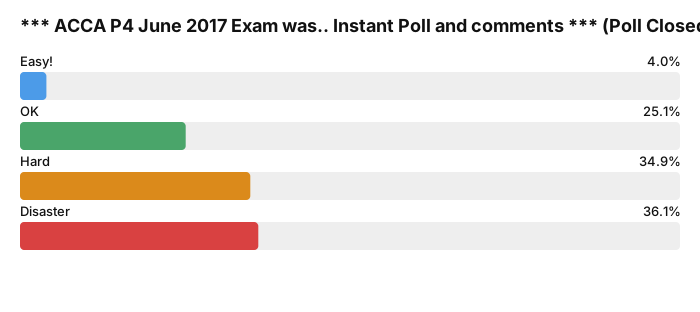
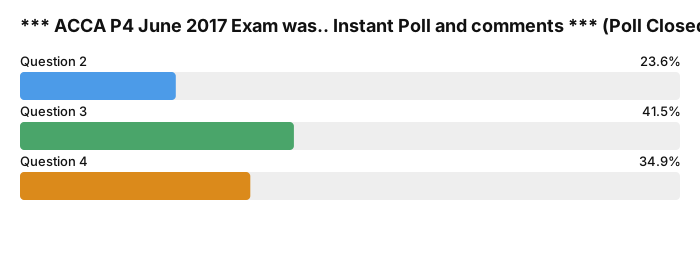
*** ACCA P4 June 2017 Exam was.. Instant Poll and comments *** poll results *** ACCA P4 June 2017 Exam was.. Instant Poll and comments *** poll results Post your comments about the ACCA P4 exam below (comments will open after 5pm UK)
Former userFormer user9y ago#61
with a collar, you calculate the premium of the cap you bought (put option) and the receipt from the floor (call) you sold. in the question, only the floor was exercised. costs was = (premium of cap) + receipt of floor - (loss from exercising the floor )
Mmansoor9y ago#62
please confirm the IGNORE BASIS RISK!!!!! if it is really written in q4 for the interest rate hedging then pleeeeaase let me know''thx
Mmansoor9y ago#63
@alemodique said: hi all. as usual hard paper p4. no way. the point is that the study text and practise book do not cover enough everything..that s the point. we need to dig in youtube for extra lessona exercises comments.. one question..in q2 or q4 do not remember it was written:DO IGNORE BASIS RISK..what does it mean?
please confirm the IGNORE BASIS RISK!!!!! if it is really written in q4 for the interest rate hedging then pleeeeaase let me know”thx
Aalemodique9y ago#64
i was a bit confused as i perfectly know how to calculate the basis in a int rate future. but as it was written to ignore the basis risk..it means future equal spot at month end...so i decided not to calculate the basis risk. maybe i am wrong..
Ffarhan9y ago#65
Basis risk is the risk that it doesn't move in a linear manner. Basis would still exist however. That's my understanding anyway
Ffarhan9y ago#66
Yeah collar is more expensive than the option only as it fixes the interest between a minimum and maximum. So standard option is cheaper in a market where rates fall. I calculated my basis differently (assumed spot rate was 3.1% lol) so my answers are on that basis (i.e. original basis of 0.98).
Former userFormer user9y ago#67
yes mansoor, it did say to ignore basis risk but it wouldnt affect our calculations. there was another similar past paper question that said the same thing, and the recent examiner i think puts that a lot in his questions. to ignore basis risk i think he means to assume that basis would be diminished in a linear matter , ie at maturity it would be 0
Aalemodique9y ago#68
thanks a lot. i simply made a mistake...nevermind...50 points really hard to get. it was my 1st try...from monday evening i am starting to study again. anyway i find it difficult to understand sometimes the bbp study book. not all is understandable 100%
Former userFormer user9y ago#69
Hi, I really felt for you when I read your comment, especially the bit about took all your strength just to read the paper, it's so hard trying to remember it all when under pressure. I only did the calc on Q2 didn't even attempt calculations on Q1 I just answered all the questions that didn't need figure analysis, I know I haven't got enough marks to pass.
Bbococonnor9y ago#70
Folks reading the comments here, lots of us in the same boat....I'm slowly coming round to having to do this again. Realistically I knew that the minute I stopped writing on Friday. I ran out of time but attempted anything I knew or could fumble together a guess for! One such topic I had a faint recollection on was yield to maturity. I did the question as I was comfortable on the narrative sects. I read an answer for a question in the bpp kit that calculated the YTM by doing an IRR calc. I did the same in the exam. Am I right/ wrong....nothing much in the kit and there's a formula in google that I haven't seen before! Also re q1 and the 4 marks available for presentation. These are pretty crucial for me to have even a mathematical chance to pass...like a lot of people I didn't finish q1 but started sect b by labelling my report correctly and doing a short note on how I was going to prepare it as I knew I wouldn't finish. I.e. Background and discussion points in the main body and calcs in an appendix which I started to do....will I get the 4 marks or am I dreaming??
Former userFormer user9y ago#71
no the working capital is 90m USD only in y=o. then it increased some cents per 1 USD of revenue increase and got it back in y4.
TTan9y ago#72
@taxman123 said: no the working capital is 90m USD only in y=o. then it increased some cents per 1 USD of revenue increase and got it back in y4.
I thought the question only mentioned first year R 800 m and then increased R 90m each year. Did the question mention the working capital is to increase according to sales? Anyone can confirm it?
Former userFormer user9y ago#73
my mistake, i must have confused it with maybe costs (not in the question, but in answering your question above :P , because sales increased i think by inflation or 25%, cant really remember now and i confuse it with the many past papers i did).
TTan9y ago#74
@taxman123 said: my mistake, i must have confused it with maybe costs (not in the question, but in answering your question above :P , because sales increased i think by inflation or 25%, cant really remember now and i confuse it with the many past papers i did).
It's okay, man. ;) For the sales, what I remember is increase by 25% each years(y2-y4), but did not mention to be increase with inflation. What I did is y2 x 1.25 y3 x1.25^2 ... Not sure I am right because it could be understand as x 1.25 every each with no square. This make my npv higher (exactly 777).
Bbococonnor9y ago#75
@sprocker said: There is a technical article on the bond calc. A yield curve needed to be obtained from the government bonds. MVs were given together with coupon payments for government bonds for individual years. You needed to calculate the yield for one year first, then use this yield to calculate the yield for second year and so on. For example 105 (MV) = 108 (coupon with principal) * (1/(1+r)). r = 108/105 -1 = 2.9%. This is the yield for year one. Then you needed to calculate yield for year two. For example 103 (MV) = 2 (coupon) * (1/(1+0.029) + 102 (coupon with principal) * (1/(1+r)^2). And so on. I recommend that you read the technical article as it is very well explained in there.
Tks
AAdelino9y ago#76
Hi Carol, Did I get you well? Are you saying you failed with 49(!!!) marks three times???
AAdelino9y ago#77
Q4 b) Adavantages and disadvantages of traded option vs OTC options Q4 c) Explain delta hedge + demonstranting how to hedge using that +the impact of increase of 0.1% on the interest rates.
TTan9y ago#78
@sprocker said: Weren't the sales given in the question for each year but prior inflation? Don't remember the 25% increase....
I pretty sure the question wrote about 25 % increment. The sales is given for each year, that why it create some confusion whether the 25% relate to inflation or sales quantity.
AAdelino9y ago#79
@jyacca said: Q1 (A) why acquisition fail and how to ensure acquisition do not fail. (B)(i) estimate Dharma co current value and estimate additional value created from the acquisition. (Ii) estimate number of share exchange for the share exchange offer method. (iii) calculate percentage gain for the cash and share exchange method (iv) discuss the shareholders reaction and state assumption (v) estimate cash available from operations to fund cash payment method (vi) impact of reduction of dividend Q2 (A) calculate the bond value when AA and when BBB (B) Reasons credit rating was downgraded by credit agency (C) impact of the downgrade in credit rating on the ability to raise finance Q3 (A) investment appraisal and assumptions (B) drawbacks of 2 transfer pricing method - 40% contribution and at cost Q4 (A) 3 interest hedge method (B)Advantages and disadvantages of traded option vs OTC options (C) Explain delta hedge + demonstranting how to hedge using that +the impact of increase of 0.1% on the interest rates.
AAdelino9y ago#80
@hoangduchung1903 said: I think the main problem is time pressure, given excessive amount of information in the scenario. We have to rush to finish on time and when we are in a rush, we tend to make mistakes or forget the details. If we were to have 4 or 5 hours to finish 3 questions, it would be easy to get 70-80 marks
I agree with you Duc
AAdelino9y ago#81
@tancw95 said: I thought the question only mentioned first year R 800 m and then increased R 90m each year. Did the question mention the working capital is to increase according to sales? Anyone can confirm it?
mentioned first year R 800 m and then increased by $90m for the next 3 years.
AAdelino9y ago#82
@tancw95 said: It's okay, man. ;) For the sales, what I remember is increase by 25% each years(y2-y4), but did not mention to be increase with inflation. What I did is y2 x 1.25 y3 x1.25^2 ... Not sure I am right because it could be understand as x 1.25 every each with no square. This make my npv higher (exactly 777).
y2 x 1.25 y3 x1.25^2 ...This is the same approach I have folowed.
Former userFormer user9y ago#83
I agree, it is pretty unfair. We should practice all exam question. For example, I wouldn't pass this time, so how I find the right answer of there is no half of the questions from this session?... How we can manage this?... May be report about it to ACCA?
Former userFormer user9y ago#84
No, ACCA , especially for P4, told you that the key is sustained, prolonged study plus exam practice. Finding P4 June 2017 sitting hard means that you did not do one of the things mentioned above. P4 was fair. Not a SINGLE thing was out of the syllabus. Not a single thing was not examined before. Every single question was exactly the same with at LEAST 2 past paper questions.
Aalexacca19y ago#85
taxman123, would you please tell us in which previuos question or question form BPP RK there was a question in which you are supposed to figure out the number of shares that you have to offer in order to acheive a certain gain distribution between the shareholders? i have run through all questions for several times and i have not found any similar to this....
Oolanrewaju9y ago#86
I guess taxman123 will end up with a minimum of 90 marks since he had practised similar questions
Former userFormer user9y ago#87
when i first read the requirements for Q1, it seemed straightforward only to get stuck halfway as the calculations were not adding up,. i then ran to section B halfway the number. but i realise this was a big mistake. i believe i should had assumed an answer and moved with thereby pickip us some marks rather than forgoing so many Q1 marks. i feel doomed but still hoping for that 50
EElie9y ago#88
Hi! How was free cash flow calculated with growth % ? Do you have to find "r" from the growth formula? I'm really not sure about that part. Please help.
DHDuc Hung9y ago#89
@elie1lwin said: Hi! How was free cash flow calculated with growth % ? Do you have to find "r" from the growth formula? I'm really not sure about that part. Please help.
Are you asking about Q1 ?
DHDuc Hung9y ago#90
Sample March/June 2017 questions have been posted on ACCA site: https://www.accaglobal.com/gb/en/student/exam-support-resources/professional-exams-study-resources/p4/past-exam-papers.html Only the bond question of June 2017 appeared. The other three were all March 2017.
Sign into reply to this topic.