
Skip to content

ACCA Forums

AFM*** ACCA P4 June 2017 Exam was.. Instant Poll and comments ***

Oopentuition_teamAdmin9y ago

Please vote in our Instant Polls about the ACCA P4 June 2017 Exam
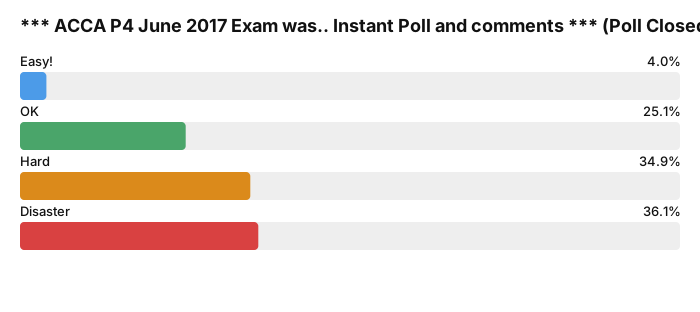
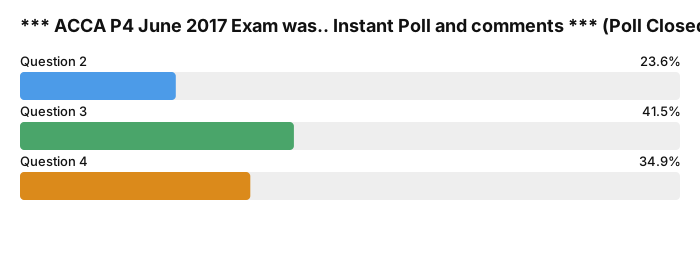
*** ACCA P4 June 2017 Exam was.. Instant Poll and comments *** poll results *** ACCA P4 June 2017 Exam was.. Instant Poll and comments *** poll results Post your comments about the ACCA P4 exam below (comments will open after 5pm UK)
CCarol9y ago#31
I have never understood the 'Free cash flow' method to value a company.. FCF = MV of Co ? FCE = MV of Equity ? Always hated this topic business valuations, partly because there is no lecture OR revision lecture on this topic, nothing, just notes & also because i just feel it doesnt fit right into P4, its more accounting than financial management... and just that had to come in Q1 !!!!!! I knew in the exam the technique, like i knew we had to first get the FCF for Darma then calulate the MV of Debt from the redeemable bonds & subtract > then we get the MV of Equity > therefore the current Share price, but I just went blank! I am tired of this paper, should have passed it 3 sittings back when i got 49! My 5th attempt at this paper, I dont know what to do anymore?!!
CCarol9y ago#32
Why cant I get for ONCE some NIce question on NPV/APV or Hedging or Black Scholes or Gearing and Ungearing Beta's for a Q1! Why always a question like Iv never seen in any past paper before!!! WHY WHY ?!!!!!!!!!! >.<
TTan9y ago#33
Q4 is interest rate future, option and collar, pretty simple if you practice enough. Q3 NPV, although there are some tricky part on inflation, but I don't think there is any issue if you have done some complex investment appraisal e.g. pilot paper 2013 Q1 Q1 a) is about the reason why acquisition fail and step to avoid it. should be no problem to most student as it is been placed at front of chapter. whereas the step to avoid i just putting up some opinion against the reason to fail. b) test on valuation of company including synergy, synergy part is a bit tricky, I just add up the additional value allocated to Darma shareholder to current value of Darma to arrive at estimated share price they willing to pay, from there, calculte how much M need to issue to D shareholder. afterward they ask percentage of gain in SP under cash or share exchange, which require some numbers compute earlier. last the question ask about some dividend policy if M decide to use cash payment, where the free cash flow to equity need to be compute and comment accordingly. overall i will say it's fair and not much silly question in June.
Ssergey9y ago#34
i had the same numbers for Q3 hopefully it is correct
CCarol9y ago#35
q3 b was on transfer pricing... why method suggested by Production Director and Finance director was not suitable for Icordia... (Contribution 40% or Full Cost) i think main reason here is it will demotivate the divisional head / management and they would not agree to a transfer price where they make a loss...
Ssed9y ago#36
@carol24 said: I have never understood the 'Free cash flow' method to value a company.. FCF = MV of Co ? FCE = MV of Equity ? Always hated this topic business valuations, partly because there is no lecture OR revision lecture on this topic, nothing, just notes & also because i just feel it doesnt fit right into P4, its more accounting than financial management... and just that had to come in Q1 !!!!!! I knew in the exam the technique, like i knew we had to first get the FCF for Darma then calulate the MV of Debt from the redeemable bonds & subtract > then we get the MV of Equity > therefore the current Share price, but I just went blank! I am tired of this paper, should have passed it 3 sittings back when i got 49! My 5th attempt at this paper, I dont know what to do anymore?!!
how has it been going? do you have all your formulas down pac? man. i also just went blank. i dont know how he does that to us. was thinking of just hitting the books hard once again and reading very wide. you go in having it all then suddenly...words just start flying around. i somehow think that if we went in less prepared we might have had more of a shot? are we overthinking it a bit too much?
TTan9y ago#37
The question did mentiond the finance ministry had accouned the interest rate may drop by 0.5% spot is -3.6+0.5 = 3.1% As you are borrowing, you sell future now at 95.92 (not sure is it correct as i can hardly remember). Later you buy future at 96.78 (100-3.6+0.5-0.12). In here you made a loss $ 186,750 (83 ticks x $25 x 90 contracts) For Q1 i dont think the FCF of M is used for overall company value to ascertained synergy, but instead it is used for calculation of dividend capacity. the additional value can be computed by using the expected value of Darma after acquisition (PEXearning) minus Current value (computed using FCF of Darma/COC and minus debt)
FFati9y ago#38
I got a positive npv as well .. but hopefully irrespective of what happens .. there would be marks for workings .. that was the I my question I was confident after answering
Former userFormer user9y ago#39
I know exactly how you feel, I experienced the same feelings when I tried this exam. Have been studying up to migraine status and felt I had an understanding of the topics and when I saw the questions is like I could not at the spur of the moment answer many areas asked. I saw questions today which was not covered in that manner by my tuition or even the online help and under exam pressure you do not have the luxury of reasoning it out, is either you know or you don't know and you just have to move on.
Former userFormer user9y ago#40
Why would you go on calculating percentages when the question asked you to calculate the costs? i assume that by percentages you went on to calculate the effective interest rate after the hedge? Which was not necessary in this question. Also, did anyone else find that both options were not to be exercised? So the cost for options was their premium only?
Ffarhan9y ago#41
@taxman123 said: Why would you go on calculating percentages when the question asked you to calculate the costs? i assume that by percentages you went on to calculate the effective interest rate after the hedge? Which was not necessary in this question. Also, did anyone else find that both options were not to be exercised? So the cost for options was their premium only?
Effective rate is also the cost lol. It's just the way the Kaplan tutor went over it. Yeah none of the options were to be exercised. As it was to protect against an increase in costs, the fall meant you don't need them :). So cost was just premium paid and the spread and the current spot rate. For the collar, the buyer of call options at 96 would exercise it for a wee gain. Put option would lapse.
DDhaval9y ago#42
Did anyone adjust the futures price based on the fact that interest rates were dropped by 0.5%? Today = 9 June Interest rates dropped by government 3 days ago = 6 June Hedging information = 31 May So I adjusted the futures price as interest rate change would have changed the price of a futures contract.
Former userFormer user9y ago#43
ok, Q1, it was FCE and we had to calculate the required return on reinvestment based on the forecast reduction of the reinvested cash flows of 10% (b) and the forecasted revenue growth of 6% and i found it to be 60%! i wrote down it's too high but went on the calculate the Ve using FCE (i also deducted interest x (1-T)) but i did my working of interest in 1 line, and i'm not sure if the examiner will realise what figure is what! i had no time! Futures question was too easy. Embarrassing for P4 level. By reading some comments above i realised i left behind the b part of Q3 for 5 marks! silly me! i must have done the npv and went on with Q1...
Former userFormer user9y ago#44
i think spot was 31/5 transaction was 1/9 maturity was 31/9 so basis was 48bp and unexpired basis 12bp so the cost really was 12 x 25 x contact size (i think 90) anyone calculated hedge with delta? i think it's amount of loan over contract size over delta (assuming delta is N(d1) and not (d1))
JJenYoong9y ago#45
Q1 (A) why acquisition fail and how to ensure acquisition do not fail. (B)(i) estimate Dharma co current value and estimate additional value created from the acquisition. (Ii) estimate number of share exchange for the share exchange offer method. (iii) calculate percentage gain for the cash and share exchange method (iv) discuss the shareholders reaction and state assumption (v) estimate cash available from operations to fund cash payment method (vi) impact of reduction of dividend Q2 (A) calculate the bond value when AA and when BBB (B) Reasons credit rating was downgraded by credit agency (C) impact of the downgrade in credit rating on the ability to raise finance Q3 (A) investment appraisal and assumptions (B) drawbacks of 2 transfer pricing method - 40% contribution and at cost Q4 (A) 3 interest hedge method (B) ??? (C) ???
TTan9y ago#46
@jyacca said: Q1 (A) why acquisition fail and how to ensure acquisition do not fail. (B)(i) estimate Dharma co current value and estimate additional value created from the acquisition. (Ii) estimate number of share exchange for the share exchange offer method. (iii) calculate percentage gain for the cash and share exchange method (iv) discuss the shareholders reaction and state assumption (v) estimate cash available from operations to fund cash payment method (vi) impact of reduction of dividend Q2 (A) calculate the bond value when AA and when BBB (B) Reasons credit rating was downgraded by credit agency (C) impact of the downgrade in credit rating on the ability to raise finance Q3 (A) investment appraisal and assumptions (B) drawbacks of 2 transfer pricing method - 40% contribution and at cost Q4 (A) 3 interest hedge method (B) ??? (C) ???
Q4 (B) Advantages and drawbacks of using trade option against over the counter option (C) Significance of delta and demonstrate how the company is going to delta hedge if the interest rate increase by 0.1%.
WBWei Bing9y ago#47
I scored 84 for my F9 and average of 70 for all other 4 P papers, but P4 is so so difficult and time pressured to me. Just aim for a pass this time.
Former userFormer user9y ago#48
Sometimes I just wonder how much of this useless number crunching we will use in real life and what acca actually prepares us for????? I mean even in q1 we had to just apply basic primary school maths to arrive to answers blablabla... Any ideas where i cud transfer my passes and get another qualification?(apart from oxford brooks?)thx
Ssed9y ago#49
honestly, i'm done. this paper is too one dimensional. can't go through it again.its like taking a math paper. just numbers. we are all accountants and we are all taking our last papers, so we are all relatively good at math, and we are putting in a lot of work, put our lives on hold and taking it seriously because we all know it is a hard paper. For so many of us to feel like we just went blank... there must be something wrong if i had put this much time and effort in any other paper, i would probably wouldn't feel as bad.p7 forum people are discussing concepts..a machine left in a warehouse, customer didn't take it yet, what do you do, is it revenue? is it still under stock? reminds me of why i started this course in the first place. all that work just cant mean this little.
DHDuc Hung9y ago#50
I think the main problem is time pressure, given excessive amount of information in the scenario. We have to rush to finish on time and when we are in a rush, we tend to make mistakes or forget the details. If we were to have 4 or 5 hours to finish 3 questions, it would be easy to get 70-80 marks
Aalemodique9y ago#51
hi all. as usual hard paper p4. no way. the point is that the study text and practise book do not cover enough everything..that s the point. we need to dig in youtube for extra lessona exercises comments.. one question..in q2 or q4 do not remember it was written:DO IGNORE BASIS RISK..what does it mean?
Aalemodique9y ago#52
another point is that...as i am working...time to study properly remainsat nights and in the weekends..hard!
Former userFormer user9y ago#53
How many marks was Q3b?
Former userFormer user9y ago#54
Hey guys,I personally think the examiner did us a justice because the questions were very ok compared to the March exam for any student that have studied well for the exam.Having said that,the questions appears too simple that one may not really understand how to go about it under time pressure especially question 1.Q2 or so on investment appraisal is the most easiest question. I struggle with question one but I managed to do most of my written part.I only pray for a pass as this is my last attempt. All the best guys
MMariam9y ago#55
The moment we were told to start, I first checked the section B qns to choose the ones I could deal wit and selected Qn 3 & 4 coz I felt I could do them as per the requirements. However the different rates of inflation and working capital tricks made Qn 3 rather daunting but I did what I could and moved on. I wonder why the examiner had to give us initial working capital of Rs800 and then telling us that it will increase by &90 for the next 3years. I got confused but made my assumptions on how I did it.. Though I didn't complete because if time pressure Qn 4 was the only one I answered wit confidence at least though I hope I didn't mess up wit basis... I discovered the "options on futures" gave the Lowest cost compared to collar and futures. As for the monster Q1.. Thank God part a) was there for easy marks & I believe I'll get at least 8 out of 11 Then moved on to compute MV of target using FCF then I deducted off debt to get the equity value. It's the equity value that I divided by the number of shares to get the initial share price. I got smthing like 1.47 per share For additional value created, I think I messed up but just moved on. As for percentage gain... For cash I just got cash price of 1.84 and compared with the initial share price of target ie (1.84/1.47)-1 For share for share.... I don't know Wat I did coz the whole thing of $0.33 and &0.67 confused me.... I ended up interpreting it in my own way and moved on .... I tried computing the Value of Acquirer using FCFE to determine the whole thing of divided & it's impact but I ended up not doing the final answer due to time as I had to ensure at least I do something on all parts of the qn. It's upon examiner to award me for the steps I had managed to take...... But over all Q1 was a real monster Keeping fingers crossed for a pass.
Former userFormer user9y ago#56
not sure ...i think it clearly said the costs. It's identical to another past paper question where it also asked about the costs, only in that question interest rates increased so the costs were futures gain/losses + increase in interest rates or option gain - premium + int.rate increase. i'm very sure about this.
Former userFormer user9y ago#57
Since the beginning of 4 attempts a year ACCA is skipping publishing two questions from each attempt so is there anyway that we can get those skipped actual questions.
Former userFormer user9y ago#58
Hi Taxman123 Q3 a) had 20 marks with assumptions you make whereas b) had only 5 marks
FFarhan9y ago#59
@farhantahir786 said: Future seems accurate. I didn't bother with the numerical costs coz of time issues (just work in percentage rates as it's faster and allowed I think). But future deal was most expensive. I think that was a given because the rates fell. So options are always better when rates fall. Collar was cheaper to (only slightly...).
Wouldn't the collar be the most expensive? You wrote a call option on interest rate futures, which gives someone else the right to benefit is rates fall. Upon the interest rate falling, that person would then exercise their right, and you'd have to pay them the difference.
Former userFormer user9y ago#60
Q2: How did you find the market risk free rate of 3 year government bonds? With coupon payment of 6% it was 98 market rate per 100 bond.
Sign into reply to this topic.