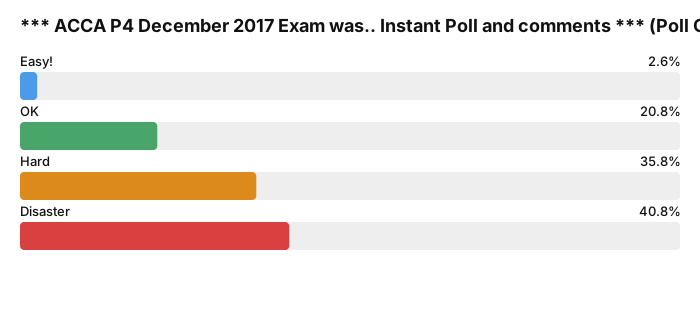
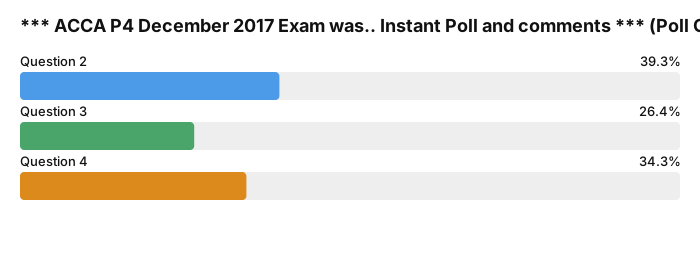
AFM*** ACCA P4 December 2017 Exam was.. Instant Poll and comments ***
p4 was a disaster for me....couldn't attempt 6 marks question (Macaulay duration). others were inadequately attempted.
My last ACCA exam and by far the hardest I have done so far.
Question 1 being on corporate reconstruction threw me, I was so unsure about adjusting the coupon rate and the new value of the bonds...
Then the Macauley duration part?
I ended up doing questions 2 & 4 then coming back to 1 to avoid sitting in the exam panicking the whole way through.
I had no idea what Monte Carlo simulation is, ended up writing few sentenses about simulation in general. Luckely it was only 5 marks and remaining was my favourite NPV.
Q1 was laughable.... a very tough question.
I did Q2 MIRR, IRR, VaR + RA WACC, not too bad on that.
Q3 a straight financial analysis - ratios and comments, not expected at P4, wasn't as technical as expected.
But that Q1 ooooffff a shocker :)
Same.
i was expecting the curve yield topic because the technical article on it was updated november 2017 but i was so confused in the exam and didn’t know what we were meant to estimate exactly?
change in value and coupon rate? wasn’t sure if we were meant to mathematically work out the coupon rate.
so frustrating cause now when i think of it i feel maybe given more time i would’ve been able to attempt it.
didn’t touch the mcaudly duration question as i had no idea how to do it (only studied it ages ago)
question 1 was horrible i couldn’t estimate anything at all.
really frustrating :(
@mbarrington said: My last ACCA exam and by far the hardest I have done so far. Question 1 being on corporate reconstruction threw me, I was so unsure about adjusting the coupon rate and the new value of the bonds... Then the Macauley duration part? I ended up doing questions 2 & 4 then coming back to 1 to avoid sitting in the exam panicking the whole way through.
Q1 The hardest toughest question in the paper I feel
Q4 Even the forex is also bit tough
Q2 NPV was far better question
My NPV was $ 1169
IRR 15% MIRR 14 %
RAWACC aproximately 12 %
I was so sad by looking at Q1 A really very horrible question one can't even imagine that
Q1 a. Takover bid i think
Q1 b. Yield Curve Bond Valuation
Q1 c. Duration after calculating b
Q1 d. Balance Sheet
Q1 e. Writing on the basis of a,b,c,d WOW all went wrong from point b onward
did some calculations only guess.....
Q2. NPV, IRR, MIRR, VAR, WACC + writing again WOW
Q3. Ratios + writing
All that in 3 hours out of which spend 60m reading to question paper
@mansari said: My NPV was $ 1169 IRR 15% MIRR 14 %I had exactly the same $1170 NPV - accept the project. IRR was 0.5% under the required - shouldn't matter because IRR is not an absolute measure of return. MIRR was 0.5% greater than required and is a much more accurate measure than IRR - accept the project Im glad someone else got these answers :)
Q1 was tough but i think i wrote enough to gain some marks, done several different calculations for the current and new bonds etc. Plus i think my format and layout would achieve the full 4 professional marks... which could be the deciding factor!
Done Q2 and Q3, of which Q3 was an absolute godsend! More like F9 stuff. Basic ratios ROCE, GP%, OP%, Div cover, Asset T/O, Share price changes, Gearing, etc... Then to discuss the ratios is basic stuff really. Excessive cash surplus' in this scenario? Could have been better utilised investing in other projects to earn greater returns for S/H's?
Q2 & 3 may have saved the day, ill be surprised if anyone enjoyed Q1 :D
Disaster! There was a massive traffic jam on my way there so arrived 20 mins late and panicking. Q1 was very confusing - I thought mark allocation vs time was terrible. I did q4 and then started q3 with 15 mins to go. I’ll definitely be rewriting in March but good luck to everyone ?
Did you use after tax cashflow for IRR and MIRR or you deducted tax. I used the cashflows directly without recognising tax.
I got a NPV of 3,018. Clearly I did something very wrong
Q1 was very difficult and what made it even more difficult was that it was all about bond calculation and interest for at least two parts. section b was not bad ...
@cm69170 said: I had exactly the same $1170 NPV - accept the project. IRR was 0.5% under the required - shouldn't matter because IRR is not an absolute measure of return. MIRR was 0.5% greater than required and is a much more accurate measure than IRR - accept the project Im glad someone else got these answers :)Question 1 was a real shocker got the same answers for question 2
How did you guys arrive at this figure?
What did you do for the year 1 and year 2 tax losses? Did you add back the tax credit on the cash flows?
Did you add it back as a tax credit so that there was a nil effect since it really wasnt a cash flow?
Based on the answers I believe that is what is causing my NPV to be 3,013 million versus this 1170 that everyone is doing. since I belive it was 2,230 in year 1 and a smaller amount in year 2. That times the Cost of Capital of 12% would have made the difference
I thought this was a fair exam,
Q1, the topics were a little unexpected to say the least. Bonds are hardly a massive part of the syllabus, I never would have guessed that there would be so many marks in Q1 on bonds. I didn't worry too much about what I actually got for the computations, hoping for some follow through marks and those presentation marks.
Q2, I thought was a fairly straightforward investment appraisal question. The only thing which threw me was the bit about taxable losses being refunded, just because I hadn't seen it before and wasn't sure how to treat it. I just guessed at it, but my answers felt a little off (what did everyone else do here?). And I didn't attempt the 5 marks on Monte Carlo simulation, I just didn't have the knowledge (who does?!).
Q3 looked like a pretty generous question on ratios (think it said 10 marks were available for calculations alone!), it must have been pretty simple to get more than 50% here. In retrospect, maybe I should have picked this question instead of Q2.
I surprised myself by choosing Q4. Besides Fx hedging being less common in questions than interest rate hedging, it was a pretty standard, "compare the results from a forward hedge, futures hedge, options hedge, and recommend a strategy" question. There wasn't much in it that was tricky.
Q1 was an oddball, but I think the Section B questions were good questions. Better questions than the last time I sat this paper anyway.
@christa316 said: How did you guys arrive at this figure? What did you do for the year 1 and year 2 tax losses? Did you add back the tax credit on the cash flows? Did you add it back as a tax credit so that there was a nil effect since it really wasnt a cash flow? Based on the answers I believe that is what is causing my NPV to be 3,013 million versus this 1170 that everyone is doing. since I belive it was 2,230 in year 1 and a smaller amount in year 2. That times the Cost of Capital of 12% would have made the differenceI got 3000m odd too for the same reason. The question definitely said the taxable losses were refunded in the same year so I added the taxable loss back to essentially cancel out the cash flow. I thought it was weird that the government would essentially be paying the company for making a loss but I couldn't find any other way to interpret the question. I too would be interested to hear from the people who got 1000m odd on what they did with the tax losses.
Hey Thank you. My IRR was oddly high as well.
Like it was insanely highly. I used 20% and I was still getting a fairly positive number.
I added back the losses to balance the cash flow. It would have been similar to when they say that it would have been utilised against future cash flows. so I used the same concept as if it was like that and when it came to calculating the cash flow, added it back just like how we would add back for the tax allowable depreciation.
@christa316 said: How did you guys arrive at this figure? What did you do for the year 1 and year 2 tax losses? Did you add back the tax credit on the cash flows? Did you add it back as a tax credit so that there was a nil effect since it really wasnt a cash flow? Based on the answers I believe that is what is causing my NPV to be 3,013 million versus this 1170 that everyone is doing. since I belive it was 2,230 in year 1 and a smaller amount in year 2. That times the Cost of Capital of 12% would have made the differenceI am pretty sure there was a line in the question scenario that prompted me to specifically add the tax losses into the FCF figures for the particular years and discount at 12% for the NPV. I cant remember exactly what though! :S
Hi everyone,
I did as follow as I remember:
Q1 b i)
Current bond value 107.8
Coupon rate 5.2
New value 106.7
Coupon rate 5.57 (5.2+0.37)
5.2/1.1+5.2/1.1^2+105.2/1.1^3=88.06
5.2/1.02+5.2/1.02^2+105.2/1.02^3=109.22
Irr= 2+((109/(109-88))×8=2.47
ii)
Gov rate y1 y2 y3 y4 y5
2.2 2.3 2.4 2.7 2.9 estimate
BBB. .4. .6 .8 .9 1.1estimate
Total. 2.6 2.9 3.2 3.6 4.0
5.57 5.57 ............105.57
1.026 1.029^2... 1.04^5
4.40 4.30 .......... 87.18
(4.4+4.3×2+....+87.18)/105.57=4.7 years
Gov rate y1 y2 y3 y4 y5
2.2 2.3 2.4 2.7 2.9 estimate
A. .3 .5 .7 .6 .9estimate
Total. 2.5 2.8 3.1 3.3 3.8
5.57 5.57 ............105.57
1.025 1.028^2... 1.038^5
4.5 4.4 .......... 91.2
(4.5+4.4×2+....+91.2)/107=4.5 years
I used here for Gov yield and A BBB spread just estimated as I can't remember but what I remember it was 4.7 years and used face value in first duration and 4.5 years and used MV
I am just shocked as examiner really grilled me buy makeing thinks very complicated for easy topics
Wish all of you a pass mark
Hi eshon5, about q1 bond new value has to be higher than current value 107.8 correct? When the yield increases the bond price / value descreases...but here it is the coupons which increased to 5.57 and when coupons go up also the price goes up...correct me if i aM wrong as i find this assumpion also in several interest web site. I get 110.something for new bond value.Anyway p4 always hard. I did the 2 25mark questions ok but simply half of the first 50 marks. Really do not know what it happens if, for example, you get 40 in the 2 optional questions and 10/15 in the compulsory...someone has an idea?
The assumption is the bond yield remains the same. I calculated the yield for the bond; then i applied it with the new coupons...and get 110....point something . Let me know if it makes sense or no
I knew that if financial reconstruction comes out for this respective sitting I might have to do it again for the upcoming sitting.Guess I am not lucky for this sitting!
I think the question was tricky but manageable.
I personally realised the only way to get a good mark for question one was to assume some of the figures.
You could have still gotten the IRR with the positive number.
But for sure I will not be able to make it .It was the toughest Section A question that I ever came across!
Topic lockedNew replies are closed.