
Skip to contentSkip to search
Kaplan Publishing: Black Friday countdown

SBL*** ACCA P3 March 2018 Exam was.. Instant Poll and comments ***

Oopentuition_teamAdmin8y ago

Please vote in our Instant Polls about the ACCA P3 March 2018 Exam
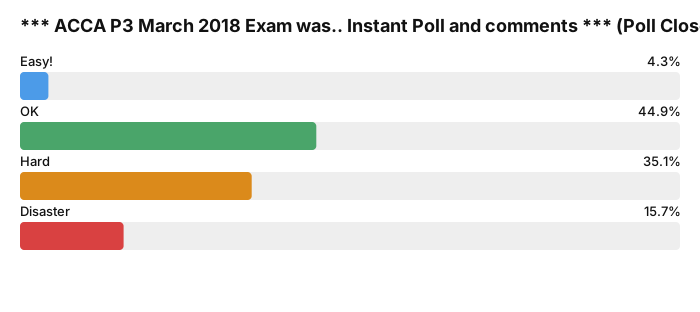
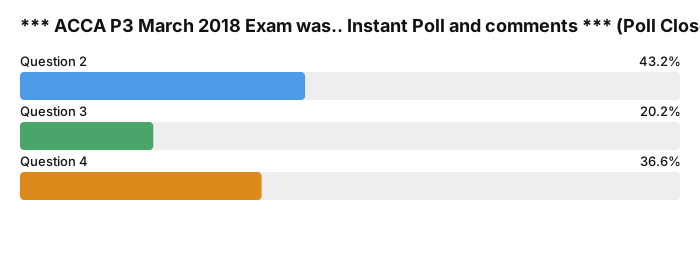
*** ACCA P3 March 2018 Exam was.. Instant Poll and comments *** poll results *** ACCA P3 March 2018 Exam was.. Instant Poll and comments *** poll results Post your comments about the ACCA P3 exam below (comments will open after 5pm UK)

TThehappyone8y ago#1
Hey guys, I think the paper was ok but I would say hard again as it concentrated on the tiny areas of the syllabus particularly question one. I panicked throughout the exam as it was my first P paper and I kept looking the time based on all the stories people have said about time management. I made sure I attempted every part of the paper even though I didn’t do well like I prepared due to panic. In reference to the strategic drift, it was complex as I wrote I don’t think the business model was drifting but the sales channels as the profits and revenue didn’t go down like it should. Is that correct and the fact that the examiner made mention of increase in the interest of history and ancestors of celebrities.
Aanonymous1238y ago#2
Not a thing predicted actually came up. I got caught out on so many thing. A disaster paper for me.
DDian8y ago#3
Q1 : Strategic drift, Strategy Lense, CSF, KPIs, mission statement, Integrated Reporting. Q4 : PID/project charter, Business Case, Benefit realisation review, post implementation review, post project review.. Q2 : Benchmarks, corporate strategy-BCG, Ashridge, parental approach Q3 : Business process improvement on procurement ,Job design Any comments? The questions were okay but couldn’t get the fact fr senario explained / linked properly due to time issue...
Ppavithra8y ago#4
P3 March 18 questions Again 1st question over ran but managed to do well in 2nd question. Struggled for time for 4th question. 1. Publishing company - establishef in 1991.publishes history books Evaluate performance over 10 yrs 20X7 to 20X17 in the context of strategic drift. 2. Analyse the differences in strategy when old CEO (Robert Hart) in position and after takeover by Venture Capitalist 3. Discuss the critical success factors and key performance indicators in relation takeover from venture capitalist 4. Define mission statement, how it can impart value. Discuss how integrated reporting can explain the objectives in mission statement 2. ALG -airline company. Parental developer. A. Discuss how parental developer can add value in the context of BCG and Ashridge matrices - Supreme holidays - High growth in revenue and profits - high market share. Market growth declining. Highly competitive market. Cash cow - Provider of luxury holidays - High feel and high benefit - Edge of heartland or heartland - Vital gym - Low market share and low growth. But acquired with view to turn around. Potential for capturing high market share once problems with booking and customer service addressed. Dog but can be turned to problem child. Retain in portfolio until losses are made - Value trap business - Soft drink manufacturer - Low market share. Low industry growth. Dominant competitors. Dog and alien territory B. Discuss advantages and disadvantages of benchmarking in this context. 4. Discuss how formal terms of refernce and business case document could have averted project slippage B. Discuss the differences between post implementation review, post project review and benefits realisation review in context.
SSean8y ago#5
Hi All How did you all find the exam? It was a fair paper for me, for part a.) I mainly discussed SWOT for the 12 marks for evaluating the performance and included the strategic drift in the summary - which models did people use? I suggested Rupert mainly used the lens of experience, as he was against try new things, i.e. website development. The new owners where very much the rational planning model approach, mission statement - corporate appraisal and environmental etc. CSF & KPI mainly spoke about the VC was more profit driven etc, CSF - profitability YOY, grow market share, few others. KPIs- ROCE etc Mission statement and IR was okay, spoke about how mission statements should offer value, strategy and purpose - the mission statement seemed to specific and didn't address the above. Also, as it was the first mission statement, stakeholder may already have an ideal mission statement given the change over. 2.) I had Supreme holiday as a cash cow and heartland business, big profits, first acquisition so understood it well. Virtual gym - question mark, huge growth potential, however slow to catch up in profit - can allocate and invest or diversify away. Pro Drinks - Dog and alien business, ALG didn't understand the market after failed attempts, slow growth and poor profits, should sell off. Benchmarking - spoke about internal, external, functional and strategic, didn't see it was only for the customer service part though!!!! 4.) Wasn't my greatest attempt, post implement review i put was comparing the implementation to original plan, benefits realisation to original plan to ensure these were realised and post project review was comparing each part, i.e. initiation, plan, execution and control to what was originally set out. Interested know how other people's approaches to the Q's!!
Former userFormer user8y ago#6
very long exam paper found question 1 very hard and specific to a small area of the syllabus only ok
Yyus168y ago#7
It was kinda hard. The first question threw me off balance. No Pestel, no five forces, no ratios, no swot analysis, no value chain. I was really disappointed and it's a shame when you think that it's one of the last P3 paper before it merged. Even thought topics such as strategy drift, strategy lenses, csf, kpi was relatively okay. For this question it was hard to relate to the context in the limited amount of time. I managed to answer all questions but failed to properly deliver a good evaluation and analysis required for a professional standard paper. Hopefully the examiners will be lenient.
LLukman8y ago#8
I put vital gym down as a question mark as I thought it had low market share in a growing industry. For supreme holidays, the question mentioned it had the largest market share in the market and from the financials I was able to calculate the market growth over the period as 25/26%. In my Regard this is can be considered as high market growth. For this reason i places supreme holidays as a star. My classifications for the other businesses are similar to yours. Let’s hope for the best.
SSean8y ago#9
Thanks all - did anyone else do a SWOT analysis for question 1 part a) evaluate the current performance of the company over the 10 years? 12 marks, assumed 4 marks per heading? I spoke about the financial but mainly SWOT and how the strategy drifted from the market trends?
AAkani8y ago#10
It was OK but I exceeded time allocation on the strategic drift question and it messed up my time management for the whole paper
DDaniel8y ago#11
I also did a SWOT analysis for question 1a). I think it should work in this case. I messed up the definition of strategic drift a little, though I was pretty close - I described it as a 'divergence from the established strategy over time' or something along those lines. For those who attempted question 3 - how did you find it? Do you remember what you spotted? I basically chose it because I was even less prepared for the project management area. I was ready for smaller parts but not for a whole question devoted to that topic. Overall, I'd second some of the above comments. The exam wasn't bad but I chose hard anyway mostly due to very high time pressure (and of course, I could have prepared better). As it's my first session with professional exams (I sat P1 yesterday), I kinda feel I'm on the verge of giving up to be honest, even though I passed all fundamental exams first time. The biggest problem is that I still don't completely get the marking scheme as there are huge differences between 'model' answers from examiners, BPP or Kaplan and some tips on here or the technical article re: P3 marking scheme. For example, should introductions be included? Should they be concise or longer (because just dumping knowledge isn't enough)? How can I 'explain' anything in short, concise points? It seems easier said than done. To me, 'explaining' always meant something longer and most importantly, understandable for the reader. Another thing is that my handwriting is slow. I managed to attempt almost every part of the paper (except for those I had no idea how) but I still feel that's an issue. To be honest, I'm afraid I'd have to know every part of the syllabus, all technical articles and all responses from past questions *by heart* to qualify. That's the only way to eliminate any 'thinking time' from the exam, and probably only that could allow me to finish everything on time and hopefully get it more than 50% correct. At least I'm fast with the calculator so maybe P2, P4 and P6 could be better if I'm well prepared for them! Sorry for the rant!
SShab8y ago#12
In the strategic drift i mentioned about how ABC did not change the stratgy even though the business environment was changing supported by financial figures and websites %. I found the paper bit difficult. In q4 project management was not sure about post project and post implementation.
SShab8y ago#13
I did manage to listen to ACCA webinar and were useful, they try to cover some topics and the way to write answer that could help in writing the exam
Llavinia698y ago#14
Ppfffttttt, I do not know where to start! Basically I did not do well. This will be a retake. I took numbers 3 and 4 as my options as they played to my strengths but question 1 was a disaster.....I do not need to say more
CChris8y ago#15
I thought some of the questions asked a lot for not that many marks. I did question 2 and 4. Question 2a was portfolio analysis which most people would be familiar with, but it asked a lot for 15 marks. You had 3 companies and for each one you had to: - analyse its performance - decide and justify its place on the BCG matrix - decide and justify its place on the Ashridge matrix - suggest a suitable strategy - justify whether the corporate developer parenting style is appropriate I felt that was asking a lot of for 5 marks each! This should have been 18 or 21 marks imo.
PPaul8y ago#16
I'm not sure it asked you to suggest a suitable strategy, just whether the style was appropriate
GGeorgina8y ago#17
Honestly felt the same as you for P1 , thought I wrote dribble but I passed it , I agree and said earlier to a colleague there is no amount of preparing that would allow you to be prepared for the questions . However after passing P1 , I believe that if u understand what u are saying about the scenario u will do better than u think . Eg P1 I want even sure if the company was in a bad way or not but understood the lack of communication and ethics on the board , obviously was enough . Keep going u never know !!
Former userFormer user8y ago#18
The previous session exam was better and the q2 was almost the same. However I identified SH as a star company and ballast business as it was high feel and low benefit an therefore could function independantly. GV was a heartland business.
Mmeeko8y ago#19
You are not sorry for the rant. You are one of those students who cry after an exam and when the results are out , you top the class. Relax, you will be fine! By the way, why did you attempt P3 if you have not done P2? You will still have to do the strategic business leader course come June, which replaces P2 and P3? Yes or no?
CChris8y ago#20
For 1a I talked about the JSW model of incremental change > strategic drift > flux > transformation/demise but I'm not sure that was what the examiner was looking for. I made a few points relating to how the strategy stayed quite static. Outside of the company the number of bookshops was falling and internet sales were growing, but the company did not sell at all through the internet until 2015, relying on bookshop sales. I didn't use a SWOT as it was asking you to analyse performance from 2007 to 2017 so I didn't think that a SWOT was the appropriate model to use. SWOT is for analysing the current strategic position, not for historic performance imo.
EEd8y ago#21
I can't remember but were we required to write the answers in the form of briefing note to get the professional marks? I only remembered after the exam!
EEd8y ago#22
@cr333 said: For 1a I talked about the JSW model of incremental change > strategic drift > flux > transformation/demise but I'm not sure that was what the examiner was looking for. I made a few points relating to how the strategy stayed quite static. Outside of the company the number of bookshops was falling and internet sales were growing, but the company did not sell at all through the internet until 2015, relying on bookshop sales. I didn't use a SWOT as it was asking you to analyse performance from 2007 to 2017 so I didn't think that a SWOT was the appropriate model to use. SWOT is for analysing the current strategic position, not for historic performance imo.
I couldn't remember strategic drift, but I saw in the scenario that BV Ventures uses the SWOT approach or something, so I thought, even if I gained 2-3 marks has to be better than nothing. I couldn't even remember Ashridge, and after the exam, I remembered them so well, so annoyed with myself.
Dds3ce8y ago#23
P3 took me 4 attempts to pass. Keep going guys! The key to success is you never give up, you keep going, you stand up every time you fall and you go on.
JMJ M8y ago#24
I can't remember exactly Q1 A Question. Q1 A - Strategy drift, was tricky. I analysed the performance from 2007 to 2017 for each table provided and commented on it. As far i remember they provided breakdown of sales by sales mode: BookShop. Internet intermediaries, ABC own website. Another table gave breakdown in there high selling area vs ABC accumulated sales. There some key trends and strategy drift : People were moving from traditional old ways of buying to internet sales, that is why Internet sales increased from 30% to 68% via Internet Intermediaries. However regardless of sales increase, the revenue of ABC did not improved. Reason could be discount sales or charges paid to Internet Intermediaries. This clearly shows strategy drift and ABC need to move towards the development of its website own website to capitalise on changing requirements of customers. Need for more E-Marking led strategy. 2. Analyse the differences in strategy when old CEO (Robert Hart) in position and after takeover by Venture Capitalist ( Strategy Lenses ) CEO ( Robert Hart ) : Strategy Experience - Old school guy army guy, had practical experience there fore hired people from same background. Vs BV Venture capital came with : Ideas and Design and experience as well in turnaround of Publishing business but not actual related to real life army experience like Robert hart and passion like him. BV Venture were more profit focused. vs Robert hart continued doing what he believed and enjoyed. 3. Discuss the critical success factors and key performance indicators in relation takeover from venture capitalist Linked Mission statement with CSF and KPIs of Venture capital and provided comments why it was important 4. Define mission statement, how it can impart value. Discuss how integrated reporting can explain the objectives in mission statement Defined Mission statement, Purpose, Value, Policies etc linked with VS Capital and steps taken by them and how it will impact challenging demands of Market ABC operates. Explained Integrated reporting as it cover all value added activities of business and compared to corporate reporting with limited focus, and gave final comments to some up. Let me know your thoughts !!
Eeneid8y ago#25
The exam was ok, I thought it would be much worse. I attempted question 2 &4 and the question 1 was long but doable. in Q1 I had some problems finding CSF and KPI for ABC, I wrote that without a mission statement is difficult to set CSF I also couldn't remember much about IR aside from the definition. I wrote a lot about the Q2 which was my first I attempted and also about Q4. I noticed some people asked for a second booklet so I wasn't the only one writing a lot. At some point i thought i was writing too much.. In Q1 i positioned ABC in Revolution although I wasn't that sure. It could have been also evolution but i thought a quick change in the culture was needed.
LLukman8y ago#26
@seannyd I didn’t use SWOT analysis for part A of question 1. I rather used a financial analysis approach. I looked at both financial and non financial indicators. Also looked at the decline in sales through the previous 2 channels. In terms of strategic drift, I spoke about how there was evidence of it in the case as ABC had failed to implement a change in strategy when there was clear indication of a change in market trends (internet sales) it was only in 2015 when such changes had been made. For the CSF and KPI question I defined both and identified them in the case. Was relatively starting forward. For the mission statement, defined it, and analysed the MS in the text. It was well defined and the memo supported it well. Picked on the fact that there was no mention of how they would attract employees to work for them as it was mentioned in mission etc. I picked Q 2 and Q3 from optionals. Q2 Question was pretty straightforward applying the BCG and ashridge portfolio by looking at the data provided. Focusing mainly on market share and growth rates. My classifications were Star,Heartland + Question mark value trap + Dog Alien. Benchmarking was straightforward too. Different types of benchmarking I.e internal + external, adv and disadvantages. Q3 Identify problems in the procurement process , how it affects value and how would you redesign it. Very simple, no need for models. Part B was to do with Job Design. Required to Define scientific management, job enrichment And Japanese method. Fell short of time So couldn’t answer t completely. Hoping for the best. Insha Allah.
LLukman8y ago#27
Hi Moveone! I attempted question 3 as I too wasn’t too comfortable in handling Q4. I was able to identify 4 problems with the procurement process, such as only having 1 reviewer and the reviewer reviewing his own work. Other issues I identified were selecting lowest cost for supppies that were too complex. The identification was pretty straightforward. In terms of value I spoke about how it would reduce bottlenecks and reduce the time departments receive their supplies. Part B was to do with job redesign. I defined the 3 concepts and allied them to the case. Application was slightly difficult. Please shed some light how you answered question 2. Thank you !
CChris8y ago#28
@eagledave said: I can't remember but were we required to write the answers in the form of briefing note to get the professional marks? I only remembered after the exam!
No, the professional marks were for structure, style, layout and clarity of your answer across the whole of question 1. I didn't really pay much attention to them, I try to structure my answers and write professionally anyway so I didn't approach it any differently to the other questions really.
@eagledave said: I couldn't remember strategic drift, but I saw in the scenario that BV Ventures uses the SWOT approach or something, so I thought, even if I gained 2-3 marks has to be better than nothing. I couldn't even remember Ashridge, and after the exam, I remembered them so well, so annoyed with myself.
I only remembered the strategic drift model as it came up in a question I practiced on Wednesday. I realised I didn't know it very well so I quickly revised it. I don't think that was the only way to approach the question though and I'm sure you'd get some credit fro your SWOT.
YYasser8y ago#29
For Q1, I didn't use SWOT as well. It was not required.
HHenry8y ago#30
It is easy to say what you did and didn't do. Ultimately, it is a very subjective exam where there is no "model" answer, therefore, if you did do a SWOT analysis for Q1, good, but if you didn't, that doesn't matter. And that is the small principles for all the questions. I felt the examiners were quite cheeky. In Q1, normally there would be a 15-20 mark question on PESTEL/5 forces/value chain, etc. which you can waffle about to get marks. However, the questions were very specific, which would have suited those who revised hard. Ultimately, I think it was a tough exam for those who didn't study that hard and but quite easy for those who did.
Topic lockedNew replies are closed.