
Skip to contentSkip to search
Kaplan Publishing: Black Friday countdown

FR*** ACCA F7 December 2017 Exam was.. Instant Poll and comments ***

Oopentuition_teamAdmin8y ago

Please vote in our Instant Polls about the ACCA F7 December 2017 Exam
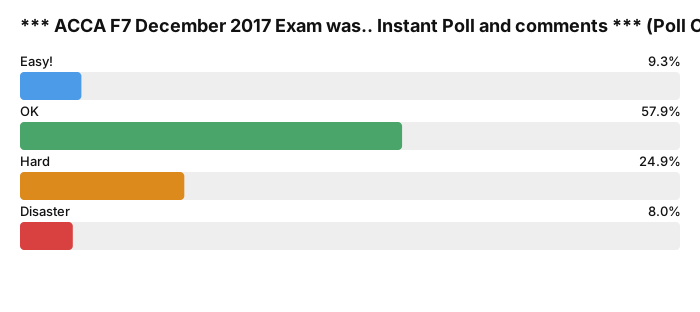
*** ACCA F7 December 2017 Exam was.. Instant Poll and comments *** poll results Post your comments about the ACCA F7 exam below (comments will open after 5pm UK) ACCA F7 December 2017 Exam was.. Instant Poll and comments

JJivesh8y ago#61
@badare said: Indeed comparability requires uniformity. if two companies have different accounting policies e.g depreciation method , their performance can not be reliably compared. Even if their reporting dates are different ; where is seasonal variations
See your BPP textbook.
MMehdi8y ago#62
Anyway could help with this? -And was the goodwill in mcq? 410,000 .. Investment of parent 950- net assets acquisition 540(340 sharecapital +200retained earnings) -In the ratios.. what was the big problem of roshan.co compared to the industrial average? The inventory days and payable days?
JJivesh8y ago#63
@mehdi2015 said: Anyway could help with this? -And was the goodwill in mcq? 410,000 .. Investment of parent 950- net assets acquisition 540(340 sharecapital +200retained earnings) -In the ratios.. what was the big problem of roshan.co compared to the industrial average? The inventory days and payable days?
I don't remember the MCQ. For the other one: Seasonal trading as it sells mainly winter clothes. Having to compulsorily but from the parent while its competitors might be benefiting from better credit terms from other better suppliers.
VVinxi8y ago#64
In section b last question of financial instrument there was some adjustment for exchange rate question anyone remember?adjusted from sales purchases or closing balances. I thought it is adjusted at the time of sales purchases n went for this.. But I guess I did wrong. Share ur answer guys :)
NNicholas8y ago#65
I certainly hope comparability requires uniformity!
AAdrianna8y ago#66
Anyone POL?
RRachel8y ago#67
I have had a look in my Kaplan text book and Comparability doesn't say anything specifically about uniformity. Talks about consistency but doesn't specifically use the word uniformity. But these mean the same thing surely?
JJivesh8y ago#68
@magd90 said: Anyone POL?
What is your query?
MMegi8y ago#69
@mehdi2015 said: Anyway could help with this? -And was the goodwill in mcq? 410,000 .. Investment of parent 950- net assets acquisition 540(340 sharecapital +200retained earnings) -In the ratios.. what was the big problem of roshan.co compared to the industrial average? The inventory days and payable days?
I got the same result too. I did not add the apportioned profit of the year ended as at 31.03.2019. Subsequently, the net asset value was the share capital (340) + retained earnings as at 30.09.2018 (200). However, I think that is not correct, because you should deduct the apportioned profit of the year ended as at 31.03.2019 from the retained earnings (200) to get the retained earnings at DOA.
AAshley8y ago#70
@megic said: I got the same result too. I did not add the apportioned profit of the year ended as at 31.03.2019. Subsequently, the net asset value was the share capital (340) + retained earnings as at 30.09.2018 (200). However, I think that is not correct, because you should deduct the apportioned profit of the year ended as at 31.03.2019 from the retained earnings (200) to get the retained earnings at DOA.
I do not remember this question in the paper?? were there different questions for the CBE??
MMegi8y ago#71
I got the same figure. I remember that the profit given in the question (can't recall now the exact amount) was the profit for the year ended as at 31 March 2019, while the acqs. occurred mid 2018. So logically, we can't add any apportioned amount of the year profit 2019 to the retained earnings for the year ended as at 31 March 2018. Being so, and having no other given amount of retained earnings at DOA, except the retained earnings of the year end as at 31 March 2018 (and also remembering a lecture saying "if you are not given any amount of retained earning at DOA, you will use the retained earning amount for the year end), I got 410,000 for goodwill. With regard to the big problems, there were two big ones, as you above-mentioned: inventory and payable s. The first one is related to purchases made from parent company at a higher value for 2015 compared to 2014 (COS way higher for 2015), closing inventory amounts and subsequently inventory days turnover. Why so much inventory for seasonal trading?! Maybe its inventory was obsolete or maybe it was overbuying from parent so the latter could manipulate its overall profits and show a better performance in the reported single FS (maybe I have gone too far with this assumption, by why would be a requirement for Rosham to purchase goods ONLY from parent??). Concerning the trade payable days, Rosham paid its suppliers way earlier compared to avg.sector (23 days i think) and one of its major suppliers is the parent company... In addition to that, there was a bank overdraft in 2015, meaning that Rosham had a lot of liquidity problem, given that its bank balance reversed from positive balance in 2014 to a negative one in 2015. It seems I can't remember the mcq question related to impairment :)
Former userFormer user8y ago#72
The two problems I put were that 1 - those were single accounts therefor inter company transactions still included. If there has been creative accounting it wouldn’t give a fair view. 2. There was no split of cash and credit sales in the question therefore the full revenue and cos were used. This wouldn’t give an accurate result on the ratios. But you could of also said that the time of year of there accounts was December when would be the start of their busy time therefore you would expect to see high stock etc compared to someone else who’s year end is say June. Hopefully that’s on the right lines?!
MMehdi8y ago#73
I based my answer on the ratios that i calculated as the question was asking problems comparing with industrial average.. So the poor ratios that i got from all those were inventory and payable days being lower performing compared to industrial average.. But i might be wrong.. Thanx fr yur opinion anyway bro
YYuza8y ago#74
I just wanted to know if there were only six ratios to calculate then campared the ratio with Industry average or we had to calculate for both years for the co itself..then compare. Thanks in advance guysss :)
Nnoha8y ago#75
how did u calculate the AP ratio Did u find the purchases ???
JJivesh8y ago#76
@nshahin93 said: how did u calculate the AP ratio Did u find the purchases ???
If by AP you mean average purchases days, you should use cost of sales based on what is given.
Topic lockedNew replies are closed.