ACCA Forums
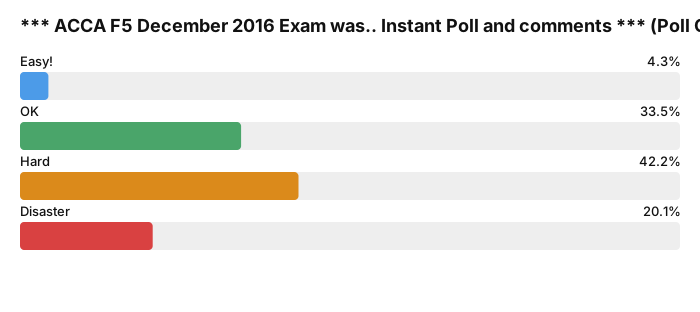
PM*** ACCA F5 December 2016 Exam was.. Instant Poll and comments ***
For the rolling budget i only prepared an extra month and rolled over the last three months from the pervious budget.
Does that mean ive done it wrong?
Yeah
Anyone remember answer of question no 29 ??
Anyone remember answer to a question in section B (throughput one) about adding one more oven, it asked for additional income it is going to incur. My answer was 95, but I am not sure.
Thanks
Ist msq is d 10 000 profit (4000 from saved fc plus 6000 contr)
Service is simultaneous
Monitoring emails was least effective
$590 transfer price (vc plus lost contr)
Rolling budget i took admin costs from actual results 2020
Cvp fixed costs were 385000, c/s ratio for full marathon 0.4, for both marathons 0.65.
Number of marathons to get the required profit-do not remember, but it was the first answer. A.
Mcqs were very time consuming. Did not have much time for long questions(((((
Good luck to everyone!!!!
I didnt do so well in MCQs ._. Werent sure about most of the answers
Can anyone explain the first MSQ? The etails were like : Sales price $25 , Contribution $15 , Fixed $4 . Units 30000....
Fixed costs will remain the same as at 30000 level. It means the profit now will be $10 per unit. Times it by 1000 units.
Worse set of mcq questions. Ques 31&32 not bad but I also fell asleep during mcq. They were so strange and hard.
mcq's was really time consuming and had very little time for the long questions, hope everyone pass, plenty prays.
Hi all
I agree with the above posts, I found the MCQ hard also, they didnt cover alot. In comparison the the Sept 16 paper that I used to practise on, the Dec paper was alot harder.
Did anyone else think that for such a broad range of topics in F5 I thought this exam was very limited in the subjects that the questions asked?
Limbo for the next month
@azaramirov said: Can anyone explain the first MSQ? The etails were like : Sales price $25 , Contribution $15 , Fixed $4 . Units 30000....Yes! That was the most difficult question! I spent to it almost 10 minutes and back twice till I understood that I've done silly mistake. It was the first question and I didn't want to be wrong on this easy item. So, the answer is D: profit increases by 100 000$. First time after calculations I couldn't get no one answers from a) b) c) d) Stupid! Just D! At the end of time I've just started to play with numbers (how I can*-)) Version 1 (30 000 units): Revenue: 30 000*25 = 750 000$ Cost of sales: 30 000*15 = 450 000$ Contribution: 300 000$ FC = 30 000*4 = 120 000$ Profit: 180 000 Version 2(Units 40 000): Revenue: 40 000*25 = 1 000 000$ Cost of sales: 40 0000*15 = 600 000$ Contribution: 400 000$ FC: 120 000$ (remain the same! That's the case!) Profit: 280 000$ Yahoo!
Hey Guys! Here are the MCq's I can remember:
1. Flow cost question - I got Waste
2. Closed system question - I put the Control test
3. Service of the eye company - I put simultaneous
4. $592000 for a BE point question
5. Reason for favourable materials variance for the Pizza..I put he actually used fewer ingredients than he expected to.
6. $590 minimum transfer price
7. The bottleneck mixing/baking question
8. Optimal plan for the cakes question - I picked the only option with i think 0 muffins or something..I remember they could make 120 brownies and all of the other cakes.
9. Optimal plan for the marathon question - I got A which is 17240 or something like that and 20something thousand.
10. Breakeeven question where everything is increased by 10% - I put BE units are unchanged but profit will be 10% higher..
11. Costs the manager of the investment division is responsible for - I put transfer price, costs and revenue. They aren't responsible for head office..
12. Total Materials price VAR I got as $40.50 Averse
13. $17.43 for the ABC cost allocated to B question?
14. The first question of course about the Margin of safety etc- I put C so I got it wrong :(
15. The question about whether EV is sensitive to probability assumptions? - I put that it is sensitive as it has it's own assumptions about probabilities and also that it ignores the various outcomes.
16. The facts about Multiple objectives in Not for profit? - I put both to satisfy stakeholders and the other option..I put just the second option but changed my mind..now I'm not sure..
17. ZBB statements about building up from the last period which i think was incremental instead, and something about it being functional?
18. The least way to ensure security of highly confidential material.
19. There was a question about whether the materials mix is treated as usage?
20. The effect on income of acquiring the $45 baking oven..something like that.. I just guessed A $55 as had no time really..
21. The question on materials Y and Z - which action would improve the TPAR? I picked to increase selling price of Y by 10%...but not sure..
22. The joint products question about X and Y..The profit of $400 gain? urgh, I was running out of time by this point..
23. TPAR was 1.5something and the asked what must have happened..
24. One on lifestyle costing If I remember?
I found the exam much more challenging than the September exam. This is my second attempt as I got 47% last time. Still kicking myself for not passing that paper as it seemed like a walk in the park when I re-did it again after the questions were published.
Ah well! Good luck everyone!
I found this exam more challenging than the September one. I got 45 last sitting. MCQ were much harder. :(
@liliyasolo777 said: Yes! That was the most difficult question! I spent to it almost 10 minutes and back twice till I understood that I've done silly mistake. It was the first question and I didn't want to be wrong on this easy item. So, the answer is D: profit increases by 100 000$. First time after calculations I couldn't get no one answers from a) b) c) d) Stupid! Just D! At the end of time I've just started to play with numbers (how I can*-)) Version 1 (30 000 units): Revenue: 30 000*25 = 750 000$ Cost of sales: 30 000*15 = 450 000$ Contribution: 300 000$ FC = 30 000*4 = 120 000$ Profit: 180 000 Version 2(Units 40 000): Revenue: 40 000*25 = 1 000 000$ Cost of sales: 40 0000*15 = 600 000$ Contribution: 400 000$ FC: 120 000$ (remain the same! That's the case!) Profit: 280 000$ Yahoo!LOL, same did I.
Hi, guys. Anyone else remembers the questions?
1. Optimal plan for cakes while 220 gram available
2. Optimal plan for marathon for $55 and $30...
3. EV is not sensitive to probabilities.
4. ZBB - not building up previous inefficiencies, or smth like this
The question specifically said the 60 days credit led to the exchange rate losses so i think that was caused by the divisional managers. How did you calculate the ROI for both divisions and what percentages did you get?
@mariane said: I found this exam more challenging than the September one. I got 45 last sitting. MCQ were much harder. :(I failed September too but with a 35 ._. Couldnt manage my time well between F5 and 7 so ended up studying more for one and not enough for other. I really wish i had passed F5 last time, it was sooo much easier
Cbaccbabdddbbaaddabcbdbacbdbca
These were my answers to the mcqs and mtqs, in order from 1-30. Fingers crossed and would really appreciate it if someone can tele it with me. Best of luck to everyone.
I think i got roi calculation wrong.... wat abt u guys... was yeild variance adverse???
When will acca upload question paper and its answers?
In q32, Gain on sale of asset, and cost of closure of company were both excluded because we were supposed to assess the divisional managers performance as asked in the question and both of these decisions were made by the head office, thus uncontrollable. Excluded depreciation on exchange rate too.
You had to work out the difference between the revenues of each quarter. the revenue of Q1 was 98% of Q2, so you had to Divide the revenue of Q2 by 98% to get the budgeted revenue of Q3 and so on.
Exchange rates cant be controlled by Managers so shouldnt by in calc, Trading profit should have been used.
What were the percentage of ROI of q 32???
I guess i got one around 18% and one 12% ...
Anyone else remembers the questions?
1. Optimal plan for cakes while 220 gram available
2. Optimal plan for marathon for $55 and $30…
3. EV is not sensitive to probabilities.
4. ZBB – not building up previous inefficiencies, or smth like this
@azaramirov said: Anyone else remembers the questions? 1. Optimal plan for cakes while 220 gram available 2. Optimal plan for marathon for $55 and $30… 3. EV is not sensitive to probabilities. 4. ZBB – not building up previous inefficiencies, or smth like this2) The option that had 17000 something and 20000 3) I picked that it doesnt show all the outcomes and there was one option related to profit
@azaramirov said: Anyone else remembers the questions? 1. Optimal plan for cakes while 220 gram available 2. Optimal plan for marathon for $55 and $30… 3. EV is not sensitive to probabilities. 4. ZBB – not building up previous inefficiencies, or smth like thisHey, I posted my answers to these. I got: 1.Optimal plan was the option with 0 muffins that can't be made and i think 120 brownies. 2. Marathon optimal plan I got the same as Msarosh option A with 17540 and 20000 3. I picked the option that EV is sensitive to probability assumptions (in my opinion) and it that it also doesn't show all outcomes. It depends precisely on assumptions about probabilities, how low or high it is at each decision point to get to the EV for a decision in the first place..so assumptions about the probabilities would affect it (in my opinion). 4. ZBB - You are right, it doesn't build up from previous inefficiencies. I can't remember the other options now but it's definitely doesn't build up from inefficiencies. What did everyone else put for the joint production profit/loss for product X? after the cut off point? And throughput ratio - how to improve TPAR to do with products Y and Z?
@heychi said: Hey, I posted my answers to these. I got: 1.Optimal plan was the option with 0 muffins that can't be made and i think 120 brownies. 2. Marathon optimal plan I got the same as Msarosh option A with 17540 and 20000 3. I picked the option that EV is sensitive to probability assumptions (in my opinion) and it that it also doesn't show all outcomes. It depends precisely on assumptions about probabilities, how low or high it is at each decision point to get to the EV for a decision in the first place..so assumptions about the probabilities would affect it (in my opinion). 4. ZBB - You are right, it doesn't build up from previous inefficiencies. I can't remember the other options now but it's definitely doesn't build up from inefficiencies. What did everyone else put for the joint production profit/loss for product X? after the cut off point? And throughput ratio - how to improve TPAR to do with products Y and Z?To improve TRAP- first one was accepting discount... Was baking or mixing bottleneck? What about life cycle cost per unit? do you remember? Also investigation cost for the activity...
@heychi said: Hey, I posted my answers to these. I got: 1.Optimal plan was the option with 0 muffins that can't be made and i think 120 brownies. 2. Marathon optimal plan I got the same as Msarosh option A with 17540 and 20000 3. I picked the option that EV is sensitive to probability assumptions (in my opinion) and it that it also doesn't show all outcomes. It depends precisely on assumptions about probabilities, how low or high it is at each decision point to get to the EV for a decision in the first place..so assumptions about the probabilities would affect it (in my opinion). 4. ZBB - You are right, it doesn't build up from previous inefficiencies. I can't remember the other options now but it's definitely doesn't build up from inefficiencies. What did everyone else put for the joint production profit/loss for product X? after the cut off point? And throughput ratio - how to improve TPAR to do with products Y and Z?Didnt the option say INsensitive to probability and not sensitive?
Topic lockedNew replies are closed.