
Employment income and national insurance
Finance Act 2025 · 2025/26
1 Earnings and assessment
In this TX lecture: The restriction on employment allowance where a director is the sole employee is not examined in FTX.

In this TX lecture: The employment-versus-self-employment status tests in this clip are not examined in FTX.

2 Employment income pro forma
Employment income computation | Amount |
Salary/wages | X |
Bonus/commission | X |
Benefits | X |
Reimbursed expenses | X |
Cash vouchers | X |
Total employment receipts | X |
Less: expenses wholly, exclusively and necessarily incurred | (X) |
Less: employee contributions to occupational pension scheme | (X) |
Less: subscriptions to professional bodies | (X) |
Less: payroll giving | (X) |
Less: travel and subsistence | (X) |
Less: own-car mileage allowance shortfall | (X) |
Employment income | X |
Individuals are generally assessed on the amount of cash received in the tax year. The date received is taken as the earlier of the date when the employee became entitled to the payment or the date it was actually received by the employee.
Benefits are assessed when they arise.
For directors, receipt can arise when remuneration is credited in company records or determined, as well as when paid or entitlement arises. Use the earliest relevant date. Other employees normally use the earlier of payment and entitlement. Benefits are assessed when provided.
3 Deductibility of expenses from employment income
The following expenditure is deductible:
The general rule is that expenses must be incurred wholly, exclusively and necessarily in the performance of the duties of employment.
Employee contributions to approved occupational pension schemes (within certain limits see chapter 9)
Fees and subscriptions to relevant professional bodies.
Payments to charity made under a payroll deduction scheme.
Travel expenses incurred necessarily in the performance of the duties of employment.
Capital allowances are available for plant and machinery provided by an employee for use in his employment duties.
4 Approved mileage allowances
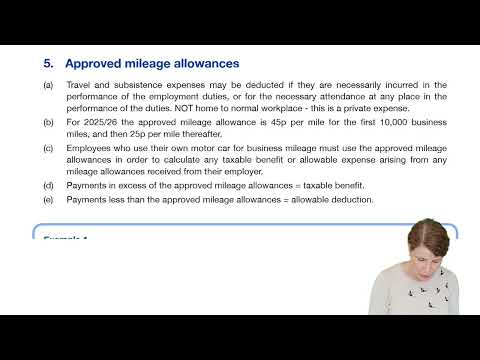
Travel and subsistence expenses may be deducted if they are necessarily incurred in the performance of the employment duties, or for the necessary attendance at any place in the performance of the duties. NOT home to normal workplace - this is a private expense.
For 2025/26 the approved mileage allowance is 45 p per mile for the first 10,000 business miles, and then 25 p per mile thereafter.
Employees who use their own motor car for business mileage must use the approved mileage allowances in order to calculate any taxable benefit or allowable expense arising from any mileage allowances received from their employer.
Payments in excess of the approved mileage allowances = taxable benefit.
Payments less than the approved mileage allowances = allowable deduction.
Kelly uses her own motor car for business travel. During 2025/26 she drove 12,000 miles in the performance of her duties. Her employer pays her 30p per mile.
Calculate the effect on Kelly's employment income.
Show answerHide answer
5 Benefits (in kind)
The term earnings includes non-cash benefits received by the employee or provided to a member of his or her family (unless they are specifically exempt).
Exempt benefits include:
Canteen available to all staff.
Qualifying removal expenses up to £8,000.
Car parking spaces at or near place of work.
Workplace nurseries (crèches).
Contributions by an employer to an approved pension scheme.
Workplace parking for bicycles plus a tax free cycling allowance of 20 p per business mile.
Provision of a mobile telephone for private use (one per employee).
Christmas parties etc for staff (up to £150 per person per year).
Sport and recreational facilities available generally for the staff.
Annual exemption of up to £500 per employee where employer pays for medical treatment to assist the employee in returning to work after a period of absence due to ill health or injury.
Outplacement counselling services to employees made redundant. The services can include counselling to help adjust to the loss of the job and to help in finding other work; i.e. retraining courses.
Contributions towards additional household costs (such as light and heat) incurred by an employee who works at home: up to £6 per week or if higher, evidence must be provided by the employee to justify the expense.
Long service awards up to £50 per each year of service (with a minimum requirement of 20 years service).
Trivial benefits which do not cost more than £50 per employee which are not cash or cash vouchers and are provided for a non-work related reason.
Use of employer bicycles and cycling safety equipment if used by employees to and from work.
Provision of eye care tests and/or corrective glasses for employees using VDU’s (if paid directly, by reimbursement to the employee or by providing vouchers).
Incidental overnight expenses provided by the employer for overnight stays from home. Up to £5 per night (UK) and up to £10 per night (overseas).
6 Taxable benefits

6.1 General rules
The amount assessed is generally the cost of providing the benefit.
Where in-house benefits are provided (for example, free air travel for employees of an airline company) the amount assessed is the marginal cost incurred by the employer. If there is no marginal cost, there is no benefit.
Benefits are time-apportioned if not available for the full tax year.
Any contribution by the employee towards the benefit reduces the benefit (unless the contribution is towards fuel for private journeys (see later).
6.2 Living accommodation
There is no taxable benefit if the accommodation is job related:
where it is necessary for the proper performance of the employee’s duties (e.g. a caretaker); or
for better performance of the employee’s duties and (for that type of employment) it is customary for employers to provide living accommodation (e.g. hotel worker); or
where there is a special threat to the employee’s security and he resides in the accommodation as part of special security arrangements.
If the accommodation is not job related then the benefit is:
if accommodation is rented by the employer on behalf of the employee, the benefit is the higher of the accommodation’s annual value, and the rent actually paid by the employer.
If the accommodation is owned by the employer, the benefit is the accommodation's annual value and there could be an additional benefit (see below).
Where the accommodation is owned by the employer, there is an additional benefit where the cost of the accommodation was greater than £75,000;
(cost of accommodation – £75,000) × the official rate of interest (3.75%)
The cost of the accommodation is the purchase price of the property plus expenditure on capital improvements incurred before the start of the tax year.
If the employer bought the accommodation more than six years before first providing it to the employee, the property’s market value when first occupied by the employee is used in the calculation instead of purchase price but note that if the cost is less than £75,000 there is no expensive accommodation benefit irrespective of the market value when the employee first occupied the property.
Any accommodation benefit is reduced by any contribution paid by the employee (e.g. the employee pays the employer 'rent').
Jones, a sales manager, occupies a flat owned by his employer. Its annual value is £4,000 and Jones pays his employer £400 per month for use of the flat. The flat was originally purchased in 2010 for £100,000 and Jones moved into the property in 2024 when the property was worth £125,000.
Calculate the total benefit assessable on Jones for 2025/26 assuming an official rate of interest of 3.75%
Show answerHide answer
6.3 Expenses connected with living accommodation
Expenses such as lighting and heating are taxable on the employee if they are paid by the employer.
When the accommodation is job related, the taxable limit is 10% of 'net remuneration' which is the employee's employment income after expenses but before this accommodation benefit. In addition the payment of council tax by the employer is an exempt benefit if the accommodation is job related.
6.4 Use of assets (including furniture in accommodation provided by employer)
Amount assessed is the higher of:
20% × market value of the asset when first provided.
rent paid by employer (if asset is rented).
6.5 Transfer/gift of assets
If an employee is gifted a new asset, he is taxed on the cost of the asset.
If an employee is gifted an asset that he has previously had private use of, he is taxed on the higher of:
the market value of the asset when given to him.
the market value of the asset when first made available to any employee less the benefit assessed on the employee(s) during the time he had the use of it.
The above rule does not apply to the gift of a bicycle, motor car or van, where the benefit is simply the market value of the asset when gifted.
If it is not an outright gift; i.e. the employee pays something for the asset, then the employee contribution is deducted from these amounts.
Gerald’s employer purchased a TV for Gerald's private use on 1 June 2024, costing £900. On 6 April 2025 Gerald was given the TV by his employer when its market value was £250.
Calculate the benefit assessable on Gerald in respect of the gift if:
(a) Gerald made no payment for the TV.
(b) Gerald paid his employer £250 for the TV.
Show answerHide answer
6.6 Car benefit
In this TX lecture: The benefit charge for a zero-emission company van is not examined in FTX.

When a car is provided to an employee and there is some private use, the assessable benefit for each car is: the list price of the car x CO2 emissions %.
The list price of the car is the list price when the vehicle was first registered, together with any optional extras NOT the price paid.
It is possible for the employee to make a one-off capital contribution towards the purchase of the car. For the purposes of calculating the benefit, the list price of the car can be reduced by this capital contribution up to a maximum of £5,000.
The CO2 emissions will be given to you in the exam as follows:
Petrol and Diesel cars:
The base level of CO2 emissions is 55 grams per kilometre.
The percentage rates applying to petrol cars (and diesel cars meeting the RDE 2 standard) with CO2 emissions up to this level are:
51 grams to 54 grams per kilometre | 16% |
55 grams per kilometre | 17% |
Electric cars:
A 3% percentage applies to electric-powered motor cars with zero CO2 emissions.
Hybrid cars:
For hybrid-electric motor cars with CO2 emissions between 1 and 50 grams per kilometre. the electric range of the car is relevant in determining the car benefit percentage, as follows:
Electric Range
130 miles or more | 3% |
70-129 miles | 6% |
40-69 miles | 9% |
30-39 miles | 13% |
less than 30 miles | 15% |
The car benefit is calculated as follows:
List price x CO2 emissions %
For petrol and diesel cars with emissions over 55 g/km, the base percentage is calculated as 17% plus 1% for every complete 5 g/km over 55 grams
To calculate the additional percentage round emissions down to nearest 5 g/km – deduct 55 g - divide the excess by 5.
Add a 4% supplement for diesel cars that do not meet the real driving emissions 2 (RDE 2) standard.
Maximum for all cars = 37%
The car benefit itself is proportionately reduced if:
a motor car is unavailable for periods of at least 30 days of the tax year, and
where the employee makes a contribution to the employer for the private use of the motor car.
Second motor cars
Where more than one motor car is made available to an employee, the benefit of each motor car is computed as above.
Pool cars
The use of a pool car does not result in a company car benefit. A pool car is one provided for the use of any employee to use for business purposes, is kept at the business place of work and not normally kept overnight at the employee's home.
During 2025/26, Speed Merchants plc provided the following employees with company cars:
Lewis was provided with a new diesel-powered company car on 6 August 2025. The car has a list price of £13,500 and an official CO2 emission rate of 117 grams per kilometre. The motor car meets the RDE2 standard.
Nico was provided with a new petrol-powered company car throughout 2025/26. The car has a list price of £16,400 and an official CO2 emission rate of 167 grams per kilometre.
Jenson was provided with a new hybrid electric-powered company car throughout 2025/26. The car had a list price of £16,000, an official CO2 emission rate of 38 grams per kilometre and an electric range of 110 miles.
Sebastian was provided with a new diesel-powered company car throughout 2025/26. The car had a list price of £14,000 and an official CO2 emission rate of 98 grams per kilometre. The car does not meet the RDE2 standard.
Calculate the taxable benefit for 2025/26 for Lewis, Nico, Jenson and Sebastian.
Show answerHide answer
6.7 Fuel provided for private use
The car benefit covers the running costs of the car with the exception of fuel provided for private journeys.
The amount of fuel benefit is computed on a base figure of £28,200 multiplied by the same percentage used for calculating the car benefit.
The fuel scale charge is reduced proportionately where private fuel is only provided for part of the tax year.
No reduction is made if the employee makes partial contributions towards the cost of petrol for private use, but if he pays for ALL fuel used for private motoring the charge is cancelled.
Using the previous example – calculate the fuel benefit for Lewis, Nico, Jenson and Sebastian assuming also that Lewis pays Speed Merchants plc £600 during 2025/26 towards the cost of private fuel, although the actual cost of this fuel was £1,000.
Show answerHide answer
Ordinary van benefit: £4,020; van fuel benefit: £769 where unrestricted private use/fuel is provided. Both may need time apportionment. Commuting with insignificant other private use does not create the ordinary van charge. Zero-emission van rules are not examined in FTX.
6.8 Beneficial loans

A beneficial loan is one made to an employee below the official rate of interest (3.75% for 2025/26).
The benefit is the interest on the loan at the official rate, less any interest actually paid by the employee.
There is no benefit if the total loans do not exceed £10,000 in total at any time in the tax year.
The benefit is calculated using the average method or the accurate/strict/precise method.
Average method.
This uses the loan outstanding at the beginning and the end of the tax year.
If the loan is taken out or paid back during the tax year, that date is used instead of the beginning or end the tax year.
Accurate/strict/precise method
This calculates benefit day by day on the balance actually outstanding.
Either the taxpayer or HMRC can elect to use the accurate method.
Jack was given a loan of £35,000 by his employer on 31 March 2025. Interest is payable on the loan at 1% p.a. On 1 June 2025 Jack repaid £5,000 and on 1 December 2025 he repaid a further £15,000.
Calculate the taxable benefit for 2025/26 under:
(a) the average method and
(b) the accurate method
You should assume that the official rate of interest is 3.75% p.a.
Show answerHide answer
In this TX lecture: Detailed PAYE operation and code calculations, payrolling of benefits, and receiving income from pension arrangements are not examined in FTX.


Martin is employed by Global plc and he is also a member of a partnership. The following information is available in respect of the tax year 2025/26:
Employment income:
1 During 2025/26, Martin was paid a gross annual salary of £144,000 in respect of his employment with Global plc.
2 In addition to his salary, Martin was paid the following bonuses by Global plc:
Amount: | In respect of the six month period | Date of payment | Date of entitlement |
£18,200 | 28 February 2025 | 30 April 2025 | 20 March 2025 |
£21,400 | 31 August 2025 | 30 October 2025 | 20 September 2025 |
£13,700 | 28 February 2026 | 30 April 2026 | 20 March 2026 |
3 During the tax year 2025/26, Global plc provided Martin with the following petrol-powered cars:
Period provided | List price | CO2 emission rate |
6 April to 31 December 2025 | £16,400 | 108 grams per kilometre |
1 January to 5 April 2026 | £36,400 | 26 grams per kilometre (hybrid car with an electric range of 55 miles) |
Martin was not provided with any fuel for private use.
4 On 6 April 2025, Global plc provided Martin with an interest-free loan of £8,000 which he used to purchase a motor bike. No loan repayments were made during the year.
5 Throughout the tax year 2025/26, Global plc allowed Martin private use of a home entertainment system owned by the company. The home entertainment system cost Global plc £7,400 on 6 April 2025.
6 During the tax year 2025/26, Martin donated a total of £1,000 to charity under the payroll deduction scheme operated by Global plc.
7 Martin paid an annual professional subscription of £560, which is relevant to his employment with Global plc. Martin also paid an annual membership fee of £1,240 to a health club, which he used to entertain Global plc’s clients. Global plc did not reimburse Martin for either of these costs.
Partnership income:
1 Martin has been in partnership with Norma and Oprah since 1 January 2009. The partnership’s trading profit for the year ended 31 March 2026 was £54,600.
2 Until 30 September 2025, profits were shared 40% to Martin, 30% to Norma and 30% to Oprah. Since 1 October 2025, profits have been shared equally.
Other income:
1 During 2025/26, Martin rented out a furnished room in his main residence, receiving rent of £9,200 for the year. No additional expenditure was incurred as a result of the letting.
2 During the tax year 2025/26, Martin received dividends of £440.
3 On 30 November 2025, Martin received interest of £1,330 on the maturity of savings certificates from NS&I (National Savings and Investments).
Calculate Martin’s taxable income for the tax year 2025/26.
Note: You should indicate by the use of zero (0) any items which are not taxable or deductible.
Show answerHide answer
Esi has a petrol company car throughout 2025/26. List price £24,000; emissions 80 g/km; employer also pays for all private fuel. No employee contribution. Calculate benefits and Class 1A NIC.
Show answerHide answer
Farhan has a hybrid car, emissions 30 g/km, electric range 75 miles, list price £30,000. It is provided for six months. Separately, Grace uses her own car for 12,000 business miles and receives £4,000 reimbursement. Find the hybrid benefit and Grace’s deduction.
Show answerHide answer
7 P11D and source documents
Record | Information to extract |
P60 / P45 | Gross pay and PAYE already deducted; check the employer and tax year |
P11D / employer benefit statement | Type and taxable value of benefits, dates available, employee contributions |
Expense / mileage records | Nature, amount and business purpose of allowable expenses |
Bank interest statement | Taxable interest received; separate exempt ISA income |
Dividend vouchers | Gross dividends received in the tax year |
A P11D reports taxable expenses and benefits: identify each category and its cash equivalent, using supporting employer records. Do not put every employer reimbursement on the return as an automatic deduction; apply the expense test.
8 Employed earners
8.1 Class 1 contributions
Class 1 NIC is paid by employees and employers as follows:
Employees
The contributions begin when the employee is aged 16 or over. For 2025/26, the rate of employee Class 1 NIC is at 8%. It is paid where cash earnings exceed a threshold of £12,570 per annum, but only up to an upper limit of £50,270 per annum. Where earnings are above £50,270 per annum there is a rate of 2% payable on the excess. The contributions cease when the employee reaches state pension age. For employees it is payable in respect of an 'earnings period' which is usually either weekly or monthly. For directors, it is calculated annually.
Employers
The rate of employer Class 1 NIC is 15%. It is paid on cash earnings that exceed a threshold of £5,000 per annum. These are payable from the employee's 16 th birthday, but there is no upper age limit.
8.2 Class 1A Contributions
The rate of Class 1A NIC is payable only by employers on taxable benefits provided to employees. The rate is 15% multiplied by the assessable value of the benefits.
The rates are given in the tax tables at the front of the exam - use them!
Class 1 | Employee | £1 - £12,570 | @ | 0% |
£12,571 – £50,270 | @ | 8% | ||
£50,271 and above | @ | 2% | ||
Class 1 | Employer | £1 - £5,000 | @ | 0% |
£5,001 and above | @ | 15% | ||
Employment allowance | £10,500 | |||
Class 1A | 15% |
9 Employment Allowance
There is an annual employment allowance of £10,500 per EMPLOYER to reduce the Employer’s Class 1 NIC payable.
For example, if the employer’s Class 1 NIC for the tax year is £16,000 the amount payable will be reduced by the £10,500 employment allowance to £5,500. If the total employer’s Class 1 NIC was say £9,500 then this would be reduced to nil.
The employment allowance does not reduce the amount of employer Class 1A NIC payable nor will it serve to reduce the amount of Class 1 employee’s NIC.
An employee of Riga Ltd was paid £60,000 per annum and was provided with the following benefits during 2025/26:
| £ |
Company car | 6,400 |
Fuel | 4,320 |
Calculate the Class 1 and Class 1A NIC liabilities in respect of this employee.
Show answerHide answer
Class 1 uses cash earnings. For weekly/monthly questions divide each supplied annual threshold by 52/12; do not use an annual threshold against one week’s pay.
Employer Class 1 has no upper limit. The £10,500 employment allowance reduces the employer’s annual Class 1 liability, not employee NIC or Class 1A. FTX excludes the sole-director and group eligibility restrictions.
Haruto earns £3,000 cash each month. Calculate one month’s employee and employer NIC before employment allowance.
Show answerHide answer
Imran earns £600 cash in one week. Calculate employee and employer NIC before employment allowance.
Show answerHide answer
Amir receives salary £32,000 and a bonus £2,000. Taxable benefits are £3,000. Allowable professional subscriptions are £300 and payroll giving is £700. Compute employment income.
Show answerHide answer
Bola is an ordinary employee entitled to a bonus on 31 March 2026 but paid on 30 April 2026. Chika is a director whose bonus is credited in company records on 20 March 2026, paid in April. Identify the assessment year.