
Income tax computations
Finance Act 2025 · 2025/26
1 Tax year and income categories

Individuals are assessed to Income Tax on their income arising in the tax year.
Individuals are chargeable to income tax, including partners on their shares of partnership profits. Earned income consists of employment income and trading profits.
The tax year runs from April 6 to following April 5. Therefore the tax year 2025/26 runs from 6 April 2025 to 5 April 2026. Each source of taxable income requires its own basis of assessment to determine how much of that income is to be assessed to tax in each such tax year.
2 Computation of Taxable Income
There are two main parts to the Income Tax computation;
firstly the computation of the taxpayer’s Taxable Income and
secondly the calculation of the Income Tax Liability and/or Income Tax payable/repayable.
The Taxable Income is divided into three analysis columns;
Non-Savings Income which will be made up of employment income, trading profits of the self-employed, property income and pension income,
Savings Income such as interest from banks and building societies, and
Dividend income.
This analysis is very important as different tax rates may apply to the different types of income.
This proforma is the expected layout for your answers in the exam - it is important that this and all proforma are laid out neatly, well labelled and presented.
2.1 Exempt Income
The following are the main examples of sources of income that are exempt from income tax:
Interest or bonuses on National Savings & Investment Certificates,
Interest and dividends within an Individual Savings Account [ISA],
Gaming, lottery and premium bond winnings.
Proforma Income Tax computation for 2025/26
Non-savings income | Savings income | Dividends | Total | |
£ | £ | £ | £ | |
Trading Profit | X | X | ||
Less Trading Loss relief – brought forward | (X) | (X) | ||
X | X | |||
Employment Income* | X | X | ||
Property Income | X | X | ||
Dividends received | X | X | ||
Building society interest received | X | X | ||
Bank deposit interest received | X | X | ||
Other interest received | X | X | ||
TOTAL INCOME | X | X | X | X |
Less** | ||||
Qualifying interest paid | (X) | (X) | ||
Other Trading Loss reliefs | (X) | (X) | ||
NET INCOME | X | X | X | X |
Less: Personal Allowance (PA)*** | (X) | (X) | ||
TAXABLE INCOME | X | X | X | X |
* Employment Income, salaries or wages, must be included gross before deduction of taxes at source by the employer and will always be stated gross in the exam question.
** Deductions from Total Income and the deduction of the PA from Net Income, are deducted in order: from firstly non-savings income, then savings income and finally dividend income for purposes of this exam.
*** UK tax payers are entitled to a personal allowance (PA). It is a tax free amount. The rate of the PA is found in the tax tables and for 2025/26 it is £12,570.
Use the UK rates supplied for FTX-UK. Revenue income is assessed to income tax; a capital gain on a disposal is computed separately for CGT. An ordinary receipt from selling trading inventory is trading income, not a capital gain.
3 Savings and dividend rates
3.1 Income Tax liability and Income Tax Payable/Repayable
Having calculated the taxable income, the next part of the computation is to compute the Income Tax Liability and/or the Income Tax Payable/Repayable of the taxpayer;
Income Tax liability = income tax on taxable income.
In calculating the Income Tax Liability it is necessary to tax each part of the Taxable Income in order, non-savings income followed by savings income and finally dividend income as these sources of taxable income have different tax rates that apply to them and rates that also change depending on how much taxable income the taxpayer has.
Income Tax payable/repayable = Income Tax liability
LESS
Income Tax already deducted at source, for example
Pay As You Earn (PAYE) on employment income.
4 Income from investments - savings and dividends
Savings income is interest income which is generally received gross without any deduction of tax at source and will include interest from financial institutions such as banks and building societies, and government securities and corporate bonds, but watch out for the exempt sources of interest noted above.
Savings income is assessed in the tax year that it is received.
Dividend income is received from shares held in companies and is received gross without any deduction of tax.
Dividend income is assessed in the tax year that it is received.
4.1 Calculation of tax
Taxable interest received is included in the savings income column of the computation.
Any deductions in the income tax computation (personal allowance and reliefs) are deducted first from non-savings income, then savings income, then dividend income, hence the order in which the analysis columns are listed.
Income Tax suffered at source (PAYE) is deducted from the tax liability in order to arrive at Income Tax payable/repayable.
The different types of taxable income are taxed as follows and in this order:
Non-Savings Income
£1 to £37,700 | 20% | basic rate | ||
£37,701 – 125,140 | 40% | higher rate | ||
£125,141 + | 45% | additional rate | ||
Savings Income
Savings income sometimes benefit from a starting rate of 0%. However, the starting rate only applies where savings income falls within the first £5,000 of taxable income. If non-savings income exceeds £5,000, then the starting rate of 0% for savings does not apply.
Savings income also sometimes benefits from a savings income nil rate band of 0%. For basic rate taxpayers, the savings income nil rate band for the tax year 2025/26 is £1,000, and for higher rate taxpayers it is £500. Additional rate taxpayers do not benefit from any savings income nil rate band.
Savings income in excess of the savings income nil rate band is taxed at the basic rate of 20% if it falls below the basic rate threshold of £37,700, at the higher rate of 40% if it falls between the basic rate threshold of £37,700 and the higher rate threshold of £125,140, and at the additional rate of 45% if it exceeds the higher rate threshold of £125,140.
In 2025/26 Polly had a trading profit of £13,500 and received bank interest of £18,000.
Calculate Polly's Income Tax liability for 2025/26.
Show answerHide answer

In 2025/26 Billy had a trading profit of £27,500 and received bank deposit interest of £10,000.
Calculate Billy’s Income Tax liability for 2025/26.
Show answerHide answer
Recalculate Billy’s Income Tax liability for 2025/26, assuming the bank deposit interest was £25,000.
Show answerHide answer
In 2025/26 Molly's only income was bank interest received of £22,500.
Calculate Molly’s Income Tax liability for 2025/26.
Show answerHide answer
Dividends
The first £500 of dividend income for the tax year 2025/26 benefits from a 0% rate. This £500 nil rate band is available to all taxpayers, regardless of whether they pay tax at the basic, higher or additional rate. However, the dividend nil rate band counts towards the basic rate and higher rate bands.
Dividend income in excess of the £500 nil rate band is taxed at:
8.75% if it falls below the basic rate threshold of £37,700,
at 33.75% if it falls between the basic rate threshold of £37,700 and the higher rate threshold of £125,140, and
at 39.35% if it exceeds the higher rate threshold of £125,140.
In 2025/26 Daisy received a salary of £19,500 (PAYE deducted of £1,400). She also received £10,000 bank deposit interest and dividend income of £1,000.
Calculate Daisy’s Income Tax payable for 2025/26.
Show answerHide answer
Recalculate Daisy’s Income Tax payable for 2025/26, assuming she received a salary of £37,500 (PAYE deducted of £5,000), bank deposit interest of £12,500 and dividend income of £1,500.
Show answerHide answer
In this TX lecture: The accrued income scheme is not examined in FTX.

In 2025/26 Amir has salary £30,000, bank interest £2,000 and dividends £1,000. PAYE is £3,000. Calculate income tax liability and payable.
Show answerHide answer
Bola’s only income is bank interest £20,000 in 2025/26. Calculate income tax.
Show answerHide answer
5 Personal allowance
The Personal Allowance (PA) is a level of tax free income available to UK taxpayers. It is deducted from Net Income to arrive at Taxable Income on the Income Tax Computation. It is deducted from the analysis columns in the order of firstly non-savings income, followed, if necessary, by savings income and finally dividend income.
The normal PA for 2025/26 is £12,570.
This allowance is gradually reduced/tapered/abated where a person’s adjusted net income (ANI) exceeds £100,000.
Adjusted net income is calculated as follows:
Adjusted net income computation | Amount |
Net income | X |
Less: gross Gift Aid donations | (X) |
Less: gross personal pension contributions | (X) |
Adjusted net income (ANI) | X |
Where ANI is more than £100,000, the PA is reduced by:
(ANI - £100,000) x 50%
Therefore, a person with adjusted net income of £125,140 or more is not entitled to any personal allowance (£(125,140 – 100,000) x 50% = £12,570).
In 2025/26 Ingrid received gross employment income of £108,000 from which £32,000 was deducted at source under PAYE.
Calculate Ingrid’s Income Tax payable for 2025/26.
Show answerHide answer
In 2025/26 Kai received the following income:
- Trading income | £91,000 |
- Bank interest | £10,000 |
- Dividends | £5,000 |
- Interest from ISA | £450 |
He made personal pension contributions of £2,500 (gross)
Compute Kai's Taxable Income for 2025/26.
Show answerHide answer
In this TX lecture: The transferable personal allowance (marriage allowance) is not examined in FTX.

6 Deductions from Total Income
6.1 Reliefs are tax deductible
Eligible interest and permitted trading-loss reliefs are deducted from total income to find net income.
qualifying interest, and
certain trading loss reliefs. These reliefs are deducted from Total Income to calculate Net Income, and are deducted firstly from non-savings income before savings income and then dividend income. Note that in this context 'Net Income' means 'net of deductions', not 'net of tax'.
6.2 Qualifying interest is:
On a loan taken out by a partner to purchase an interest in the partnership or a contribution to the partnership of capital or a loan.
On a loan taken out by a partner to purchase plant or machinery used in the partnership.
On a loan taken out by an employee to purchase plant and machinery for use in the performance of duties.
On a loan taken out to purchase an interest in a close trading company (broadly, one controlled by five or fewer people).
In 2025/26 Kathy's share of the partnership trading profit was £52,000. During 2025/26 she paid £1,000 interest on a loan to purchase plant and machinery used in the business of her partnership.
Calculate Kathy’s Income Tax liability for 2025/26.
Show answerHide answer
7 Payments to charity under the Gift Aid scheme
The gift aid scheme is a tax efficient way by which to give money to charity and is available to individual taxpayers.
7.1 Basic rate taxpayers
Payments to charity under the gift aid scheme are treated as being paid net of the basic rate of tax (20%). Therefore for a basic rate taxpayer, tax relief at the basic rate is automatically obtained as payments are made to the charity net of basic rate.
For example, in order for the charity to receive £100, the taxpayer need only make a gift aid payment of £80. The charity will then be able to claim back from HMRC the basic rate tax of £20 thereon collected by HMRC from the taxpayer’s income.
Therefore, because the tax relief is automatic, the donation is NOT shown as a deduction in the calculation of Taxable Income.
If the exam question tells you what is the amount paid by the taxpayer, for example £80 and you must gross up this amount (£80 x 100/80) to compute the gross figure. The question may state amount paid £100 (gross) and give you the already grossed up figure to use - read the information in the question carefully - as ever!!
7.2 Higher rate taxpayer
For higher rate taxpayers, 40% tax relief is given as follows:
20% at source (as noted above), and,
20% through the income tax computation, obtained by extending the basic rate band by the gross donation (so that more income is taxed at 20% and less at 40%).
7.3 Additional rate taxpayer
For additional rate taxpayers, 45% tax relief is given as follows:
20% at source (as noted above) and,
25% through the income tax computation by extending both the basic rate band and higher rate band limits by the gross donation (so that more income is taxed at 20% instead of 40% and 40% instead of 45%).
In 2025/26 Elliot had a trading profit of £53,000. He paid £1,600 to charity under the gift aid scheme.
Calculate Elliot’s Income Tax liability for 2025/26.
Show answerHide answer
In 2025/26 Tom had a trading profit of £160,000. He paid £6,400 to charity under the gift aid scheme.
Calculate Tom’s Income Tax liability for 2025/26.
Show answerHide answer
In 2025/26 Kelly had a trading profit of £98,000. In addition, she received bank interest of £4,000 and dividend income of £6,000. She paid interest of £3,000 on a loan to contribute capital into a partnership of which she is a partner. She made a payment of £4,800 to charity under the gift aid scheme.
Calculate Kelly’s Income Tax liability for 2025/26.
Show answerHide answer
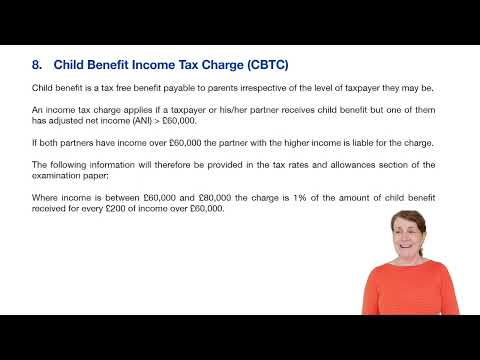
In this TX lecture: The high income child benefit charge is not examined in FTX. The jointly owned property income rules are taught in chapter 4.
Kate had the following income and outgoings in 2025/26
Trade profits | £38,000 |
Employment income | £ 8,000 (PAYE of £505 was deducted) |
Bank interest received | £ 3,500 |
Dividend income | £ 7,000 |
Qualifying interest paid | £ 1,000 |
Gift aid (amount paid) | £ 2,000 |
Calculate Kate's Income Tax payable for 2025/26.
Show answerHide answer
Payroll giving is deducted from employment income before tax. Do not also gross it up or extend a rate band. Gift Aid is different: gross up the net payment by 100/80, then extend both band limits and deduct the gross amount only when calculating adjusted net income.
8 Liability versus payable
List all income in the correct columns; deduct eligible reliefs to find net income.
Compute adjusted net income and the personal allowance; subtract the allowance in non-savings, savings, then dividend order.
Tax the categories in that order, using the supplied rates and any Gift Aid/personal-pension band extensions.
Liability is the tax on the taxable income. Deduct PAYE already withheld to find tax payable, or a repayment if PAYE exceeds the liability.
Chika has trading income £54,000 and pays £2,400 net under Gift Aid. There is no other income or relief. Calculate her 2025/26 liability.
Show answerHide answer
Deepak has net income £110,000 and pays gross personal-pension contributions £4,000. Calculate his personal allowance.