
Relevant Cash Flows in DCF (Inc. Tax and Inflation)

1 Introduction
Chapters 10 and 11 dealt with the mechanics of appraisal — how to discount, how to read an NPV, how to interpolate an IRR. This chapter deals with the harder question that comes before them: which cash flows go into the calculation at all.
Examination questions test that judgement far more often than they test the arithmetic. The chapter covers the principles of relevant costing, and then the three conventions that turn a simple discounting exercise into a full investment appraisal — working capital, taxation and inflation.
2 Relevant and non-relevant costs
This recording covers sections 2 and 3 and works Example 1 item by item, which is exactly how the requirement asks for it to be answered.
One notice: the recording is in pounds throughout and the notes are in dollars. No figure changes — the total is 174,000 either way.
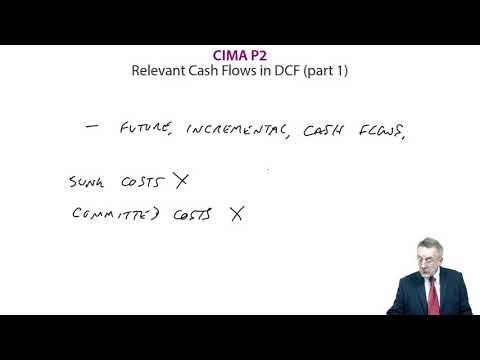
Its closing summary is the sentence to carry into the examination: what we are after is "the future incremental or extra cash flows".
One more. The tutor calls this “chapter 13” throughout. That is the pre-2020 numbering; it is chapter 12 in this edition, and the section numbers he quotes are this chapter's.
2.1 Relevant costs
Relevant cost
A cost that is directly incurred, or directly saved, as a result of the decision being taken.
A relevant cost must be future, incremental and cash. Fail any one of the three and it does not belong in the appraisal.
As well as direct costs, relevant costs include opportunity costs — the value of the next best alternative that has to be given up in order to pursue the chosen course of action.
An opportunity cost can only arise on a limited or finite resource. If a resource is freely available, using it on this project sacrifices nothing, and there is no opportunity cost. For example, the contribution lost by moving key sales staff onto a new project is a relevant cost of that project — but only because those staff cannot simply be replaced.
2.2 Non-relevant costs
Non-relevant costs are those that will not change as a result of the decision. Always read the particulars of the question, but in general the following are not relevant:
Type of cost | Why it is not relevant |
Sunk costs | Already paid, so they do not change with the decision. Research already spent on a project cannot be recovered and must not be included in the decision whether to continue. |
Committed costs | Must be paid whatever is decided — typically an existing lease or rental agreement the business is contractually bound to honour. |
Book values and historic costs | Out of date, and not a consequence of a decision being taken now. What matters is what the asset could realise or what it would cost to replace, not what it once cost. |
Non-cash costs | Depreciation and amortisation are accounting valuations, not cash flows. (They still matter indirectly, through the tax computation — see section 4.) |
Absorbed or apportioned overhead | A share of an unchanged total is not an incremental cost. If the question says total overheads rise by a stated amount, that increase IS relevant; a re-apportionment is not. |
Finance costs | Interest and dividends on the project's capital are already accounted for by discounting at the cost of capital. Including them as well double-counts. |
The overhead trap catches more candidates than any other item in this chapter. "Overhead absorbed into this production would amount to $20,000" is an apportionment and is not relevant. "Total overheads will increase by $20,000" is an incremental cash cost and is. The two sentences look almost identical and mean opposite things.
Relevant cash flows
A research project which to date has cost the company $150,000 is currently under review.
If the project were allowed to proceed it would be completed in approximately one year, when the results would be sold to a government agency for $300,000.
Shown below are the additional expenses which the managing director estimates will be necessary to complete the work.
Materials
The materials required have just been purchased at a cost of $60,000. They are toxic and, if not used in this project, must be disposed of at a cost of $5,000.
Labour
Skilled labour is hard to recruit. The workers concerned have been transferred to this project from a production department, and the production manager claims that if the men were returned to him they could generate sales of $150,000 in the next year. The prime cost of these sales would be $100,000, including $40,000 for the labour cost itself. The overhead absorbed into this production would amount to $20,000.
Research staff
It has already been decided that when work on this project ceases, the research department will be closed. Research wages for the year are $60,000, and redundancy and severance pay has been estimated at $15,000 now, or $35,000 in one year's time.
Equipment
The project uses a special microscope which cost $18,000 three years ago. It has a residual value of $3,000 in another two years, and a current disposal value of $8,000. If used in the project it is estimated that its disposal value in a year's time will be $6,000.
Share of general building services
The project is charged with $35,000 p.a. to cover its share of general building expenses. Immediately the project is discontinued, the space occupied by the project could be sub-let for an annual rental of $7,000.
Required
Advise the managing director as to whether or not the project should be allowed to proceed, explaining your reasons for the treatment of each item. (Ignore the time value of money.)
Show answerHide answer
3 Working capital
This recording covers sections 3 and 4 — working capital and taxation — and works Examples 2 and 3. It is correct throughout; the two notices are about presentation, not substance.
One. It is in pounds; the notes are in dollars.
Two. The tutor works Example 3 with the original 2003/2004 year ends. These notes use 2027/2028. Nothing about the mechanics changes — the tax is still payable one year in arrears and every figure in the answer is the same.
His two-route explanation of the tax working — the full computation, then the faster "tax on the operating flow, then add the tax saved on the capital allowance" route — is the presentation used in section 4 and in the answers.

As well as the initial outlay at the start of a project, cash is very often needed immediately to fund the working capital the project requires — inventory of raw materials, and the receivables that arise from selling on credit.
Unless told otherwise, use the following convention:
the working capital is a cash outflow at the time it is first needed, normally time 0;
the requirement stays in place for the life of the project;
at the end of the project the working capital is released, giving a cash inflow of the same amount in the final year;
in the intervening years only the incremental increase in the requirement is a cash flow.
Working capital is not a cost — it is money tied up and then recovered. Over the life of the project the outflow and the inflow cancel out in nominal terms, but not in present value terms, because the outflow happens at time 0 and the inflow happens years later. That difference is a real cost of the project.
Working capital
A machine costs $100,000 to purchase. In addition a further $20,000 of working capital will be required at the start of the project.
The project is expected to last 4 years and the machine is expected to have a scrap value of $20,000 at the end of its useful life.
Net operating cash flows are expected to be $30,000 p.a. for the first two years and $40,000 p.a. for the following two years. All operating flows are assumed to occur at the ends of years.
Required
Calculate the net cash flow for each of the years in question. (You are not required to discount or to arrive at an investment decision.)
Show answerHide answer
4 Taxation
A profitable investment generates additional taxable profit, and the tax on it is a cash flow caused directly by the decision to proceed. It is therefore relevant and belongs in the appraisal. Equally, a project that makes a loss reduces the company's tax bill, and that saving is a cash inflow.
4.1 The two tax effects
There are two, and both must be brought in:
Extra operating cash flow generates extra tax payable — a cash outflow.
The initial capital investment attracts capital allowances (tax allowable depreciation), which reduce taxable profit and therefore save tax — a cash inflow in the relevant year.
It is always the tax saved on the capital allowance that enters the appraisal, never the capital allowance itself. A $2,500 allowance at a 30% tax rate is a $750 cash inflow, not a $2,500 one.
Objective test questions will normally state the rate of tax, when tax is payable, and the rate of tax allowable depreciation on the asset. That is enough to produce both flows.
Where an asset is sold, the difference between its written-down value for tax purposes and its sale proceeds gives rise to a balancing allowance (proceeds below written-down value) or a balancing charge (proceeds above it) in the year of sale.
4.2 The examination's simplifying assumptions
Unless a question says otherwise, assume:
tax is calculated on operating cash flows (in practice it is charged on adjusted operating profits);
there is no advance tax payable;
there is no tax on working capital, on either the outflow or the inflow;
there is no pool of assets for capital allowance purposes — allowances are computed in isolation for the investment in question;
no other taxes are relevant, so no capital gains tax and no carry-back of losses.
Tax and capital allowances
A company has a year end of 31 December each year.
It is considering the purchase of a new machine on 1 January 2027 at a cost of $10,000.
The machine is expected to generate net operating cash flows of $5,000 during the first year and $7,000 during the second year.
It is intended to sell the machine at the end of the second year for $6,000.
Additional working capital of $1,000 will be required at the start of the project.
Corporation tax is 30%, payable one year in arrears. Capital allowances are available at 25% p.a. on a reducing balance basis. The cost of capital is 10%.
Required
Calculate the net present value of the project and advise whether it should be accepted or rejected.
Show answerHide answer
5 Inflation
This recording covers section 5 and works Example 4 in full. It is correct and the notice is the standard one: it is in pounds, and it reads Example 4's figures in thousands throughout, which is also how the printed answer is laid out.
Watch the point at which he inflates the first year's material and labour costs — they are given at current prices, so year 1 already carries one year of inflation, while the selling price is given as the year 1 price and carries none. That asymmetry is the whole of the difficulty in this example.

An appraisal is built on forecast future cash flows, and over a long project it is very likely that some of those flows will rise with inflation.
The discounted cash flow calculation needs the actual amounts expected to be paid or received, so where an inflation rate is given the individual cash flows must be inflated before they are discounted. Different flows often inflate at different rates — materials at one rate, labour at another, selling prices at a third — and each is inflated separately.
Read carefully whether a figure is given "at current prices" or as the price in a particular year. A cost quoted at current prices has to be inflated once to reach year 1; a selling price quoted as "$20 in the first year" is already the year 1 figure and is inflated only from year 2 onwards. Getting these two out of step by one year is the commonest error in the topic.
Inflation, tax and working capital
Ventspils plc is considering buying a new machine in order to produce a new product.
The machine will cost $2,800,000 and is expected to last for 3 years, at which time it will have an estimated scrap value of $1,000,000.
The company expects to produce 100,000 units p.a. of the new product, which will be sold for $20 per unit in the first year.
Production costs per unit, at current prices, are as follows:
$ per unit | |
Materials | 8 |
Labour | 7 |
Materials are expected to inflate at 8% p.a. and labour at 5% p.a. The company expects to be able to increase the selling price of the product by 7% p.a.
Fixed overheads of the company currently amount to $1,000,000. The management accountant has decided that 20% of these should be absorbed into the new product.
An additional $200,000 of working capital will be required at the start of the project.
Capital allowances are available at 25% on a reducing balance basis. Tax is 25%, payable one year in arrears. The cost of capital is 10%.
Required
Calculate the net present value of the project and advise whether or not it should be accepted.
Show answerHide answer
6 Inflation — the Fisher equation
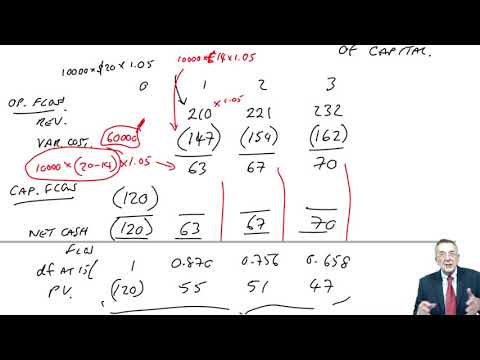
This recording covers section 6 and works all three parts of Example 5: the inflated cash flows at the money cost of capital, the current-price flows at the real rate from the Fisher equation, and why, in theory, the decision does not depend on the rate of inflation.
One. Check two figures against the answer below: the net present value in part (a) is $30,522, and in part (b), discounted at 10% because 9.52% is not in the tables, it is $29,220. The recording works in thousands, so take the dollar figures from the notes.
Two. Where you hear pounds, read dollars: the notes are in dollars throughout.
The method in section 5 — inflate the cash flows, then discount at the cost of capital — is the normal and usually the quickest approach. It assumes that the cost of capital you are given already includes inflation.
Sometimes, though, the discount rate you are given is a real rate: one that excludes inflation. A real rate can be used to discount cash flows that also exclude inflation, that is, flows stated at current prices with no adjustment at all.
The matching rule
Discount money (nominal) cash flows — the inflated ones — at the money (nominal) cost of capital.
Discount real cash flows — those at today's prices — at the real cost of capital.
Both routes give the same net present value. What you must never do is mix them.
If no information is given about which you have been handed, assume it is the money or nominal cost of capital, and therefore that it is inclusive of inflation.
Objective test questions frequently pose a deliberate mismatch — inflated cash flows with a real cost of capital, or vice versa. To move between the two rates, use the Fisher equation:
(1 + i) = (1 + r)(1 + h)
where i is the nominal (money) cost of capital, r the real cost of capital and h the general rate of inflation, all expressed as decimals.
The Fisher equation
A new machine will cost $120,000 and is expected to last 3 years with no scrap value.
Production is expected to be 10,000 units p.a. The selling price is $20 per unit and the variable production cost is $14 per unit, both quoted at current prices.
Inflation is expected to be 5% p.a. and the cost of capital is 15% p.a.
Required
Calculate the net present value of the project by inflating each flow and discounting at the cost of capital.
Calculate the net present value by discounting the current price flows at the effective (real) rate.
Explain why, in theory, the decision will remain the same whatever the actual rate of inflation turns out to be.
Show answerHide answer
7 Where the cash flows come from
Everything in this chapter assumes the numbers exist. The syllabus is explicit that they have to come from somewhere, and that the quality of the decision depends on the quality of the data behind it: the topics named alongside relevant cash flows are sources and integrity of data and the role of business intelligence systems.
Two cross-references, so that this chapter is not read as though a forecast simply arrives:
Chapter 18 covers the data side — transaction processing, management information and decision support systems, data warehouses and business intelligence tools, and the integrity risks that attach to each. Read it as the answer to "where did these cash flows come from, and how far can they be trusted?"
Chapter 9 covers the case where the conventional relevant-cash-flow model is hardest to apply — digital transformation projects, whose benefits are largely intangible and cannot be reduced to a line in a table like the ones above.
A relevant cash flow is future, incremental and cash. Sunk costs, committed costs, book values, depreciation, absorbed overhead and interest are all excluded. Working capital goes out at the start and comes back at the end. Tax bites twice — on the operating flows, and as a saving on capital allowances — and it is the tax saved that is the cash flow. Inflate money flows and discount at the money rate, or leave flows at current prices and discount at the real rate; never mix the two, and move between the rates with (1 + i) = (1 + r)(1 + h).
8 Test your knowledge
Two quick checks before you move on: work through the flashcards to fix this chapter’s key terms and definitions, then sit the objective questions for exam-style practice. Both mark themselves and explain the answers as you go.
Relevant Cash Flows in DCF (Inc. Tax and Inflation)
12 questionsAnswer the questions one at a time. Your progress is saved so you can leave and come back.
Open chapter practice