
Long-Term Debt Finance

1 Introduction
To finance long-term investment and the permanent part of its working capital, an entity has to raise long-term capital. Deciding how is part of the financial manager's job. The broad choice is between equity finance, from shareholders, and debt finance, from lenders; this chapter deals with the debt side — what the instruments are, how they are issued, what they return to the investor and cost the entity, what the lender will demand in return, and how a borrower manages the whole portfolio of its borrowings rather than one loan at a time.
Benchmark reference rate
A floating rate of interest is quoted as a margin over a benchmark reference rate — a published rate, specific to a currency, that moves with the money market. In US dollars the benchmark is SOFR, the Secured Overnight Financing Rate; other currencies have their own. Older material refers to LIBOR, which ceased in 2023; the mechanics are unchanged, only the published rate has a different name.
In this chapter a floating rate is written as BR + a margin, where BR is the benchmark reference rate for the currency concerned. The rate itself is never examinable; the margin, and what the margin depends on, is.
2 Types of long-term debt
This recording predates the 2027 syllabus. It is sound on the types of debt and on which suits which project; carry two things with you.
Preference shares: it says the dividend is an obligation to pay cash, and later calls it a higher rate of interest. Neither holds. An ordinary preference dividend is paid only out of distributable profits — as the recording itself says a few minutes later — and it is never interest. Preference shares are counted as debt for gearing analysis; the pitfall box under Preference shares sets out the accounting.
Two small slips: it calls the introductory financial accounting paper BA2; it is BA3. And it tells the currency-matching point from a UK company’s side; the point holds for any home currency.

2.1 Bank borrowings
The simplest and most convenient form of long-term debt finance is a loan arranged through a bank — either a term loan, drawn once and repaid on a set schedule, or a revolving credit facility, which the entity may draw, repay and redraw up to a limit, paying a commitment fee on the undrawn part. The considerations are:
fixed rate or floating rate;
secured or unsecured;
the period to maturity, and the repayment schedule within it;
the currency;
the covenants the bank attaches (section 7) and the arrangement and commitment fees.
A bank loan is quick to arrange, can be drawn in modest amounts, and can be renegotiated with a single counterparty if things go wrong. Against that, banks generally lend for shorter periods than the capital markets will, and they impose tighter covenants.
2.2 Preference shares
Preference shares carry a fixed rate of dividend and a prior claim on the profits available for distribution, unlike ordinary shares where the dividend can fluctuate. On a liquidation they rank ahead of the ordinary shareholders and behind all the creditors.
The dividend is payable only if there are sufficient distributable profits. If there are not, the right to it is carried forward where the shares are cumulative; otherwise that year's dividend is simply lost.
For gearing analysis, preference shares are normally counted as debt: the dividend is fixed and it ranks ahead of the ordinary dividend, so the return behaves like interest even though the shares are legally equity.
Do not confuse that analytical treatment with the accounting one, and never call a preference dividend “interest”.
The dividend on ordinary preference shares is not an obligation — it is payable only out of distributable profits and, in principle, only if declared. In the financial statements the classification follows whether there is a contractual obligation to deliver cash: mandatorily redeemable preference shares, or shares carrying a non-discretionary dividend, are liabilities and the payment is presented as a finance cost; discretionary, irredeemable preference shares are equity. Analysts count both as debt for gearing purposes, which is a different question.
Advantages | Disadvantages |
They carry no voting rights in normal circumstances, so there is no loss of control. | The dividend is not deductible for tax, unlike debt interest, so preference shares are an expensive way to raise a fixed-return instrument. |
Unlike debt, the dividend need not be paid if the profits are not there, and the shares are not secured on the entity's assets. | Because the investor ranks behind every creditor, the dividend rate has to be higher than the interest rate the entity would pay on debt of the same size. |
2.3 Bonds, loan notes and debentures
A bond — also called a loan note, or, where secured on assets, a debenture — is a written acknowledgement of a debt containing provisions for the payment of interest and the repayment of the principal.
Bonds may be secured or unsecured. Secured means that on a liquidation the holders have a charge over the assets given as security, either a fixed charge over named assets or a floating charge over a class of assets. Unsecured holders have no such charge and therefore normally require a higher rate of interest to compensate.
Bonds are traded, normally in units of $100 nominal. They carry a fixed rate of interest — the coupon — expressed as a percentage of the nominal value, so a 7% bond pays $7 a year per $100 nominal whatever the bond is trading at.
Irredeemable bonds are never repaid, and are rare in practice. Redeemable bonds are repayable on a fixed date, or during a fixed period. They are usually repaid at nominal value (at par), but may be issued as repayable at a premium.
Advantages | Disadvantage |
The interest is normally less than the return shareholders would require, because the lender's position is less risky. | Every dollar of fixed interest is paid out of profits that would otherwise have been available to shareholders, which makes the dividend riskier — the financial gearing effect of chapter 4. |
The interest is deductible in computing taxable profit, so the net cost to the entity is the coupon less the tax relief. | The principal has to be repaid on a fixed date whether or not the entity is in a position to do so, which creates refinancing risk (section 6). |
2.4 Deep-discount bonds
Bonds issued at a substantial discount to nominal value but repayable at par on maturity. Because the investor receives a large gain on redemption, they will accept a lower coupon from year to year.
The attraction to a growing entity is a low cash interest cost during the life of the bond, in the expectation that it will be in a position to redeem at par when the time comes — if necessary by issuing conventional bonds to finance the redemption. The risk is the mirror image: the entity has deferred the cost rather than avoided it, and the redemption amount is larger than the amount raised.
2.5 Zero-coupon bonds
Bonds issued at an extremely large discount to nominal value and redeemable at par, on which no interest at all is paid. The whole of the investor's return is the gain on redemption. The entity pays nothing until maturity, and then repays substantially more than it raised.
The difference between the two is a difference in cash flow profile, and that is what decides between them. A deep-discount bond still requires interest to be paid out every year, only less of it; a zero-coupon bond requires nothing until the redemption date. So a project that generates no cash at all until it is complete is matched by a zero-coupon bond and not by a deep-discount one. In both cases the entity has deferred the cost, not avoided it, and has to be able to find a much larger amount on one day.
2.6 Criteria for selecting a debt instrument
The instruments above are not alternatives to be ranked once and for all; the right one depends on the entity, the asset being financed and the state of the market. The criteria are:
Criterion | The question to ask |
Cost | What is the coupon, what are the issue costs, and what is the cost after tax relief on the interest? |
Maturity | Does the repayment date match the life of the asset being financed? Financing a twenty-year asset with three-year money means refinancing it six times. |
Interest basis | Fixed or floating? Does the entity want certainty of cost, or does its own income move with interest rates? |
Currency | Is the borrowing in the currency of the cash flows that will service it? |
Security | What assets are available to pledge, and what does pledging them cost in future flexibility? |
Covenants | What restrictions will the lender impose, and can they be lived with through a bad year as well as a good one? |
Control and dilution | Debt does not dilute ownership. A convertible eventually may. |
Availability and speed | A bank facility can be arranged in weeks; a public bond issue takes months and needs a credit rating. |
Tax | Is there taxable profit against which to relieve the interest, and is there withholding tax on interest paid across a border? |
Sustainability | Does the entity want the pricing linked to environmental or social performance (section 3.4)? |
3 Issuing debt securities
Raising debt from a bank is a negotiation with one counterparty. Raising it as a security means selling paper to investors, and there are two routes.
3.1 A capital market issue
A public issue of bonds into the capital markets runs roughly as follows:
the entity, or the individual issue, is assessed by one or more credit rating agencies; the rating awarded is the single biggest determinant of the margin the entity will pay;
one or more banks are appointed to arrange the issue and to build the order book;
an offering document is prepared, setting out the terms, the use of proceeds and the risks, and the issue is marketed to institutional investors;
the book is built — investors indicate the amount they will take and the yield they require — and the coupon is set at the level that clears the book;
the bonds are issued, usually listed, and then trade in the secondary market at whatever price gives the yield investors then require.
A capital market issue reaches a very large pool of money, can be for long maturities, and usually carries looser covenants than a bank would impose. Against that, the issue costs are largely fixed, so the issue has to be big to be economic; a rating is effectively compulsory; and the terms and the entity's affairs become public.
3.2 Private placement
A private placement is a sale of debt securities directly to a small number of institutional investors — typically insurance companies and pension funds — without a public offering and usually without a listing.
there is no public offering document, so the issue costs are much lower and the process is far quicker — weeks rather than months;
a formal credit rating is not normally required; the investors do their own credit work;
it is therefore open to entities that are too small, too infrequent an issuer or simply not listed, and for which a public bond issue would be uneconomic;
longer maturities are often available than a bank will offer;
the paper is illiquid — the investors expect to hold to maturity — so the yield demanded is usually a little higher than on a comparable public bond;
the covenants are negotiated one-to-one and tend to be tighter and more bank-like;
the terms are confidential, which matters to an entity that does not want its cost of borrowing published.
3.3 Comparing the three routes
Bank facility | Private placement | Capital market issue | |
Typical size | Small to large | Medium | Large |
Speed | Weeks | Weeks to a few months | Months |
Issue costs | Low | Low to moderate | High, and largely fixed |
Rating needed | No | Not normally | Effectively yes |
Public disclosure | None | None | Extensive and continuing |
Covenants | Tightest | Tight | Loosest |
Maturity available | Shorter | Long | Long |
Liquidity for the investor | n/a | None | Traded |
3.4 Sustainability-linked and green instruments
Two variants have become common and are worth knowing as applications of the selection criteria in section 2.6 rather than as separate instruments:
Green bonds — conventional bonds whose proceeds are committed to defined environmentally beneficial projects, with reporting on how the money was spent. The use of proceeds is restricted; the credit risk is unchanged, because the investor is still lending to the same entity.
Sustainability-linked loans and bonds — the proceeds are unrestricted, but the margin steps up or down according to whether the entity meets stated performance targets, such as an emissions reduction. Here it is the pricing that is linked, not the spending.
Why an entity uses them: a marginally lower cost where investor demand exceeds supply, access to funds that are mandated to invest sustainably, and a public commitment that is expensive to break. The costs are the reporting and verification burden, and the reputational damage of missing a target the entity has itself put a price on.
These are illustrations of the selection criteria, not separate syllabus topics. The underlying instrument is still a bond or a loan and everything in sections 2 to 7 applies to it unchanged.
4 Returns on debt
The cleanest recording in this chapter, and the only one of its six with no correction to its substance.
Returns on debt finance and debt covenants: one caption. It says a covenant breach means “the loan will be foreclosed”. A breach entitles the lender to demand repayment; in practice it is normally met with a waiver, a fee and tighter terms. It also promises a redemption-yield example that no recording in the chapter delivers — Section 4.2 works it.

Two measures, and they answer different questions.
4.1 Interest yield
Interest yield = Annual interest payment ÷ Market value of the debt × 100%
This measures the income return to investors each year, ignoring any gain or loss on redemption. It is sometimes called the running yield or the flat yield.
4.2 Redemption yield
The gross redemption yield is the overall return earned by an investor who buys at today's price and holds to maturity, taking into account both the annual interest and the gain or loss on redemption. It is calculated as the internal rate of return of the future cash flows — the discount rate at which the present value of the interest and the redemption amount equals the current market price.
Interest yield and redemption yield
A company's 7% bonds are redeemable at par in four years' time and are currently quoted at $94 per $100 nominal. Interest has just been paid.
Required
Calculate the interest yield.
Calculate the gross redemption yield.
Show answerHide answer
One consequence is worth stating plainly, because it underlies the whole of the interest rate risk material in chapter 10: the coupon is fixed but the yield is not. If market yields rise, the price of an existing bond falls until its redemption yield matches what the market now demands, and if yields fall the price rises. Bond prices and interest rates move in opposite directions.
5 The target debt profile
An entity of any size does not have a loan; it has a portfolio of borrowings. The target debt profile is the shape it wants that portfolio to have, and it is set in three dimensions, each of which is a risk being managed.
Dimension | The risk it manages | What a target looks like |
Interest basis — the proportion fixed and floating | Interest rate risk. All-fixed gives certainty of cost but no benefit if rates fall; all-floating means the cost tracks the market. | A stated range, for example 40% to 60% of gross debt at fixed rates, reviewed as rates and the entity's own interest cover move. |
Currency — which currencies the debt is denominated in | Currency risk. Debt in a currency the entity does not earn has to be serviced out of a currency conversion at an unknown future rate. | Borrow in the currencies of the cash flows that will service the debt, so that the interest cost and the income move together — the natural hedge of chapter 9. |
Maturity — when the borrowings fall due | Refinancing risk. Debt maturing all at once has to be replaced all at once, in whatever market and on whatever terms exist on that day. | A spread of maturities — a maturity ladder — with no single year carrying an outsized amount, and committed facilities in place ahead of the largest repayments. |
Refinancing risk is the one that is routinely underestimated, because nothing goes wrong until the day the money is needed. An entity that has financed long-lived assets with debt that all matures in the same year is solvent and profitable right up to the morning the market is closed to it. The defence is the maturity ladder and committed facilities arranged while conditions are good, not a plan to refinance when the time comes.
Two further points, and they change how the rest of this chapter should be read.
The profile is managed with derivatives, not by refinancing. An entity that has issued fixed-rate bonds but wants more floating-rate exposure does not redeem the bonds; it enters an interest rate swap (section 8). The same applies to currency (chapter 9) and to the rate on a borrowing not yet taken out (chapter 10). The arbitrage saving in the swap examples below is how swaps are introduced; adjusting the profile is what they are mostly used for.
The profile is constrained at both ends. The treasury policy sets the target; the covenants in section 7 set limits the entity cannot cross whatever the target says.
6 Tax considerations
Interest is deductible; dividends are not. This is the whole of the tax argument for debt, and the reason the weighted average cost of capital falls as gearing rises in the M&M 1963 model of chapter 4.
Relief is only worth having if there is profit to relieve. An entity that is loss-making, or whose taxable profit is already sheltered, gets nothing from the deduction now; whether it can be carried forward, and for how long, depends on the regime.
Regimes restrict the deduction deliberately. Thin-capitalisation rules cap the amount of related-party debt that will be recognised, and interest-restriction rules cap the deduction as a proportion of earnings. Transfer-pricing rules govern the rate that may be charged on a loan between group companies.
Interest paid across a border may suffer withholding tax. Whether it does, and at what rate, depends on the two jurisdictions and on any treaty between them; the lender will usually require the borrower to gross the payment up, so the cost falls on the borrower.
Where the debt sits in a group matters. Interest is relieved against the taxable profit of the company that pays it — chapter 4, section 7.
7 Debt covenants
To reduce the risk of default, a lender attaches rules that the borrower must observe throughout the life of the debt. These are the debt covenants. Typical examples:
the borrower must maintain interest cover above a prescribed figure;
the borrower must ensure that gearing does not rise above a prescribed level;
the borrower must not dispose of specified assets, or grant security to anyone else, without consent;
the borrower must limit dividends, or further borrowing, or capital expenditure;
the borrower must supply financial information at set intervals.
The measures are taken from the borrower's own financial statements, which is why the choice of capital structure has consequences for the reported figures and not only for the value of the entity (chapter 4, section 6).
A breach — an event of default — does not usually mean the loan is called in the next day, but it entitles the lender to do so, and that is the point: it puts the lender back in control. In practice a breach is met with a request for a waiver, for which the lender charges a fee, tightens the terms, or both. The realistic cost of a covenant breach is a higher margin and a loss of freedom, not immediate insolvency — though it can be that too.
Covenant headroom
Sirius Co has $180 million of borrowings and equity, at book value, of $220 million. Its loan agreement contains a covenant that gearing, measured as debt divided by equity on the book values in the audited financial statements, must not exceed 90%.
The company is considering raising a further $40 million to fund an acquisition, either as debt or as equity.
Required
Calculate the current gearing and the headroom under the covenant.
State whether each financing option would breach the covenant, and calculate the maximum further debt that could be raised without breaching it.
Show answerHide answer
8 Interest rate swaps
Two recordings cover interest rate swaps, and both get the arithmetic right.
Swaps (1): it works Interest rate swap (1) correctly — a 1.5% saving, 0.75% each, X fixed at 9.25%, Y at BR + 5.75% and a fixed leg of 6.25%. But absolute and comparative advantage are not alternatives: X has an absolute advantage in both markets and a greater comparative advantage in the floating one, which is why it borrows floating.
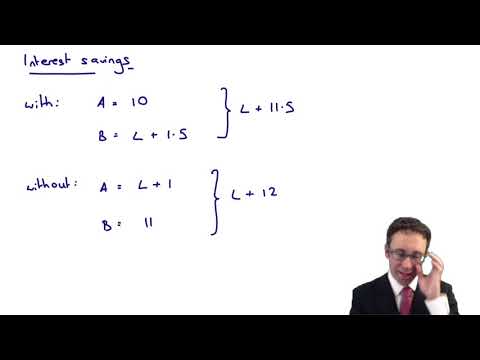
Swaps (2): it works the swap example correctly — a saving of 0.5%, 0.25% each, a fixed leg of 9.25% and the second party at 10.75%.
Wording: both use the retired sterling interbank benchmark as a bare acronym, and Swaps (1) also defines it — skip the definition. That rate no longer exists; these notes say benchmark reference rate, BR, and so should you.

An entity may borrow at a fixed or at a floating rate. The advantage of fixed-rate borrowing is that once the loan is taken out the interest payments are certain and there is no exposure to future movements in interest rates.
An entity may nevertheless prefer to borrow at a floating rate, for either of two reasons:
it expects interest rates to fall, and floating-rate borrowing captures the benefit of the fall — with the obvious risk that it is wrong and rates rise instead;
its own income rises and falls with interest rates, so a floating-rate cost moves with its income and the two partly cancel.
Whichever basis an entity wants, some entities can borrow at better rates than others according to their credit standing — and, crucially, the size of that advantage is not the same in the fixed market as in the floating market. Where it is not, two entities can each borrow in the market where their comparative advantage is greater and then exchange the payments, so that each ends up with the basis it wanted at a lower cost than it could have obtained directly. That arrangement is an interest rate swap.
Method
Find the difference between the two entities' fixed rates, and the difference between their floating rates.
The total saving available is the difference between those two differences. If it is nil there is no swap worth doing.
Each entity borrows in the market where its comparative advantage is greater — which is the market it does not want.
Split the saving as the question directs, and write down each entity's target rate: the rate it could have obtained on its own, less its share of the saving.
Build the swap payments to reach those targets. One leg is normally the benchmark rate itself; solve for the fixed leg.
Interest rate swap (1)
Company X can borrow at a fixed rate of 10% or at a floating rate of BR + 3%.
Company Y can borrow at a fixed rate of 12% or at a floating rate of BR + 6.5%.
Company X wishes to borrow at a fixed rate, and Company Y at a floating rate. Any saving is to be shared equally.
Required
Show how a swap can benefit both companies.
Show answerHide answer
Interest rate swap (2)
Company A and Company B can borrow as follows:
Fixed | Floating | |
Company A | 10% | BR + 1% |
Company B | 11% | BR + 1.5% |
Company A's income fluctuates with interest rates, whereas Company B's does not. They wish to borrow the same amount, and to share any saving equally.
The benchmark reference rate is currently 9%.
Required
Explain how an interest rate swap can benefit each party.
Calculate the interest each company will pay in the first year on a notional principal of $20 million.
Show answerHide answer
Three qualifications the examples leave out.
A swap is normally arranged through a bank, which stands between the two parties and takes part of the saving as its margin — so in practice the two counterparties share rather less than the whole of it, and often do not know each other.
The principal is notional. It is never exchanged in an interest rate swap; only the difference between the two interest amounts changes hands on each payment date.
The swap creates counterparty credit risk. If the other party fails, the original borrowing does not go away — the entity is left paying its own lender without the receipt that was funding it.
9 Convertibles and warrants
This recording predates the 2027 syllabus. Its figures agree with the answer below — a market value of $102.66 and a conversion premium of $12.66; carry three things with you.
Dates and rounding: it dates the example — redemption “in 2019”, “if today is the end of 2016”; below it is simply three years to redemption. It also wavers over rounding; use $110.20, as the answer does.
When the holder converts: it says at one point that the holder can convert at any time. In this example the choice is made on redemption, as it says at the start.
Warrants: its definition leaves out the fixed exercise price. A warrant is a right to subscribe for new shares at a fixed price, and it can be detached and traded separately from the bond.

9.1 Convertibles
Convertibles are bonds that give the investor a choice on redemption: take the cash, or take a pre-determined number of shares in the entity.
The attraction to investors is that the choice is theirs and it is one-sided. They gain if the entity does well and the share price rises, and they do not lose if it does badly, because they can still take the cash — provided the entity is in a position to pay it.
The attraction to the entity is a lower coupon, because investors will accept less interest in exchange for the option. There is a second attraction: if the entity does well and the holders convert, the cash never has to be found at all — the debt turns into equity instead of being repaid. The price of that is dilution of the existing shareholders at a price fixed years earlier.
Three values are worth distinguishing:
Value | What it is |
Conversion value (parity value) | The number of shares on conversion × the current share price. What the conversion right would be worth if it could be exercised today. |
Straight bond value (the floor) | The present value of the interest and the cash redemption amount, discounted at the return investors require on the entity's ordinary bonds. What the instrument would be worth if the conversion right were removed. |
Conversion premium | The market value of the convertible less its conversion value — what investors are paying for the possibility that the share price will be higher at the conversion date than it is now. |
Convertibles
A company has in issue 8% bonds redeemable at par in three years' time. On redemption, the holder of each $100 nominal may instead take 20 ordinary shares in the company.
The share price is currently $4.50 and is expected to grow at 7% a year. Investors require a return of 10% on the company's bonds.
Required
State what the bondholders would choose to do on redemption if the share price at that date were:
$4.00 per share
$6.00 per share
Calculate, per $100 nominal:
the current market value of the bonds
the conversion premium
the value of the conversion right
Show answerHide answer
9.2 Warrants
A warrant is a right given to an investor to subscribe for new shares at a future date at a fixed price.
Warrants are sometimes issued attached to bonds in order to make them more attractive, and so allow the entity to pay a lower coupon. They may be detached and bought or sold separately from the bonds during the exercise period.
The difference from a convertible matters. Exercising a warrant brings new cash into the entity — the subscription price — and the original bond remains outstanding and still has to be repaid. Converting a convertible brings in no cash and extinguishes the bond.
10 Lease versus buy
This recording predates the 2027 syllabus. Its method and figures agree with the answer below — $69,961 to buy against $93,608 to lease; carry two things with you.
Lease types: it treats IAS 17’s finance and operating leases as current. IFRS 16 replaced IAS 17 from 2019, and this decision does not depend on how a lease is classified: compare the present value of each method’s costs, as the list below does. Its sentence on repair costs comes out back to front.
Tax timing: it calls the example too tricky more than once. It is a standard question, and the two tax lags it explains are the ones in the pitfall box below.

The decision whether an investment is worthwhile is made first, on the assumption that the asset will be purchased. Having decided to acquire it, the entity then has a separate question: how to finance it. Leasing is one answer, and it is a financing decision, not an investment decision.
The two are compared by discounting the costs of each method to present value and choosing the cheaper. The discount rate is the entity's after-tax cost of borrowing, because that is the alternative being displaced — the question is not whether the asset earns its keep, but which of two financing packages is cheaper. The revenues the asset generates are identical either way and drop out of the comparison.
Buy — the purchase price, any scrap proceeds, and the tax saved on the tax depreciation (capital allowances) available on the asset.
Lease — the lease rentals and the tax saved on them, plus, where the lessor bears them, the running and maintenance costs the entity avoids.
Get the tax timing right and state the assumption you are using, because the two lags in this calculation are not the same length:
the capital allowance is claimed for the accounting year in which the asset is acquired — and an asset bought on the last day of a year is acquired in the year then ending — so the tax is saved one period later;
a lease rental paid in advance at the start of a year is an expense of that year, which does not end until a year later, so the tax on it is saved two periods after the payment is made.
An examiner will accept a consistent alternative assumption if it is stated. What loses marks is applying one lag to the capital allowances and, silently, a different one to the rentals — or the same lag to both.
Lease versus buy
A company is considering whether to buy a new machine at a cost of $100,000, or alternatively to lease it for $35,000 a year, the lease payments being payable at the start of each year.
Buying it will involve borrowing money at an after-tax interest cost of 7% a year.
If the machine is bought, it will be bought on the last day of the current financial year.
The machine will be needed for four years and, if purchased, will have a scrap value after four years of $10,000.
Corporate income tax is 30%, payable one year after the end of the financial year. Capital allowances are 25% on the reducing balance, with a balancing allowance on disposal.
Required
Advise whether the machine should be bought or leased.
Show answerHide answer
11 Test your knowledge
Two quick checks before you move on: work through the flashcards to fix this chapter’s terms and definitions, then sit the objective questions for exam-style practice. Both mark themselves and explain the answers as you go.
Long-Term Debt Finance
21 questionsAnswer the questions one at a time. Your progress is saved so you can leave and come back.
Open chapter practice