
Entity Valuation – Practical Issues

1 Introduction
Chapter 13 valued securities in theory. This chapter asks why the theory does not work perfectly in practice, and sets out the methods used instead — particularly for the two situations the dividend model handles worst: valuing an unquoted company, and valuing a holding large enough to give control.
It ends with a comparison of every method in the paper, because the syllabus asks you to discuss the strengths and weaknesses of each, and because a valuation question almost always wants more than one basis and a recommendation.
Three recordings cover this chapter.
Practical issues (introduction): roughly a quarter of this short recording is commentary on one 2016 political event, and that commentary carries the whole market-inefficiency argument. It dates the recording more heavily than anything else in the paper. It also dismisses the control-versus-minority question, which is what decides which valuation method applies.
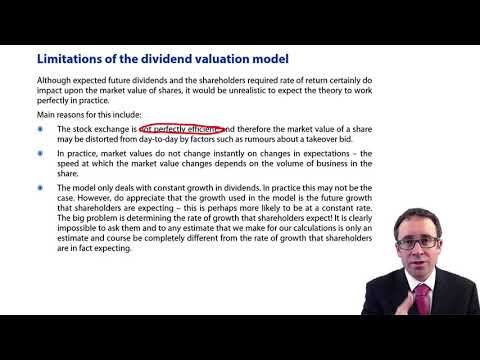
2 Limitations of the dividend valuation model
Expected future dividends and the shareholders' required rate of return certainly do affect the market value of a share. But it would be unrealistic to expect the model to work perfectly.
The stock market is not perfectly efficient. The market value of a share can be pushed away from its theoretical value from day to day by things the model contains nothing about — a rumoured takeover bid, a change of chief executive, general sentiment. Chapter 17 examines how far a market price can be relied upon.
Prices do not adjust instantly. How quickly the price responds to new information depends on how heavily the share is traded. In a thinly traded share the price may be days or weeks out of date, and the last recorded price may be a poor guide to what a buyer would actually pay.
The model requires a constant growth rate, and estimating it is the real difficulty. The growth in the model is the growth shareholders expect, not the growth the company has achieved. It cannot be observed. Whatever estimate is made — from past dividend growth, or from the retention rate multiplied by the return on reinvested funds — it is an estimate of somebody else's expectation, and it may be quite different from what shareholders actually expect.
It needs a dividend. A company that pays no dividend, or pays one erratically, cannot be valued this way. An owner-managed unquoted company often takes profits out as and when it suits the owner, which makes the dividend record meaningless as a basis for valuation.
It values a minority holding. A shareholder who receives only the dividend is valued on the dividend. Someone buying control acquires the right to decide what is done with all of the earnings, and will value the business on those instead.
The cost of equity must itself be estimated, usually through the capital asset pricing model (Chapter 16), which brings its own assumptions with it.
Those limitations are why the methods below exist. All of them are used in practice; none of them is right on its own.
3 Financial accounts based valuations of equity
Two common practical approaches value shares in an unquoted company from its published financial statements: one works from the statement of financial position, and one from the statement of profit or loss.
3.1 Net assets basis
Net assets and intangibles valuations: minor wording only. It says “balance sheet” and “income statement” for the statement of financial position and the statement of profit or loss, and it transposes two figures while the right answer is on screen. It agrees with this chapter’s Answer 4.

The value of the entity is taken to be the value of the net assets shown in its financial statements — total assets less total liabilities, which by the accounting equation is the equity.
The whole difficulty is deciding on what basis to value those net assets.
Basis | What it means | What it tells you |
Book value | The carrying amounts already in the financial statements. | Normally of little relevance. Non-current assets are carried at cost less accumulated depreciation, so a property bought years ago may be worth many times its carrying amount; and every figure is the product of the accounting policies the company happens to have chosen. |
Realisable value | What each asset would fetch if it were sold separately, less what would have to be paid to settle the liabilities. | The minimum value. It is what the owners would receive on a winding up, so it is the floor below which a seller should never accept an offer. It is the right basis only if the business is actually going to be broken up. |
Replacement value | What it would cost to buy equivalent assets today. | The maximum a buyer should pay on an asset basis — because rather than pay more, the buyer could assemble the same collection of assets and start the business from scratch. It ignores whatever the assembled business is worth over and above its parts. |
Two further adjustments are needed whichever basis is used:
Intangibles that are not recognised. Internally generated brands, customer relationships and the workforce itself do not appear in the financial statements, and they may be the most valuable things the business has. See the calculated intangible value at the end of this chapter.
Contingent liabilities that are not recognised. A liability disclosed but not recognised, because it could not be measured reliably, is still a liability a buyer will inherit. Ignoring it means paying more for the business than it is worth.
The net assets basis gives the minimum value of an entity, and it is at its most useful in a capital-intensive business — property, shipping, infrastructure — where most of the value really is in identifiable assets, and in a business that is going to be wound up.
3.2 Earnings basis
Worth watching.
Earnings valuations: the recording says 5.5 is the MAXIMUM the acquirer would want to pay. These notes give both: a maximum of $5.55m and a floor of 6 × $450,000 = $2,700,000.
One notice: it names “P2” for a ratio that belongs to F2.

This approach takes the price earnings ratio of a similar quoted company and applies it to the earnings of the company being valued.
Market value per share = P/E ratio × Earnings per share
Equivalently, and often more convenient, the value of the whole entity is the P/E ratio multiplied by total earnings.
A P/E valuation
The latest financial statements of an unquoted publishing company show earnings per share of 50c. Quoted publishing companies currently have price earnings ratios of 18.
Value per share = 18 × $0.50 = $9.00.
Which earnings, and which P/E?
Earnings means profit after tax — the profit attributable to the ordinary shareholders. It is not profit before tax and it is not operating profit. Questions supply those figures deliberately, and applying a P/E ratio to either of them is a wrong answer, not a rounding difference.
The P/E ratio must come from a genuinely comparable company — same industry, similar size, similar gearing, similar growth prospects. Where the company being valued is unquoted, the comparator's ratio is normally reduced, often substantially, because the shares of an unquoted company cannot be freely sold.
Operating profit, and what it will mean from 2027. For accounting periods beginning on or after 1 January 2027 that figure is defined by IFRS 18. Under IFRS 18, operating is the residual category. Operating profit is the total of that category and is a defined, required subtotal in the statement of profit or loss, rather than a measure each company defines for itself, and it is not interchangeable with the older informal label "profit before interest and tax". That makes it more comparable between companies — but it does not make it the figure a P/E ratio uses. A P/E ratio is a price divided by earnings, and earnings are struck after interest and after tax.
Bootstrapping. Where the predator believes it can improve the target's earnings, it may apply a higher P/E ratio to those earnings than the target's own — commonly its own ratio, or an estimated ratio for the combined business — rather than adjusting the earnings figure itself.
Bootstrapping raises reported earnings per share; it does not by itself create value. A company with a high P/E ratio that acquires one with a low ratio, paying in shares, will mechanically report a higher combined EPS even if nothing about either business has changed. The value is real only if the higher rating is justified — by genuine synergies or better management. If it is not, a market that sees through the arithmetic will re-rate the combined company's P/E downwards and the apparent gain will disappear (Chapter 17).
P/E valuation (1)
Dory has 10 million shares in issue and has made profits after tax of $550,000 for the year, with operating profits of $790,000.
Calculate the value per share using a P/E valuation, assuming an appropriate P/E ratio of 12.
Show answerHide answer
P/E valuation (2)
Nemo has 1 million shares in issue and has recently declared a dividend of $4 million, giving it a dividend cover of 3.
Calculate the value per share using a P/E valuation, assuming an appropriate P/E ratio of 10.
Show answerHide answer
P/E valuation (3)
Woody has a P/E ratio of 8 and earnings of $600,000. Woody is looking to acquire Buzz, which has a P/E ratio of 6 and earnings of $450,000.
The estimated new P/E ratio of the combined entity is 9 and post-tax synergy savings of $100,000 are anticipated.
Calculate how much Woody should pay to acquire the entire share capital of Buzz.
Show answerHide answer
4 The market price of a quoted share
Where the company is quoted, there is already a price. Multiplying it by the number of shares in issue gives the market capitalisation — the market's own valuation of the equity, arrived at by the people actually trading it.
It is the natural starting point, but it is not the answer to "what should we pay?":
It is the price of a small parcel of shares. Acquiring control requires a premium over it, because the target's shareholders will not sell control for the same price at which they would sell a few shares.
It reflects the business as currently run and currently financed, and contains none of the acquirer's intended synergies.
It may already have moved on rumour of the bid, in which case a premium measured against it understates what is really being paid (Chapter 11).
In a thinly traded share it may reflect very little trading, and how much information the price contains at all is the subject of Chapter 17.
5 Intangible asset valuations
The net assets basis ignores intangible assets that the financial statements do not recognise, which in a service or technology business may be most of what is being bought. The calculated intangible value (CIV) puts a figure on them.
The logic is that if a company earns a higher return on its tangible assets than the industry average, the excess cannot be coming from the tangible assets — they are the same assets everybody else has. It must be coming from something not on the statement of financial position: the brand, the customer base, the know-how. Capitalise that excess and you have a value for the intangibles.
The CIV method, step by step
1. Establish the company's pre-tax earnings. (Gross up if you are given earnings after tax: the industry return is a pre-tax return, so the two must be on the same basis.)
2. Calculate what the tangible assets would have earned at the industry return: industry return on assets × tangible assets.
3. The difference is the pre-tax excess return attributable to the intangibles.
4. Convert it to a post-tax excess return.
5. Capitalise it as a perpetuity at the weighted average cost of capital. The result is the calculated intangible value, which is then added to the net tangible assets to value the entity.
CIV
Peppa has the following information which is relevant to be able to calculate the calculated intangible value.
Tangible assets | $1.85m |
WACC | 8% |
Ke | 10% |
Earnings | $0.58m |
Industry return on tangible assets | 12% |
Tax rate | 20% |
Calculate the calculated intangible value of Peppa.
Show answerHide answer
CIV is not the only way to value an intangible, and a discussion question may expect you to name others: valuing it by reference to market transactions in comparable assets, by the royalty that would have to be paid to license it from someone else, or by discounting the cash flows attributable to it directly. Each depends on evidence that is often unavailable, which is why CIV — which needs only the financial statements and an industry average — is the one most commonly taught.
The syllabus notes observe that the valuation of intangibles is of particular importance in a digital economy, and ask how digital assets should be valued. The same three questions apply to any of them: what cash will it generate, what would it cost to replace, and what have comparable assets changed hands for? The difficulty with a novel asset is that the evidence for all three is thin.
6 Strengths and weaknesses of the valuation methods
No method is right on its own. A valuation question expects at least two, and a recommendation that says which you would rely on and why.
Method | Strengths | Weaknesses |
Market price (quoted companies) | Objective, observable and set by people actually trading. Reflects all publicly available information if the market is efficient. | Only available for a quoted company. Prices a minority stake, so a control premium must be added. Contains none of the acquirer's synergies, and may already have moved on the bid. |
Net assets | Simple, and based on figures that have been audited. Gives a defensible minimum value, and is genuinely appropriate for a capital-intensive business or one being wound up. | Ignores the business as a going concern, and ignores unrecognised intangibles. Book values reflect accounting policies rather than worth; realisable and replacement values have to be estimated. |
Dividend valuation model | Theoretically sound — a share is worth what it pays its holder. The right basis for a minority holding. | Needs a stable dividend and a constant growth rate, neither of which may exist. Extremely sensitive to the estimates of g and ke. Useless for a company that pays no dividend, and understates the value of control. |
Earnings basis (P/E) | Quick, widely used and easily understood. Values the business on its earning power rather than its assets, and benchmarks it against real quoted companies. | Requires a genuinely comparable quoted company, which may not exist. Earnings are an accounting figure and can be distorted by policy choices and one-off items. The answer moves proportionately with a P/E ratio that is a matter of judgement. |
Discounted cash flow (free cash flow / FCFE) | Theoretically the strongest method: it values the actual cash the business will generate, and it can be built up year by year to reflect the acquirer's own plans and synergies. | Demands forecasts of cash flows, a growth rate and a discount rate, and the answer is highly sensitive to all three — particularly to the terminal value, which is usually the largest part of it. |
Calculated intangible value | Puts a number on assets no other method captures, using only published information and an industry average. | Assumes the whole of the excess return is attributable to intangibles and that it will continue for ever. Depends on the industry average being a fair comparator and on the return being measured consistently. |
A valuation is a range, not a number. The seller's floor is normally the realisable value of the net assets, or the standalone value of the business if it is worth more as a going concern. The buyer's ceiling is what the business is worth in the buyer's hands, including the synergies. Anything in between is negotiation, and Chapter 15 deals with the terms on which that negotiation is settled.
The dividend valuation model is theoretically right and practically limited: markets are not perfectly efficient, prices do not adjust instantly, growth cannot be observed, and many companies either pay no dividend or are being bought for control rather than for their dividends.
The net assets basis gives a minimum value and is best in a capital-intensive business, but it ignores unrecognised intangibles and contingent liabilities. The earnings basis applies a comparable company's P/E ratio to profit after tax — not to operating profit, and not to profit before tax — and bootstrapping raises reported EPS without, on its own, creating any value. The calculated intangible value capitalises at the WACC whatever return the company earns above the industry return on its tangible assets.
Every method rests on estimates, so use more than one, state your assumptions, and present the answer as a range with a recommendation.
7 Test your knowledge
Two quick checks before you move on: work through the flashcards to fix this chapter’s terms and definitions, then sit the objective questions for exam-style practice. Both mark themselves and explain the answers as you go.
Entity Valuation – Practical Issues
22 questionsAnswer the questions one at a time. Your progress is saved so you can leave and come back.
Open chapter practice