
Entity Valuation – Theoretical Approach

1 Introduction
This chapter sets out what, in theory, determines the market value of a company's equity and of its debt. It is the arithmetic behind most of the valuation questions in the examination.
In practice a good many other things affect what a business changes hands for, and those are the subject of Chapter 14. They matter more for discussion than for computation — but you cannot discuss the limitations of a model you cannot apply.
The syllabus names several methods of valuing equity. They are spread across four chapters, so it is worth knowing where each one lives.
Method | Where it is dealt with |
Dividend valuation — constant dividends and constant growth | This chapter |
Discounted cash flow — free cash flow and free cash flow to equity | This chapter |
Valuation of debt — irredeemable and redeemable | This chapter |
Asset basis, earnings (P/E) basis, and the valuation of intangibles | Chapter 14 |
The cost of equity itself, through the capital asset pricing model | Chapter 16 |
What the market price of a quoted share can be relied on to tell you | Chapter 17 (the efficient market hypothesis) |
2 The valuation of equity – constant dividends
Three of this chapter’s six recordings send you to CIMA F1 for material F1 does not teach. Checked across all nineteen F1 chapters: dividend valuation appears zero times, cost of equity zero times, perpetuity zero times. Everything they point at is taught here.
Equity valuation – no growth: the symbol K in the cum-div formula is never defined. It is the cost of equity. The arithmetic is correct throughout.

The market value of a share is set by the shareholders: it is the price they are prepared to pay for it. In theory that price depends on two things only —
the dividends they expect to receive in the future, and
the rate of return they require for taking the risk of holding the share.
So the value of a share is the present value of the future dividend stream, discounted at the shareholders' required rate of return. Where the dividend is expected to stay the same for ever, that stream is a perpetuity and the valuation collapses to a single division:
P0 (ex div) = D0 ÷ ke
where D~0~ is the dividend just paid (and, since it never changes, every future dividend as well) and k~e~ is the shareholders' required rate of return, or cost of equity.
Valuation of equity (1)
Alpha plc has in issue $1 shares and has just paid a dividend of 20c per share. Dividends are expected to remain constant. Shareholders' required rate of return is 10% p.a.
Calculate the current market value per share.
Show answerHide answer
Valuation of equity (2)
Beta plc has in issue $0.50 shares and has just paid a dividend of 15c per share. Dividends are expected to remain constant. Shareholders' required rate of return is 12%.
Calculate the current market value per share.
Show answerHide answer
The nominal value of the share is irrelevant. Alpha's shares are $1 and Beta's are 50c, and neither figure appears in either calculation. What a share is worth depends on the cash it will pay its holder, not on the number printed on it.
In both of those examples the company had just paid a dividend, so a buyer would have to wait a full year for the first one. (Interim dividends are ignored throughout.) That is an ex-div valuation, and it is the assumption unless you are told otherwise.
Suppose instead the company is about to pay a dividend. A buyer would receive that dividend almost immediately, on top of every future dividend, and so would pay more for the share — more by exactly the amount of the dividend about to be paid. That is a cum-div valuation.
P0 (cum div) = P0 (ex div) + dividend about to be paid
Valuation of equity (3)
Beta plc has in issue $0.50 shares and is about to pay a dividend of 15c per share. Dividends are expected to remain constant. Shareholders' required rate of return is 12%.
Calculate the current cum-div market value per share and the ex-div market value per share.
Show answerHide answer
The dividend valuation model can in principle handle any pattern of future dividends, but you will only be asked to deal with dividends that are constant or that grow at a constant rate.
3 The valuation of equity – constant growth in dividends
Equity valuation – constant growth: the same undefined K, and here it is offered as the thing that distinguishes the two formulas — which makes it worse. It is the cost of equity in both, and what distinguishes them is the growth rate. The arithmetic is correct.

Where dividends are expected to grow at a constant rate, the dividend valuation model gives the following formula. Its proof is not examinable; using it is.
P0 (ex div) = D0(1 + g) ÷ (ke − g)
where:
D~0~ = the dividend just paid — the current dividend, not next year's
k~e~ = the shareholders' required rate of return
g = the expected constant annual rate of growth in dividends
The numerator is D~0~(1 + g), not D~0~. The value of a share today is the present value of the dividends still to come, and the first of those is next year's — which is this year's grown by g. If a question gives you the dividend that is about to be paid or the dividend for next year, that figure is already D1 and must not be grown again.
The cum-div version follows from the same reasoning as before: add back the dividend about to be paid. Writing it out as a single formula gives
P0 (cum div) = D0(1 + g) ÷ (ke − g) + D0 = D0(1 + ke) ÷ (ke − g)
Note that the k~e~ in that numerator is the cost of equity, not the growth rate. You are not given this formula in the examination and you do not need it — adding the dividend to the ex-div value is quicker and harder to get wrong.
Valuation of equity (4)
Gamma plc has just paid a dividend of 30c per share. Dividends are growing at the rate of 4% p.a. The shareholders' required rate of return is 15% p.a.
Calculate the market value per share.
Show answerHide answer
Valuation of equity (5)
Epsilon plc has just paid a dividend of 40c per share. Dividends are growing at the rate of 6% p.a. The shareholders' required rate of return is 20% p.a.
Calculate the market value per share.
Show answerHide answer
In practice dividends do not grow at a constant rate. But remember what the model is actually built on: the market value reflects the dividends shareholders expect, and an expectation is more likely to be held as an average annual rate of growth than as a different figure for every future year. In the examination the growth rate is always constant, so the formula always applies.
The formula breaks down when g is greater than or equal to k~e~. The denominator becomes zero or negative and the answer is meaningless. A business cannot grow faster than its cost of equity for ever, so if a question produces that result, check whether the growth rate is a short-term rate that should not have been treated as perpetual.
4 The valuation of equity – discounted cash flow


Free cash flow and valuation: one cosmetic slip: the tutor says “0.8” and “0.2” where the screen correctly shows 0.08 and 0.02. Everything else is right.

The dividend model values a share on the cash the shareholder receives. That is the right basis for valuing a minority holding, because a minority shareholder gets the dividend and nothing else. Someone buying control, however, is buying the right to decide what the business does with all of its cash — so the valuation should be built on the cash the business generates.
Free cash flow
Free cash flow (FCF) is the cash a business generates that is available to all of its providers of finance — the lenders, as interest, and the shareholders, as dividends.
Free cash flow to equity (FCFE) is what is left of that after the lenders have been paid: the cash available to the shareholders alone.
Free cash flow is built up from profit in the same way that cash generated from operations is built up in a statement of cash flows: start with profit, add back the non-cash charges, and adjust for the cash spent on assets and working capital.
$ | |
Operating profit | X |
Add: depreciation (a non-cash charge) | X |
Less: investment in non-current assets | (X) |
Less: investment in working capital | (X) |
Less: tax | (X) |
Free cash flow | X |
Less: interest paid to lenders | (X) |
Free cash flow to equity | X |
The two simplifying assumptions in that pro-forma
Tax is taken as the tax rate applied to operating profit. You are not expected to prepare a tax computation. Where a question gives you an actual tax charge or tax paid figure, use that instead.
Interest is deducted gross in arriving at free cash flow to equity. A fuller treatment would deduct interest net of the tax relief obtained on it, and would add any new borrowing raised and deduct any debt repaid. Follow the basis the question gives you and state the assumption you have made.
One point of vocabulary, because it changes in 2027. The pro-forma starts from operating profit. From accounting periods beginning on or after 1 January 2027 that figure is defined by IFRS 18. Under IFRS 18, operating is the residual category. Operating profit is the total of that category and is a defined, required subtotal in the statement of profit or loss, rather than a figure each preparer defines for itself. It is not interchangeable with the older informal label "profit before interest and tax" — a figure described that way may include investment income that operating profit excludes. Where a question gives you a starting figure, read what it is actually made up of.
Which discount rate? That depends entirely on whose cash flow you have.
You are given | Discount at | What you get | Then |
Free cash flow — the cash available to lenders and shareholders | the weighted average cost of capital, the return required by lenders and shareholders together | the value of the entity — the total of all the claims on the business | deduct the market value of the debt to arrive at the value of the equity |
Free cash flow to equity — the cash available to shareholders only | the cost of equity, the return required by shareholders alone | the value of the equity, directly | divide by the number of shares if a value per share is wanted |
Do not deduct the debt twice. If you have discounted free cash flow to equity at the cost of equity, the lenders have already been paid inside the cash flow and the answer is the value of the equity. Deducting the value of the debt from it is the single commonest error in this topic — and questions include the debt figures precisely to see whether you will.
Free cash flows
Kappa has recently published its financial statements and extracts reveal the following information:
$000s | |
Investment in working capital | 185 |
Investment in non-current assets | 420 |
Depreciation | 120 |
Operating profit | 935 |
Interest | 170 |
Dividends | 150 |
Kappa's company profits are currently taxed at 20%.
Calculate the free cash flow and the free cash flow to equity of Kappa.
Show answerHide answer
Once the cash flows are established, the same discounting techniques used for dividends give the value. A free cash flow to equity growing at a constant rate for ever is a growing perpetuity, valued exactly like a growing dividend:
Value of equity = FCFE0(1 + g) ÷ (ke − g)
Free cash flow valuation (1)
Sigma has free cash flows to equity of $6.5 million and they are expected to grow at 2% per annum indefinitely. The company has a cost of equity of 8%.
The capital structure is as follows:
$000s | |
Equity ($1 shares) | 5,000 |
Debentures | 1,000 |
The debentures are currently trading at $90 per $100 nominal.
Calculate the value of a Sigma share.
Show answerHide answer
Free cash flow valuation (2)
The financial manager of Omega has prepared the following schedule of forecast free cash flows to equity for the next three years:
Year 1 | Year 2 | Year 3 | |
Free cash flows to equity ($000s) | 340 | 410 | 450 |
The cash flows at year 3 are expected to grow at 2% indefinitely for the foreseeable future.
Calculate the equity value of Omega, assuming that the shareholders' expected return is 8%.
Show answerHide answer
5 The valuation of debt
The most valuable recording in this chapter.
Valuation of debt: it works the answer per $100 to “three six four forty” — $364,840. These notes carry $364,840.
Notice: this is the recording that makes the F1 claim in its most specific form — “you’ve covered the valuation of debt way back in F1”. F1 does not teach it. It is taught here. The year-5 discount factor is stumbled over before it is given correctly as 0.567.
This section is about traded debt — borrowing that is bought and sold on a stock exchange and therefore has a market value. Unless you are told otherwise, debt is traded in units of $100 nominal and is called debentures, loan stock or bonds; the three words mean the same thing.
The interest paid on it is fixed by the coupon rate, which is applied to the nominal value, not to the market value. What changes is the market value: it depends on the return investors currently require.
The basis of valuation
The market value of debt is the present value of the future expected receipts, discounted at the investors' required rate of return.
That is the same principle as for equity. The receipts are the interest, plus the redemption amount if there is one; the discount rate is k~d~, the return investors require — and because we are valuing what the lender receives, everything here is pre-tax. The tax relief the borrower obtains on the interest does not affect the price at which the debt trades.
This is a market valuation, not an accounting one. It is what an investor would pay today for the right to the remaining receipts. It is not the amount at which the borrowing appears in the borrower's own financial statements, which is a financial reporting question dealt with elsewhere in your studies. The two figures answer different questions and there is no reason for them to agree.
5.1 Irredeemable debt
Irredeemable debt is never repaid. The holder simply receives the interest every year for ever — or sells the debt on, in which case the buyer receives it instead. The receipts are therefore a perpetuity:
P0 (ex int) = I ÷ kd
where I is the interest per annum on $100 nominal and k~d~ is the investors' required rate of return.
Valuation of irredeemable debt (1)
P plc has in issue $500,000 10% irredeemable debentures. Investors currently require a return of 8% p.a.
Calculate the market value of the debt.
Show answerHide answer
That answer is an ex-interest market value. As with dividends, a cum-interest value would be the ex-interest value plus any interest about to be received; and, as with dividends, values are assumed to be ex-interest unless you are told otherwise.
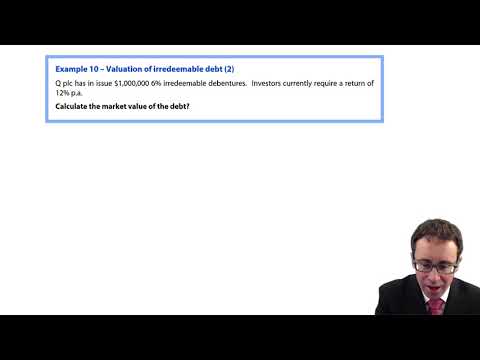
Valuation of irredeemable debt (2)
Q plc has in issue $1,000,000 6% irredeemable debentures. Investors currently require a return of 12% p.a.
Calculate the market value of the debt.
Show answerHide answer
5.2 Redeemable debt
Most debt is redeemable: the company repays the borrowing at a specified date, either at par or at a premium. Redeemable debt is the one place in this chapter where there is no formula. The receipts are the interest for a fixed number of years plus the redemption amount at the end, and they have to be discounted from first principles.
Work per $100 nominal, then scale up at the end. The interest is defined by the coupon rate on $100, the redemption is quoted as a percentage of $100, and the tables give factors that are easiest to apply to small numbers. Convert to the total nominal value in a single final step. Doing it the other way round is where the arithmetic goes wrong.
Valuation of redeemable debt (1)
R plc has in issue $400,000 8% debentures redeemable in 5 years' time at a premium of 10%. Investors require a return of 12% p.a.
Calculate the market value of the debt.
Show answerHide answer
Valuation of redeemable debt (2)
S plc has in issue $1,000,000 7% debentures redeemable in 4 years' time at par. Investors require a return of 10% p.a.
Calculate the market value of the debt.
Show answerHide answer
A share is worth the present value of the dividends it will pay, discounted at the shareholders' required return: D~0~ ÷ k~e~ where dividends are constant, and D~0~(1 + g) ÷ (k~e~ − g) where they grow at a constant rate. A cum-div value is the ex-div value plus the dividend about to be paid; ex-div is assumed unless you are told otherwise.
Where control is being bought, value the cash the business generates instead. Discount free cash flow at the WACC to get the value of the entity and deduct the market value of the debt; or discount free cash flow to equity at the cost of equity to get the value of the equity directly. Do not do both.
Debt is worth the present value of its future receipts at the investors' pre-tax required return: I ÷ k~d~ if it is irredeemable, and a first-principles discounting of interest plus redemption if it is not. Work per $100 nominal and scale up at the end.
6 Test your knowledge
Two quick checks before you move on: work through the flashcards to fix this chapter’s terms and definitions, then sit the objective questions for exam-style practice. Both mark themselves and explain the answers as you go.
Entity Valuation – Theoretical Approach
21 questionsAnswer the questions one at a time. Your progress is saved so you can leave and come back.
Open chapter practice