
Consolidated Statement of Financial Position

1 Why consolidated financial statements exist
When one company buys a controlling shareholding in another, the purchase shows up in the buyer's own statement of financial position as a single asset — Investment in S, carried at what was paid for it. That one line tells the buyer's shareholders almost nothing. It does not say what the subsidiary owns, what it owes, or what it has earned since it was bought. The whole of a group's trade can sit inside it and never be seen.
Consolidated financial statements replace that single line with the things behind it. The parent's own assets and liabilities are added to the subsidiary's, line by line, and the investment is cancelled against what it bought. The result is a set of financial statements for something that has no legal existence at all: P and S remain separate companies, each with its own accounts, its own tax return and its own creditors. What is reported is the substance of the relationship — one pool of resources under one management — rather than its legal form.
Consolidated financial statements are prepared for the shareholders of the parent. That single fact explains most of the mechanics in this chapter: why only the parent's share capital appears; why the parent's retained earnings are taken in full but the subsidiary's only from the date it was acquired; and why the other owners of the subsidiary are shown separately, as non-controlling interests (NCI), rather than being left out.
Parent and subsidiary
A parent is an entity that controls one or more other entities. A subsidiary is an entity that is controlled by another entity.
The relationship is defined by control, not by ownership. That is why control is the first thing this chapter has to pin down.
2 Control — the test that creates a subsidiary
IFRS 10 Consolidated Financial Statements decides whether a subsidiary exists and requires a parent to consolidate it. IFRS 10 defines control through three elements, and an investor controls an investee only when it has all three.
The three elements of control | What it means |
1. Power over the investee | Existing rights that give the investor the current ability to direct the activities that most significantly affect the investee's returns — normally the right to appoint and remove the directors, which comes with a majority of the voting shares. |
2. Exposure, or rights, to variable returns from its involvement with the investee | The investor's return rises and falls with the investee's performance. Dividends, movements in the value of the investment, and fees that vary with performance all count. |
3. The ability to use its power over the investee to affect the amount of those returns | The link between the first two. An investor that can direct an investee but takes no variable return from it — a trustee, say — is acting as an agent for somebody else, not as a controlling party. |
Control is normally achieved by acquiring more than 50% of the voting equity shares, and that is the signpost almost every exam question uses. It is a rule of thumb, not the definition. More than half the votes carries an ordinary resolution; an ordinary resolution appoints the directors; the directors direct the activities. The power element follows from the shareholding, which is why the shorthand works so often.
Because the test is control and not the percentage, control can exist on less than half the shares. A 40% holding may give control where the remaining shares are spread among many small holders who do not act together, so that 40% is enough to carry a vote in practice; or where a contractual arrangement with other shareholders gives the investor the right to direct the activities; or where the investor holds options or convertible instruments that are currently exercisable and would take it past half. The traffic runs the other way too: more than 50% may not give control, if the shares carry no votes, or if the investee is in administration and its activities are being directed by somebody else.
The definition you may have met elsewhere is the old one. Older material defines control as "the power to govern the financial and operating policies of an entity so as to obtain benefit from its activities". That was the IAS 27 definition, and it was superseded when IFRS 10 was issued.
The two wordings point at the same commercial idea, but only the IFRS 10 version has the three elements — and it is the three elements that a question about control below 50%, or about a majority holding that is not control, is testing.
2.1 The standards this chapter applies
Group accounting is a small family of standards, and the syllabus names them, so it is worth being able to say which one does what.
Standard | What it does | Where it is taught |
IFRS 10 Consolidated Financial Statements | Defines control, and requires a parent to present consolidated financial statements in which every subsidiary is consolidated in full. | This chapter |
IFRS 3 Business Combinations | The acquisition method: identify the acquirer, measure the consideration, recognise the identifiable assets and liabilities acquired at fair value, measure the non-controlling interests, and recognise goodwill. | This chapter |
IAS 27 Separate Financial Statements | The parent's own financial statements, in which the subsidiary is carried as an investment rather than consolidated. Named here so that the two sets of statements are not confused. | This chapter |
IAS 28 Investments in Associates and Joint Ventures | The equity method, for an investment carrying significant influence but not control. | The associates chapter |
IFRS 11 Joint Arrangements | Joint operations and joint ventures — arrangements under joint control rather than the sole control IFRS 10 describes. | The related parties chapter, which carries F2's joint-arrangement material |
IFRS 5 Non-current Assets Held for Sale and Discontinued Operations | Presentation where a subsidiary is held for sale, or its results are a discontinued operation. | The group statement of profit or loss and other comprehensive income chapter, in its section Discontinued operations and assets held for sale |
3 The acquisition method
IFRS 3 Business Combinations requires every acquisition of a subsidiary to be accounted for by the acquisition method.
Identify the acquirer — the entity that obtains control. Usually obvious: it is the company that buys the shares.
Determine the acquisition date — the date control passes, which is not necessarily the date the contract was signed or the cash changed hands. Everything in the consolidation is measured at that date, and the subsidiary's results are consolidated only from it.
Recognise and measure the identifiable assets acquired and liabilities assumed, at their fair values at the acquisition date — not at the amounts sitting in the subsidiary's own books. This is what produces the fair value adjustments dealt with later in this chapter.
Recognise and measure goodwill, or, in the rare case where the calculation comes out negative, a gain on a bargain purchase.
Two consequences of control are worth fixing in mind before the first example, because between them they explain the shape of every consolidated statement of financial position in this chapter.
All of the subsidiary's assets and liabilities are consolidated — 100% of them — whatever percentage the parent owns, because the parent controls all of them. The other shareholders' stake is shown once, in equity, as the non-controlling interests.
Only the parent's share capital and share premium appear, because the consolidated statement reports to the parent's shareholders. The subsidiary's share capital never reaches the face of the statement: it is cancelled against the investment inside the goodwill working.
4 Basic consolidation
4.1 The basic steps
Add across 100% of the parent's and 100% of the subsidiary's assets and liabilities, line by line, and cancel the investment in the subsidiary — it has been replaced by the things it bought.
Show the parent's share capital and share premium only.
Consolidated retained earnings are the parent's own retained earnings in full, plus the parent's share of the subsidiary's post-acquisition retained earnings. Pre-acquisition reserves were bought and paid for; they are not the group's earnings.
Do those three things and the statement balances. In a question with no goodwill and no adjustments — which is what the first two examples are — that is the whole method.
Basic consolidation
Peter acquired 100% of the equity share capital of Steven on 31 December 20X4 for $1,000,000.
The financial statements of the two companies at that date were as follows:
Peter $000 | Steven $000 | |
Investment in Steven | 1,000 | – |
Other assets | 1,500 | 1,200 |
Total assets | 2,500 | 1,200 |
Equity share capital | 1,000 | 250 |
Retained earnings | 1,100 | 750 |
2,100 | 1,000 | |
Liabilities | 400 | 200 |
Total equity and liabilities | 2,500 | 1,200 |
Prepare the consolidated statement of financial position for the Peter Group at 31 December 20X4.
Show answerHide answer
Basic consolidation (continued)
Following Peter's acquisition of 100% of Steven's equity share capital on 31 December 20X4, both companies continued to trade. The financial statements of the two companies at the end of the following year, 31 December 20X5, were as follows:
Peter $000 | Steven $000 | |
Investment in Steven | 1,000 | – |
Other assets | 1,900 | 1,450 |
Total assets | 2,900 | 1,450 |
Equity share capital | 1,000 | 250 |
Retained earnings | 1,400 | 900 |
2,400 | 1,150 | |
Liabilities | 500 | 300 |
Total equity and liabilities | 2,900 | 1,450 |
Prepare the consolidated statement of financial position for the Peter Group at 31 December 20X5.
Show answerHide answer
5 Non-controlling interests
A parent does not have to own all of a subsidiary. A holding of 80% carries control just as a holding of 100% does, so the subsidiary is still consolidated in full: every one of its assets and liabilities, at 100%, line by line.
The other 20% of the subsidiary belongs to somebody else. Those owners are the non-controlling interests (NCI), and their stake is shown as a single figure within equity in the consolidated statement of financial position.
The non-controlling interests are equity, not a liability. The group does not owe the non-controlling shareholders anything — they are owners of part of the group's net assets, exactly as the parent's shareholders are. That is what the equity section of a consolidated statement of financial position is for: the top of the statement adds across everything the group controls, and equity answers the question who owns it. The answer is: the parent's shareholders, and the NCI.
5.1 The two ways of measuring the non-controlling interests
IFRS 3 allows the non-controlling interests in a subsidiary to be measured, at the acquisition date, in either of two ways:
at the fair value of the non-controlling shareholders' interest — usually taken from the market value of the subsidiary's shares just before the acquisition; or
at the NCI's proportionate share of the acquiree's identifiable net assets at the acquisition date.
The choice is made acquisition by acquisition. It is not an accounting policy that has to be applied consistently to every subsidiary a group owns: a group may measure the NCI in one subsidiary at fair value and the NCI in another at the proportionate share. In an exam question you will always be told which method applies to the acquisition in front of you — and the two methods give different figures for goodwill, for the NCI, and for the effect of any later impairment.
NCI at fair value | NCI at the proportionate share of net assets | |
What the NCI figure includes at acquisition | The NCI's share of the subsidiary's net assets and the NCI's share of the goodwill | The NCI's share of the subsidiary's net assets only |
The goodwill it produces | Full (or gross) goodwill — the whole of the subsidiary's goodwill, the parent's share and the NCI's | Partial goodwill — the parent's share only |
The NCI figure in the consolidated statement of financial position | Higher | Lower |
Goodwill in the consolidated statement of financial position | Higher | Lower |
A later impairment of that goodwill | Shared between group retained earnings and the NCI, in the ownership ratio | Charged entirely against group retained earnings — the NCI carries no goodwill, so there is no NCI share to reduce |
The last row is the one candidates lose marks on. Under the proportionate method the goodwill on the face of the statement is only the parent's share, so an impairment of it is only the parent's loss: none of it touches the non-controlling interests. Example 10 at the end of this chapter turns on exactly that point.
Non-controlling interests
Pierre acquired 80% of Stefan's equity share capital on 31 December 20X4, when Stefan's retained earnings were $750,000. The financial statements of the two companies at 31 December 20X5 were as follows:
Pierre $000 | Stefan $000 | |
Investment in Stefan | 800 | – |
Other assets | 1,900 | 1,450 |
Total assets | 2,700 | 1,450 |
Equity share capital | 1,000 | 250 |
Retained earnings | 1,200 | 900 |
2,200 | 1,150 | |
Liabilities | 500 | 300 |
Total equity and liabilities | 2,700 | 1,450 |
Prepare the consolidated statement of financial position for the Pierre Group at 31 December 20X5, assuming the non-controlling interests are measured using the proportionate share of net assets method.
Show answerHide answer
6 Goodwill
A parent usually pays more for a subsidiary than the fair value of the identifiable net assets it acquires. The excess is goodwill — what the parent is paying for things the subsidiary cannot recognise as assets in its own accounts:
a loyal customer base;
a reputation, and brand names the subsidiary built itself and so may not recognise;
an assembled and trained workforce;
the expectation that the two businesses together will earn more than the two apart.
Goodwill acquired in a business combination is recognised as a non-current asset in the consolidated statement of financial position. Goodwill a group generated itself is never recognised — internally generated goodwill fails the recognition requirements of IAS 38. This is the one place goodwill gets onto a statement of financial position, and it is why the goodwill working exists.
Goodwill = FV of consideration + NCI at acquisition − FV of identifiable net assets acquired
Both of the first two terms matter. The consideration is what the parent gave; the NCI figure brings in the other shareholders' stake, measured on whichever of the two bases the question specifies. Add them together and you have the value put on the whole of the subsidiary; take off what its identifiable net assets are worth and the remainder is goodwill.
6.1 Goodwill after the acquisition date
Goodwill is never amortised. It is carried at cost less accumulated impairment losses, and it is tested for impairment at least annually, and whenever there is an indication that it may be impaired. An impairment loss on goodwill is charged to profit or loss and, once recognised, is never reversed.
In the consolidated statement of financial position the goodwill line is shown net of the impairment to date, and the loss comes off retained earnings — split with the non-controlling interests only where the NCI was measured at fair value, for the reason given in the comparison table above.
6.2 A bargain purchase
Occasionally the calculation comes out negative: the consideration plus the NCI is less than the fair value of the net assets acquired. IFRS 3 requires the whole calculation to be reviewed first, because a negative figure is far more often a mis-measured asset or an omitted liability than a genuine bargain. If it survives that review, the excess is recognised immediately as a gain in profit or loss — not as negative goodwill on the statement of financial position, and not as a deferred credit released over time.
Goodwill
A parent company buys 75% of the equity shares in a subsidiary company for $156,000.
The remaining shares were valued at $56,000, and the fair value of the subsidiary's identifiable net assets at acquisition was $170,000.
Calculate the goodwill arising on acquisition, assuming that:
(i) the non-controlling interests are measured using the proportionate share of net assets method; and
(ii) the non-controlling interests are measured using the fair value method.
Show answerHide answer
Group SFP – standard workings and adjustments: where the recording says not to worry about share-for-share exchanges, they are examinable; “Consideration” teaches them, with deferred and contingent consideration. Control is IFRS 10’s three elements, and more than 50% of the voting shares is only the usual sign of it (“Control — the test that creates a subsidiary”). Its opening points to changes in group structure, which the 2027 syllabus does not examine.

7 The five standard workings
Everything in this chapter is done with the same five workings, in the same order, every time. Learning them as a method is worth more than learning any individual answer, because the objective-test questions ask for one figure out of the five and expect you to reach it without preparing the whole statement.
Working | What it produces | Why it exists |
W1 Group structure | Who owns what, and from when | It fixes the three facts every other working needs: the parent's percentage, the NCI percentage, and the acquisition date. |
W2 Net assets of the subsidiary | The subsidiary's net assets at acquisition, at the reporting date, and the movement between them | The acquisition column feeds goodwill; the movement column feeds both the NCI and group retained earnings. Every adjustment made to the subsidiary lands here. |
W3 Goodwill | Goodwill at acquisition, less impairment to date | It is the extra asset that appears in the consolidated statement of financial position. |
W4 Non-controlling interests | The single NCI figure in equity | It shows what the other shareholders own — their stake at acquisition, plus their share of what the subsidiary has earned since. |
W5 Group retained earnings | The consolidated retained earnings figure | It shows what the parent's shareholders own — all of the parent's reserves, plus their share of the subsidiary's post-acquisition reserves. |
7.1 W1 — Group structure
You do not have to draw a group structure for a one-subsidiary question, but write down the three things it would have told you: the parent's holding, the NCI percentage, and the acquisition date. Getting the NCI percentage wrong here makes W3 and W4 wrong together, which is the quickest way to lose two marks with one slip.
7.2 W2 — Net assets of the subsidiary
At the reporting date | At acquisition | Post-acquisition | |
Share capital | X | X | |
Share premium | X | X | |
Retained earnings | X | X | |
Fair value adjustments | X | X | |
Extra depreciation on the fair value adjustment | (X) | — | |
Unrealised profit, where the subsidiary is the seller | (X) | — | |
X | X | X |
Two rules make this working work. Share capital and share premium do not change between the two columns, unless the subsidiary has issued shares since the acquisition, so the same figures go in both. And only two numbers leave this working: the total at acquisition, which goes into W3, and the post-acquisition movement, which goes into W4 and W5.
7.3 W3 — Goodwill
Goodwill | $ |
Fair value of consideration | X |
Non-controlling interests at acquisition (fair value, or NCI% × net assets at acquisition (W2)) | X |
X | |
Fair value of identifiable net assets at acquisition (W2) | (X) |
Goodwill at acquisition | X |
Impairment to date | (X) |
Goodwill in the consolidated statement of financial position | X |
7.4 W4 — Non-controlling interests
Non-controlling interests | $ |
NCI at acquisition (W3) | X |
NCI% × the subsidiary's post-acquisition movement (W2) | X |
NCI% × the goodwill impairment — fair value method only | (X) |
Non-controlling interests in the consolidated statement of financial position | X |
7.5 W5 — Group retained earnings
Group retained earnings | $ |
100% of the parent's retained earnings | X |
Parent's % × the subsidiary's post-acquisition movement (W2) | X |
Unrealised profit, where the parent is the seller | (X) |
Goodwill impairment — the group's share | (X) |
Group retained earnings | X |
7.6 Other reserves
Every other reserve is treated exactly like retained earnings: the parent's in full, plus the parent's share of the subsidiary's post-acquisition movement in that reserve. There is one working per reserve, and they all have the same shape.
Group revaluation reserve | $ |
100% of the parent's revaluation reserve | X |
Parent's % × the subsidiary's post-acquisition revaluation reserve | X |
X |
The standard workings
Matthews purchased 80% of Jones for $600,000 two years ago, when Jones's retained earnings showed a balance of $100,000.
Matthews $000 | Jones $000 | |
Non-current assets | 1,000 | 500 |
Investment in Jones | 600 | – |
Current assets | 800 | 600 |
Total assets | 2,400 | 1,100 |
Equity share capital ($1) | 500 | 200 |
Retained earnings | 800 | 400 |
1,300 | 600 | |
Liabilities | 1,100 | 500 |
Total equity and liabilities | 2,400 | 1,100 |
Additional information:
Matthews measures the non-controlling interests using the fair value method.
The fair value of the non-controlling interests in Jones at the acquisition date was $200,000.
Prepare the consolidated statement of financial position for the Matthews Group at 31 December 20X5.
Show answerHide answer
Fair value adjustments: the recording reads the question as a guess for about two minutes and never checks its answer; these notes word the requirement differently. It does work Example 9.
This recording predates IFRS 18 Presentation and Disclosure in Financial Statements, which replaces IAS 1 for accounting periods beginning on or after 1 January 2027. Where the recording’s statement of profit or loss differs from this chapter’s, the chapter governs.
8 Fair value adjustments at acquisition
Step 3 of the acquisition method requires the subsidiary's identifiable assets and liabilities to be brought into the consolidation at their fair values at the acquisition date, not at the carrying amounts in the subsidiary's own books. The subsidiary does not change its own accounts; the adjustment is made in the consolidation, in W2.
The mechanics are always the same, and there are three of them.
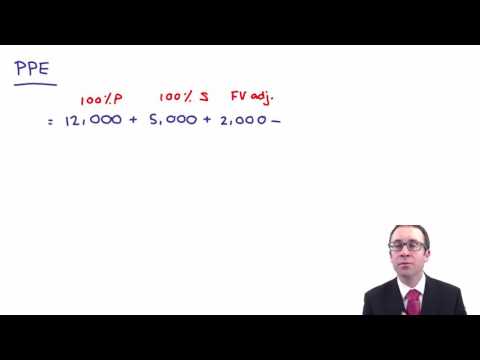
Put the uplift — fair value less carrying amount at the acquisition date — into both columns of W2: at acquisition, and at the reporting date. It is the same figure in both, unless the question tells you the asset has since been sold or revalued again.
Where the asset is depreciable, charge the extra depreciation on the uplift for the post-acquisition period, and put it in the reporting-date column only. The subsidiary has been depreciating the carrying amount in its own books; nobody has been depreciating the uplift.
Show the same two figures on the face of the consolidated statement of financial position. Property, plant and equipment is 100% of P, plus 100% of S, plus the uplift, less the extra depreciation.
The extra depreciation is the half that gets forgotten, and it costs marks twice over: once in the goodwill working, where W2's reporting-date column is too high, and once on the face of the statement, where property, plant and equipment is too high by the same amount.
A fair value adjustment that is remembered in the goodwill calculation and forgotten on the face of the statement is only half an answer. It changes two numbers, not one.
Property, plant and equipment is much the most common fair value adjustment. Two others are worth recognising when they appear:
Inventory — the fair value is usually lower than the carrying amount, so the adjustment reduces net assets and goes in brackets.
Contingent liabilities — the subsidiary does not recognise a contingent liability in its own accounts, but IFRS 3 requires one assumed in a business combination to be recognised at its fair value where it is a present obligation arising from a past event and that fair value can be measured reliably, even though an outflow is not probable. It is a liability, so it reduces net assets in both columns.
9 Mid-year acquisition
Where a subsidiary is acquired part-way through a year, the question is what its retained earnings were on the acquisition date — the figure W2's acquisition column needs. Unless told otherwise, assume the subsidiary's profit for the year accrued evenly, and work backwards or forwards from a figure you are given.
Note what does not change. The subsidiary's assets and liabilities still go in at 100%: a statement of financial position is a snapshot at a date, and at the reporting date the group controls all of them however recently they were acquired. What the acquisition date changes is the split between pre-acquisition and post-acquisition reserves.
Mid-year acquisition
Richard acquired 80% of Andy's equity share capital on 1 August 20X5. Both companies have a year end of 31 December 20X5.
Andy's retained earnings at the end of the year were $600,000 and its profit for the year was $120,000.
Andy was acquired five months before the year end, so five twelfths of the year's profit was earned after the acquisition and the other seven twelfths before it. Assuming the profit accrued evenly, retained earnings at 1 August 20X5 were:
$600,000 − (5/12 × $120,000) = $600,000 − $50,000 = $550,000
So $550,000 goes into W2's acquisition column, and the post-acquisition movement for the year is the $50,000 Andy earned while Richard owned it.
10 Intra-group adjustments
Consolidation treats the parent and its subsidiaries as one entity. An entity cannot owe money to itself, sell goods to itself, or make a profit out of itself, so anything that happened between group companies has to be taken back out.
10.1 Intra-group balances
Where the parent and the subsidiary trade with each other, the receivable in one company's accounts and the payable in the other's are the same debt seen from two sides. Both are removed:
Dr | Payables | X |
Cr | Receivables | X |
Neither the group's net assets nor its profit changes — the two sides are equal and cancel — but leaving them in would overstate receivables and payables alike, and distort every liquidity ratio computed from the statement.
10.2 Cash in transit
The two intra-group balances should be equal. Where they are not, something is in transit at the year end: most often a payment sent by one company and not yet received, and so not yet recorded, by the other.
The fix has two steps, and they must be done in this order: record the item in the receiving company's books first, so that the two balances agree, and only then cancel them against each other. It helps to forget the phrase "cash in transit" altogether and treat it as an ordinary receipt from a credit customer.
Cash in transit
P has an intra-group trade receivable of $1,500 at the year end, due from S. This does not agree with the corresponding $1,000 trade payable in S's books, because S sent a cheque for $500 immediately before the year end which P did not receive until after the start of the new accounting year.
1. Record the cash in transit in the group accounts
Dr | Bank | $500 |
Cr | Receivables | $500 |
2. Eliminate the now-equal intra-group balances
Dr | Payables | $1,000 |
Cr | Receivables | $1,000 |
P's receivable of $1,500 has been reduced to $1,000 and then cancelled against S's payable of $1,000; the group's bank balance is $500 higher. The consolidated statement of financial position shows the cash, which really does belong to the group, and neither of the intra-group balances, which do not exist outside it.
10.3 Goods in transit
The same thing happens with goods. Where one group company has despatched goods before the year end and the other has not yet recorded their receipt, record the purchase in the receiving company's books — Dr Inventory, Cr Payables — so that the two intra-group balances agree, and then cancel them as usual.
Goods in transit have not been sold outside the group, so any profit the selling company took on them is unrealised, and is eliminated in the ordinary way described next.
Unrealised profit: the goodwill figure is never computed and there is no check back to the statement; “post-acquisition profits” is phrased loosely. It does work Example 10.
10.4 Unrealised profit
When one group company sells goods to another at a profit and the buyer still holds them at the year end, the group's inventory is carried at more than those goods cost the group. Nothing has been sold to anyone outside the group, so no profit has been realised. The provision for unrealised profit — the PUP — takes it back out:
Dr | The retained earnings of the company that made the profit | X |
Cr | Inventory (consolidated statement of financial position) | X |
The seller test
Which working is adjusted depends on one thing only: who sold the goods.
The subsidiary sold → the profit is in the subsidiary's retained earnings, so the adjustment goes in W2, in the reporting-date column. The non-controlling interests then bear their share of it automatically, because W2 feeds W4.
The parent sold → the profit is in the parent's retained earnings, so the adjustment goes in W5. The non-controlling interests bear none of it.
Working out how much profit is in the goods is the other half of the job, and it turns on how the question states the profit.
The question says | Profit as a fraction of the selling price | On $120,000 of goods |
a mark-up of 20% on cost | 20/120 | $20,000 |
a mark-up of 25% on cost | 25/125 | $24,000 |
a margin of 20% on selling price | 20/100 | $24,000 |
Then multiply by the proportion of the goods still held at the year end. A mark-up is a percentage of cost; a margin is a percentage of selling price. Reading one as the other is the commonest arithmetic error in this chapter, and the figures above show why it matters: the same 20% gives $20,000 or $24,000 depending on which it is.
Unrealised profit
P sells goods that cost $100 to S for $125, and S has not sold them on by the end of the year.
The profit of $25 is entirely unrealised: the goods are still inside the group. The group's inventory must come down to what the goods cost the group, $100, and the $25 must come off the retained earnings of the company that recognised it.
P is the seller, so the adjustment is made in W5:
Dr | Group retained earnings (W5) | $25 |
Cr | Consolidated inventory | $25 |
Had S been the seller, the same $25 would have gone into W2's reporting-date column instead, and the non-controlling interests would have borne their share of it.
Unrealised profit
Statements of financial position as at 31 December 20X5:
James $000 | Molly $000 | |
Property, plant and equipment | 900 | 500 |
Investment in Molly | 800 | – |
Current assets | 700 | 600 |
2,400 | 1,100 | |
Share capital | 500 | 200 |
Retained earnings | 800 | 400 |
Current liabilities | 1,100 | 500 |
2,400 | 1,100 |
Additional information:
James bought 80% of the equity shares in Molly for $800,000 when Molly's retained earnings were $150,000.
The non-controlling interests are measured using the fair value method. The fair value of the non-controlling interests in Molly at the acquisition date was $200,000.
During the year Molly sold goods to James for $120,000, at a mark-up of 20%. Half of those goods remain in James's inventory at the year end.
Prepare the consolidated statement of financial position for the James Group as at 31 December 20X5.
Show answerHide answer
11 Consideration
The fair value of consideration at the top of W3 is the fair value, at the acquisition date, of everything the parent gave in order to obtain control. It is not always cash, and the alternatives each have their own measurement rule.
cash paid at the acquisition date;
a share-for-share exchange;
deferred cash consideration;
contingent consideration.
Cash paid at the acquisition date is the easy case: it goes into W3 at the amount paid, with nothing to value and nothing to discount. The other three are the ones questions are set on.
11.1 Share exchange
Instead of paying cash, the parent issues some of its own shares to the subsidiary's shareholders. Four steps, in order:
Calculate the number of subsidiary shares acquired — the parent's percentage × the subsidiary's total shares in issue.
Calculate the number of parent shares issued, from the exchange ratio the question gives.
Value them at the parent's share price at the acquisition date. The consideration is the fair value of what the parent has given, not the nominal value of the shares it issued.
Record the share issue: Dr Investment at the fair value; Cr Share capital with the nominal value of the shares issued; Cr Share premium with the balance.
Value the shares issued at fair value, not at nominal value. Using nominal value understates the consideration and therefore understates goodwill — and it is the single most common error in a share-exchange question.
Note also where the credits land. A share exchange increases the parent's own share capital and share premium, and it is the parent's share capital and share premium that appear in the consolidated statement of financial position, in full.
Share exchange
Harry acquired 80% of the 10 million ordinary $1 shares of Sally by offering a share exchange of one Harry share for every four Sally shares acquired. Harry's shares have a nominal value of $1 and a fair value of $3 per share.
Calculate the cost of the investment for the acquisition, and prepare the journal entry to record the share issue.
Show answerHide answer
11.2 Deferred consideration
A parent may agree to pay cash at a later date. Paying $1 in a year's time is not the same as paying $1 today, so deferred consideration is included in W3 at its present value at the acquisition date, discounted at the rate the question gives.
The liability is then unwound over the period to payment: each year it is increased towards the amount that will actually be paid, and the increase is charged as a finance cost.
Dr | Finance cost | X |
Cr | Deferred consideration liability | X |
The unwinding does not change goodwill. Goodwill is fixed at the acquisition date using the present value at that date. The unwinding is a post-acquisition financing expense of the group, not part of what was paid for the subsidiary.
Deferred consideration
Pony acquired 80% of the 30 million $1 equity shares of Star on 1 January 20X5. The consideration was a share exchange of two Pony shares issued for every three Star shares acquired, together with a cash payment of $1 per share acquired, payable on 31 December 20X5.
The fair value of Pony's equity shares was $2 at 1 January 20X5.
The present value of $1 receivable in one year's time is $0.91 at a rate of 10%.
Calculate the cost of the investment in Star at 1 January 20X5.
Show answerHide answer
11.3 Contingent consideration
The parent may promise to pay more if the subsidiary hits a target — an earn-out. That promise is contingent consideration, and IFRS 3 requires it to be included in the consideration at its fair value at the acquisition date: an estimate of what is likely to be payable, discounted where the timing makes the difference material.
It goes in even though it may never be paid. It is part of the price agreed for control, and a buyer who promises an earn-out has given something up for the subsidiary just as surely as one who pays cash.
What happens to it afterwards depends on how it is classified:
contingent consideration that is a financial liability is remeasured to fair value at each reporting date, and the movement goes to profit or loss;
contingent consideration to be settled by delivering a fixed number of the parent's own equity shares is classified as equity and is not remeasured at all.
Goodwill is not restated when the estimate changes. A revision to the expected payout after the acquisition date is a post-acquisition event: it goes through profit or loss (or nowhere, if the consideration is equity-classified), and goodwill stays exactly where it was.
The one exception is a measurement-period adjustment — new information obtained within twelve months of the acquisition about facts and circumstances that existed at the acquisition date. That does change goodwill, because it corrects the acquisition-date measurement rather than reflecting something that happened later.
So there are two ways to get contingent consideration wrong, and they pull in opposite directions: leaving it out of goodwill because it "might not be paid", and going back to restate goodwill every time the estimate moves. Neither is right.
12 Exam questions
The two examples that close this chapter are in the objective-test format the exam uses: three separate figures, each of which could be asked on its own. Work each one from the workings rather than by preparing the whole statement — that is the skill being tested.
Fair value adjustments
Statements of financial position at 31 December 20X5:
AB $ | XY $ | |
Non-current assets | ||
Property, plant and equipment | 12,000 | 5,000 |
Investment in XY | 5,000 | – |
Current assets | ||
Inventory | 7,000 | 3,500 |
Receivables | 6,000 | 2,000 |
Bank | 4,500 | 500 |
34,500 | 11,000 | |
Equity shares ($1) | 15,000 | 3,000 |
Reserves | 14,000 | 6,500 |
Current liabilities | 5,500 | 1,500 |
34,500 | 11,000 |
AB purchased 75% of XY two years ago, when the reserves of XY were $500.
At the date of acquisition, XY's property, plant and equipment had a carrying value of $1,500 and a fair value of $3,500, and a remaining useful life of four years.
The group policy is to measure the non-controlling interests at fair value at the acquisition date. The fair value of the non-controlling interests in XY at acquisition was $2,600.
An impairment review performed on 31 December 20X5 indicated that the goodwill on the acquisition of XY had been impaired by 20% of its value.
Property, plant and equipment will be included in the consolidated statement of financial position of the AB group at 31 December 20X5 at a value of:
$_________
The goodwill recorded in non-current assets of the AB group at 31 December 20X5 is:
$_________
The amount in respect of XY that will be included in the consolidated retained earnings of the AB group at 31 December 20X5, after the goodwill impairment, is:
$_________
Show answerHide answer
Unrealised profit
Statements of financial position as at 31 December 20X5:
CD $000 | PQ $000 | |
Non-current assets | ||
Property, plant and equipment | 11,000 | 6,000 |
Investments | 6,000 | – |
Current assets | ||
Inventory | 5,000 | 1,500 |
Receivables | 4,500 | 5,500 |
Bank | 1,500 | 2,000 |
28,000 | 15,000 | |
Equity shares ($1) | 11,000 | 5,000 |
Reserves | 13,000 | 7,000 |
Current liabilities | 4,000 | 3,000 |
28,000 | 15,000 |
CD acquired 60% of the shares in PQ for $5m four years ago, when PQ's retained earnings were $1.5m. It is group policy to value the non-controlling interests at acquisition using the proportionate share of net assets method. CD's investments include the investment in PQ.
CD owed PQ $1m in respect of group trading during the year. This balance is reflected in both companies' statements of financial position.
During the year PQ sold $1m of goods to CD at a mark-up of 25% on cost. Half of these goods had been sold on by CD by the year end.
Goodwill on acquisition has been impaired by $0.5m since the acquisition date.
Inventory will be included in the consolidated statement of financial position of the CD group at 31 December 20X5 at a value of:
$_________
Receivables will be included in the consolidated statement of financial position of the CD group at 31 December 20X5 at a value of:
$_________
Non-controlling interests in the consolidated statement of financial position of the CD group at 31 December 20X5 will be included at a value of:
$_________
Show answerHide answer
Watch the units when you type an answer into an objective-test box. The figures in Example 10 are $000 and the requirement asks for a value in $: consolidated inventory is $6,400,000, not 6,400. Example 9's figures are already in $, so no conversion is needed there — check which you are looking at before you type.
13 Where this appears under IFRS 18
IFRS 18 Presentation and Disclosure in Financial Statements replaces IAS 1 Presentation of Financial Statements for accounting periods beginning on or after 1 January 2027. For this chapter its effect is easy to state: nothing changes.
IFRS 18 and this chapter
IFRS 18 restructured the statement of profit or loss from 2027, but it did not change the statement of financial position, and it did not change any recognition or measurement rule. Everything in this chapter is presented in 2027 exactly as it is now. IFRS 18 is taught in the chapter IFRS 18 – Presentation and Disclosure in Financial Statements.
Goodwill, the non-controlling interests at fair value or at the proportionate share of net assets, fair value adjustments, unrealised profit eliminations and the equity-method carrying amount are all measured exactly as before. Not one number in this chapter moves because of IFRS 18.
A parent consolidates every entity it controls. IFRS 10 defines control by three elements — power over the investee, exposure to variable returns, and the ability to use the power to affect those returns — and all three must be present; more than 50% of the voting shares is the usual signpost, not the test, so control can exist below half and a majority holding is not always control. IFRS 3's acquisition method then brings the subsidiary in: its identifiable assets and liabilities measured at fair value at the acquisition date, and 100% of them consolidated line by line whatever percentage the parent owns, with only the parent's share capital on the face and the other owners shown once, inside equity, as the non-controlling interests (NCI).
The NCI is measured, acquisition by acquisition, either at fair value — which produces full goodwill and makes any later impairment a shared loss — or at its proportionate share of net assets, which produces partial goodwill and leaves the whole impairment with the group. Goodwill is consideration plus NCI at acquisition less the fair value of the identifiable net assets acquired; it is never amortised, is tested for impairment at least annually, and is not restated for anything that happens after the acquisition date — a measurement-period adjustment inside twelve months being the one exception.
Five workings do all the work: W1 group structure, W2 the subsidiary's net assets at acquisition, at the reporting date and the movement between, W3 goodwill, W4 the NCI, W5 group retained earnings. Fair value adjustments go into both columns of W2 and carry extra depreciation in the reporting-date column and on the face of the statement. Intra-group balances are cancelled — after recording anything in transit — and unrealised profit on goods still held inside the group is removed from inventory and from the retained earnings of whoever sold them: W2 if the subsidiary sold, W5 if the parent did. Consideration is measured at its acquisition-date fair value however it is paid: shares at the parent's share price, deferred cash at present value with the unwinding charged as a finance cost, and contingent consideration at fair value — none of which is ever revisited in goodwill. IFRS 18 changes nothing in this chapter.
14 Test your knowledge
Consolidated Statement of Financial Position
22 questionsAnswer the questions one at a time. Your progress is saved so you can leave and come back.
Open chapter practice