
IAS 16 Property, Plant and Equipment

IAS 16 Property, Plant and Equipment is one of the three standards BA3 expects you to know in some detail. It sets the rules for tangible non-current assets: when to recognise one, what its cost includes, how to treat spending on it later, how to depreciate it, how to revalue it (up or down), what to do when it is impaired, how to remove it when it is sold, and what to disclose. Chapter 5 did the bookkeeping; this chapter adds the rules behind it.
1 The main points of IAS 16
The lecture for this chapter is short and covers the summary in this section and the disclosure list in section 9. Sections 2 to 8 go further, to cover everything the BA3 syllabus asks about IAS 16 — cost, later spending, a fall in value on revaluation, impairment and disposal — so read them here. The tutor uses an older name for the carrying amount.
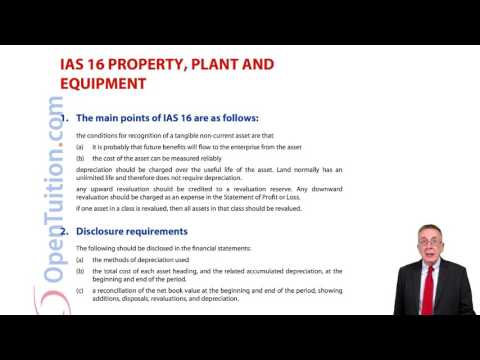
The main points of IAS 16 are as follows:
the conditions for recognition of a tangible non-current asset are that
it is probable that future economic benefits will flow to the entity from the asset
the cost of the asset can be measured reliably
depreciation should be charged over the useful life of the asset. Land normally has an unlimited life and therefore does not require depreciation.
any upward revaluation should be credited to a revaluation surplus (revaluation reserve), through other comprehensive income. Any downward revaluation should be charged as an expense in the Statement of Profit or Loss — except that, where the same asset has an earlier revaluation surplus, the decrease is first set against that surplus.
if one asset in a class is revalued, then all assets in that class should be revalued.
Property, plant and equipment means tangible items that are held for use in producing or supplying goods or services, for renting to others, or for administrative purposes, and that are expected to be used during more than one period — land, buildings, machinery, vehicles, furniture, computers and so on.
2 Recognition
An item is recognised (recorded as an asset) only when both conditions in section 1 are met: it is probable that future economic benefits will flow to the entity, and its cost can be measured reliably. A machine bought and used in the business meets both. Spending that will not bring future benefits beyond the current period — a repair, say — does not, and is an expense.
3 Measurement at recognition: cost
An item of property, plant and equipment is first recorded at its cost. Cost is everything spent to bring the asset to the location and condition needed for it to work as intended:
Included in cost (capitalised) | Not included (expensed) |
Purchase price, after deducting trade discounts and rebates | Staff training on how to use the asset |
Import duties and non-refundable purchase taxes | Administration and general overheads |
Site preparation | Maintenance or service contracts, and repairs once in use |
Initial delivery and handling | Insurance and other running costs after the asset is ready |
Installation and assembly | Costs of opening a new facility, advertising and promotion |
Testing that the asset works properly | Sales tax that the business can recover (Chapter 12) |
Professional fees (for example an architect or engineer) |
The test for each cost is the one from Chapter 5: was it needed to get the asset working? If so it is capital expenditure and part of the cost; if it is a cost of running or using the asset it is revenue expenditure.
Ama Boateng runs a printing business. She buys a new printing press. The supplier’s invoice and her other costs are:
Item | $ |
List price of the press | 64,000 |
Trade discount allowed by the supplier | 5% of list price |
Delivery to her works | 1,200 |
Preparing the floor where the press stands | 1,800 |
Installation | 2,500 |
Test runs before the press was used | 900 |
Training her staff to operate the press | 1,100 |
Insurance of the press for its first year | 700 |
Two-year service contract | 2,400 |
At what cost should the press be recorded under IAS 16?
Show answerHide answer
4 Subsequent expenditure
Spending on an asset after it has been brought into use is treated by the same recognition test:
Day-to-day servicing, repairs and maintenance keep the asset working as it already did. They are revenue expenditure — an expense in the statement of profit or loss.
Improvements, extensions and the replacement of major parts (a new roof, an extension to a building, a new engine that lengthens a vehicle’s life) bring future economic benefits. They are capital expenditure, added to the cost of the asset and depreciated. Where a major part is replaced, the carrying amount of the old part is removed.
A delivery company incurs the following costs on its buildings and vehicles during the year:
Building a new loading bay on to the side of its warehouse, $45,000
Repainting the warehouse, $6,000
Fitting a larger engine to a lorry, which will add three years to its working life, $9,500
The lorry’s annual service and new tyres, $1,300
State whether each cost is capital or revenue expenditure.
Show answerHide answer
5 Depreciation
Depreciation is charged over the useful life of every item of property, plant and equipment except land (Chapter 5 covers the methods and the entries). IAS 16 adds:
Depreciation starts when the asset is available for use, and the charge goes to the statement of profit or loss.
Land and buildings are separate assets, even when bought together. The land normally has an unlimited life and is not depreciated; the building has a limited life and is.
The depreciation method, the useful life and the residual value are accounting estimates. They are reviewed at least at each year end, and if they change the new estimate is used from then on — past years are not restated.
For example, a machine costing $40,000 (no residual value) has been depreciated straight line over 10 years for 4 years, so its carrying amount is $24,000. If its remaining life is now reassessed as 3 years, the charge from this year is $24,000 ÷ 3 = $8,000 a year.
6 Revaluation
After recognition a business chooses, for each class of property, plant and equipment, either the cost model (cost less accumulated depreciation and impairment) or the revaluation model (fair value at the date of revaluation less later depreciation and impairment). Under the revaluation model:
If one asset in a class is revalued, the whole class must be revalued, and revaluations must be regular enough that the carrying amount stays close to fair value.
An increase in carrying amount is recognised in other comprehensive income and accumulated in equity as a revaluation surplus (as in the revaluation example in Chapter 5). If it reverses an earlier decrease on the same asset that was charged to profit or loss, that part is credited to profit or loss.
A decrease is charged to profit or loss — except that, to the extent of any revaluation surplus already held for that same asset, it is first debited to the surplus (through other comprehensive income).
Depreciation after a revaluation is based on the revalued amount and the remaining useful life, and the excess over depreciation on cost may be transferred each year from the revaluation surplus to retained earnings (Chapter 5).
Rahul Traders uses the revaluation model for its buildings. Two years ago it revalued its warehouse upwards and credited a revaluation surplus of $30,000 for this warehouse. At 31 December the warehouse has a carrying amount of $280,000, and it is now revalued to $230,000.
How much of the decrease is charged to the statement of profit or loss, and how much is taken to the revaluation surplus?
Show answerHide answer
7 Impairment
An asset is impaired when its carrying amount is more than the amount the business can recover from it. Signs that an asset may be impaired include physical damage, the asset becoming obsolete or idle, or a sharp fall in its market value. IAS 16 requires the asset to be written down; the detailed rules for measuring the recoverable amount are in another standard, IAS 36, which goes beyond what BA3 asks you to calculate. What you need is:
Recoverable amount is the higher of the asset’s fair value less costs of disposal (what it could be sold for, less the costs of selling it) and its value in use (the present value of the cash it will bring in if the business keeps using it). In a question both figures will be given.
Impairment loss = carrying amount – recoverable amount (only if the carrying amount is higher).
The entry for an asset held at cost: Dr Impairment loss (an expense in the statement of profit or loss), Cr Accumulated depreciation and impairment. For a revalued asset the loss is treated like a revaluation decrease: first against any revaluation surplus for that asset, then to profit or loss.
Afterwards depreciation is based on the new, lower carrying amount over the remaining useful life.
Chipo Ltd has a machine that cost $100,000 and has accumulated depreciation of $40,000. It is depreciated straight line with no residual value, and has 3 years of its useful life left. After a fall in demand for its product the machine is reviewed: it could be sold for $44,000 with selling costs of $2,000, and its value in use is $45,000.
(a) Calculate the impairment loss.
(b) Give the journal entry.
(c) Calculate the depreciation charge for each of the remaining 3 years.
Show answerHide answer
8 Derecognition
An asset is removed from the statement of financial position (derecognised) when it is sold or scrapped, or when no future economic benefits are expected from it. The gain or loss is the net disposal proceeds less the carrying amount at that date, and it goes to the statement of profit or loss (the disposal example in Chapter 5 shows the disposal account). A gain on disposal is not revenue. Any revaluation surplus still held for the asset may be transferred to retained earnings; it does not pass through profit or loss.
9 Disclosure requirements
The following should be disclosed in the financial statements:
the methods of depreciation used, and the useful lives or depreciation rates
the total cost of each asset heading, and the related accumulated depreciation, at the beginning and end of the period.
a reconciliation of the carrying amount at the beginning and end of the period, showing additions, disposals, revaluations, impairment losses and depreciation.
for each class, whether the cost model or the revaluation model is used.
You must be aware of what is disclosed; you will not be asked to prepare the note. It usually looks like this:
Property, plant and equipment — extract from the notes to the financial statements
Buildings $ | Plant $ | Total $ | |
Cost | |||
At 1 January | 500,000 | 120,000 | 620,000 |
Additions | — | 35,000 | 35,000 |
Disposals | — | (20,000) | (20,000) |
At 31 December | 500,000 | 135,000 | 635,000 |
Accumulated depreciation | |||
At 1 January | 80,000 | 50,000 | 130,000 |
Charge for the year | 8,000 | 27,000 | 35,000 |
Disposals | — | (16,000) | (16,000) |
At 31 December | 88,000 | 61,000 | 149,000 |
Carrying amount at 31 December | 412,000 | 74,000 | 486,000 |
Carrying amount at 1 January | 420,000 | 70,000 | 490,000 |
The carrying amount of $490,000 at the start of the year, plus additions $35,000, less disposals at carrying amount $4,000 ($20,000 – $16,000) and depreciation $35,000, gives $486,000 at the end.
10 Test your knowledge
Two quick checks before you move on: work through the flashcards to fix this chapter’s terms and definitions, then sit the objective questions for exam-style practice. Both mark themselves and explain the answers as you go.
IAS 16 Property, Plant and Equipment
12 questionsAnswer the questions one at a time. Your progress is saved so you can leave and come back.
Open chapter practice