Skip to content

Changes in group structure

VIVA Subject Guide

A group structure can change if the parent company either buys more shares in an entity or sells shares of an entity.

1 Step acquisition
YouTube video

An investment in an entity will, in practice, be bought in stages over a period of time

1.1 No control -> control

In this situation A may own 10% or 30% of B. It then buys an additional 50%, taking it over the ‘control threshold’. IFRS 3 requires that goodwill is calculated in the event of the control threshold being crossed. Furthermore the goodwill calculation must use the FAIR VALUE of consideration as measured on the DATE THAT CONTROL IS ACHIEVED.

The accounting treatment is to treat the original investment as being disposed of at fair value and re-acquired at fair value. The fair value on re-acquisition plus the extra consideration paid for the additional new shares bought, becomes the cost of the increased investment.

  1. Re-measure original investment to fair value and gain to profit or loss

  2. Calculate goodwill

Sometimes the gain or loss is recognised in other comprehensive income. (We will discuss later how different investments can be classified – this will be dealt with in the chapter on financial instruments).

(W) Goodwill

$m

Cost of additional investment

X

Fair value of existing interest

X

NCI at acquisition

X

Fair value of S’s net assets at acquisition

(X)

Goodwill at acquisition

X

Cover both stages of a step acquisition. Account for the earlier holding as whatever it was until control is obtained — equity accounting if it was an associate, fair value if it was a simple investment — then remeasure that previously held interest to fair value at the acquisition date and explain why, before calculating goodwill.

Example 1

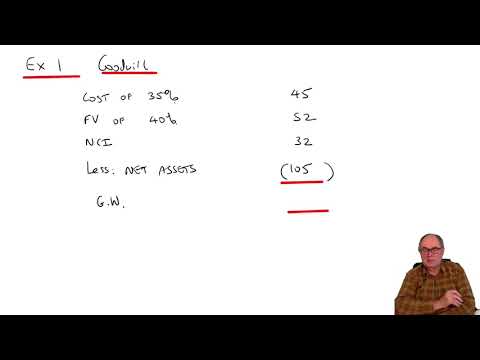
Jeremy acquired 40% of the equity interest of David for $40 million several year ago. On the 1 January 2015, Jeremy acquired an additional 35% for $45 million when the fair value of the identifiable net assets were $105 million. The investment was classified as fair value through profit or loss.

The fair value of the non-controlling interest on 1 January 2015 was $32 million the fair value of the original 40% holding was $52 million.

Calculate the goodwill to appear in the Jeremy group statement of financial position as at 31 December 2015.

Show answerHide answer

Example Answer 1

Goodwill

$m
FV consideration
FV of existing interest
FV NCI @ acquisition
FV net assets @ acquisition
Goodwill @ acquisition

A gain of $12 million is also recorded in the group retained earnings, being the increase in fair value of the original investment from $40 million to $52 million.

1.2 Control -> control (change in ownership)

In this situation A may own 60% of B. It then buys an additional 10%. Note that there is no change in control. All that is happening is that the NCI will get smaller (from 40% to 30%). NO FURTHER GOODWILL IS CALCULATED. Instead the transaction is seen as a transaction with the NCI shareholders. Two things will change:

  1. NCI goes down.

  2. Cash goes down.

  3. There will be a difference – this is known as the ‘difference’ or ‘adjustment’ It is posted to reserves – there is no impact on P&L or OCI. You might almost say that it is being ‘swept under the carpet’.

Example 2

A owns 75% of B. On 31 December, when the NCI has a carrying amount of 75, it then buys the remaining 25% shares for 100.

Prepare the journal entry for this transaction.

Show answerHide answer

Example Answer 2

DRNCI
DRRetained earnings - balancing figure
CRBank

2 Step disposals

YouTube video

2.1 Control -> control (change in ownership)

In this situation A may own 80% of B. It then sells 10%. Note that there is no change in control. All that is happening is that the NCI will get larger (from 20% to 30%). NO PROFIT ON DISPOSAL IS CALCULATED. Instead the transaction is seen as a transaction with the NCI shareholders. Two things will change:

  1. NCI goes up.

  2. Cash goes up.

There will be a difference – this is known as the ‘difference’ or ‘adjustment’ It is posted to reserves – there is no impact on P&L or OCI.

DR

Bank

X

CR

Non-controlling interest

X

DR/CR

Retained earnings (balancing figure)

X

Example 3

Betty owned 100% of the equity shares of Penny before it then sold 10% of the subsidiary on 31 December 2015 for $50 million.

The net assets at the date of disposal of the shares was $350 million and the goodwill on acquisition of the original holding was $50 million.

Assume that the goodwill is ‘full’ goodwill’.

Prepare the journal entry to record the change in ownership from a 100% holding to a 90% holding.

Show answerHide answer

Example Answer 3

DRBank
CRNCI
CRRetained earnings – balancing figure

Increase in NCI = 10% x (350 +50)

When a parent sells part of a subsidiary but keeps control, do not report a gain or loss in profit or loss. It is a transaction with the NCI: the difference between the proceeds and the change in the NCI goes to equity, and goodwill is not altered. Weaker exam answers booked a disposal profit here.

2.2 Control -> no control

In this situation A owns 80% of B. It then sells 45%, leaving a holding of 35%. The control threshold (50%) has been crossed. IFRS 3 requires that a profit (or loss) on the loss of control must be recorded in the P&L.

Calculation:

(W) Group profit/loss on disposal

$m

Sale proceeds of
45%

X

Fair value of remaining shares
(35%)

X

Less: Sub sold:

Net assets

X

Goodwill

(X)

NCI

(X)

(X)

X

YouTube video

Example 4

Socks owned 90% of Mogs before it decided to sell a 50% stake of its investment on 31 December 2015 for $120 million. The non-controlling interest at that date was $53 million and the fair value of the remaining 40% is $96 million.

The goodwill on acquisition of the original 90% holding was $38 million and the net assets at the date of disposal were $201 million.

Calculate the group profit on disposal that will appear in the group financial statements of Socks group for the year-ended 31 December 2015.

Show answerHide answer

Example Answer 4

$m
Sale proceeds
Fair value of remaining shares
Less: Sub sold:
Net assets
Goodwill
NCI

Example 5 – Group SFP

Reilly, a public limited company, operates in the manufacturing sector. The draft statements of financial position at 31 December 2015 are as follows:

Reilly
$m

Hulme
$m

Jones
$m

Non-current assets

180

115

100

Investment in Hulme

90

-

-

Investment in Jones

85

-

-

Current assets

80

90

60

Total assets

435

205

160

Share capital

250

80

75

Retained earning

110

65

45

Other components of equity

10

-

-

Non-current liabilities

15

14

10

Current liabilities

50

46

30

Total equity and liabilities

435

205

160

The following information is relevant in preparing the group financial statements of the Reilly Group.

Reilly acquired a 60% holding in the equity shares of Hulme on 1 January 2014 for a cash consideration of $75million, when the retained earnings were $25 million. The fair value of the non-controlling interest was $40 million.

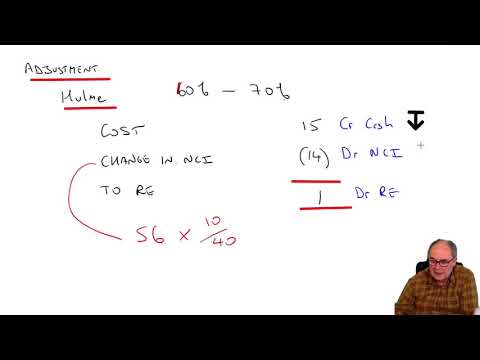
On the 31 December 2015, Reilly acquired a further 10% of the equity shares of Hulme for a cash consideration of $15million. At this date the NCI was $56m.

Reilly acquired a 90% of the equity shares of Jones on 1 January 2015 for a cash consideration of $120 million when the retained earnings were $35 million. The fair value of the non-controlling interest was $13 million

On 31 December 2015, Reilly disposed of 20% of the equity shares in Jones for a cash consideration of $35 million. At this date the NCI was $14m.

The group policy is to value the non-controlling interest at acquisition using the fair value method.

Calculate for inclusion in the consolidated statement of financial position of the Reilly Group as at 31 December 2015 the following balances (i) Goodwill, (ii) The difference posted to retained earnings in respect of the share transactions on 31 December 2015.

Show answerHide answer

Example Answer 5 – Group SFP

Goodwill

HULME
Cost
NCI
Less Net Assets
SC
RE
JONES
Cost
NCI
Less Net Assets
SC
RE
Difference / Adjustment
HULME
Cash paid
Reduction in NCI
10/40 x 56
Adjustment1 debit
JONES
Cash received
Increase in NCI
20/10 x 14
Adjustment7 credit

Example 6 – Group SPL

Maryland
$m

Tansey
$m

Revenue

2,468

1,664

Cost of sales

(1,808)

(1,287)

Gross profit

660

377

Other expenses

(285)

(156)

Profit before interest and tax

375

221

Finance costs

(83)

(39)

Profit before tax

292

182

Taxation

(53)

(36)

Profit for the year

239

146

The following information is relevant in the preparation of the group financial statements:

Maryland acquired 75% of the equity share capital of Tansey on 1 January 2012. On 1 April 2015, Maryland disposed of a 10% holding in Tansey.

Calculate the non-controlling interest in the Maryland Group consolidated statement of profit and loss for the year ended 31 December 2015.

Show answerHide answer

Example Answer 6 – Group SPL

NCI = [25% x 146 x 3/12] + [35% x 146 x 9/12] = $47.45 million.

Example 7

Harry Co owns 90% of the shares in Matthew Co. Harry Co originally acquired 25% of the shares many years ago. Last year Harry Co acquired a further 55% to take its holding to 80%. In the current year Harry Co acquired a further 10% to take its holding to 90%.

Explain how the accounting treatment for Matthew Co should have been accounted for each time Harry acquired shares.

Show answerHide answer

Example Answer 7 – Group SPL

The initial 25% holding would have been treated as an associate and equity accounting used. The statement of financial position would show the investment in associate in non-current assets, shown as the cost plus 25% share of post-acquisition movement in Matthew’s retained earnings. The statement of profit or loss would show the share of profit of associate, 25% of Matthew’s profit for the year, immediately before profit before tax.

The acquisition of the additional 55% gives control as the parent now owns 80% and the associate becomes a subsidiary and is consolidated. The assets/liabilities and revenue/costs are added together 100% on a line-by-line basis. Goodwill on acquisition will be calculated alongside the non-controlling interest (20%) and group retained earnings for inclusion in the group statement of financial position.

The associate is removed from the accounts at its carrying amount, and the fair value of the shares previously held is included in the goodwill calculation. Any difference between the carrying amount and fair value goes through profit or loss.

The acquisition of the additional 10% to give 90% ownership is a change in ownership. The subsidiary is consolidated as previously, but there is a change in the NCI percentage, which has decreased from 20% to 10%. The difference between the amounts paid and the reduction in the NCI goes through retained earnings.

A note about associates

Note that the principles set about above apply equally to the acquisition or loss of significant influence.

Thus, for example, if a company owns 40% of another company, and then sells 25% (losing significant influence), there will be a profit or loss recognised in the profit and loss account:

$M

Proceeds of sale

X

Fair value of 15% retained

X

Less: Carrying amount of 40% associate

(X)

To profit and loss account

X

Relevant examiner articles on the ACCA (students) website:

  • Business combinations – IFRS 3 (revised)

  • Topic explainer video: Disposal of investments