
Basic group structures


1 Subsidiary
A subsidiary is an entity that is controlled by another entity (parent).
Control means:
Power to direct relevant activities of investee AND
Exposure or rights to variable returns from involvement with investee AND
Ability to use power over investee to affect amount of investor’s returns
An entity has control over an entity when it has the power to direct the activities, which is assumed to be when the entity has > 50% of the voting rights.
The parent company must prepare consolidated financial statement if it has control over one or more subsidiaries.
Note however that IFRS 3 requires that there is a genuine business combination (or combination of two or more businesses!). A business must have:
Inputs (e.g. wood)
A substantive process (e.g. a machine and an employee to switch the machine on)
The ability to create outputs (e.g. chairs).
Therefore, if the parent buys a company which simply holds an asset (e.g. PPE) and does nothing with it, it would not be a business. IFRS 3 refers to this as the ‘concentration test’ – if all of the value of the entity is concentrated in a single asset – then there may be no business.
The underlying principles of consolidation are:
Substance over legal form
Control and ownership
Other situation where control exists are when the investor:
Can exercise the majority of the voting rights in the investee
Is in a contractual arrangement with others giving control
Holds < 50% of the voting rights, but the remainder are widely distributed
Holds potential voting rights which will give control
2 Associate
An associate is where an entity has significant influence over the associated company.
Significant influence is the power to participate in the financial and operating policy decisions. It is presumed that an investment of between 20% and 50% indicates the ability to significantly influence the investee.
Other situations where significant influence exists are when the investor:
Representation on the board
Participation in policy making process
Material transaction between the two entities
Interchange of managerial personnel
Provision of essential technical information
A ‘why is this a subsidiary?’ or ‘why is there significant influence?’ requirement needs two parts: state what the definition requires, then test the scenario facts against each element and conclude. No marks follow for going on to explain how the investment would then be consolidated or equity accounted.
3 Consolidated statement of financial position
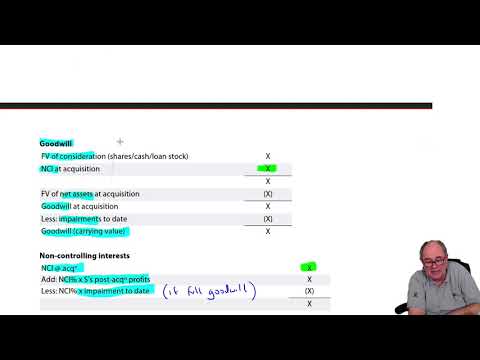
In this exam you will not be asked to prepare an entire SOFP. However, you might be asked to calculate key figures such as:
Goodwill
Non-controlling interest
Retained earnings.
You may find it useful to refresh your knowledge of consolidation techniques from our ACCA Financial Reporting Course Notes.
Note that this proforma assumes that NCI is measured at fair value
Group Structure
Goodwill
FV of consideration (shares/cash/loan stock) | X |
NCI at acquisition | X |
X | |
FV of net assets at acquisition | (X) |
Goodwill at acquisition | X |
Less: impairments to date | (X) |
Goodwill (carrying value) | X |
Non-controlling interests
NCI @ acqn | X |
Add: NCI% x S’s post-acqn profits | X |
Less: NCI% x impairment to date | (X) |
X |
Group retained earnings
100% P | X |
Add: P’s % of S’s post acqn retained earnings | X |
Add: P’s % of A’s post acqn retained earnings | X |
Less: P’s% x impairment to date in subsidiary | (X) |
Less: Impairment to date (associate) | (X) |
X |
Investment in associate
Cost | X |
Add: P% x A’s post-acqn profits | X |
Less: Impairment to date (100%) | (X) |
X |
4 Adjustments – group and subsidiary
4.1 Intra-company balances
Remove the payable
Remove the receivable
4.2 Unrealised profits
4.3 Inventory PUP
Need to remove the intra-group profit included in inventory held @ year-end
Cr Inventory (SFP) | X |
Dr Retained earnings (of seller) | X |
5 Other issues
5.1 Cost of investment
Cash
now (@ price paid/share)
deferred (@PV)
contingent (@FV)
Shares
Measure at FV on the date that the parent buys the subsidiary.
Transaction costs
Transaction costs, such as legal fees, must be expensed in the P&L. They cannot be capitalised.
Non-controlling interest
Can either be measured at fair value (full goodwill) or as the NCI share of the subsidiaries’ net assets acquired (partial or proportionate goodwill)
Net assets of subsidiary acquired
Must be measured at fair value. This may result in the recognition of assets or liabilities that would not have been recognised in the subsidiary’s own financial statements. For example:
Internal brand name would be recognised as an asset in the group accounts at FV.
Contingent liability (even if only possible) would be recognised as a liability in the group accounts at FV.
Negative goodwill
Must be credited in the group profit and loss account.
Adjustment period
When a parent company takes over a subsidiary, it will take some time to assess the fair value of the net assets. Therefore, there is a 12 month ‘window’ during which the parent company can revise these fair values. In summary, goodwill may change in the first 12 months.
Mid-year acquisitions
Calculate the subsidiary’s retained earnings at acquisition, assuming subsidiary profits in the year accrue evenly.
Uniform accounting policies
Subsidiary must adopt the parent’s accounting policies in the group accounts. Accounted for by adjusting the value of assets/liabilities.
Non-coterminous year-ends
Financial statements within three months of the parents year-end can be used and adjusted for any significant events.
6 Adjustments - group and associate
Trading transactions – do not eliminate the balances
Unrealised profits – adjust for P’s% of any PUP

7 Other components of equity
Other components of equity is an additional reserve that constitutes any reserve that does not go into retained earnings. It could therefore include share premium, revaluation reserve, gains/losses on fair value through other comprehensive income investments.
In the group accounts it is treated in exactly the same way as the group retained earnings, i.e. 100% P plus P’s% x S’s post acquisition movement.
Consolidated statement of profit and loss and other comprehensive income

X/12
P | S | Adj. | Group | |
Revenue | X | X | (X) | X |
COS | (X) | (X) | X | (X) |
-PUP (Inventory) | (X) | (X) | ||
-FV adj (extra depⁿ) | (X) | |||
Gross profit | X | |||
Dist costs | (X) | (X) | (X) | |
Admin exp. | (X) | (X) | (X) | |
-Impairment | (X) | |||
Finance cost | (X) | (X) | X | (X) |
Investment income | X | X | (X) | X |
-Dividend from S/A | (X) | |||
Associate (P’s % x A’s PFY) - impairment | X | |||
Profit before tax | X | |||
Taxation | (X) | (X) | (X) | |
PFY | X | X | ||
Revaluation gain | X | X | X | |
Associate | X | |||
TCI | X | X | ||
X |
NCI
Remember that the group accounts must separately disclose:
PAT attributable to NCI (NCI % of S’s PAT)
TCI attributable to NCI (NCI% of S’s TCI)
8 Disclosure of interest in other entities (IFRS 12)

IFRS 12 requires that a parent discloses the significant assumptions and judgement used in determining whether control exists over an investee.
The parent will therefore list all the entities it has a relationship with and explain the basis of the accounting treatment.
8.1 Structured entity
IFRS 12 defines a structured entity as one in which voting rights are not the dominant factor in determining control.
For example, A might own only 5% of the shares of B, but controls the company through a ‘control contract’. In this case, if the company is not consolidated, the ‘acquiring’ company must at least make full disclosure of its relationship with the other company.
9 Impairments and group accounts
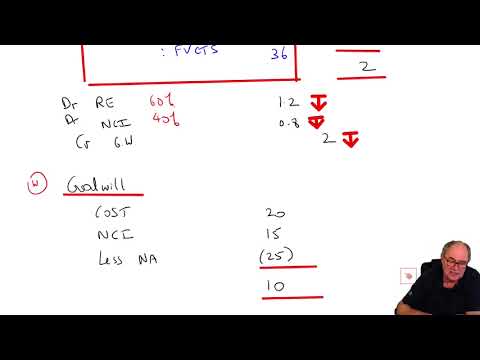
An asset/CGU is impaired if the carrying amount is greater than the recoverable amount.
The recoverable amount is the higher of the value in use and the fair value less costs to sell.
9.1 Impairment – Subsidiary (full goodwill)
The subsidiary is treated as a cash generating unit, where the carrying value is that of the subsidiary plus any goodwill.
In the example above if the goodwill is measured under the full goodwill method then the impairment is split between the parent and the NCI based upon the ownership percentages as the goodwill consists of the parent’s goodwill and NCI goodwill. The journal entry would be as follows:
DR Retained earnings – P’s % of the impairment
DR NCI – NCIs % of the impairment
CR Goodwill – 100% of the impairment
9.2 Impairment – subsidiary (partial goodwill)
If goodwill is measured using the proportionate share method the goodwill calculated consists of the partial goodwill (P’s share) and the impairment is allocated entirely to the group retained earnings as there is no NCI share of goodwill.
The calculation of the impairment becomes slightly more complex as the carrying value of the subsidiary needs to reflect the net assets of the subsidiary plus the full goodwill, as the recoverable amount used is that of the entire subsidiary. The issue is that the goodwill figure reflects the partial goodwill, i.e. only the parent’s share and not the full goodwill, so the partial goodwill will therefore need to be grossed up to an equivalent full goodwill amount so that the impairment is calculated on the full value of the subsidiary (S’s net assets plus grossed up goodwill). This carrying value can then be compared to the recoverable amount as normal to calculate the impairment.
Note that the grossing up is only for the purpose of the calculation of the impairment. The grossing up is not recorded in the ledger or the financial statements.
9.3 Impairment – Associate
The associate is treated as an asset, where the value of the asset is the value of the investment in associate.
10 Final points

10.1 Exemption from the preparation of group accounts
A company need not prepare consolidated accounts if it meets all of the following conditions:
It is a subsidiary of another company
It is not listed on a Stock Exchange
It's parent produces group accounts.
Thus, if Company A owns Company B which owns Company C, then Company B would not have to prepare group accounts.
10.2 Carrying amount of a subsidiary or associate in the parent's financial statements
Any of the following can be used:
Cost
Fair value
Equity accounting
10.3 IFRS 19 – DISCLOSURES IN FINANCIAL STATEMENTS OF SUBSIDIARIES
Applies to subsidiaries ‘without public accountability’ – in other words where the subsidiary is not quoted on a Stock Exchange.
It is important that subsidiaries use the same principles of recognition, measurement and presentation as their parent. However, the users of the accounts (principally the parent company!) do not need the detail of disclosure.
Therefore, the impact of the standard is to reduce the burden of disclosure by these companies.
Relevant examiner articles on the ACCA (students) website:
Impairment of goodwill