Skip to content

Leases (IFRS 16)

VIVA Subject Guide
YouTube video

IFRS 16 Leases is to be adopted for accounting periods starting on or after 1 January 2019. It can be adopted earlier but only if the entity has already adopted IFRS 15 Revenue from contracts with customers.

The new standard on leases is replacing the old standard (IAS 17) where the existence of operating leases meant that significant amounts of finance were held off the balance sheet. In adopting the new standard all leases will now be brought on to the statement of financial position, except in the following circumstances:

  • leases with a lease term of 12 months or less and containing no purchase options – this election is made by class of underlying asset; and

  • leases where the underlying asset has a low value when new (such as personal computers or small items of office furniture) – this election can be made on a lease-by-lease basis. Low value is less than $5,000.

The accounting for low value or short-term leases is done through expensing the rental through profit or loss on a straight-line basis.

Example 1 – Low-value assets

Banana leases out a machine to Mango under a four year lease and Mango elects to apply the low-value exemption.

The terms of the lease are that the annual lease rentals are $2,000 payable in arrears. As an incentive, Banana grants Mango a rent-free period in the first year.

Explain how Mango would account for the lease in the financial statements.

Show answerHide answer

Answer 1 – Low-value assets

An expense of $1,500 would be recognised through profit or loss for each of the four year lease. At the end of year one an accrual of $1,500 would be recognised on the statement of financial position of which $500 would be released over the remaining three years of the lease.

Expense (p.a.)  =  ($2,000 x 3) ÷ 4  =  $1,500

1 Identifying a lease

YouTube video

A contract is, or contains, a lease if it conveys the right to control the use of an identified asset for a period of time in exchange for consideration [IFRS16:9]

Control is conveyed where the customer has both the right to direct the identified asset’s use and to obtain substantially all the economic benefits from that use. [IFRS 16:B9] However, if the supplier has a substantive right to substitute the asset during the period of use then the customer does not have the right of use of the asset and hence there is no lease.

Example 2 – Identifying a lease

For each of the two following scenarios explain if the contract is a lease or if it contains a lease.

Peach needs to transport its goods to customers in Europe using rail freight. The company enters into a contract with a rail freight carrier for the use of 10 rail cars of a particular type for five years.

Peach needs to transport its goods to customers in Europe using rail freight. The company enters into a contract with a rail freight carrier that requires the carrier to transport a specified quantity of goods by using a specified type of rail car in accordance with a stated timetable for five years

Show answerHide answer

Answer 2 – Identifying a lease

  1. The identified asset is the specific rail cars in the contract to which the supplier does not have substantive substitution rights (unless for repairs or maintenance). The customer has exclusive use of the rail cars so has the right to all the economic benefits. The contract therefore contains a lease of the rail cars.

  2. There is no identified asset as the supplier can use any rail car as long as it meets the specific type as designated in the contract, which means that the supplier has substantive substitution rights. As the supplier can choose which rail car to use out of a fleet then they have substantially all of the economic benefit of the rail car and hence there is no lease within the contract.

2 Lease and non-lease components

YouTube video

A combined contract where part of the payment is for the lease of the asset and part of the payment is for the provision of additional services by the lessor (e.g. maintenance) then the lessee needs to split the rental into a lease component and non-lease component. The payment by the lessee is to be allocated based on the stand-alone prices of the components.

Example 3 – Lease and non-lease components

Pear enters into a contract for the use of an item of machinery and its annual maintenance for a combined total of $100,000 per annum, payable at the end of the lease period.

The rental of the machinery without any maintenance is $95,000 per annum, whilst a stand-alone maintenance contract is $10,000 per annum.

Explain how the annual rental should be split between the lease and non-lease component.

Show answerHide answer

Answer 3 – Lease and non-lease components

Pear will allocate $90,476 as the lease rental and apply this using IFRS 16 (right-of-use asset and lease liability), whilst the $9,524 will be recognised through profit or loss each year.

Stand-alone price $Allocated $
Machinery (lease)90.48% (=95/105)
Maintenance (non-lease)9.52% (10/105)
Total

3 Lessee accounting

YouTube video

3.1 Initial recognition

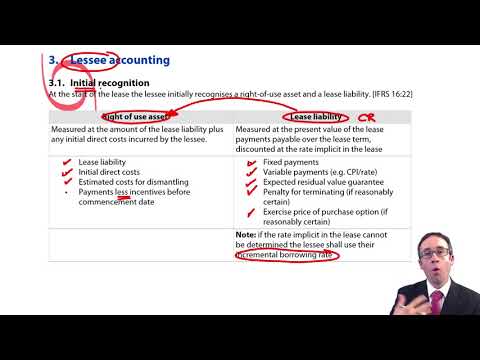
At the start of the lease the lessee initially recognises a right-of-use asset and a lease liability. [IFRS 16:22]

Right of use asset

Lease liability

Measured at the amount of the lease liability plus any initial direct costs incurred by the lessee.

Measured at the present value of the lease payments payable over the lease term, discounted at the rate implicit in the lease

  • Lease liability

  • Initial direct costs

  • Estimated costs for dismantling

  • Payments less incentives before commencement date

  • Fixed payments less incentives

  • Variable payments (e.g. CPI/rate)

  • Expected residual value guarantee

  • Penalty for terminating (if reasonably certain)

  • Exercise price of purchase option (if reasonably certain)

Note: if the rate implicit in the lease cannot be determined the lessee shall use their incremental borrowing rate

3.2 Subsequent measurement

Right of use asset

Lease liability

Cost less accumulated depreciation

Financial liability at amortised cost

Note: Depreciation is based on the earlier of the useful life and lease term, unless ownership transfers, in which case use the useful life.

Settle the perspective before the numbers: is the entity the lessee or the lessor, and is a lease being accounted for at all? For a lease recognised under the normal lessee model, interest is charged on the outstanding liability, not on the annual payment, and the lease payments themselves are not the profit or loss expense. A present value given in the exhibit does not need recalculating.

3.3 Variable lease payments

If lease payments are, for example, linked to a price index, then the lease liability will change. There will be a corresponding change in the carrying amount of the right-of use asset.

So, if the lease liability increases by $1 million, the adjustment will be Dr Right-of-use asset Cr Lease liability with $1 million.

Example 4 – Lessee accounting

On 1 January 2015, Plum entered into a five year finance lease of machinery. The machinery has a useful life of six years. The annual lease payments are $5,000 per annum, with the first payment made on 1 January 2015. To obtain the lease Plum incurs initial direct costs of $1,000 in relation to the arrangement of the lease but the lessor agrees to reimburse Plum $500 towards the costs of the lease.

The rate implicit in the lease is 5%. The present value of the minimum lease payments is $22,730.

Demonstrate how the lease will be accounted in the financial statements over the five year period.

Show answerHide answer

Answer 4 – Lessee accounting

Initial recognition

  1. Record the right of use asset and lease liability

DR

Right-of-use asset

$22,730

CR

Lease liability

$22,730

  1. Record the initial direct costs

DR

Right-of-use asset

$1,000

CR

Cash

$1,000

  1. Record the incentive payments received

DR

Cash

$500

CR

Right-of-use asset

$500

Right-of-use asset = 22,730 + 1,000 – 500 = 23,230

Subsequent measurement

Depreciate the asset over the earlier lease term of five years.

Expense (p.a.)  =  $23,230 ÷ 5  =  $4,646

Record finance lease payments and interest using the rate implicit in the lease

YearB/fPaymentCapital balanceFinance cost (5%)C/f
1(5,000)
2(5,000)
3(5,000)
4(5,000)
5(5,000)---

4 Lessor accounting

YouTube video

4.1 Classification of the lease

LeasesFinanceOperatingClassify using the tests below

Finance lease if risks and rewards of ownership transferred to lessee.

  • Ownership passes at end of the lease term

  • Option to purchase asset at below fair value at end of lease and reasonably certain option will be exercised

  • Lease term represents the major part of assets economic life

  • PV of minimum lease payments represents substantially all of the asset’s fair value

  • Leased asset is specialised in nature

4.2 Operating lease accounting

YouTube video

Operating lease income receipts are recognised as income through profit or loss on a straight line basis.

Depreciation on the asset continues over its useful life.

Example 5 – Operating leases

Banana leases out a machine to Mango under a four year operating lease. The terms of the lease are that the annual lease rentals are $2,000 payable in arrears. As an incentive, Banana grants Mango a rent free period in the first year.

Explain how both Banana would account for the lease in the financial statements.

Show answerHide answer

Answer 5 - Lessor accounting

Income of $1,500 would be recognised through profit or loss for each of the four year lease. At the end of year one, accrued income of $1,500 would be recognised on the statement of financial position of which $500 would be released over the remaining three years of the lease.

4.3 Finance lease accounting

YouTube video
  1. Derecognise asset and record a receivable (@ net investment in the lease”)

  2. Record finance lease receipts as a reduction in the receivable

  3. Record interest income on the receivable

Net investment in the lease = Gross investment in the lease discounted at the implicit rate of interest

Gross investment in the lease = Minimum lease payments receivable plus any unguaranteed residual value

Example 6 – Finance lease

Cherry leases out an item of property, plant and equipment under a 5 year finance lease. The lease commenced on 1 January 2015 and the rate implicit in the lease is 4%. The annual lease rentals of $5,000 are paid at the start of the lease period.

Cherry estimates that the unguaranteed residual value of the PPE is $400.

Calculate Cherry’s net investment in the lease.

Show answerHide answer

Answer 6 – Lessor accounting

Net investment in the lease = $23,484 (W)

YearDF 4%PV
05,0001
15,0000.962
25,0000.925
35,0000.889
45,0000.855
54000.822

5 Sale and leaseback

YouTube video

A sale and leaseback transaction occurs when one entity (seller) transfers PPE to another entity (buyer) who then leases the asset back to the original seller (lessee).

The companies are required to account for the transfer contract and the lease applying IFRS 16, however consideration is first given to whether the initial sale of the transferred asset is a sale under IFRS 15.

If the lease term is similar to the asset life, it is likely that the transaction is NOT a sale. It is in substance a loan secured on the PPE - as when you might raise a loan from a bank.

If the transfer of the asset is not a sale then the following rules apply:

Seller-Lessee

Buyer-Lessor

  • Continue to recognise the PPE

  • Do not recognise the PPE

  • Recognise a financial liability (= proceeds)

  • Recognise a financial asset (= proceeds)

If the transfer of the asset is a sale then the following rules apply:

Seller-Lessee

Buyer-Lessor

  • Derecognise the PPE

  • Recognise purchase of the PPE

  • Recognise the sale at fair value

  • Recognise lease liability (PV of lease rentals)

  • Apply lessor accounting

  • Recognise a right-of-use asset, as a proportion of the previous carrying value of underlying asset

  • Gain/loss on rights transferred to the buyer

Example 7 – Sale and leaseback

Apple required funds to finance a new ambitious rebranding exercise. It’s only possible way of raising finance is through the sale and leaseback of its head office building for a period of 10 years. The lease payments of $1 million are to be made at the end of the lease period

The current fair value of the building is $10 million and the carrying value is $8.4 million. The interest rate implicit in the lease is 5%.

Advise Apple on how to account for the sale and leaseback in its financial statements if the office building were to be sold at the fair value of $10 million and:

Performance obligations are not satisfied; or,

Performance obligations are satisfied.

Show answerHide answer

Answer 7 – Sale and leaseback

(i) Transfer of asset is not a sale

Seller

Lessor

  • Continue to recognise the asset @ $8.4 million and depreciate.

  • Do not recognise the asset as it has not been sold to the buyer.

  • Recognise a financial liability @ transfer proceeds of $10 million.

  • Recognise a financial asset @ transfer proceeds of $10 million.

(ii) Transfer of asset is sale

Seller

Lessor

  • Derecognise the asset @ $8.4 million1

  • Recognise purchase of the asset @ $10 million (fair value = proceeds)

  • Recognise lease liability @ PV of lease rentals2

  • Apply lessor accounting

  • Recognise a right-of-use asset, as a proportion of the previous carrying value of underlying asset 3

  • Gain/loss on rights transferred 4

DR Bank
DR Right of use asset3 (W2)
CR Lease liability2 (W1)
CR PPE – Building1
CR Gain on transfer4 (balancing figure)

(W1) Lease liability = PV of lease rentals at rate implicit in the lease = $1 million x AF1-10@5%

Lease liability = $1 million x 7.722 = $7,721,735

(W2)

$

$

Right-of-use retained

7,721,735

77.22%

6,486,257

Rights transferred

2,278,265

22.78%

1,913,743

Total

10,000,000

100.0%

8,400,000

Note: If the proceeds are less than the fair value of the asset or the lease payments are less than market rental the following adjustments to sales proceeds apply:

  • Any below-market terms should be accounted for as a prepayment of the lease payments; and,

  • Any above-market terms should be accounted for as additional financing provided to the lessee.

6 SUB-LEASES

YouTube video

Assume that a building has a life of 100 years, and that A leases the building to B for 90 years (HEAD-LEASE); B then sub-lets the building to C (SUB-LEASE).

How will B reflect these transactions its financial statements?

In terms of the HEAD-LEASE, B would normally recognise a right of use asset and a lease liability in its SFP, and depreciation and finance costs in its SPL.

Initial recording of the HEAD-LEASE would be:

Dr Right of use asset x Cr Lease liability x

But what is the impact of the SUB-LEASE?

Scenario 1 – B sub-lets the building for 90 years.

As the SUB-LEASE is for the majority of the asset’s life, B will treat the transaction as a finance lease. Therefore, B will recognise a lease receivable (‘net investment in finance lease’) in its SFP and finance income in its P&L. The right of use asset will be derecognised.

Initial recording of the lease would be:

Dr Lease receivable x Cr Right of use asset x

(Any difference between the lease receivable and the right of use asset would be recognised in the P&L).

Scenario 2 – B sub-lets the building for 10 years.

As the SUB-LEASE is not for the majority of the asset’s life, B will treat the transaction as an operating lease. Therefore, B will recognise rental income in its SPL. The right of use asset will not be derecognised.