
Revenue from contracts with customers (IFRS 15)

IFRS 15 has replaced the previous IFRS on revenue recognition, IAS 18 Revenue and IAS 11 Construction Contracts. It uses a principles-based 5-step approach to apply to contact with customers.
The five steps are as follows:
Identification of contracts
Identification of performance obligations (goods, services or a bundle of goods and services)
Determination of transaction price
Allocation of the price to performance obligations
Recognition of revenue when/as performance obligations are satisfied
1 Identification of contracts
The contract does not have to be a written one, it can be verbal or implied. In order for IFRS 15 to apply the following must all be met:
The contract is approved by all parties
The rights and payment terms can be identified
The contract has commercial substance
It is probable that revenue will be collected
2 Identification of performance obligations
If the goods or services that have agreed to be exchanged under the contract are distinct (i.e. could be sold alone) then they should be accounted for separately.
If a series of goods or services are substantially the same they are treated as a single performance obligation.
3 Determination of transaction price
The amount the selling party expects to receive is the transaction price.
This should consider the following:
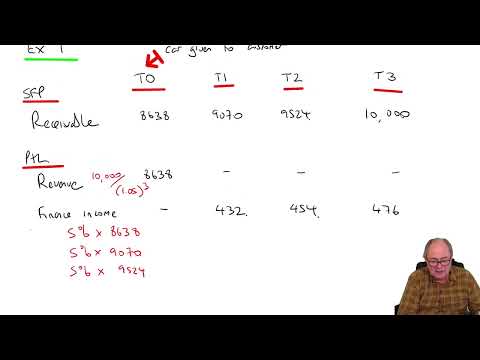
Significant financing components
Variable consideration
Refunds and rebates (paid to the customer!)
4 Allocation of the price
The price is allocated proportionately to the separate performance obligations based upon the stand-alone selling price.
5 Recognition of revenue
Once control of goods or services transfers to the customer, the performance obligation is satisfied and revenue is recognised. This may occur at a single point in time, or over a period of time.
If a performance obligation is satisfied at a single point in time, we should consider the following in assessing the transfer of control:
Present right to payment for the asset
Transferred legal title to the asset
Transferred physical possession of the asset
Transferred the risks and rewards of ownership to the customer
Customer has accepted the asset.
If a performance obligation is transferred over time, the completion of the performance obligation is measured using either of the following methods:
Output method – revenue is recognised based upon the value to the customer, i.e. work certified.
Output method = Work certified to date ÷ Total contract revenue
Input method – revenue is recognised based upon the amounts the entity has used, i.e. costs incurred or labour hours.
Input method (cost based) = Costs to date ÷ Total estimated costs
6 Specifics

Marks sit in the specific issue, not the five-step model. Go straight to whether the up-front fee, modification or right of return creates a distinct performance obligation, and then to how much revenue falls in each reporting period. Reproducing the five steps, or pricing goods the requirement never asked about, is time the answer cannot spare.
Principal vs agent - When a third party is involved in providing goods or services to a customer, the seller is required to determine whether the nature of its promise is a performance obligation to:
Provide the specified goods or services itself (principal) or
Arrange for a third party to provide those goods or services (agent)
In an AGENCY situation, the company will recognise commission received and receivable as revenue.
Repurchase agreements - When a vendor sells an asset to a customer and is either required, or has an option, to repurchase the asset. The legal form here is always a sale followed by a purchase at a later date. The economic substance is more likely to be a loan secured against an asset that is never actually being sold.
Consignments – arises where a vendor delivers a product to another party, such as a dealer or retailer, for sale to end customers. The inventory is recognised in the books of the entity that bears the significant risk and reward of ownership (e.g. risk of damage, obsolescence, lack of demand for vehicles, no opportunity to return them, the showroom-owner must buy within a specified time if not sold to public)
Contract modifications - what happens if a contract is changed so that one party agrees to do something extra for the other party in return for extra consideration? If the extra consideration reflects the normal selling price ('stand-alone selling price') of the additional service, then the modification will be seen as a separate contract with a separate performance obligation. Therefore, there will be no change to the accounting for the original contract.
Sale with a right of return - if a store sells goods and the customer has the right to return the goods within 30 days if they change their mind about the purchase, should the sale be recognised? The store will have to assess the likelihood of the goods being returned. If a return is likely, no revenue should be recognised. Instead the sale proceeds would be credited to the contract liability account. At the year end the business would recognise an asset - being the right to recover the inventory from the customer - this is the equivalent to recognising closing inventory: Dr Asset (right to recover) Cr Cost of sales.
Non-refundable up-front fees - if you join a gym you are sometimes asked to pay a joining fee of, say, $50. Is this a separate performance obligation? Is the gym doing something extra for you on the joining day? The facts of every case are different - however, this is probably just another way of extorting money from the customer! In many cases the up-front fee would not be a separate performance obligation, and it would therefore be credited to the contract liability account.
Warranties - if you buy a car with a 1 year warranty (seller to repair the car if it breaks down), would this be a separate performance obligation? Probably not - in most cases the buyer has no choice about the warranty; the seller will not offer a discount with no warranty! Therefore, the seller would recognise the total sale proceeds on the date of transfer of control of the car. However, the seller would also recognise a provision for expected repair costs.
Sometimes sellers do offer an optional extended warranty (for an extra 2 years). As this is a distinct service it would be seen as a separate performance obligation, with revenue being recognised over the term of the extended warranty.
Relevant examiner articles on the ACCA (students) website:
Revenue revisited