
Financial Instruments (IAS 32, IFRS 7 and IFRS 9)


Company A | Company B |
Financial asset | Financial liability, or equity |
Purchase shares in co. B | Issues shares |
Purchase co. B debt | Issues debt |
Sells goods to B | Buys good from A |
1.1 Key definitions (abbreviated)
Financial asset | Equity investment in another company OR contractual right to receive cash. |
Financial liability | Contractual obligation to deliver cash |
Equity | Residual interest in assets after deduction of liabilities |
Derivative
Value linked to underlying asset
Requires little or no initial investment
Settled (for cash) at a future date
Note that commodity derivates (e.g. oil) settled by the delivery of the physical commodity are outside the scope of IFRS 9. These are known as executory contracts.
2 Financial assets

2.1 Initial measurement
Initially recognise at fair value plus transaction costs, unless classified as fair value through profit or loss where transaction costs are immediately recognised through profit or loss.
2.2 Subsequent measurement
Equity instruments
Fair value through profit or loss (default)
Re-measure to fair value at the reporting date, with gains or losses through profit or loss.
Fair value through other comprehensive income
If there is a strategic intent to hold the asset for the long term, then the option to hold at fair value through other comprehensive income is available. Re-measure to fair value at reporting date, with gains or losses through other comprehensive income.
Note that any decision to hold shares as FVOCI requires an IRREVOCABLE election – i.e. the company cannot later change its mind.
Debt instruments
Amortised cost
A financial asset is measured at amortised cost if it fulfils both of the following tests:
Business model test – intent to hold the asset until its maturity date; and,
Contractual cash flow test – contractual cash receipts on holding the asset.
If the contractual cash flow test is satisfied but there is no intention to hold the asset until maturity then the financial asset is held as fair value through other comprehensive income.
Debt instruments may be reclassified if the entity changes its business model.
2.3 Derecognition
Financial assets are derecognised on transfer of risks and rewards to another party.When financial assets are sold, any gain or loss is treated as follows:
Equities held at FVPL – gain or loss to P&L.
Equities held at FVOCI – gain or loss to OCI (but transaction costs are charged in P&L).
Debt instruments held at FVOCI:
Step 1 – gain or loss to OCI
Step 2 – cumulative gains or losses recycled from OCI to P&L
3 Financial liabilities
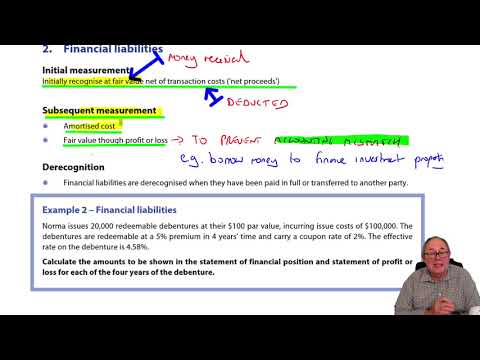
3.1 Initial measurement
Initially recognise at fair value net of transaction costs (‘net proceeds’)
3.2 Subsequent measurement
Amortised cost
Fair value though profit or loss
- this is rare but might be used to prevent an 'accounting mismatch'. For example, if the company borrows money to buy an investment property, it would make sense to value both the investment property and the loan liability at fair value - with changes being recognised in the profit and loss account.
3.3 Derecognition
Financial liabilities are derecognised when they have been paid in full or transferred to another party.
3.4 Modifications
What happens if the company refinances a debt (e.g. agrees a change of terms with the lender)? If the new liability is substantially different to the old liability, then the original liability is regarded as extinguished, and a new liability will be recognised. Any difference will be charged or credited in the profit and loss account.
4 Convertible debentures

If a convertible instrument is issued, the economic substance is a combination of equity and liability and is accounted for using split equity accounting.
The liability element is calculated by discounting back the maximum possible amount of cash that will be repaid assuming that the conversion doesn’t take place. The discount rate to be used is that of the interest rate on similar debt without a conversion option.
The equity element is the difference between the proceeds on issue and the initial liability element.
The liability element is subsequently measured at amortised cost, using the interest rate on similar debt without the conversion option as the effective rate. The equity element is not subsequently changed.
Issue costs associated with the issue are recognised by adjusting the effective rate of interest on the debenture.
Split accounting starts with the liability: discount the cash flows payable if conversion never happens, using a market rate for comparable debt without the conversion option. Using the instrument’s own coupon rate is the classic error — it leaves no equity component at all.
5 Derivatives
Derivative financial instruments should be recognised as either assets (favourable) or liabilities (unfavourable). They should be measured at fair value both upon initial recognition and subsequently, with any gains or losses through profit or loss.
You will be given the FV of a derivative in the exam. In general terms:
Options start out as a financial asset (premium paid). At the SFP date they will still be a financial asset.
Other derivatives (e.g. futures, swaps) start out with $nil value. At the SFP date they will either be a financial asset or a financial liability.
6 Impairment of financial assets

Impairment rules under IFRS 9 apply to investments in debt (loan assets) that are held at amortised cost or at fair value through other comprehensive income.
An expected credit loss model is used in an attempt to recognise credit losses before default occurs, and it uses a three stage model to recognise the loss incurred.
Expectations of credit losses | Credit losses recognised | |
Stage 1 | Initial recognition and when no subsequent, significant deterioration in credit quality | PV of expected credit losses 12 months after reporting date |
Stage 2 | Significant deterioration in credit quality | Impairment recognised at PV of expected credit shortfalls |
Stage 3* | Objective evidence of an impairment |
*The effective interest rate is applied to the carrying amount of the asset, net of any allowance, if there has been objective evidence of an impairment.
Interest income runs on the gross carrying amount until stage 3; netting off the allowance first is the most common error in amortised cost workings. Move from 12-month to lifetime losses as soon as credit risk deteriorates significantly, and keep the word ‘allowance’ — a bad debt described as a provision points the answer at the wrong standard.
Trade receivables
It would place too much of a burden on companies to use the three-stage model for trade receivables. Therefore, prospective bad debts should ALWAYS be recognised in an allowance account based on LIFETIME EXPECTED CREDIT LOSSES.
Allowance account
You should note above that we have referred to ‘allowances’ not ‘provisions’. It is very important that you only use the word ‘provision’ in connection with liability accounting, which is clearly not the case here.
Purchase of credit-impaired financial asset
If a company (probably a bank) takes over a debt of $10 million of which $1 million is not expected to be recovered, then the asset will be recognised with an initial carrying amount of $9 million.
7 Hedging (IAS 39)

Companies have items on their statement of financial position that may change in value or may have highly likely future cash flows that may fluctuate. The changes in the value of these items give rise to additional risk in the business. Financial managers may therefore adopt a process of hedging to manage this risk.
Hedged item – Exposed asset, liability or future cash flow
Hedging instrument – Derivative designed to protect against fluctuations in value
Hedged risk – Specific risk being hedged against (IFRS 7)
The hedge accounting treatment of the hedged item and hedging instrument depends on the type o hedge.
7.1 Fair value hedge

A fair value hedge aims to protect the fair value of an item already recognised in the financial statements. It usually addresses the fear that the value of the asset might fall whilst it is being held within the business.
Gain or loss on the instrument is recognised through profit or loss
Gain or loss on the hedged item also recognised through profit or loss
7.2 Cash flow hedge

A cash flow hedge aims to protect the value of a highly probable future cash flow. It usually addresses the fear that the asset may rise in value before it is bought by the business.
Gains / losses on effective portion of the instrument is recognised in other comprehensive income (OCI)
Gain or loss on ineffective portion recognised through profit or loss
Gain or loss on effective portion reclassified through profit or loss when the item is recognised.
7.3 Hedge Accounting Criteria

Hedge accounting is permitted under certain circumstances provided that all the following conditions are met:
Formally designated and documented (including the entity's risk management objective and strategy for undertaking the hedge, identification of the hedging instrument, the hedged item, the nature of the risk being hedged, and how the entity will assess the hedging instrument's effectiveness)
The hedging relationship consists of eligible hedging instruments and eligible hedged items
The hedge is effective through an economic relationship between the item and instrument, the effect of credit risk does not dominate the changes in value, designated hedge ratio is consistent with risk management strategy.
7.4 Hedge effectiveness (Cash Flow Hedges only)
The changes in the value of the item may not match up exactly to the changes in the value of the instrument. This gives rise to an ineffectiveness in the hedge.
‘Over-hedge’ – change in instrument > change in item, and ineffectiveness in the hedge and the gain/loss recognised through other comprehensive income is equivalent to the change in the item (lower)
‘Under-hedge’ – change in instrument < change in item, and no ineffectiveness in the hedge and the gain/loss recognised through other comprehensive income is equivalent to the change in the instrument (lower)
8 Disclosure (IFRS 7)
Financial instruments, particularly derivatives, often require little initial investment, though may result in substantial losses or gains and as such stakeholders need to be informed of their existence. The objective of IFRS7 is to allow users of the accounts to evaluate:
The significance of the financial instruments for the entity’s financial position and performance
The nature and extent of risks arising from financial instruments
The management of the risks arising from financial instruments
Nature and extent of financial risks
Financial risk arising from the use of financial instruments can be defined as:
Credit risk
Liquidity risk
Market risk
Disclosures with regards to these risks need to be both qualitative and quantitative.
Relevant examiner articles on the ACCA (students) website:
IFRS 9 Financial Instruments
Impairment of financial assets
IFRS 13 Fair value measurement
When does debt seem to be equity?
Topic explainer video (2 videos) Financial Instruments