If the fair value of goods/services is known then this should be used in order to value the option, if the fair value of the goods/services is not known then the fair value of the option at the grant date should be used to value the options.
The fair value should be taken to profit or loss over the vesting period on a straight line basis, based on the number of options expected to be exercised. The corresponding credit entry will be recorded in equity reserves.
The grant-date fair value is fixed and never updated; later fair values, intrinsic values and averages in a scenario are distractors. What is revised each year is the number of awards expected to vest, with the cumulative charge recalculated. The expense sits in operating staff costs and the credit in equity, never a liability.
Example 1 – Fair value equity settled (services)
Brie granted 10,000 equity settled share based payments to its 20 directors on 1 January 2015. The options vest on 31 December 2017. It is anticipated that none of the directors will leave over the three year period. The fair value of the option is as follows:
$
1 January 2015
12.00
31 December 2015
13.50
31 December 2016
13.80
31 December 2017
14.20
Prepare the extracts to be shown in the statement of profit or loss and the statement of financial position for each of the three years ended 31 December 2015 to 31 December 2017.
Show answerHide answer
Example Answer 1 – Fair value equity settled (services)
Statement of financial position (extract)
31 Dec’15
31 Dec’16
31 Dec’17
Other components of equity (W)
$800,000
$1,600,000
$2,400,000
Statement of profit or loss (extract)
31 Dec’15
31 Dec’16
31 Dec’17
Expense (= movement)
$800,000
$800,000
$800,000
Workings
31 December 2015
Obligation = 10,000 options x 20 employees x $12 x 1/3
= $800,000
31 December 2016
Obligation = 10,000 options x 20 employees x $12 x 2/3
= $1,600,000
31 December 2017
Obligation = 10,000 options x 20 employees x $12 x 3/3
= $2,400,000
Example 2 – Options expected to be exercised
On 1 January 2014, Edam granted 20,000 share options to each of its ten directors. The conditions attached to the share option scheme is that the directors must remain an employee of Edam for three years. The fair value of each equity settled share based payment at the grant date was $60.
At 31 December 2014, it was estimated that four directors would leave before the end of the three years.
At 31 December 2015, due to a downturn in the economy, it was estimated that one director would leave before the end of the three years.
Prepare the extracts to be shown in the statement of profit or loss and the statement of financial position for the year ended 31 December 2014 and 31 December 2015.
Show answerHide answer
Example Answer 2 – Options to be exercised (equity settled)
Statement of financial position (extract)
31 Dec’14
31 Dec’15
Other components of equity (W)
$2,400,000
$7,200,000
Statement of profit or loss (extract)
31 Dec’14
31 Dec’15
Expense (= movement)
$2,400,000
$4,800,000
Workings
31 December 2014
Obligation = 20,000 options x (10 – 4) employees x $60 x 1/3
= $2,400,000
31 December 2015
Obligation = 20,000 options x (10 – 1) employees x $60 x 2/3
= $7,200,000
YouTube video
Example 3 – Fair value equity settled (goods)
Caerphilly purchased inventory at a cost of $10 million on 1 July 2015. The goods were sold in November 2015 for $14 million.
Caerphilly had cash flow problems during 2015 and negotiated with its supplier to exchange the goods for options on its shares. The shares had a market value of $11.5 million on 1 July 2015.
Explain how the transaction should be dealt with in the financial statements for the year-ended 31 December 2015.
Show answerHide answer
Example Answer 3 – Fair value equity settled (goods)
The transaction involves an equity settled share based payment for goods as the supplier has the right to receive shares in Caerphilly in return for the transfer of goods.
As it is an equity settled share based payment the fair value of the goods at $10 million should be used to record the transaction.
DR
Purchases/inventory
$10 million
CR
Other components of equity
$10 million
2 Cash settled
YouTube video
If the fair value of goods/services is known then this should be used in order to value the option, if the fair value of the goods/services is not known then the fair value of the option should be reassessed at each reporting date and this value should be used to value the options.
The fair value should be taken to profit or loss over the vesting period based on the number of options expected to be exercised. However as there will be a cash payment, the credit entry is recorded as a liability.
Example 4 – Fair value cash settled
Gouda granted 10,000 cash settled share based payments to its 20 directors on 1 January 2015. The options vest on 31 December 2017. It is anticipated that none of the directors will leave over the three year period. The fair value of the option is as follows:
$
1 January 2015
12.00
31 December 2015
13.50
31 December 2016
13.80
31 December 2017
14.20
Prepare the extracts to be shown in the statement of profit or loss and the statement of financial position for each of the three years ended 31 December 2015 to 31 December 2017.
Show answerHide answer
Example Answer 4 – Fair value cash settled
Statement of financial position (extract)
31 Dec’15
31 Dec’16
31 Dec’17
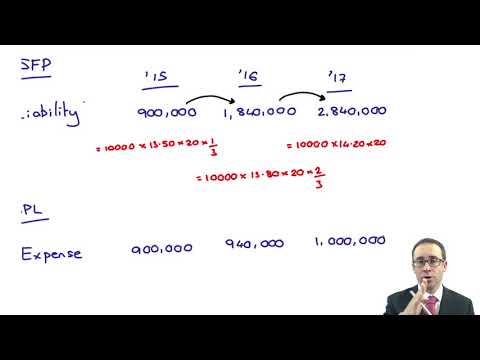
Liability (W)
$900,000
$1,840,000
$2,840,000
Statement of profit or loss (extract)
31 Dec’15
31 Dec’16
31 Dec’17
Expense (= movement)
$900,000
$940,000
$1,000,000
Workings
31 December 2015
Obligation = 10,000 options x 20 employees x $13.50 x 1/3
= $900,000
31 December 2016
Obligation = 10,000 options x 20 employees x $13.80 x 2/3
= $1,840,000
31 December 2017
Obligation = 10,000 options x 20 employees x $14.20 x 3/3
= $2,840,000
Example 5 – Options expected to be exercised (cash settled)
On 1 January 2014, Cheddar granted 20,000 share appreciation rights to each of its ten directors. The conditions attached to the cash settled share based payment scheme is that the directors must remain an employee of Cheddar for three years. The fair value of each cash settled share based payment at the 31 December 2014 was $80 and at 31 December 2015 was $75.
At 31 December 2014, it was estimated that four directors would leave before the end of the three years.
At 31 December 2015, due to a downturn in the economy, it was estimated that two directors would leave before the end of the three years.
Prepare the extracts to be shown in the statement of profit or loss and the statement of financial position for the year ended 31 December 2014 and 31 December 2015.
Show answerHide answer
Example Answer 5 – Options to be exercised (cash settled)
Statement of financial position (extract)
31 Dec’14
31 Dec’15
Liability (W)
$3,200,000
$8,000,000
Statement of profit or loss (extract)
31 Dec’14
31 Dec’15
Expense (= movement)
$3,200,000
$4,800,000
Workings
31 December 2014
Obligation = 20,000 options x (10 – 4) employees x $80 x 1/3
= $3,200,000
31 December 2015
Obligation = 20,000 options x (10 – 2) employees x $75 x 2/3
= $8,000,000
3 Vesting conditions
YouTube video
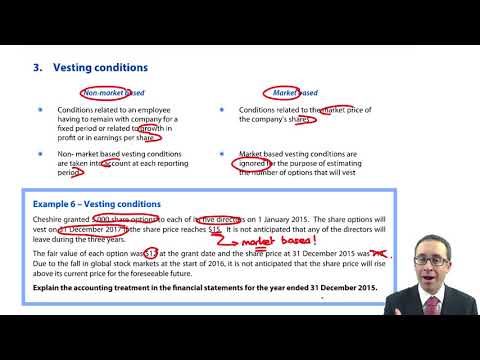
Non-market based
Market based
Conditions related to an employee having to remain with company for a fixed period or related to growth in profit or in earnings per share
Conditions related to the market price of the company’s shares
Non- market based vesting conditions are taken into account at each reporting period.
Market based vesting conditions are ignored for the purpose of estimating the number of options that will vest
Example 6 – Vesting conditions
Cheshire granted 5,000 share options to each of its five directors on 1 January 2015. The share options will vest on 31 December 2017 if the share price reaches $15. It is not anticipated that any of the directors will leave during the three years.
The fair value of each option was $12 at the grant date and the share price at 31 December 2015 was $13. Due to the fall in global stock markets at the start of 2016, it is not anticipated that the share price will rise above its current price for the foreseeable future.
Explain the accounting treatment in the financial statements for the year ended 31 December 2015.
Show answerHide answer
Example Answer 6 – Vesting conditions
The scheme contains both market based and non-market based vesting conditions.
The market based condition where the share price needs to be $15 at the vesting date is ignored over the vesting period. It is only taken into consideration on 31 December 2017 when the condition is either fulfilled or not fulfilled.
The non-market based vesting condition is accounted for over the vesting period as normal. The fair value at the grant date is therefore spread over the three year vesting period.
The obligation at 31 December is $100,000 (=5,000 options x 5 employees x $12 x 1/3) so therefore an equity balance of $100,000 will be shown on the statement of financial position.
As it is the first year of the scheme the statement of profit or loss will be shown and expense for the same amount.
3.1 Unusual situations
YouTube video
Employee has a choice as to receiving shares or cash
A form of split accounting is used (similar to a convertible loan) where part of the cost is credited to liability with the balance being credited to equity.
Relevant examiner articles on the ACCA (students) website: