
Governance


1 Why corporate governance is needed
Corporate governance is a system by which companies are directed and controlled.
The problem is that although the shareholders own companies, the day-to-day management and direction of large companies is given to the Board of Directors. In large companies, many shareholders are relatively passive and the Board of Directors are given more or less free rein to make whatever decisions they wish.
Shareholders are the principals in the relationship: they own the company and the company should be run for their benefit.
Directors are the agents and should run the company for the shareholders’ benefit
Auditing was instituted so that, at least once a year when the accounts were presented to the members of the company, the auditors would examine the accounts and give some expression of opinion to the members of the company as to whether the accounts were true and fair. Without that assurance the members of the company really would have a little idea as to whether or not the accounts were worth relying on. The auditors therefore examine the financial statements and this adds credibility to those statements, the shareholders have a much better idea of the performance of the directors and the company.
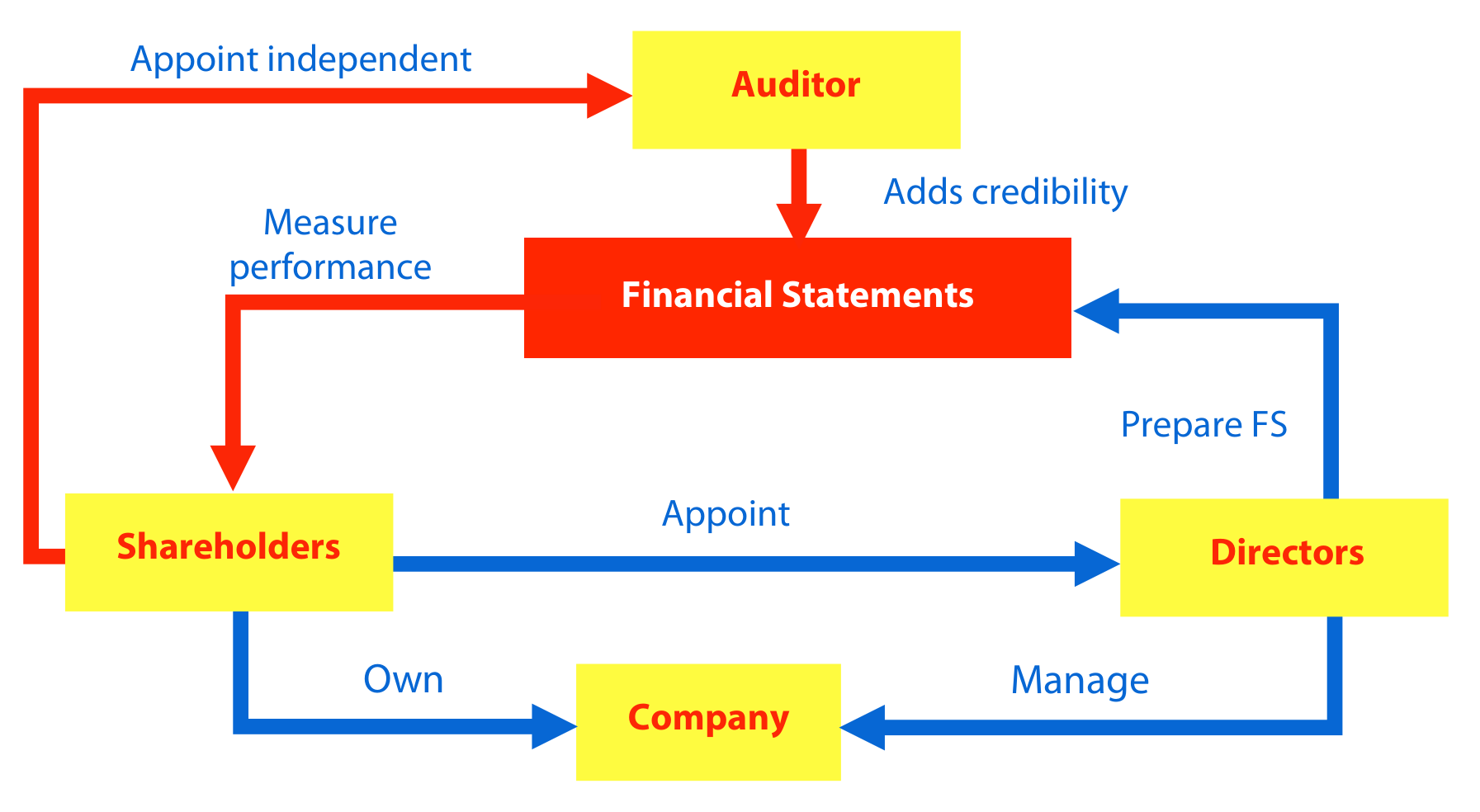
Note that shareholders appoint the independent auditors, they also appoint the directors.
The problem is, however, that once directors were appointed, shareholders often didn’t take much further interest in what the directors were doing and there is at least an annual gap between sets of financial statements and audits. This gave directors ample opportunities to pursue their own ambitions when running the company. For example:
Arranging over-generous remuneration and share options
First class travel
Luxury cars
Excessive expense allowances
Pursuing risky strategies because it was shareholders who would stand to lose rather than directors if the strategy failed.
Scandals such as Enron, Worldcom in the early 2000’s and perhaps banking problems in 2008 showed that this hands-off approach was entirely inadequate and additional safeguards have been instituted to try to ensure that directors act in the best interests of the members of the company.
Note that corporate governance is likely to be less of an issue in small companies (where the owners are directors) and partnerships (where the owners manage the business. Organisations such as trusts and charities can have governance issues when they become large enough for there to be a separation between those who are charged with governance (trustees, governors) and those who run the organisations on a day-to-day basis (managers).
2 Corporate Governance
Ethical directors should always seek to act in the best interests of their shareholders, but often did not. Sometimes, as explained above, this was deliberate so that directors could enrich themselves at the expense of the shareholders. Sometimes it was accidental such as not understanding the risks and returns that shareholders were happy with. Therefore, to encourage better (and more ethical) corporate governance most advanced economies has introduced corporate governance rules, laws and guidelines.
2.1 International Corporate Governance Network
The International Corporate Governance Network (ICGN), founded in 1995 at the instigation of major institutional investors, represents investors, companies, financial intermediaries, academics and other parties interested in the development of global corporate governance practices. One of its objectives is to facilitate international dialogue on issues of concern to investors.
High standards of corporate governance, including effective dialogue between companies and their shareholders, the ICGN believes, are a prerequisite for companies to compete effectively and for economies to prosper. The ICGN also believes that it is in the public interest to encourage and enable the owners of corporations to participate in their governance.
2.2 ICGN Principles
ICGN Principles are obtainable in full here:
https://www.icgn.org/sites/default/files/2021-11/ICGN%20Global%20Governance%20Principles%202021.pdf
Principle 1: Board role and responsibilities
The board should promote the long-term best interests of the company by acting … for the benefit of shareholders, while having regard to relevant stakeholders.
Principle 2: Leadership and independence
Board leadership requires clarity and balance in board and executive roles and an integrity of independent process …in promoting the long-term success of the company.
Principle 3: Composition and appointment
The board should comprise a sufficient mix of directors with relevant knowledge, independence, competence, industry experience … to generate effective challenge, discussion and objective decision-making in alignment with the company’s purpose…
Principle 4: Corporate culture
The board should instil and demonstrate a culture of high standards ….
Principle 5: Remuneration
Remuneration should be designed to equitably and effectively align the interests of the CEO, executive officers and workforce with a company’s strategy and purpose to help ensure long-term sustainable value preservation and creation. Aggregate remuneration should be appropriately balanced with the payment of dividends to shareholders and retention of capital …
Principle 6: Risk oversight
The board should proactively oversee the assessment and disclosure of the company’s key risks and approve the approach to risk management and internal controls regularly …
Principle 7: Corporate reporting
Boards should oversee timely and reliable company disclosures for shareholders and relevant …
Principle 8: Internal and external audit
The board should establish rigorous, independent and effective internal and external audit procedures …
Principle 9: Shareholder rights
Rights of all shareholders should be equal and must be protected….
Principle 10: Shareholder meetings
Boards should ensure that meetings with shareholders are efficiently, democratically and securely facilitated to enable constructive interactivity and accountability …
3 Rules-based v framework-based
There are two approaches to formulating and applying corporate governance codes (and indeed ethical codes):
Rules based: The rules based, or compliance based, approach is based on specific checks and punishments or sanctions. Controls are implemented, perhaps requiring employees to sign-off that they have complied with the rules and for directors, and perhaps auditors, to sign off on corporate governance. This is the approach taken in the USA by the Sarbanes Oxley Act.
Framework based: The framework based, or integrity based, approach sets out guiding principles, and creates a culture that promotes ethical sound behaviour. This approach is taken in the UK and other European countries.
An analogy can be seen from driving a car. If a driver sees a speed camera (a control) then he or she will slow down to ensure compliance with the speed limit and to avoid a fine. This is the rules or compliance approach. The danger is that the driver then breaks the limit when there are no speed cameras around.
The framework or integrity-based approach would have instilled into the driver that breaking the speed limit is morally wrong and is dangerous. That driver will drive ethically even in the absence of speed camera.
The rules-based approach allows organisations to design the checks it thinks are needed and can provide evidence that employees have complied with the rules. However, it is unlikely that the organisation can check compliance for every decision, both because of the enormous bureaucracy that would be needed and because it is difficult to foresee every ethical dilemma. The integrity-based approach is much more flexible but does require the organisation to extend more trust to its employees that they have the moral discernment to ’do the right thing’.
4 Unitary and two-tier boards
Most corporate governance problems arose because of the way boards were structured and run. There were particular dangers where a company was headed by a charismatic CEO. The word ‘charismatic’ was often used instead of more accurate descriptions such as ‘domineering’ or ‘bullying’. Often the CEO would ensure that the board was filled with directors who would offer little resistance to the CEO’s wishes and the CEO was then able to get away with outrageous decisions and, occasionally, robbery.
Two approaches have been taken to try to introduce some supervision to the board’s activities: unitary boards and two-tier boards. In the European Union, the corporate governance codes in eight countries recommend a unitary-board system and in ten countries the codes recommend a dual-board system. In the remaining nine countries, a hybrid system applies and companies can choose between a one or two-tier approach.
4.1 Two-tier boards
The boards are:
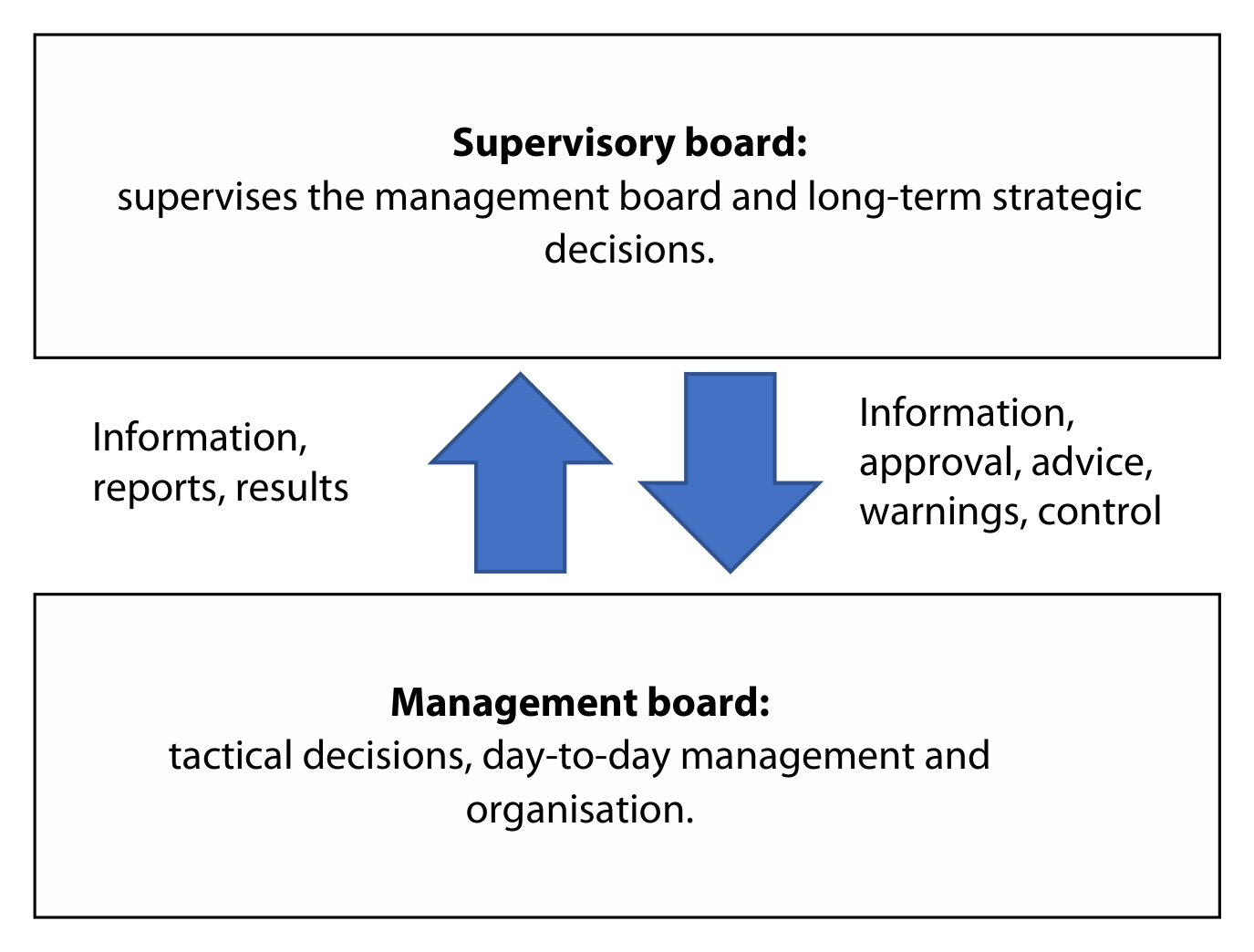
A supervisory board: This is elected by the shareholders and is usually composed of more experienced senior members, and employee representatives. The supervisory board is led by a chairman and it supervises and advises the management board. The Supervisory board is particularly involved in the long-term decision making, and strategic planning of the business. It is also in charge of hiring and dismissing members of the management board.
A management board: The management board will meet regularly and is in charge of the day-to-day management of the business. It is led by a CEO (chief executive officer). Its responsibilities are tactical issues (short term decisions), the everyday management of the business’s transactions.
Advantages of two-tier boards | Disadvantages of two-tier boards |
Clear separation of roles | Poor information flows |
The supervisory board can include a wide range of stakeholders eg workers’ representatives | Confusion over power and roles |
Greater independence of discussion and decision making | Slower decisions and potential stalemates |
Unitary boards
There is only one board and it appoints a mix of executive and non-executive directors. The executive directors look after the day-to-day management of the company (like the management board in the two-tier system); the non-executive directors warn and advise (like the supervisory board in the two-tier system). However, all votes are taken by the single board with each executive and non-executive director having a vote.
5 UK Corporate Governance Code
The OECD principles are put into effect in a variety of ways in different countries, but the UK Corporate Governance Code can be taken as an example of best practice for corporate governance using a unitary board approach.
The full code can be accessed at:
The code states that the purpose of corporate governance is to facilitate effective entrepreneurial and prudent management that can deliver long-term success of the company. It then goes on to list the main principles of the code:
Main principles
Leadership
Division of responsibility
Composition, succession and evaluation
Audit risk and internal control
Remuneration
Comply or explain
The code has no force in law and is enforced on listed companies through the Stock Exchange. Listed companies are expected ‘‘comply or explain’’ and this approach is the trademark of corporate governance in the UK. Listed companies have to state that they have complied with the code or else explain to shareholders why they haven’t. This allows some flexibility and noncompliance might be acceptable in some circumstances.
Leadership
A successful company is led by an effective and entrepreneurial board, whose role is to promote the long-term sustainable success of the company
The board should establish the company’s purpose, values and strategy… All directors must act with integrity, lead by example and promote the desired culture.
The board should ensure that the necessary resources are in place for the company to meet its objectives and measure performance against them. The board should also establish a framework of prudent and effective controls, which enable risk to be assessed and managed.
In order for the company to meet its responsibilities to shareholders and stakeholders, the board should ensure effective engagement with, and encourage participation from, these parties.
The board should ensure that workforce policies and practices are consistent with the company’s values …. The workforce should be able to raise any matters of concern.
Division of responsibilities
The chair leads the board and is responsible for its overall effectiveness.
The board should include an appropriate combination of executive and non-executive (and, in particular, independent non-executive) directors, such that no one individual or small group of individuals dominates the board’s decision-making. There should be a clear division of responsibilities between the leadership of the board and the executive leadership of the company’s business.
Non-executive directors should have sufficient time to meet their board responsibilities. They should provide constructive challenge, strategic guidance, offer specialist advice and hold management to account.
The board, supported by the company secretary, should ensure that it has the policies, processes, information, time and resources it needs in order to function effectively and efficiently.
Composition, succession and evaluation
Appointments to the board should be subject to a formal, rigorous and transparent procedure, and an effective succession plan should be maintained for board and senior management….should be based on merit…and promote diversity. The board should establish a nomination committee to lead the process for appointments, ensure plans are in place for orderly succession to both the board and senior management positions, and oversee the development of a diverse pipeline for succession. The board should establish a nomination committee to lead the process for appointments.
The board and its committees should have a combination of skills, experience and knowledge. .. membership regularly refreshed.
Annual evaluation of the board.
Audit risk and internal controls
The board should:
Establish formal and transparent policies and procedures to ensure the independence and effectiveness of internal and external audit functions. The board should establish an audit committee of independent non-executive directors, with a minimum membership of three, or in the case of smaller companies, two. The chair of the board should not be a member.
Present a fair, balanced and understandable assessment of the company’s position and prospects.
Establish procedures to manage risk, oversee the internal control framework, and determine the nature and extent of the principal risks the company is willing to take in order to achieve its long-term strategic objectives.
Remuneration
Remuneration policies and practices should be designed to support strategy and promote long-term sustainable success. Executive remuneration should be aligned to company purpose and values, and be clearly linked to the successful delivery of the company’s long-term strategy. The board should establish a remuneration committee of independent non-executive directors, with a minimum membership of three, or in the case of smaller companies, two.
A formal and transparent procedure for developing policy on executive remuneration and determining director and senior management remuneration should be established. No director should be involved in deciding their own remuneration outcome.
Test a proposed remuneration scheme against the three principles above rather than accepting it. Executive pay has to be linked to the successful delivery of the company’s long-term strategy, so a bonus that is paid simply for staying in post for a number of years is not sound governance however attractive it looks; the procedure has to be formal and transparent, which is why a chief executive who proposes their own bonus is a governance problem in itself; and remuneration is set by a committee of independent non-executive directors, not by the directors who will receive it. Examiners report that candidates routinely welcome a long-service bonus and fail to query a director setting their own pay.
Directors should exercise independent judgement and discretion when authorising remuneration outcomes, taking account of company and individual performance, and wider circumstances.
6 Public sector governance
6.1 Types of organisations
Commercial organisations. These are profit-seeking and can be sole traders, partnerships, limited liability partnerships and limited companies. They should be run for the benefit of their owners - though as we have seen there can be agency difficulties (shareholders v directors) which corporate governance codes seek to address.
The second type of organisation is a not-for-profit organisation. An example of a not-for-profit organisation could be a charity, such as a charitable hospital. Instead of producing a profit and loss account, they tend to produce income and expenditure accounts. Ultimately their income has to exceed their expenditure or they will run out of money. There can be similar governance problems in not-for profit organisations as with commercial organisations as the day-to-day running (managers) is separated from those with overall responsibility for the entity (trustees or governors)
Public sector organisations are owned by the state either at a national level, local level, or supra-national level (like the EU or the United Nations). Examples could be the defence department, many health services and educational systems. In some economies other industries or businesses are also owned by the state. For example, many national airlines are state-owned.
Politicians and civil servants should be running public-sector organisations for the benefit of the population, but it is obvious that this is not always the case and it is not unknown for politicians to ‘feather their own nests’. A democratic process offers the possibility of changing politicians but even that is often an ineffective solution as the same people are recycled through government.
Politicians need to be subject to rules, regulation, laws, criticism and review processes just as much as directors of limited companies are.
Non-governmental organisations tend to be not-for-profit organisations but with an international brief. Many United Nations organisations will fall into this category.
Non-profit seeking organisations, including many public sector organisations are those whose prime goal cannot be assessed by economic means. Examples would include charities and state bodies such as the police and the health service.
For this sort of organisation, it is not possible or desirable to use standard profit measures. Instead (for example the health service) the objective is to ensure that the best service is provided at the best cost.
6.2 Problems
Particular problems relating to governance and strategy arise from:
Multiple objectives
Even if all objectives can be clearly identified, it may be impossible to identify an over-riding objective or to choose between competing objectives and stakeholders. For example, how much to spend on heart patients compared to cancer patients?
The difficulty of setting and measuring outputs
An objective of the health service is obviously to make ill people better. However, how can we in practice measure how much better they are? If objectives cannot be definitively set then planning and governance can become difficult.
Financial constraints
Public sector organisations have limited control over the level of funding that they receive and the objectives that they can achieve.
Political, social and legal considerations
The public have higher expectations from public sector organisations than from commercial ones, and such organisations are subject to greater scrutiny and more onerous legal requirements.
Little market competition and no profit motive
This can make incentivising employees and stimulating innovation difficult. Why bother if you are a monopoly supplier of a service?
6.3 The three Es
However, usually non-profit organisations, such as the health service, are expected to provide value for money. This can be defined as providing a service in a way which is economical, efficient and effective. Performance should be managed and assessed under each of these ‘3 E’s ‘
Effectiveness
Determining how well the organisation has achieved its desired objectives. This, of course, means that the objectives have to be defined.
Efficiency
Maximising the output for a given input (or, for a given output achieving the minimum input).
Economy
Attaining the appropriate quantity and quality of inputs at the lowest cost.
6.4 Public sector portfolio matrix
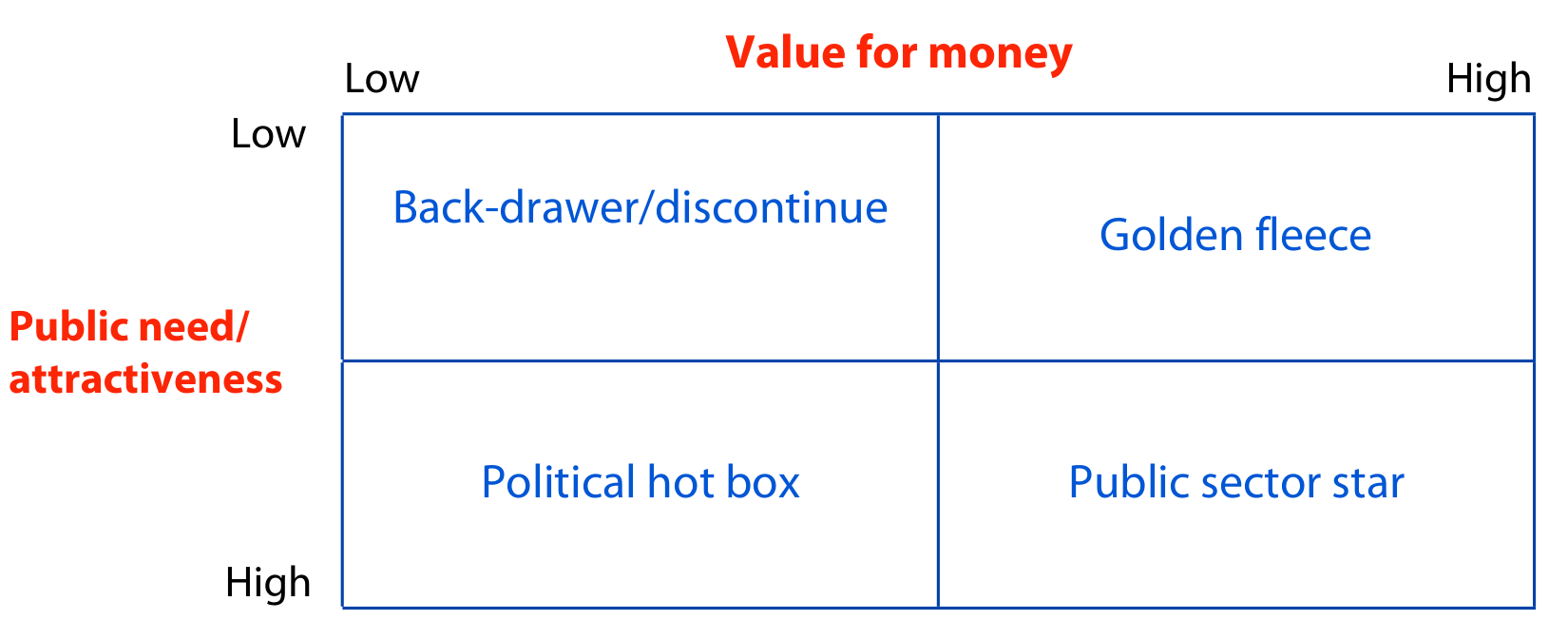
This matrix considers public services, with reference to:
Their value for money
The public need/their attractiveness
It might be of some help to governments and other public institutions when deciding how to prioritise projects:
Public sector star: both value for money and attractiveness are high. Don’t hold back: maintain or increase funding for this popular and good value service.
Back-drawer/discontinue: poor value and no-one is interested anyhow. Discontinue this service.
Golden fleece: good value for money but the public is indifferent and might not appreciate the expenditure there. It makes sense either to reduce funding to reflect public views or to try to convince the public of the value of the service.
Political hot box: attractive and popular but not good value for money. It implies that funds are being somewhat wasted using the current approach. Therefore, change the way in which the service is provided or try to convince the public that the service should be discontinued and the funds applied somewhere more useful.