
Fraud, bribery, whistle-blowing and company ethics


1 Fraud
1.1 Introduction
Fraud is an intentional act involving deception to gain unjust or illegal advantage.
There are two types:
Fraudulent financial reporting. For example, overstating profits to generate high directors’ bonuses, boost the share price or to achieve a good sale price for the company.
Misappropriation of assets. For example, theft of cash or inventory.
Managers and those charged with governance are responsible for the prevention or detection of fraud. Auditors should always be aware of an organisation’s susceptibility to fraud.
1.2 The pre-conditions for fraud
Three conditions or risk factors are necessary for fraud to be committed:
Incentive
Opportunity
Attitude/dishonesty
Risk factor | Examples relating to fraudulent financial reporting | Examples relating to the misappropriation of assets. |
Incentive | Pressure from shareholders to perform | Personal financial pressure |
Opportunity | Poor internal control | Poor internal control |
Attitude | Poor ethics | Poor ethics |
1.3 An anti-fraud strategy
An anti-fraud strategy, ie the deterrence of fraud, has three elements:
prevention
detection
response
These interrelate as follows:
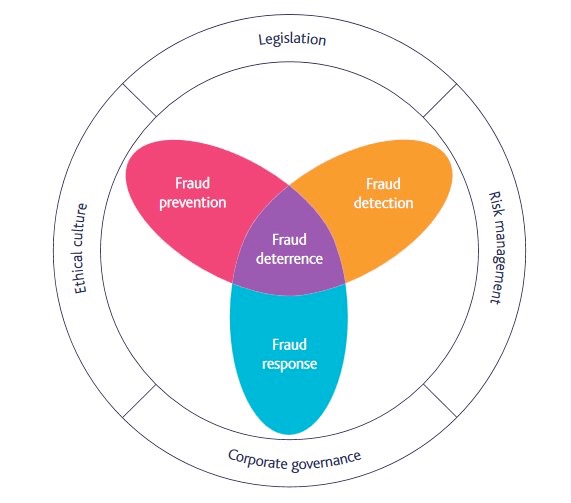
Deterrence is the result of prevention (too difficult to get to the inventory to steal it), detection (you will be subject to random searches as you leave the factory) and response (you will definitely be prosecuted).
Surrounding these specific anti-fraud strategies there are:
Legislation: for example, what types of actions (such as, insider trading) are illegal?
Risk management: an awareness by the organisation’s senior managers and directors of where the main dangers of fraud lie and then suitable controls being put in place.
Corporate governance: For example, non-executive directors providing independent advice about behaviour. Audit committee being available to support internal audit and whistle blowers.
Ethical culture: for example, making it clear that ‘shady’ practices are wrong and will not be tolerated by the company. Training in ethical behaviour will be important
2 Whistle blowing
Whistle blowing is defined as “making a disclosure that is in the public interest”.
Many frauds are known about or suspected by people who are not involved in the dishonesty. The challenge for management is to encourage these ‘innocent’ people to speak out and to demonstrate that it is very much in their own interest to do so. Reporting mechanisms are a very important element of risk management and fraud deterrence.
There can be many conflicting emotions influencing the potential ‘whistle blower’:
working group/family loyalties
intimidation
fear of consequences
suspicion rather than proof.
The organisation’s anti-fraud culture and reporting processes can be a major influence on the whistle blower, as it is often fear of the consequences that has the impact. To the whistle blower the impact of speaking out can be traumatic, ranging from being dismissed to being shunned by other employees. Confidential reporting mechanisms might help.
In the UK, whistle blowers (employees, trainees, agency workers) are protected by law if they report:
a criminal offence, eg fraud
someone’s health and safety is in danger
risk or actual damage to the environment
a miscarriage of justice
the company is breaking the law, eg doesn’t have the right insurance
you believe someone is covering up wrongdoing
Personal grievances (eg bullying, harassment, discrimination) aren’t covered by whistleblowing law, unless your particular case is in the public interest.
To enjoy legal protection, disclosures by whistle blowers must actually be in the public interest. Therefore, to be protected by the law the whistle blower must:
have made the disclosure in good faith – in other words you must be disclosing the information because it is in the public interest and is clearly wrong
reasonably believe that the information is substantially true
reasonably believe you are making the disclosure to the right prescribed person.
3 Bribery
3.1 Introduction
Bribery can be defined as: offering financial or other advantage to perform a relevant function or activity improperly
For example:
Any function of a public nature.
Any activity connected with a business.
Any activity performed in the course of a person’s employment any activity performed by, or on behalf of, a group of persons.
These functions or activities may be anywhere in the world.
Many countries have anti-bribery legislation that can lead to prosecution of both companies and employees.
3.2 Types of bribery and potential offences
Bribing another person
Receiving a bribe
Bribing a foreign public official that is someone who holds an administrative, legislative or judicial position intending to influence them in gaining business or an advantage in connection with business
A commercial organisation failing to prevent bribery.
Note that “hospitality” that is reasonable and proportionate is acceptable.
Facilitation payments are payments to induce officials to carry out their proper functions, but perhaps to carry out those functions more quickly, such as fast clearance of goods through customs. Countries are divided on whether these ‘grease money’ payments are criminal activities or not.
3.3 The Six principles
Businesses can make use of the following six principles when deciding whether their approach to preventing bribery is adequate:
Proportionate procedures
Proportionate to risks faced and size of company.
Commitment by management
Management should assess the nature and extent of risks faced and develop appropriate procedures to manage that risk.
Due diligence
The company should apply due diligence procedures in respect of company personnel who are at greater risk of offering bribes.
Communication
To ensure all employees / connected persons are aware of the company’s culture and attitude includes training and education procedures.
Monitoring and review
Procedures should be regularly reviewed and improved as necessary.
4 Company ethics
4.1 The importance of ethics
When it comes to corporate ethics you do not have to appeal to a moral or ethical stance to see that companies should be ethical. An ethical stance can be justified on a purely economic basis. This rests on the fact that if the company acts unethically or immorally, it will usually be found out, and when it is found out it is usually punished, either through the operation of the law, compensation, or by the loss of goodwill and reputation. Therefore, an ethical company reduces risk.
Everyone can make mistakes but if you own up to mistakes then you are limiting the damage, and you are reducing the risk that further damage will be done and the punitive damages that may later be awarded against you.
If risk is lower so too is cost. Ethical organisations often have to spend less ensuring that regulations are followed. Lower risks also means that banks and other providers of capital will be willing to supply the money at lower rates. In general lower returns are required because risk and return go together.
If your reputation is good, you are more likely to find good, willing partners with whom you can co-operate perhaps to form joint ventures or perhaps just to be satisfied customers.
A good reputation will tend to attract better employees. No one really wants to be associated, if possible, with a company which has a poor reputation.
Finally, a good reputation should increase goodwill and increase sales. Companies which are regarded as being unethical tend not to be trusted and certainly not liked by customers. Customers will always be trying to find an alternative.
Therefore, for very sound commercial reasons, it pays companies to be ethical.
Organisations have an effect on their environment and the human stakeholders with whom they interact. These effects can often produce ethical dilemmas that organisations have to deal with.
4.2 Corporate codes of ethics
This can be defined as: a written set of guidelines issued by an organisation to its workers and management to help them conduct their actions in accordance with its values and ethical standards.
Areas covered can include:
Equal opportunity/discrimination
Bullying
Use of the internet
Reporting wrong-doing
Bribery
Money-laundering
Response to conflicts of interest
The code must be fully supported by top management if it is to be effective. Staff training is also needed to illustrate decision-making processes. A code that is properly implemented can bring the following advantages to an organisation:
Emphasises the organisation’s values.
Guidance to employees and directors.
Risk reduction through avoidance of regulatory and legal problems.
Good public relations and reputation.
Here is an excerpt from Amazon’s code of ethics:
I. Compliance with Laws, Rules and Regulations
Employees must follow applicable laws, rules and regulations at all times.
II. Conflicts of Interest
…employees are expected .. to act … in the best interests of Amazon.com. A "conflict of interest" exists when an employee's personal interest interferes with the best interests of Amazon.com. For example, a conflict of interest may occur when an employee or a family member receives a personal benefit as a result of the employee's position with Amazon.com. … the Legal Department will consider the facts and circumstances of the situation to decide whether corrective or mitigating action is appropriate.
III. Insider Trading Policy
Employees of the Company may not a) trade in stock or other securities while in possession of material non-public information or b) pass on material non-public information to … or recommend to others that they trade in stock or other securities based on material non-public information.
IV. Discrimination and Harassment
Amazon.com provides equal opportunity in all aspects of employment and will not tolerate any illegal discrimination or harassment of any kind…
V. Health and Safety
Amazon.com provides a clean, safe and healthy work environment. Each employee has responsibility for maintaining a safe and healthy workplace by following safety and health rules and practices and reporting accidents…Violence and threatening behaviour are not permitted. …
VI. Price Fixing
Employees may not discuss prices or make any formal or informal agreement with any competitor regarding prices …
VII. Bribery; Payments to Government Personnel
Employees may not bribe anyone for any reason, whether in dealings with governments or the private sector. ….
VIII. Record-keeping, Reporting, and Financial Integrity
Amazon.com's books, records, accounts and financial statements must be maintained in appropriate detail.
IX. Questions; Reporting Violations
Employees should speak with anyone in their management chain or the Legal Department when they have a question about the application of the Code of Conduct …The Amazon.com Legal Department has developed … reporting guidelines for employees who wish to report violations of the Code of Conduct. … Amazon.com will not allow retaliation against an employee for reporting misconduct by others in good faith…Employees who violate the Code of Conduct will be subject to disciplinary action up to and including discharge.
X. Periodic Certification
The Legal Department will designate certain employees who, based on their level of responsibility or the nature of their work, will be required to certify periodically that they have read, understand and complied with the Code of Conduct.
XI. Board of Directors
With respect to their service on behalf of the Company, Amazon.com's Board of Directors must comply with the relevant provisions of this Code of Conduct…
5 Ethical conflict and its resolution
An ethical conflict arises when a person encounters one or both of the following:
Obstacles to following an appropriate course of action due to internal or external pressures
Conflicts in applying relevant professional and legal standards.
Here are some examples of ethical conflicts:
You are a pharmaceutical company developing new drugs. How much testing should be carried out before the drugs can be marketed? More testing might identify unwanted side-effects, but more testing will delay treatment for people who are very ill.
Your factory is old and inefficient and you are thinking of moving to new one with more efficient use of energy, in another area of the country with better transport connections. Carbon foot-print will be reduced, but existing employees will lose their jobs.
You run an airline. You transport passengers for business and leisure and to visit overseas family members. However, airlines also cause noise and air pollution.
House-builders create accommodation for families, but they might build over attractive land and displace wild-life.
You are an accountant reporting to a lender on the prospects of a client. A poor report will lead to business closure and redundancies but an optimistic report might lead to the lender losing their investment.
You might be asked by a manager to remain silent about certain matters that would have an adverse impact on the financial accounts of an organisation, thereby testing the employee’s loyalty to his or her manager on the one hand, and the responsibilities as a professional on the other
You might may consider that the employer’s policies are unethical and may find it difficult to reconcile personal values with those of the organisation
Once an ethical conflict is encountered, a member may be required to take steps to best achieve compliance with the rules, fundamental principles and the law. The IFAC Code offers a framework through which ethical dilemmas may be addressed.
When faced with ethical conflicts, the decision taker should:
(1) Consider the facts of the situation
Identify all relevant facts.
Do not rely on word of mouth, or assumptions. Is it really your problem?
Can anybody else help?
(2) Consider the ethical principles involved
Does it feel right?
How would you feel if you saw it in a newspaper?
How would you feel about your peers, friends, family knowing about it?
Have you referred to the ACCA Code of Ethics?
Have you referred to your internal Code of Ethics/Conduct and other internal policies?
(3) Consider the related fundamental principles
Tucker’s five question approach might be of help
(4) Consider relevant internal procedures
Many organisations will have well-developed procedures that should be followed in the first instance
(5) Consider the alternative courses of action
Escalate internally; consider grievance procedures.
Document every action you take to resolve the conflict.
Escalate externally to auditor, legal advisors, professional body.
(6) Consider the consequences of each alternative course of action.
How will the individuals, organisations and key stakeholders be affected?
Are there conflicts between the effects on different stakeholders?
Understand the effects of non-action– to the organisation, to yourself and to society.
Ultimately, if resolution seems unlikely, disassociate yourself from the issue – in writing if necessary. Legal advice may be needed if this affects your employment status or if you are implicated in any way with the issue.
Note that in some cases there might be a statutory duty to report on problems (eg money laundering).