
Throughput accounting

1 Introduction
Key factor analysis deals with the situation where several products are being made but where there are limited resources available.
In this chapter we will look at key factor analysis first, and then explain how this may be adapted in a modern environment to perhaps a more meaningful approach known as throughput accounting.
2 Key Factor Analysis

In a situation where we are manufacturing several products, all of which use the same limited resource, then we need to decide on how best to use the limited resource in production.
The standard key factor approach is to rank the products on the basis of the contribution earned per unit of the limited resources.
Pi plc manufactures 2 products, A and B.
The cost cards are as follows:
A | B | |||
Selling price | 25 | 28 | ||
Materials | 8 | 20 | ||
Labour | 5 | 2 | ||
Other variable costs | 7 | 2 | ||
Fixed costs | 3 | 2 | ||
23 | 26 | |||
Profit | $2 | $2 | ||
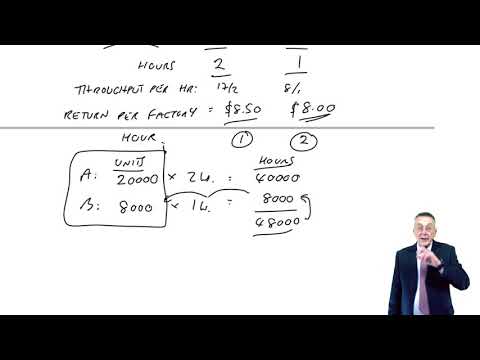
Machine hours p.u. | 2 hrs | 1 hr | ||
Maximum demand | 20,000 | units | 10,000 | units |
The total hours available are 48,000.
Calculate the optimum production plan and the maximum profit using conventional key factor analysis
3 Throughput Accounting
The key factor approach described in the previous section is very sensible, and the throughput approach is effectively the same. However, there are two main concepts of throughput accounting which result in us amending the approach.
3.1 The main concepts of throughput accounting are:
in the short run, all costs in the factory are likely to be fixed with the exception of materials costs
in a JIT environment then we should be attempting to eliminate inventories. Use of a limited resource in production of inventories should be avoided and therefore any work-in-progress should be valued at only the material cost
4 Definitions:
Throughput = sales revenue – material cost
Total factory costs = all production costs except materials
4.1 Target for decision making:
The TA ratio should be greater than 1 if a product is to be viable. Priority should be given to those products which generate the highest TA ratios.
Pi plc manufactures 2 products, A and B.
The cost cards are as follows:
A | B | |||
Selling price | 25 | 28 | ||
Materials | 8 | 20 | ||
Labour | 5 | 2 | ||
Other variable costs | 7 | 2 | ||
Fixed costs | 3 | 2 | ||
23 | 26 | |||
Profit | $2 | $2 | ||
Machine hours p.u. | 2 hrs | 1 hr | ||
Maximum demand | 20,000 | units | 10,000 | units |
The total hours available are 48,000.
Calculate the optimum production plan and the maximum profit, on the assumption that in the short-term only material costs are variable i.e. using a throughput accounting approach
Calculate the Throughput Accounting ratios
5 Bottleneck Resource

In practice, it is likely that a product will have to be worked on by several machines - one after the other.
The rate of production will be restricted by the slowest of the machines, and this machine is known as the bottleneck resource.
The calculations that we have been through in the earlier examples will be performed using the hours per unit in this bottleneck resource.
Work the bottleneck out rather than reading it off. Divide each process’s total hours by the time one unit takes there; the process with the lowest maximum output is the constraint. It is not necessarily the one with the fewest hours available, nor the one with the longest time per unit.
Yam Co is involved in the processing of sheet metal into products A, B and C using three processes, pressing, stretching and rolling.
The factory has 50 production lines each of which contain the three processes: Raw material for the sheet metal is first pressed then stretched and finally rolled. The processing capacity varies for each process and the factory manager has provided the following data:
Processing time per metre in hours | |||
Product A | Product B | Product C | |
Pressing | 0.5 | 0.5 | 0.4 |
Stretching | 0.25 | 0.4 | 0.25 |
Rolling | 0.4 | 0.25 | 0.25 |
The factory operates for 225,000 hours.
Identify the bottleneck process and explain why this process is described as a ‘bottleneck’.
Throughput accounting
7 questionsAnswer the questions one at a time. Your progress is saved so you can leave and come back.
Open chapter practice