
Company Law


1 Types of Corporation and Ways of Formation
corporation sole – a public office occupied by a natural person. Death of the person does not affect the continuing survival of the corporation. The Mayor of London is a corporation sole.
corporation aggregate – a collection of like-minded people who combine to form an artificial person – the corporation aggregate. Death of individual members has no effect on the existence of the corporation.
formation may be by any of 3 ways
Royal Charter – eg East India Tea Company, many UK universities
very rare in modern times
Statute – equally (if not more) rare
Eg British Waterways
Registration – by far the most common method
Eg Tesco plc, Small & Co Ltd.
since 2004 a new form of company, the Community Interest Company (CIC) is available in UK for organisations created for the benefit of the community / society rather than for the pursuit of profit
2 Types of Company
public quoted
share price quoted on a recognised stock exchange
must be limited by shares
public unquoted
again limited by shares, but not quoted
private – unlimited
private – limited by shares
private – limited by guarantee but with no share capital
community interest companies
3 Public Companies
a company is a public company if it satisfies the definition
it is a company which is limited by shares
the constitution states that it is public
the name ends with the words “public limited company“ or “plc”
it has an allotted share capital not less than £50,000…
…of which not less than 25% is credited as paid up…..
….together with the whole of the share premium
any company which does not satisfy the definition is a private company
although a public company exists from the date on its certificate of incorporation, it cannot commence to trade until it acquires a trading certificate
4 Trading Certificates also known as “Certificates to Commence Trading”
public companies cannot commence to trade until after they have received a trading certificate
this is issued by the registrar following an application made by the company
the application states
that the nominal value of allotted shares is not less than £50,000
the preliminary / formation expenses
and to whom these have been paid (or are still payable)
the application must be accompanied by a statement of compliance
if a public company does in fact commence trading before the receipt of the trading certificate, an innocent third party is protected
but the company, and any officer in default, is liable to a fine
if a public company fails to obtain a trading certificate within 12 months of incorporation, the court on application may grant a liquidation order against the company
5 Advantages of Being a Company as Distinct From a Partnership
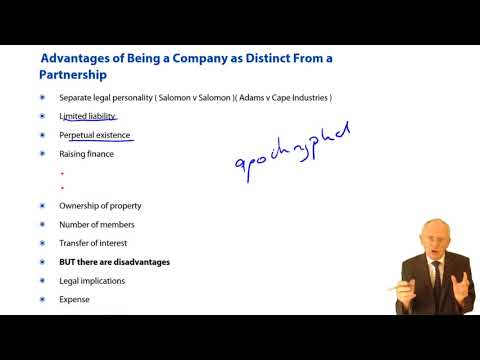
separate legal personality (Salomon v Salomon)(Adams v Cape Industries)
limited liability
perpetual existence
raising finance
offer shares to the public
secure borrowing by way of floating charge
ownership of property
number of members
transfer of interest
BUT there are disadvantages
legal implications
expense
publicity and disclosure
6 Disadvantages (Expanded)
legal implications
formation
audit
share issues
meetings and resolutions
liquidation
“proper accounting records“
expense
publicity
details of directors and their remuneration
business details
7 Lifting the Veil
the court will look behind the veil of incorporation where justice requires it to prevent fraud, illegality or oppression:-
Gilford Motor Co v Horne
Daimler v Continental Tyre and Rubber
Ebrahimi v Westbourne Galleries
R v Oll
Re F G Films
the veil will also be lifted under the provisions of statute:-
fraudulent trading
wrongful trading
commencing to trade without a trading certificate
abuse of company name
other situations:-
preparation of group accounts
tax law
personal guarantees
Keep the statutory grounds apart from the case-law ones. A façade concealing the true purpose, or a company formed for an illegal purpose, comes from the cases above. Of the grounds in this list, wrongful trading is the one specifically covered by legislation — and the answer needs its consequence for the officers' liability, not just the label. (LW GLO S23–A24 examiner's report, Question 3, page 3.)
8 Formation

formed by promoters (see next)
pre incorporation contracts (Kelner v Baxter)
documents to be filed :-
application for registration
memorandum
articles
statement of compliance
statement of capital and initial shareholders
registration fee
9 Formation - role and duties of promoters
roles
act, under instruction, to form a company
this involves:
finding people who will sign the memorandum and articles of association, and act as the company’s first directors
select a suitable name for the company
determine the form and amount of the company’s share capital
determine the rights to be attached to the different classes of share capital
prepare the constitution of the company
submit all the necessary forms to the registrar of companies
pay all the preliminary and formation expenses of the company
duties
act with reasonable skill and care
disclose any profit or potential conflict of interest
either to the first independent board of directors, or
to the company’s existing or intended shareholders
breach of duty - ie non-disclosure - allows the company to rescind the contract and recover the purchase price (Erlanger v New Sombrero Phosphate Mining Co)
the company may require the promoter to pay over to the company any undisclosed profits (Gluckstein v Barnes) (Whaley Bridge v Green)
the company may sue the promoter and claim damages for breach of fiduciary duty (Leeds and Hanley)
10 Formation (continued)
the application for registration details:-
proposed name
registered office (England and Wales)
proposed postal address of registered office
limitation of members liability (shares or guarantee)
public or private
certificate of incorporation
if everything is in order, registrar will issue a certificate of incorporation
the date on the certificate is conclusive proof
Jubilee Cotton Mills v Lewes
a company must keep the required statutory records and registers, including PSC information, and make the required returns and confirmation statement
11 Memorandum and the Constitution

historically the memorandum of association was a major document
since 2006, now just a matter of record
states that the subscribers
wish to form a company
agree to become members
agree to take at least one share each
company’s constitution comprises
articles
resolutions (affecting the articles)
agreements (affecting the articles)
12 Articles – Contractual Force
when a person becomes a member of a company, it is as though they have separately entered a contract with the company and with all the other members individually
the terms of that contract are contained within the articles
the effect is to bind the members to the company
Hickman v Kent or Romney Marsh Sheepbreeders Association
…..and the company to the members
Pender v Lushington
….and the members to the members
Clarke v Dunraven
but the articles do not create a contract between the company and third parties
Eley v Positive Government Life Assurance Co.
13 Articles – Alterability
basic rule – can only alter if for the benefit of the company as a whole
individual hypothetical member of the future
Greenhalgh v Arderne Cinemas
no outside contract shall prevent a change, but company may become liable for breach of that contract (Southern Foundries v Shirlaw)
even if proposed alteration adversely affects only one member, it may still be valid (Allen v Gold Reefs of West Africa)
alterations allowing compulsory purchase of minority’s shares will be (normally) disallowed (Dafen Tinplate v Llanelli Steel)
allowing expulsion of defrauding director – OK (Shuttleworth v Cox Brothers)
allowing expulsion of competing members – OK (Sidebottom v Kershaw Leese)
possible to prevent alteration by weighted voting rights
Bushell v Faith
14 Articles – Procedure for Alteration
special resolution
75% majority
14 days notice
copy of resolution to registrar within 15 days
copy of amended articles to registrar
alteration is binding on all members
articles may say that, for a meeting proposing an alteration, the affected member must be present
so affected member can prevent alteration by not attending
articles may require a greater majority than 75%
…but can never be drafted to prevent amendment
15 Company Names
basic rule – company can have any name selected by promoters
but there are restrictions
registrar may refuse to register a company with a name which is misleading or offensive
connection with royalty, banks…..
name may be restricted by statute
ANZAC
name will not be allowed if the same as an existing company
name may be disallowed as a tort (passing-off)
Ewing v Buttercup Margarine
the word ‘limited’ (or plc) shall not appear anywhere except at the end of the name
16 Name Change
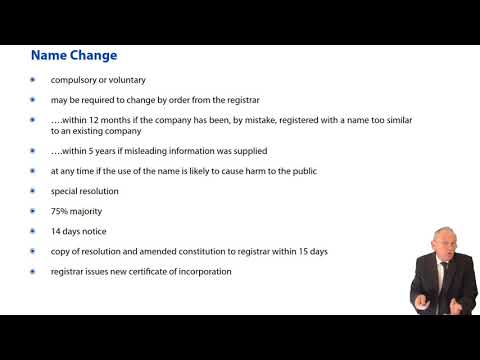
compulsory or voluntary
may be required to change by order from the registrar
….within 12 months if the company has been, by mistake, registered with a name too similar to an existing company
….within 5 years if misleading information was supplied
at any time if the use of the name is likely to cause harm to the public
special resolution
75% majority
14 days notice
copy of resolution and amended constitution to registrar within 15 days
registrar issues new certificate of incorporation
17 Objects
company can do anything so long as it is legal
so since 2006, only reason to mention objects in the articles is restrictively
if company tries to ignore the restriction, ultra vires
member can object (Ashbury Railway v Riche)
“the validity of a transaction shall not be called into question on the grounds of lack of capacity”
“in favour of a third party acting in good faith, the power of the directors to bind the company shall be deemed to be free of any limitation under the company’s constitution”
these apply only to third parties, not to members
good faith – but this is presumed unless shown otherwise
no requirement for third party to make enquiries
so third parties are protected, but company cannot sue to enforce an ultra vires transaction
Company Law: Formation and Constitution
10 questionsAnswer the questions one at a time. Your progress is saved so you can leave and come back.
Open chapter practice