
Partnership Law

a partnership is defined in UK law as “the relationship which subsists between two or more people carrying on business in common with a view to profit”
much of present-day partnership law is contained in the Partnership Act 1890
partners may agree amongst themselves how their firm is to operate, so long as their arrangement is legal
the business must be being “carried on“. It should be more than a one-off transaction, and must be continuing
it must be “with a view to profit” and is more than the simple sharing of gross revenues
if a business relationship satisfies the definition, the courts may well determine that a partnership exists, regardless of any written documentation (or intention of the parties) to the contrary
as a general rule, partners in a firm are jointly and severally liable for partnership debts
every partner is an agent of the firm and the other partners for the purpose of the business of the firm
the acts of every partner done in the course of the firm’s business bind the firm and the partners unless the partner was exceeding his authority and ……
... the other party knew that fact, or was not aware that the person was a partner
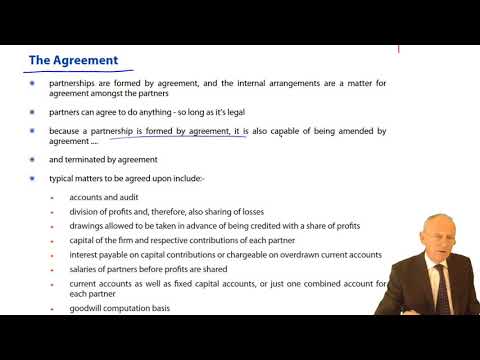
1 The Agreement
partnerships are formed by agreement, and the internal arrangements are a matter for agreement amongst the partners
partners can agree to do anything - so long as it’s legal
because a partnership is formed by agreement, it is also capable of being amended by agreement ....
and terminated by agreement
typical matters to be agreed upon include:-
accounts and audit
division of profits and, therefore, also sharing of losses
drawings allowed to be taken in advance of being credited with a share of profits
capital of the firm and respective contributions of each partner
interest payable on capital contributions or chargeable on overdrawn current accounts
salaries of partners before profits are shared
current accounts as well as fixed capital accounts, or just one combined account for each partner
goodwill computation basis
time period for which the partnership is to last. If no time period is specified, this is a “partnership at will”
2 1890 Act
in the event that partners fail to make an arrangement about some matter which is later disputed, then the Partnership Act 1890 establishes what should happen. The main provisions are :- (medics in bed)
management entitlement for all partners
equality of profit share
derived benefit, without consent of the other partners, should be paid back into the firm
indemnity by other partners where one partner incurs a personal liability when doing anything necessary to protect the firm or its property
competing business profits, gained without consent, should be paid back into the firm
salaries - no automatic entitlement
interest on capital not payable, but interest at the rate of 5% per annum is payable on loans and advances
made to the firm over and above agreed fixed capital
no new person may be introduced into the firm as a partner
books of account shall be available for inspection by any partner at any time
expulsion of a partner requires unanimous consent
disputes concerning the business of the firm are settled by majority vote but no change in the nature of the firm’s business may be made without unanimous consent
3 Dissolution Grounds – Automatic and by Court Order (dissolutions)

death of a partner
insolvency of a partner
sending notice in a partnership at will
share pledged by partner to settle private debts
object of a joint venture is complete
lapse of time where partnership formed for a specific period
unable to carry out one’s obligations created by the partnership agreement
termination by the Court under the principles of “just and equitable”
insanity of a partner
only able to carry on the business at a loss
naughty conduct calculated to affect the carrying on of the firm prejudicially
shirty conduct - persistent breaches of the partnership agreement
the first six are all objective matters of fact, whereas
the last six have to be proved in a Court and the dissolution is as a result of the Court’s subjective decision
on dissolution, firm assets are applied to outside creditors, partners’ advances, capital and then any surplus; a retiring partner remains liable for existing debts unless released and should give notice to existing and potential creditors
4 LPA 1907 and LLPA 2000
Limited Partnerships Act 1907 main features are :-
at least one general partner (with unlimited liability) and one limited partner (with limited liability)
must be registered with the registrar of companies
limited partner should take no part in the management of the firm
if the firm becomes bankrupt, only the general partners are liable for the firm’s debts
Limited Liability Partnerships Act 2000 main features are :-
combination of the advantages of a partnership with those of a limited company
must be registered with the registrar of companies
an LLP is a separate legal person; it must register and file accounts and confirmation information, but may be audit-exempt
as a separate legal entity, the partners are not liable for the firm’s debts, thereby protecting themselves from personal disasters. However, the provisions relating to wrongful and fraudulent trading apply.

5 Partnership compared with company (learn fast rats)
Partnership | Company | |
liability | usually unlimited for partners | usually limited for member |
existence | no separate legal existence so no perpetual existence | separate legal entity so enjoy perpetual existence |
accounts | no requirement to file with government | required to file annual accounts |
raising capital | cannot secure debts by way of floating charge | can secure debt by way of floating charge |
number | normally a limit of 20 partners | no limit on the number of members |
formality | firm may be created by informal oral agreement | company must have a formal constitution |
assets | partners own assets jointly | company owns assets – members own company |
separate entity | firm does not exist as a separate entity | company does have separate personality |
transfer of interest | partners cannot without unanimous consent | members can |
reduction of capital | easy for partners to withdraw their capital | very difficult for companies to reduce capital |
active participation | partners are entitled to take an active part in management | members appoint directors as agents to manage the company |
taxation | partners taxed on profit share | company pays tax on profits members pay tax on their dividend income |
secretary | no requirement for partnership firm to have a secretary | public companies must have appropriately qualified secretary |
Partnership Law
8 questionsAnswer the questions one at a time. Your progress is saved so you can leave and come back.
Open chapter practice