
Company Law: Illegalities


1 Wrongful Trading
previous law extended by Insolvency Act 1986
previously, directors could only be liable for company’s debts where they were guilty of fraudulent trading – difficult to prove
I.A. 1986 designed to give creditors increased protection
an example of lifting the veil
a director knew or ought to have concluded that there was no reasonable prospect of avoiding insolvent liquidation and failed to take every step to minimise creditor loss
court may allocate financial penalty on the liquidator’s application
Directors may be held personally liable for debts incurred during the period of insolvent trading even though there was no intent to defraud
2 Fraudulent Trading
two offences under the name “fraudulent trading”
a criminal offence under the Companies Act 2006, and
a civil offence under the Insolvency Act of 1986
the criminal offence applies to the situation where an entity has been set up
or allowed to continue trading specifically with the intention of defrauding creditors
penalty is a fine and/or imprisonment up to 10 years
the civil offence applies when an entity is being liquidated
where it becomes apparent that an entity has continued trading with the intention of defrauding creditors, the liquidator can take action against anyone who was knowingly a party
if found liable, the Court may direct that those persons liable shall contribute to the shortfall in the entity’s assets in such amounts as the Court thinks fit
The essential difference between Fraudulent Trading and Wrongful Trading is in the words ‘intent to defraud creditors’. In Wrongful Trading, there is no such intent whereas with Fraudulent Trading …
3 Money Laundering
a process whereby the proceeds of criminal activity are converted into assets appearing to have a legitimate origin
usually involves 3 distinct phases
placement of the funds into legitimate business activity
transfer of money from business to business (or place to place) to conceal its original source
integration – the money takes on the appearance of having come from a legitimate source
Proceeds of Crime Act 2002 seeks to control money laundering by the creation of 3 categories of criminal activity
laundering (maximum 14 years prison and / or fine)
failure to report (maximum 5 years prison and / or fine)
tipping-off (maximum 5 years prison and / or fine)
the offence of failure to report relates only to individuals acting in the course of business – for example, accountants
Policies, procedures and controls in relation to money laundering
Abbreviations in general use in the area:
AIM Alternative Investment Market
FATF Financial Action Task Force
JMLSG Joint Money Laundering Steering Group
MLRO Money Laundering Reporting Officer
4 Assessing risk for money laundering purposes
risk management; internal controls and an MLRO; customer due diligence and beneficial-owner verification; reliance and record keeping; ongoing monitoring and internal communication
Money Laundering Regulations require the accountancy profession to adopt a risk-based approach when considering the issue of money laundering
the Regulations identify 4 types of risk arising from the
firm’s client profile – determines the sort of client activities that the firm’s personnel will be watching for
potential of new clients being involved in money laundering or terrorist financing – determines the level of initial customer due diligence work to be undertaken
ongoing activities of clients – affects the level of ongoing monitoring that will need to be applied to a client
firm’s internal procedures – affects the firm’s training and record keeping policies
it is highly unlikely that the high-street practice in a small market town in the UK will encounter clients or business contacts involved in terrorist financing
but it is equally likely that at least one of that firm’s clients is involved in tax evasion, fraud or theft (all are examples of money laundering)
a firm’s policies and procedures should be sufficient to ensure that all members of the firm’s staff are aware of the sort of money laundering activities that they are likely to encounter
Examples of obvious instances where clients:
deliberately fail to take action where their own customers have overpaid in the hope that that customer fails to notice their error (theft)
falsify accounting information in order to obtain finance from a bank or money lending organisation (fraud by misrepresentation)
such as solicitors or surveyors ‘borrow’ their clients’ money for their own purposes (fraud by abuse of position)
fail to disclose information where required – for instance failure to provide all relevant information to an insurance company (fraud by failure to disclose)
tax evasion, theft and fraud are the three forms of money laundering most likely to be encountered by auditors / accountants
but firms should ensure that all members of staff are aware and alert to other types of potential laundering activities
(It is increasing the case that police with production orders are visiting accountancy firms seeking information about clients that are suspected of serious criminal activity)
firms need to consider the nature of the client base. It is highly likely that a firm will have clients with geographical connections with other countries and this will affect the level of risk assessment for those clients individually
but where a firm has multiple clients from a particular country or area, this would affect the entire risk assessment policies and procedures for the firm
FATF monitors the effectiveness of the anti-money laundering regimes in countries across the World and publishes a list of non-cooperating countries and countries with weak controls
5 Initial client risk assessment
different clients, even operating within the same field, will present different risk profiles
consider the case of 2 clients operating as charities
the first, a small local charity funded largely by government grant, will pose little risk from a money laundering point of view
the second, a large charity collecting money from street collections and door-to-door collectors ready to send that money abroad to help relieve the suffering of people caught up in natural disasters – therein lies considerable opportunity for money laundering and even terrorist financing
JMLSG has issued Guidance referring specifically to three levels of due diligence:
simplified due diligence
standard due diligence
enhanced due diligence
JMLSG acknowledges that, where a firm has a client base that is substantially homogenous with only a restricted range of products and services, it could be appropriate to use a simple risk assessment model
where this simple approach is not appropriate, many firms are adopting a risk assessment process that classifies their clients into high, normal and low level risk
Guidance sets out specific instances where low level / simplified due diligence can be applied
instances include:
stock exchange listed companies including AIM listed
financial institutions
credit institutions
at the other extreme, Guidance identifies situations where enhanced due diligence is mandatory
instances include:
clients that are politically exposed
clients that use products, services or entities that provide anonymity
whereas most firms will not have politically exposed people in their client list, it is important to remember that political exposure relates not just to clients as individuals but includes also:
spouse
partner
children and their spouse
parents
known close associates such as business partners
with reference to ‘anonymity’ mentioned above, this relates for example to people involved in offshore trusts in places such as the British Virgin Islands
enhanced due diligence would be appropriate where the local regime is specifically designed to provide anonymity as in the BVI
but even with enhanced due diligence, the Regulations are absolutely clear … if you don’t have adequate customer due diligence, you can’t act for that client
it would seem appropriate when assessing risk for a new client to assume a standard level of due diligence unless circumstances would justify either a simplified level or an enhanced level
6 Record keeping and monitoring
risk assessment is applicable not just at the stage of initial assessment of a new client – the initial risk assessment noted earlier
it’s a continuous process
subsequent ongoing monitoring should be a part of the assignment planning process to ensure that all assigned staff is aware of the money laundering risk
even where initial assessment was simplified due diligence with no requirement to check the identity of individuals that manage or own the client entity, ongoing monitoring is still necessary
this ongoing activity then links directly to a duty to report any abnormal suspicious activity
how can we determine what is ‘normal’ and therefore what is ‘suspicious’?
from the ‘know your client’ information collected on the audit client permanent file!
for example, for a client that has numerous customers in The Cayman Islands, regular and frequent trips to the Caribbean tax haven could be considered to be ‘normal’ activity
but for a client that owns a building supplies business, regular and frequent trips to Grand Cayman would more likely be viewed justifiably as ‘suspicious’
still within the ‘know your client’ area, certain business activities carry with them an increased inherent risk
a client’s business may involve the purchase of used vehicles. These could be acquired for the purposes of being used as a source for spare parts, could be sold in the country of origin or could be exported
but what was the source of the vehicles that the client has acquired? Motor vehicle theft in the UK is not an unusual occurrence! And a stolen vehicle bought for cash can soon be stripped of its identity
Regulations do not require additional steps of an accountant, but it is a requirement that accountants are aware of the potential for money laundering and terrorist financing opportunities
that awareness then requires an accountant to consider whether the transactions inspected as part of normal work appear consistent with the accountant’s expectations, given knowledge of the client
and, where the accountant comes across any activity that lies beyond those expectations, there is a positive duty to report it
important to realise that the findings from initial risk assessment could well require amendment as circumstances change and this, in turn, may require a reconsideration of the level of due diligence that is appropriate together with the extent of ongoing monitoring
7 Exposure of the profession
many regulations that face the profession tend to be routinely followed
but, unlike most other regulations, the Money Laundering Regulations have the potential for criminal sanctions to be taken against the accountancy firm and its members in addition to them facing regulatory action from the ACCA
criminal sanctions are relatively rare
firms should have appropriate and risk-sensitive policies and procedures designed to prevent the firm’s services being used to launder money
remember, this includes tax evasion, theft and fraud
Regulations specifically include the requirement to provide staff with ongoing training
in the area of monitoring compliance with, and the internal communication of, the required policies, controls and procedures, firms should be able to answer these self-assessment questions positively:
if asked, would your staff know who is the MLRO, what are the firm’s procedures and where may these be found?
could you demonstrate that all staff have been trained on the regulations and given ongoing training on the recognition and dealing with suspicious transactions?
if you were to select a number of client files at random, would they all have a risk assessment and adequate customer due diligence for the entity, management and beneficial owners?
if you were to analyse the pattern of reporting of suspicious transactions, would it identify potential issues – for example would it identify where individuals or departments appear to have unusually high or low levels of reporting when compared with other individuals or departments with similar client fee bases?
it must be tempting simply to buy a manual and treat that manual as the firm’s policies and procedures
JMLSG Guidance states that the use of such a standard proforma would likely reflect adversely on the level of seriousness with which the firm’s management is dealing with the issue of money laundering and terrorist financing
yes, accepted that a manual could very well be helpful
but the policies and procedures contained within the manual should be tailored to the specific risks faced by the firm
and who bears the responsibility for the firm’s compliance?
initially, that responsibility is borne by the MLRO
but legally it is the collective responsibility of all the principals within the firm
and the consequences of failure adequately to assess risk and monitor effectively?
there is considerable regulatory risk where a firm falls foul of the Regulations in addition to considerable reputation risk for both the firm and for the principals within that firm
8 Insider Dealing
insider – a person who has a business connection with a company as a result of which they may acquire relevant information
dealing – buying or selling shares or securities in a company
inside information is specific, price-sensitive information which is not generally available
an insider in possession of unpublished price – sensitive information should not deal
an offence is also committed if the insider encourages another person to deal
a person dealing as a result of that encouragement, and believing the source to be an insider, is also committing an offence
disclosure of inside information, other than in the proper course of employment to an authorised person, is also an offence
some defences are available to be claimed
9 Market abuse
a civil FCA regime covering misuse of inside information, misleading statements and market manipulation
10 Bribery
Bribery Act 2010 targets both bribery and corruption
4 offences
bribing another person
receiving a bribe
bribing a foreign public official (FPO) (see next page)
commercial organisation failing to prevent bribery (see next)
bribing = offering financial or other advantage to perform a relevant function or activity improperly
relevant function or activity:
any function of a public nature
any activity connected with a business
any activity performed in the course of a person’s employment
any activity performed by, or on behalf of, a group of persons
these “relevant functions or activities” may be anywhere in the world
11 Bribing an FPO
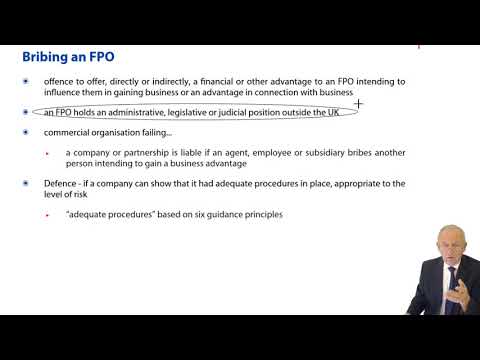
offence to offer, directly or indirectly, a financial or other advantage to an FPO intending to influence them in gaining business or an advantage in connection with business
an FPO holds an administrative, legislative or judicial position outside the UK
commercial organisation failing...
a company or partnership is liable if an agent, employee or subsidiary bribes another person intending to gain a business advantage
Defence - if a company can show that it had adequate procedures in place, appropriate to the level of risk
“adequate procedures” based on six guidance principles
Check which bribery offence the facts fit. Because a foreign public official holds office outside the UK, offering a local councillor a holiday to obtain planning permission is bribing another person, not bribing a foreign public official. Note also that the offence is complete on the offer, and does not depend on trading through a company. (LW GLO S19–A20 examiner's report, Question 3, page 2.)
12 The Six principles
proportionate procedures
proportionate to risks faced and size of company
commitment by management
management should assess the nature and extent of risks faced and develop appropriate procedures to manage that risk
risk assessment – the organisation should assess the nature and extent of its exposure to bribery risks
due diligence
the company should apply due diligence procedures in respect of company personnel who are at greater risk of offering bribes
communication
to ensure all employees / connected persons are aware of the company’s culture and attitude
includes training and education procedures
monitoring and review
procedures should be regularly reviewed and improved as necessary
“adequacy of procedures” is a matter for a court to decide
NB “hospitality” that is reasonable and proportionate is acceptable, ie is it not prohibited by the Act.
13 Penalties
an individual who is found guilty faces imprisonment up to 10 years
a guilty company is liable to an unlimited fine
but, in addition, there is reputation loss...
... and potentially, civil claims against the directors for failing to implement adequate procedures
14 First conviction
Munir Patel found guilty of accepting £500 to suppress a driving conviction from court records. Serving a 3 year prison sentence
15 Facilitation of Tax Evasion
Under the Criminal Finances Act 2017, ‘relevant bodies’ (including firms of accountants and auditors) may be held liable if they fail to prevent individuals associated with them from facilitating tax evasion. So, if an employee or agent of, say, a firm of accountants engages in actions that are designed to help others to evade taxes, the accountancy firm itself can face legal consequences.
It may avoid those consequences where the firm can show that it had adequate prevention measures in place.
Now, ask yourself, if the firm did have adequate prevention measures in place, how come the situation has arisen? Would you not think that the prevention measures were self-evidently not adequate? Res ipsa loquitur?
16 Failure to prevent fraud
a large organisation may be liable where an associated person commits specified fraud intending to benefit it; reasonable fraud-prevention procedures are the defence
17 Summary
In summary, companies must exercise vigilance in their operations and management in their efforts to prevent the occurrence of all the above six fraudulent activities. Failure to be so vigilant may lead to severe legal consequences for both the organisation itself as well as for the offending individuals.
Company Law: Illegalities
10 questionsAnswer the questions one at a time. Your progress is saved so you can leave and come back.
Open chapter practice