
Revenue from contracts with customers (IFRS 15)


IFRS 15 has replaced the previous IFRS on revenue recognition, IAS 18 Revenue and IAS 11 Construction Contracts. It uses a principles-based 5-step approach to apply to contact with customers.
The five steps are as follows:
Identification of contracts
Identification of performance obligations (goods, services or a bundle of goods and services)
Determination of transaction price
Allocation of the price to performance obligations
Recognition of revenue when/as performance obligations are satisfied
1 Identification of contracts
The contract does not have to be a written one, it can be verbal or implied. In order for IFRS 15 to apply the following must all be met:
The contract is approved by all parties
The rights and payment terms can be identified
The contract has commercial substance
It is probable that revenue will be collected
2 Identification of performance obligations
If the goods or services that have agreed to be exchanged under the contract are distinct (i.e. could be sold alone) then they should be accounted for separately.
If a series of goods or services are substantially the same they are treated as a single performance obligation.
3 Determination of transaction price

The amount the selling party expects to receive is the transaction price. This should consider the following:
Significant financing components
Variable consideration
Refunds and rebates (paid to the customer!)
Transaction price
Luckers Co. sells a car to a customer for $10,000, offering interest-free credit for a three-year period. The car is delivered to the customer immediately. The annual market rate of interest on the provision of consumer credit to similar customers is 5%.
What is the transaction price?
Show answerHide answer
4 Allocation of the price

The price is allocated proportionately to the separate performance obligations based upon the stand-alone selling price.
Allocation of price
Richer Co. sells home entertainment systems including a two-year repair and maintenance package for $10,000. The price of a home entertainment system without the repair and maintenance contract is $9,000 and the price to renew a two-year maintenance package is $2,000.
How is the $10,000 contract price allocated to the separate performance obligations?
Note: Ignore any discounting and time value of money.
Show answerHide answer
5 Recognition of revenue

Once control of goods or services transfers to the customer, the performance obligation is satisfied and revenue is recognised. This may occur at a single point in time, or over a period of time.
If a performance obligation is satisfied at a single point in time, we should consider the following in assessing the transfer of control:
Present right to payment for the asset
Transferred legal title to the asset
Transferred physical possession of the asset
Transferred the risks and rewards of ownership to the customer
Customer has accepted the asset.
IFRS 15 (1)
Telephonica sells mobile phones, selling them for “free” when a customer signs up for a 12 month contract. The contract costs the customer $45 per month.
Explain how the revenue should be recognised in Telephonica’s financial statements
Note: Vodaphone sells mobile phones without a monthly contract, selling the handset for $480. Call and data charges are $20 per month. Ignore discounting and the time value of money
Show answerHide answer
IFRS 15 (2)
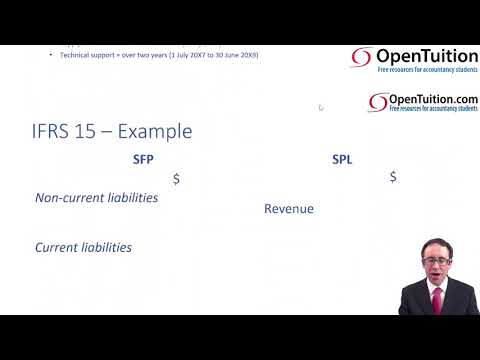
LiverTech is a computer business that primarily sells computer hardware. As well as selling computers, it also supplies and installs the software to its customers and provides a technical support package over two years. The business commonly sells the supply and installation, and technical support in a combined goods and services contract.
The combined goods and services contract sells for $1,600, but if sold separately the supply and installation is sold for $1,500 and the technical support for $500.
If LiverTech sold a combined contract on 1 July 20X7, demonstrate how the transaction would be presented in the financial statements for the year ended 31 December 20X7.
Show answerHide answer

If a performance obligation is transferred over time, the completion of the performance obligation is measured using either of the following methods:
Output method – revenue is recognised based upon the value to the customer, i.e. work certified.
Input method – revenue is recognised based upon the amounts the entity has used, i.e. costs incurred or labour hours.
Any costs incurred to fulfil the contract with a customer should be expensed to the statement of profit or loss as they are incurred.

Performance obligations over time and the statement of profit or loss (1)
Alex commenced a three-year building contract during the year-ended 31 December X4 at a contract price of $50million. At the 31 December X4, the costs incurred to date are $15million and the contract is estimated to be 40% complete.
Calculate the revenue and costs to be recognised in the statement of profit or loss for the year-ended 31 December 20X4.
Show answerHide answer

Performance obligations over time and the statement of profit or loss (2)
Alex commenced a three-year building contract during the year-ended 31 December X4 at a contract price of $50million. At the 31 December X4, the costs incurred to date are $15million and the contract is estimated to be 40% complete. At 31 December the costs incurred to date are $28million and the contract is estimated to be 70% complete.
Calculate the revenue and costs to be recognised in the statement of profit or loss for the year-ended 31 December 20X5.
Show answerHide answer
As contracts that span more than one accounting period progress, the company is creating an asset for the customer that needs to be recognised in the statement of financial position. The amount to be recognised is as follows:
$ | |
Revenue recognised to date | X |
Less: amounts invoiced to date | (X) |
Contract asset/(liability) | X |
The contract balance is measured against what has been invoiced, not against what has been received in cash, and not against the profit recognised. Revenue recognised to date less amounts invoiced to date is the whole calculation: a positive figure is a contract asset and a negative one a contract liability. Cash received from the customer does not enter it.
Performance obligations over time and the statement of financial position
Alex commenced a three-year building contract during the year-ended 31 December X4 at a contract price of $50million. At the 31 December X4, the costs incurred to date are $15million and the contract is estimated to be 40% complete. At 31 December the costs incurred to date are $28million and the contract is estimated to be 70% complete.
Rory has invoiced the customer for work completed to date as follows:
31 December 20X5 | $26m |
31 December 20X4 | $16m |
Calculate the contract asset/liability to be recognised in the statement of financial position at 31 December 20X4 and 20X5.
Show answerHide answer
6 Specifics
Principal vs agent - When a third party is involved in providing goods or services to a customer, the seller is required to determine whether the nature of its promise is a performance obligation to:
Provide the specified goods or services itself (principal) or
Arrange for a third party to provide those goods or services (agent)
Agent vs. principal
Evie is a business manufacturing aircraft component parts, selling two types of components to Ben. Ben acts as a selling agent and sells component X to the public receiving 10% of commission on the selling price. Ben also sells component Y directly to its customers making a 25% gross margin on these sales.
The following relates to sales made in the month of December:
Component X | Component Y | |
Revenue ($) | 300,000 | 80,000 |
How much revenue should Ben recognise for the month of December?
Show answerHide answer
Repurchase agreements - When a vendor sells an asset to a customer and is either required, or has an option, to repurchase the asset. The legal form here is always a sale followed by a purchase at a later date. The economic substance is more likely to be a loan secured against an asset that is never actually being sold.
Bill and hold arrangements - an entity bills a customer for a product but the entity retains physical possession of the product until it is transferred to the customer at a point in time in the future
Consignments – arises where a vendor delivers a product to another party, such as a dealer or retailer, for sale to end customers. The inventory is recognised in the books of the entity that bears the significant risk and reward of ownership (e.g. risk of damage, obsolescence, lack of demand for vehicles, no opportunity to return them, the showroom-owner must buy within a specified time if not sold to public).
Revenue from contracts with customers (IFRS 15)
10 questionsAnswer the questions one at a time. Your progress is saved so you can leave and come back.
Open chapter practice