
IASB Conceptual Framework


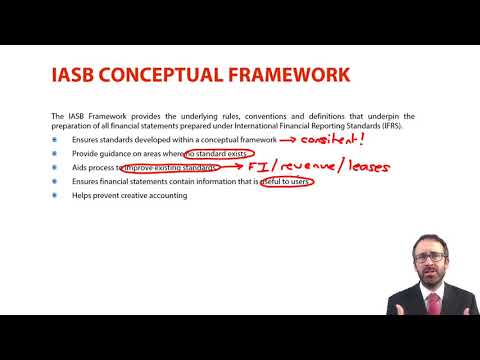
The IASB Framework provides the underlying rules, conventions and definitions that underpin the preparation of all financial statements prepared under International Financial Reporting Standards (IFRS).
Ensures standards developed within a conceptual framework
Provide guidance on areas where no standard exists
Aids process to improve existing standards
Ensures financial statements contain information that is useful to users
Helps prevent creative accounting
The revised IASB Conceptual Framework was issued in March 2018 and the new areas included are as follows:
Measurement basis
Presentation and disclosure
Derecognition
Whilst updates have been made to the following:
Definitions of assets/liabilities
Recognition of assets/liabilities
And clarification on:
Measurement uncertainty
Prudence
Stewardship
Substance over form
1 Objective of financial reporting
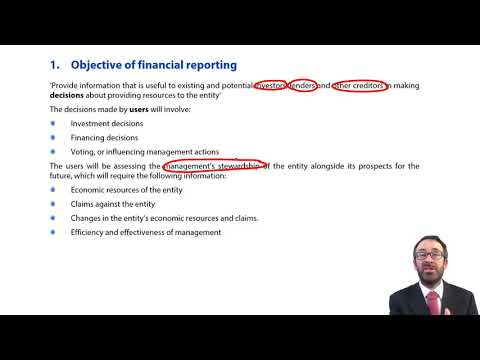
‘Provide information that is useful to existing and potential investors, lenders and other creditors in making decisions about providing resources to the entity’
The decisions made by users will involve:
Investment decisions
Financing decisions
Voting, or influencing management actions
The users will be assessing the management’s stewardship of the entity alongside its prospects for the future, which will require the following information:
Economic resources of the entity
Claims against the entity
Changes in the entity’s economic resources and claims.
Efficiency and effectiveness of management
2 Qualitative characteristics – make information useful

Fundamental qualitative characteristics
Relevance – information that makes a difference to decisions made by users (nature and materiality)
Faithful information – must faithfully represent the substance of what it represents, and is therefore complete (helps understand and includes descriptions and explanations), neutral (no bias, and therefore supported by the exercise of prudence) and free from error. Measurement uncertainty will impact the level of faithful representation.
Enhancing qualitative characteristics
Comparability – identify similarities/differences between entities and year-on-year
Verifiability – assures the information represents the economic phenomena it represents
Timeliness – information is less useful the longer it takes to report it
Understandability – user have a reasonable knowledge of business and activities
Keep the two lists above apart. Relevance and faithful representation are the two fundamental characteristics; comparability, verifiability, timeliness and understandability are the four enhancing ones. A statement that offers relevance or faithful representation as an enhancing characteristic is wrong for that reason alone, and this is the way the point is most often set.
A cost constraint applies in ensuing that the information is useful, in that the benefit of obtaining the information should outweigh the cost of obtaining it.
3 Financial statements and the reporting entity

Reporting entity
Is the entity that is required to prepare financial statements and does not necessarily have to be a legal entity.
Financial statements
Report the entities assets, liabilities, income and expenses for:
Consolidated financial statements
Un-consolidated financial statements
Combined financial statements
Prepared for the entity as a whole
Entity is a going concern and will continue to do so
4 Elements of financial statements

Assets
Present economic resource
Controlled
Past events
Liabilities
Present obligation
Transfer an economic resource
Past event
Equity
Residual interest in assets less liabilities
Income
Increase in asset
Reduction in liability
Expense
Reduction in asset
Increase in liability
5 Recognition and derecognition

Recognition – the process of including an item in the financial statements and is appropriate if it results in relevant and faithful representation
Derecognition – the removal of all or part of an asset (loss of control)/liability (no obligation)
6 Measurement
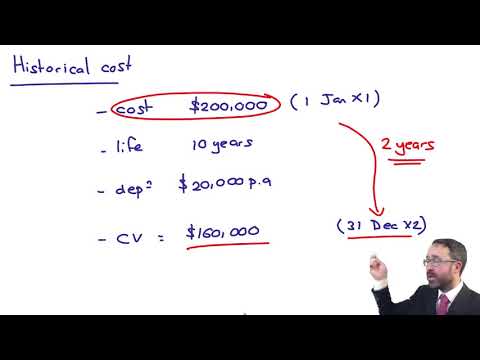
Historical cost | Current value |
Price of the transaction that gave rise to the item | Provides updated information to reflect conditions at the measurement date |
7 Presentation and disclosure

Statement of profit or loss is the primary source of information for a company’s performance, which includes all income and expense. If the income and expense arises from changes in current value then it can be recognised though other comprehensive income.
Reclassification of other comprehensive to profit or loss is allowable if it gives more relevant information.

Show answerHide answer
IASB Conceptual Framework
10 questionsAnswer the questions one at a time. Your progress is saved so you can leave and come back.
Open chapter practice