
Statements of Cash Flows

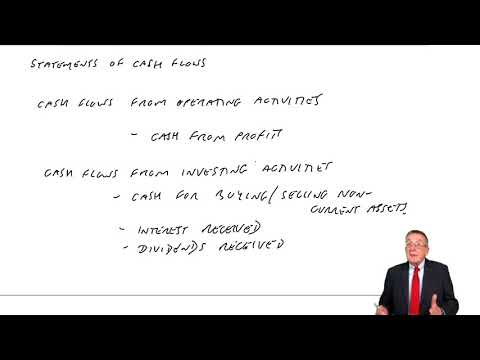
1 Introduction
Companies are required by IAS 7 Statements of Cash Flows to include a Statement of Cash Flows in their financial statements.
In this chapter we will look at the required format and explain how to prepare a Statement of Cash Flows.
2 Description
A Statement of Cash Flows is simply a summary of the cash receipts and payments. The purpose is to provide users of the financial statements with more information than is provided just by the Statement of Profit or Loss and Statement of Financial Position.
For example, the company may have issued shares during the year, but the cash balance at the end of the year may be lower than at the end of the previous year. An ordinary shareholder may be puzzled by this, but maybe the explanation is that the company had very large expenditure on non-current assets. To you as an accountant, this may be obvious from inspection of the Statement of Financial Position, but a Statement of Cash Flows will make it more obvious to the shareholder.
3 The indirect method
There are two approaches allowed in preparing a Statement of Cash Flows – the direct method and the indirect method. We will look at the indirect method first which is more common in practice.
Statement of Cash Flows - PROFORMA
X plc Statement of Cash Flows for the year ended 31 December 2008
$ | $ | ||
Cash flows from operating activities | |||
Net profit before taxation | x | ||
Adjustments for: | |||
Depreciation | x | ||
Profit on sale of non-current assets | (x) | ||
Interest expense | x | ||
Op. profit before working cap. changes | x | ||
Increase in accounts receivable | (x) | ||
Increase in inventories | (x) | ||
Increase in accounts payable | x | ||
Cash generated from operations | x | ||
Interest paid | (x) | ||
Dividends paid | (x) | ||
Taxation paid | (x) | ||
Net cash from operating activities | x | ||
Cash flows from investing activities | |||
Purchase of non-current assets | (x) | ||
Sale proceeds of non-current assets | x | ||
Interest received | x | ||
Dividends received | x | ||
Net cash from investing activities | x | ||
Cash flows from financing activities | |||
Proceeds from issue of shares | x | ||
Repayment of debenture loan | (x) | ||
Net cash from financing activities | x | ||
Net increase in cash & cash equivalents | x | ||
Cash and cash equivalents b/f | x | ||
Cash and cash equivalents c/f | x |

Blair Limited -Statement of Financial Position as at 31 December 2008
2008 | 2007 | |||
$ | $ | $ | $ | |
ASSETS | ||||
Non-current assets | 545,000 | 410,000 | ||
Current assets: | ||||
Inventories | 90,000 | 81,000 | ||
Receivables | 83,000 | 75,000 | ||
Cash | 45,000 | 64,000 | ||
218,000 | 220,000 | |||
763,000 | 630,000 | |||
EQUITY AND LIABILITIES | ||||
Capital and reserves: | ||||
$1 ordinary shares | 150,000 | 100,000 | ||
Share Premium Account | 20,000 | |||
Accumulated profits | 476,000 | 431,000 | ||
646,000 | 531,000 | |||
Current liabilities: | ||||
Trade payables | 97,000 | 69,000 | ||
Corporation tax payable | 20,000 | 30,000 | ||
117,000 | 99,000 | |||
763,000 | 630,000 |
$ | |
Turnover | 1,000,000 |
Cost of sales | 700,000 |
Gross profit | 300,000 |
Administrative expenses | 199,000 |
Operating profit | 101,000 |
Interest | 1,000 |
Profit before tax | 100,000 |
Tax | 39,000 |
Profit after tax | $61,000 |
Show answerHide answer
4 The direct method
In the previous paragraph, where we used the indirect method, we established the cash flow from operations by taking the profit from the Statement of Profit or Loss and working backwards – eliminating non-cash items and adjusting for changes in working capital.
The alternative approach is to calculate the cash flow from operations directly by taking the cash receipts from customers and deducting the cash payments. This is known as the direct method. (Note that the rest of the Statement of Cash Flows stays the same as before.)
The layout for arriving at the cash flow from operations is as follows:
Cash received from customers | x |
Cash payments to suppliers | (x) |
Cash paid to and on behalf of employees | (x) |
Other cash payments | (x) |
Net cash inflow from operating activities | x |

Gatis has the following Statement of Profit or Loss for the year ended 31 December 2007:
$ | |
Revenue | 1,200,000 |
Cost of sales | (840,000) |
Gross profit | 360,000 |
Distribution and administrative expenses | (120,000) |
Net profit before tax | 240,000 |
2007 | 2006 | ||
$ | $ | ||
Current assets | |||
Inventory | 160,000 | 140,000 | |
Trade receivables | 259,000 | 235,000 | |
Current liabilities | |||
Trade payables | 168,000 | 138,000 |
Show answerHide answer
Statements of Cash Flows
5 questionsAnswer the questions one at a time. Your progress is saved so you can leave and come back.
Open chapter practice