
Accounting for Limited Companies

1 Introduction
Most of our examples so far have related to sole traders. In this chapter we will consider limited companies.
All the day to day double entries are as we have covered, but there are various differences that we need to consider in terms of the layout of the financial statements and the terminology.
2 The key features of a limited company
A limited company is a separate legal entity
The owners of the company (shareholders) are separate from the management (directors)
The shareholders have limited liability for the debts of the company
There are more formalities required (e.g. disclosure, audit)
3 The layout of Financial Statements
The layout of the financial statements is very similar to that of a sole trader. There are however a few important differences:
the capital will be shown differently in the Statement of Financial Position
the company will prepare two Statements of Profit or Loss, one for internal management use which is exactly the same as for a sole trader, but also a summarised version. The reason is that the financial statements of a limited company are available to the general public and they are therefore only required to make a summary version available.
the financial statements will also include a ‘Statement of Changes in Equity’ in order to inform shareholders as to why the equity balances have changed over the year.
because a limited company is a separate legal entity, the company itself will pay tax which will therefore appear as an expense in the Statement of Profit or Loss, and (if owing at the year end) will appear as a current liability in the Statement of Financial Position.
We will look at these statements and the differences as we work through this chapter.
Note that a limited company will normally also be required to produce a Statement of Cash Flows. We will deal with this in a separate chapter
(Note also, that in practice the financial statements will always show last years figures also (or comparative figures). However you will never be required to show these in examinations.
4 The Statement of Profit or Loss

As written in the previous section, a limited company will prepare two Statements of Profit or Loss. One will be as for a sole trader, showing all of the separate expenses - this will be used for management purposes. They will then produce a ‘summarised’ version which will be filed with the State and will be sent to the shareholders. The standard format is as in the statement below.
Statement of Profit or Loss for the year ended 31 December 2016
$ | |
Revenue | 100,000 |
Cost of sales | (40,000) |
Gross profit | 60,000 |
Other income | 2,000 |
62,000 | |
Distribution costs | (26,000) |
Administrative expenses | (9,000) |
27,000 | |
Finance costs (Interest) | (2,000) |
Profit before tax | 25,000 |
Company Tax expense | (5,000) |
Profit for the year | 20,000 |
5 The Statement of Financial Position

The Statement of Financial Position is almost identical to that for a sole trader.
The assets are presented in exactly the same way, with the exception that only the carrying value (net book value) is shown on the face of the Statement. Details of the cost and accumulated depreciation (and the movements on non-current assets) are shown in a separate statement.
The main difference is the presentation of the amount owing to the owners (equivalent to the capital in the case of a sole trader) as you can see in the example below:
ASSETS | $ | $ | |
Non-current assets | |||
Property, plant and equipment | 100,000 | ||
Motor Vehicles | 20,000 | ||
120,000 | |||
Current assets | |||
Inventories | 5,000 | ||
Trade receivables | 8,000 | ||
Prepayments | 500 | ||
Cash | 1,500 | ||
15,000 | |||
Total assets | 135,000 | ||
EQUITY AND LIABILITIES | |||
Capital and reserves | |||
Share capital | 50,000 | ||
Capital reserves | 15,000 | ||
Revenue reserves | 42,000 | ||
107,000 | |||
Non-current liabilities | |||
10% Loan Notes | 20,000 | ||
20,000 | |||
Current liabilities | |||
Trade and other payables | 2,000 | ||
Company Tax | 4,000 | ||
Short term borrowings | 2,000 | ||
8,000 | |||
Total equity and liabilities | 135,000 |
6 Capital on the Statement of Financial Position
When a sole trader puts money into the business it is known as Capital. With a limited company, many shareholders will put money into the business, and it is known as Share Capital (we will deal with the issuing of shares shortly).
As a sole trader makes profits and takes drawings, the Capital will change from year to year.
For a limited company, the money taken by shareholders is called Dividends (not drawings). The amount remaining owing to shareholders will be the share capital plus the profits less the dividends, but the presentation is different - the share capital remains unchanged, and the profits less dividends are shown separately as Retained Earnings.
Alex is a sole trader, and Bertha Ltd is a limited company.
The both start business with capital of $10,000.
They both make profits in the first three years of trading of:
Year 1 $5,000
Year 2 $7,000
Year 3 $10,000
Alex takes drawings, and Bertha pays dividends of the same amount each year as follows:
Year 1 $1,000
Year 2 $2,000
Year 3 $3,000
You are required to show how the capital section of the Statement of Financial Position would appear at the end of each of the three years, for each business.
7 Dividends

For ordinary shareholders (equity), the directors of the company will propose a dividend payable to shareholders which will largely depend on how much profit the business has made - the shareholders will then vote on it at the annual general meeting of the company. Because the directors will not be in a position to decide on the dividend to propose until the end of the year when they know what the profits are, the proposed dividend will normally not be paid to the shareholders until early in the following year.
These dividends are not recorded until they are actually paid. Therefore proposed dividends will not appear in the Statement of Financial Position. In addition, dividends will be subtracted from the retained earnings only in the year that they are actually paid.
Instead of shareholders having to wait a whole year for each dividend, it is common for companies to pay a small dividend during the year - this is known as an Interim Dividend - and then propose a Final Dividend at the end of the year when they know what profit has been made.
A company has a year end of 31 December each year.
During the year ended 31 December 2017, the following occurred:
1 March 2017Paid a final dividend for year ended 31.12.2016 of $5,000
5 July 2017Paid an interim dividend for year ended 31.12.2017 of $1,000
31 December 2017Proposed a final dividend of year ended 31.12.2017 of $6,000
State the effect of each of these dividends in the financial statements of the company for the year to 31 December 2017.
8 Reserves
A reserve is anything owing to shareholders in addition to the Share Capital.
We have seen one reason for a reserve to exist - retained earnings.
This is known as a Revenue Reserve, because the company is allowed (should they wish) to pay it to shareholders as dividend - it is distributable.
There are two other reasons why a reserve may exist - one (the Share Premium Account) can occur when shares are issued, the other (the Revaluation Reserve) if any non-current assets are revalued. As you will see in the following paragraphs, these are known as Capital Reserves because they can not be distributed to shareholders as dividends.
9 The issue of shares
A company can issue shares at any price it wants, provided that it is not less than the nominal value (the amount printed on the shares and stated in the statutes of the company).
If shares are issued at a price higher than the nominal value, then the extra is known as share premium.
The total raised is effectively the capital, but it is shown as two separate items on the Statement of Financial Position – share capital (the nominal amount) and share premium (the excess). The Share Premium Account is a capital reserve - it cannot be distributed to shareholders by way of dividend.
a) A company is formed on 1 January 2015 and issues 10,000 $0.50 shares at a price of $0.50 each.
Show the necessary entries to record this transaction, and what will appear in the Statement of Financial Position under the heading equity.
b) The same company issued more shares on 30 June 2017. The issue another 20,000 $0.50 shares at a price of $0.80 each.
Show the necessary entries to record this transaction, and what will now appear in the Statement of Financial Position.
10 Rights issues and Bonus issues of shares

A Rights Issue is an offer of new shares in the company to existing shareholders.
The shares must be offered to all existing shareholders in the same ratio, depending on how many shares they currently own.
(Shareholders do not have to buy the new shares, but in the exam we do assume that the do so - that the issue is fully subscribed.)
A Bonus Issue is the issue of new shares to existing shareholders, free of charge.
Again, they must be given to existing shareholders in the same ratio.
Since new shares are issued, the Share Capital must increase. However, because shareholders did not pay in any cash, the total owing to shareholders will not change and therefore Reserves must fall by the same amount as the increase in the Share Capital. Companies are allowed to use the Share Premium Account for this purpose, and will always use this account in preference.
(Companies have bonus issues partly as a way of ‘tidying up’ their Financial Statements by removing the Share Premium Account, but mainly as a way of reducing the share price on the Stock Exchange - however understanding this is not in the syllabus for this exam.)
At 31 December 2004 a company’s capital structure was as follows:
Ordinary share capital (500,000 shares of 25c each)$125,000
Share premium account$100,000
During the year ended 31 December 2005, the company made a rights issue of 1 share for every 2 held at $1 per share and this was taken up in full. Later in the year, the company made a bonus issue of 1 share for every 5 held, using the share premium account for the purpose.
What would be balances be on the share capital and share premium accounts at 31 December 2015?
11 The Revaluation Reserve
During a period of high-inflation, the value of non-current assets may be well in excess of their carrying value (net book value).
In this situation a company may choose to show the current worth of such assets on their Statement of Financial Position.
Any profit resulting from such revaluation is an unrealised profit (in that the asset has not been sold and therefore no real profit has actually been made). As a result, the profit is shown separately from the Statement of Profit or Loss in a revaluation reserve. (For a limited company this must be the case. For a sole trader, where the owner has unlimited liability, this is not a rule even though it is good practice.)
IAS 16 Property, Plant and Equipment requires that when an item of property, plant or equipment is revalued, then the entire class of property, plant and equipment to which the asset belongs must be revalued.
When a non-current asset has been revalued, the future charge for depreciation should be based on the revalued amount and the remaining economic life of the asset.
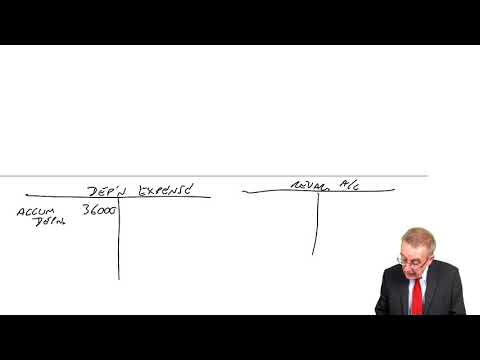
The depreciation charge will be higher than it was before the revaluation, and the excess of the new charge over the old charge should be transferred from the revaluation reserve to retained earnings.
Purpurs has a year end of 31 December each year.
In his Statement of Financial Position as at 31 December 2002 he has buildings at a cost of $3,600,000 and accumulated depreciation of $1,080,000.
His depreciation policy is to charge 2% straight line.
On 30 June 2003, the building is to be revalued at $3,072,000. There is no change in the remaining estimated useful life of the building.
Show the relevant ledger accounts for the year to 31 December 2003.
12 Preference Shares
All the shares that we have referred to so far in this chapter have been what are known as ordinary shares (or equity shares). All limited companies must have ordinary shareholders - these shareholders are entitled to vote at meetings, and the dividends they receive are not certain, they depend largely on the level of profit that the company has made.
Some companies have in addition what are known as preference shares. These shares receive a fixed dividend each year that has to be paid to them, and the ordinary shareholders are only entitled to their dividends out of whatever profits are left after paying the preference dividends.
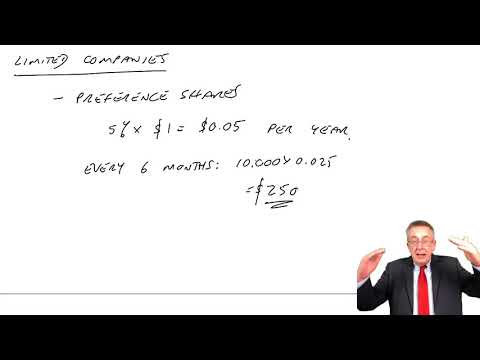
A company has in issue 10,000 5% Preference Shares of $1 each. The dividend is payable half-yearly.
How much dividend will the company pay each time?
Preference shares can be either redeemable, which means they will be repaid on a fixed date in the future, or irredeemable, which means that they will never be repaid.
Redeemable preference shares are effectively the same as long-term loans, and therefore the dividends are shown together with interest on the Statement of Profit or Loss, and the nominal value of the shares is shown on the Statement of Financial Position under the heading “Non-current liabilities”.
Irredeemable preference shares are more like ordinary shares (except for the fixed dividend) and therefore the dividends do not appear in the Statement of Profit or Loss, and the nominal value appears under the heading “Capital” on the Statement of Financial Position.
13 The Statement of Comprehensive Income
Although unrealised profits (which for this exam this will only ever mean profit on revaluation) do not appear in the Statement of Profit or Loss, to show more clearly what is happening a company is required to produce a Statement of Comprehensive Income.
This is identical to the Statement of Profit or Loss, but any profit on revaluation is shown at the very end - after the profit for the year.
$ | |
Revenue | 100,000 |
Cost of sales | (40,000) |
Gross profit | 60,000 |
Other income | 2,000 |
62,000 | |
Distribution costs | (26,000) |
Administrative expenses | (9,000) |
27,000 | |
Finance costs (Interest) | (2,000) |
Profit before tax | 25,000 |
Company Tax expense | (5,000) |
Profit for the year | 20,000 |
Other Comprehensive Income | |
Surplus on the revaluation of non-current assets | 5,000 |
Comprehensive Income for the year | 25,000 |
14 The Statement of Changes in Equity
Share capital | Share premium | Revaluation reserve | Retained Earnings | Total | |
$ | $ | $ | $ | $ | |
Balance b/f | 40,000 | - | - | 27,000 | 67,000 |
Surplus on revaluation | 5,000 | 5,000 | |||
Net profit for the period | 20,000 | 20,000 | |||
Dividends paid | (5,000) | (5,000) | |||
Issue of share capital | 10,000 | 10,000 | 20,000 | ||
Balance c/f | 50,000 | 10,000 | 5,000 | 42,000 | 107,000 |
Accounting for Limited Companies
5 questionsAnswer the questions one at a time. Your progress is saved so you can leave and come back.
Open chapter practice