

Transfer pricing sounds like a tax topic, but in ACCA Performance Management (PM) it starts with a much simpler question: when one division supplies another division, what price should appear in their accounts?
In a simple single-country, pre-tax example, that internal price does not change the group’s profit by itself. It moves reported profit from one division to another. The trouble begins when divisional managers use those reported profits to make decisions, earn bonuses or judge whether an internal trade is worthwhile. A poorly chosen transfer price can make a sensible group decision look unattractive to one division. Cross-border tax and customs effects are considered later in this guide.
Important for September 2026 to June 2027: transfer pricing is examined in PM as part of divisional performance. The syllabus now explicitly includes the objectives of a transfer-pricing system and multinational considerations. Transfer pricing has been removed from APM for this syllabus year.
Reviewed 16 July 2026 against the current ACCA PM syllabus and ACCA transfer-pricing guidance.
1. Begin with the group—not the transfer price
Suppose Division A manufactures a component for $30 and transfers it to Division B for $50. Division B adds further costs of $20 and sells the completed product outside the group for $90.
Per unit | Division A | Division B | Group |
|---|---|---|---|
External revenue | – | $90 | $90 |
Transfer revenue/(cost) | $50 | ($50) | – |
Division’s own cost | ($30) | ($20) | ($50) |
Reported profit | $20 | $20 | $40 |
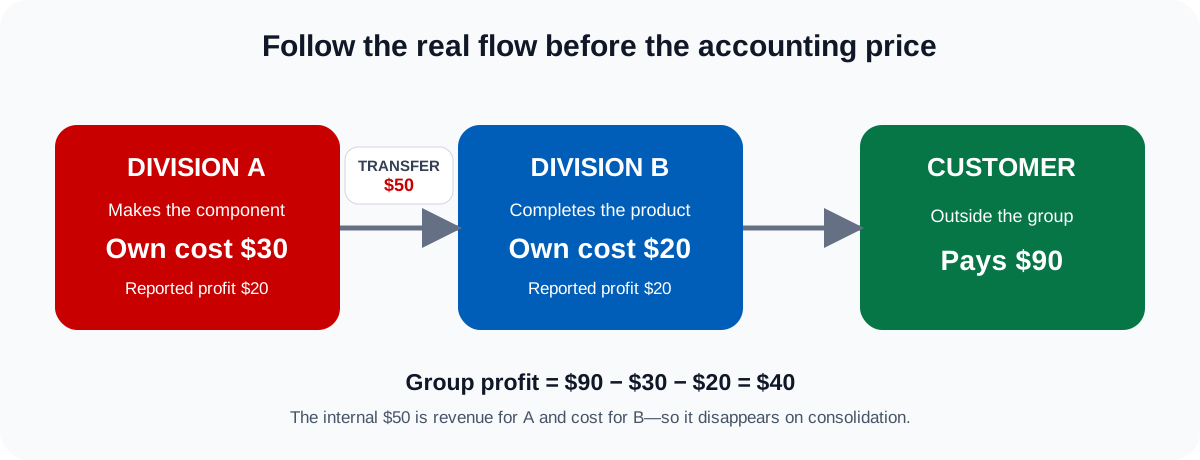
The transfer price is income for A and the same amount is a cost for B, so it cancels when group profit is calculated.
If the transfer price rises to $55, A’s profit becomes $25 and B’s profit falls to $15. Group profit remains $40. This gives us the first rule:
In this simple pre-tax setting, a transfer price reallocates profit; it does not create group profit. It affects group profit when it changes what people decide to produce, buy, sell or invest in. Cross-border tax and customs effects can also change the group’s after-tax result.
2. What should a good transfer-pricing system achieve?
A good system tries to satisfy several objectives at once:
Goal congruence: a decision that improves a division’s profit should also improve total group profit.
Fair performance measurement: divisional profit, return on investment (ROI) and residual income (RI) should not be distorted by an arbitrary internal charge.
Divisional autonomy: managers should have meaningful control over the decisions for which they are held responsible.
Motivation: both divisions should have a reason to trade and improve performance.
Useful information: the price should support sound short-term and long-term decisions.
Simplicity and transparency: managers should understand how the price is calculated and why it is being used.
These objectives can conflict. A variable-cost price may encourage the correct group decision but leave the selling division reporting a loss after fixed costs. A market price may appear independent and fair but can make the buying division reject an internal transfer that would benefit the group.
3. Understand the main cost-based approaches
Basis | Why it might be used | Main weakness |
|---|---|---|
Variable cost | Shows the incremental production cost and can support goal-congruent short-term decisions when capacity is available. | The selling division receives no contribution toward fixed costs or profit, so reported performance and motivation may suffer. |
Full cost | Allows the selling division to recover an allocation of fixed costs. | The buying division may incorrectly treat transferred fixed cost as a relevant cost and reject business that would contribute to group profit. |
Cost plus | Adds a profit margin for the selling division and may improve motivation. | The mark-up is often arbitrary and can worsen dysfunctional decisions in the buying division. |
Standard cost | Keeps selling-division inefficiency out of the price charged to the buyer and supports responsibility accounting. | A poor or outdated standard will still distort results, and agreement is needed about who bears variances. |
Actual cost passes inefficiency to the receiving division: if A wastes material, B pays more. Using a standard variable or standard full cost keeps the related variance in A, where the cost was controlled. That normally gives a cleaner performance signal.
4. Why full cost can lead to the wrong decision
Assume A has spare capacity, its variable cost is $18 and its full cost is $30. B adds a variable cost of $10. If the final selling price falls to $35:
with a full-cost transfer price of $30, B sees a cost of $40 ($30 + $10) and rejects the sale;
but the group’s relevant cost is only $28 ($18 + $10); and
the group would earn a contribution of $7 ($35 − $28).
B’s decision is sensible for B’s reported profit but wrong for the group. This is dysfunctional decision-making: the transfer price has made divisional and group objectives point in different directions.
5. Learn the seller’s minimum transfer price
Start from the selling division’s point of view:
Minimum transfer price = marginal cost of transfer + opportunity cost
The opportunity cost is the contribution lost from the best alternative use of the resources.
When the selling division has spare capacity
If A can make the internal units without giving up external sales, the opportunity cost is zero. If variable cost is $18:
Minimum transfer price = $18 + $0 = $18
This is the economic minimum, not necessarily a price A’s manager will happily accept. A may negotiate for a contribution toward fixed costs and profit.
When the selling division is at full capacity
Suppose A can sell every unit externally for $40. An external sale incurs $2 of packaging and delivery that would be avoided on an internal transfer. A’s net external receipt is therefore $38.
The opportunity-cost method gives the same answer:
marginal production cost: $18;
external contribution forgone: $40 − $2 − $18 = $20; therefore
minimum transfer price: $18 + $20 = $38.
At $38, A is indifferent between selling internally and externally. Always adjust for costs saved by internal trading.
When only some spare capacity exists
Do not force one opportunity cost onto every unit. If A has spare capacity for 2,000 units but B requires 5,000, the first 2,000 units may have a minimum price equal to variable cost. The remaining 3,000 displace external sales and include an opportunity cost. Show the two blocks separately unless the requirement specifically asks for an average price.
6. Learn the buyer’s maximum transfer price
Now switch perspective. The buying division will not normally pay more internally than the best external alternative.
If B can buy an equivalent component externally for $42, its maximum internal price is normally $42, adjusted for relevant differences in quality, delivery, risk or internal purchasing costs.
If there is no external source, the upper limit can be the net marginal revenue generated by B: final marginal revenue less B’s own marginal costs.
If B can sell the finished product for $90 and incurs its own variable costs of $10, the maximum transfer price consistent with earning a contribution is:
Net marginal revenue = $90 − $10 = $80
7. Find the acceptable range
A negotiated transfer is possible when the seller’s minimum does not exceed the buyer’s maximum.
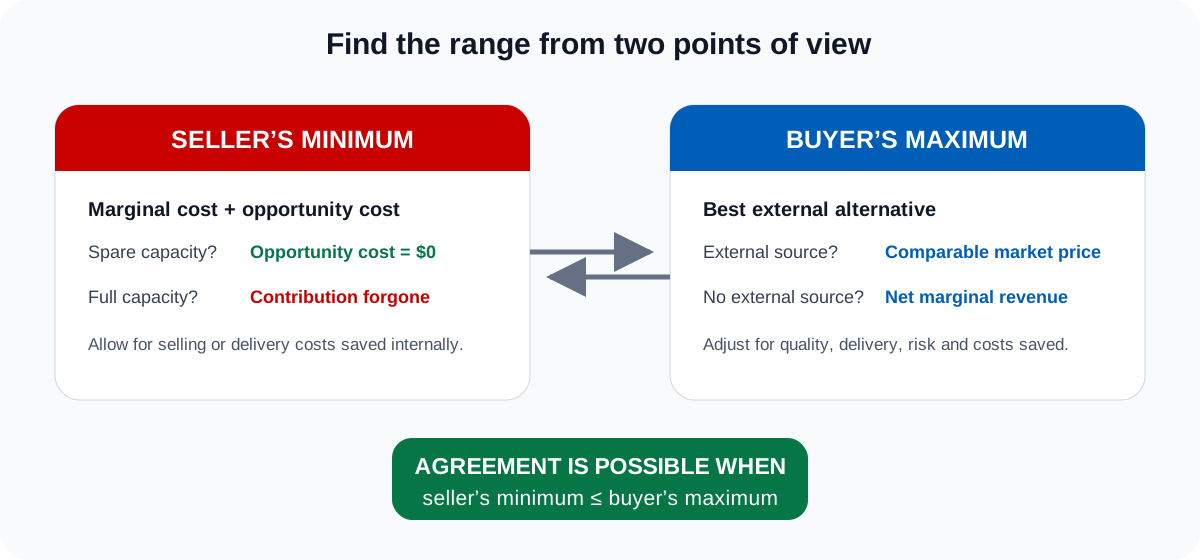
Calculate the limits from two perspectives: the seller protects its best alternative; the buyer protects its best alternative.
Scenario | Seller’s minimum | Buyer’s maximum | Negotiation range |
|---|---|---|---|
A has spare capacity; no external component market; B sells at $90 and adds $10 variable cost | $18 | $80 | $18 to $80 |
A is at full capacity; net external receipt is $38; B can buy externally for $42 | $38 | $42 | $38 to $42 |
If the minimum exceeds the maximum, the divisions will not voluntarily agree to trade on the facts given. Do not invent a range by reversing the numbers. Explain the conflict and consider whether head office should intervene, whether external trading is better, or whether costs, capacity or product differences change the analysis.
8. What an intermediate market changes
An intermediate market exists when the transferred component or service can be traded outside the group. Divisions may be allowed to buy or sell externally, which supports autonomy and supplies an observable market price.
A market-based price can be perceived as fair and allows comparison with independent suppliers. But check:
whether the external product is genuinely comparable in quality and specification;
whether the quoted market price applies to the relevant quantity;
whether internal transfers avoid selling, delivery, purchasing or credit-control costs;
whether the selling division has spare capacity;
whether an external supplier is reliable; and
whether divisions are truly free to trade or head office can intervene for group benefit.
“Use market price” is therefore not a complete answer. State which market price, make relevant adjustments and explain how the divisions and group will respond.
9. Explain how transfer prices distort performance
A high transfer price increases A’s profit and reduces B’s profit; a low price does the opposite. This can alter:
divisional profit, ROI and RI;
bonuses and management motivation;
decisions to trade internally or externally;
pricing and output decisions in the receiving division;
investment decisions and apparent cash inflows; and
head office decisions about rewarding, investing in or closing divisions.
A manager should be evaluated on controllable performance. If head office imposes both the internal trade and its price, it is unfair to treat the resulting profit as entirely the divisional manager’s achievement or failure. A good discussion links the price to a decision or behaviour; merely saying “profit changes” is not enough.
10. Multinational transfer pricing: know the issues, not a tax textbook
When divisions are in different countries, the transfer price determines how much profit is reported in each jurisdiction. PM requires awareness of the issues—not detailed international tax calculations.
Different tax rates: a group may have an incentive to report more profit in a lower-tax country, but tax authorities generally expect related-party transactions to follow an arm’s-length basis.
Customs duties and withholding taxes: a higher import value can increase duties, while other taxes may apply to cross-border payments.
Tax-authority scrutiny: unsupported prices can lead to adjustments, penalties, disputes and possible double taxation.
Exchange controls and profit remittance: local rules may restrict payments or the movement of cash to the parent.
Currency risk: exchange-rate movements can change the real burden on the buying division and the return to the seller.
Performance fairness: a price selected for group tax or treasury purposes may give a misleading picture of the local manager’s controllable performance.
Ethics, law and reputation: the group must balance tax efficiency with compliance, transparent documentation and stakeholder trust.
In an exam answer, recognise the tension: one price may be used to achieve a group-level international objective but be unsuitable for motivating or measuring a local division. State the issue clearly rather than claiming that the lowest tax outcome must automatically be best.
11. A reliable PM exam method
Draw the flow. Identify the selling division, buying division and external customer or supplier.
Calculate group economics first. Ignore the internal price and identify external revenues and relevant group costs.
Take the seller’s view. Calculate marginal cost plus opportunity cost and check capacity.
Take the buyer’s view. Identify the external purchase price or net marginal revenue.
State the range. Do not give a single negotiated price unless the requirement or facts justify it.
Discuss behaviour. Explain motivation, autonomy, goal congruence, performance measurement and likely decisions.
Conclude for the group. Recommend a policy that fits the scenario rather than repeating a memorised rule.
Common exam trap: fixed cost matters for long-run profitability and performance reporting, but an allocated fixed cost is not automatically an incremental cost of one more transfer. Keep the short-run decision calculation separate from the evaluation of whether each division can report a fair profit.
12. Quick self-check
Can you explain why changing the transfer price does not directly change group profit?
Can you calculate a minimum price with spare capacity, full capacity and partial spare capacity?
Can you calculate the buyer’s maximum from an external price or net marginal revenue?
Can you explain why full cost can cause dysfunctional decisions?
Can you compare variable, full, cost-plus, standard-cost and market-based approaches?
Can you discuss autonomy, goal congruence, motivation and controllability?
Can you identify the main multinational issues without drifting into detailed tax rules?
13. Continue studying with OpenTuition
The OpenTuition transfer-pricing rule: calculate the group benefit first, protect the seller’s alternative, protect the buyer’s alternative, then choose a price or range that encourages both divisions to make the right decision.