

New for the 2026–27 PM syllabus: use our complete Transfer Pricing for ACCA PM guide for cost and market bases, minimum and maximum prices, divisional decisions and multinational considerations.
ACCA Performance Management (PM) is not an exam about producing calculations for their own sake. It asks whether you can use management accounting information to help an organisation plan, make decisions, control operations and assess performance.
That distinction changes how you should study. You need accurate technique, but a number is rarely the end of the answer. You must understand what the number means, connect it to the scenario and explain what management should conclude or do next.
This is the PM exam study guide. It explains what to learn and how to turn that learning into a pass. For the separate resource-by-resource workflow, see How to Study for ACCA PM Using OpenTuition.
Reviewed 15 July 2026 for the ACCA PM syllabus applicable from September 2026 to June 2027.
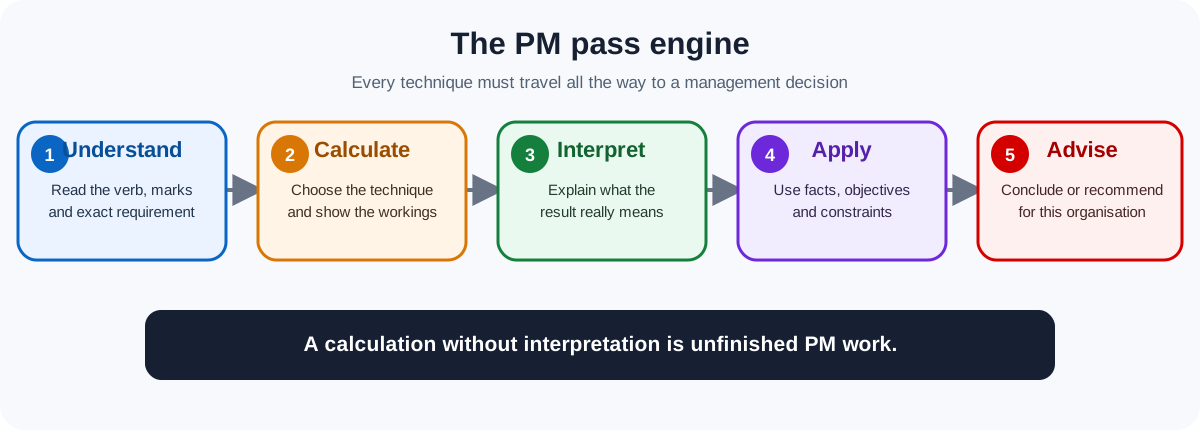
1. Understand what PM is really examining
PM builds on Management Accounting (MA), but the intellectual step is important. In MA you learn many of the building blocks. In PM you are expected to select and apply techniques in less obvious situations, combine numerical and qualitative information and discuss performance in context.
The official syllabus has six connected capabilities:
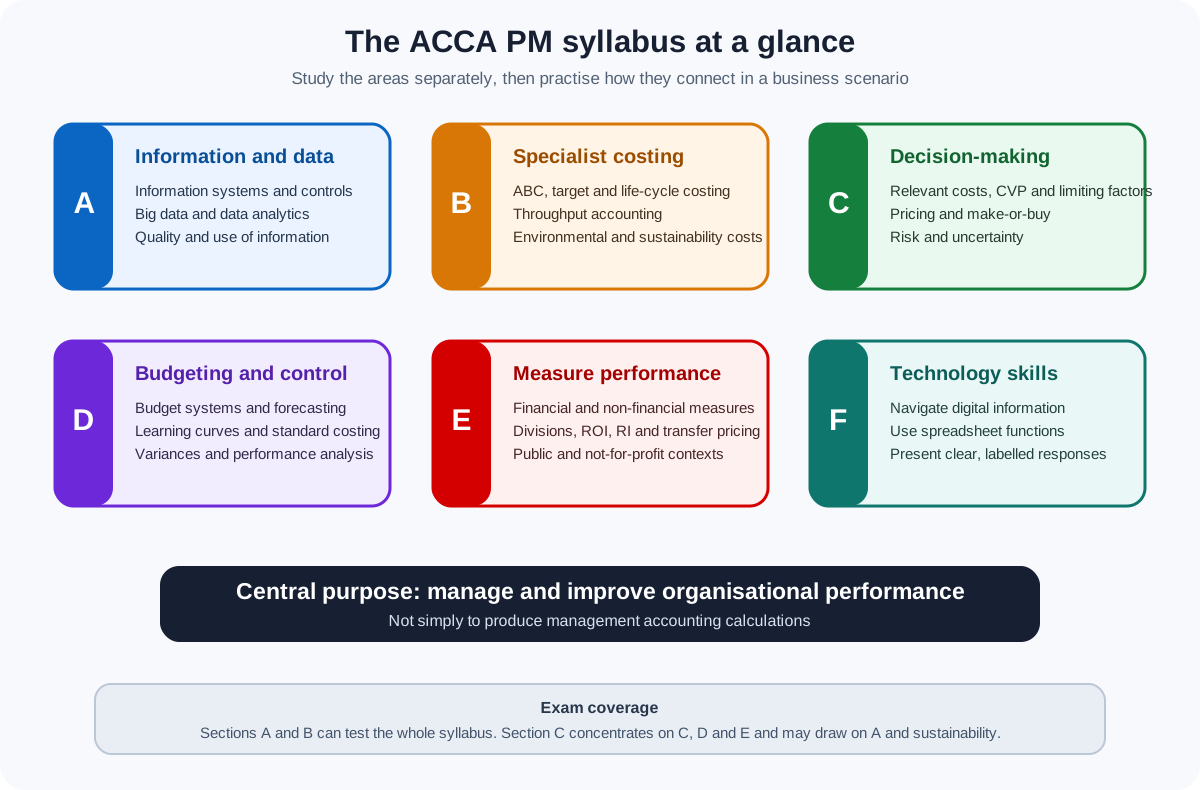
A. Management information systems and data analytics
You need to understand how organisations collect, control and use information. This includes the role of information systems, the qualities of useful information, controls over data, big data and data analytics.
How to study it: do not reduce this area to definitions. Ask what information a manager needs, whether the source is reliable, how quickly it is available and how poor information could distort a decision or performance measure.
B. Specialist cost and management accounting techniques
This area includes activity-based costing, target costing, life-cycle costing, throughput accounting and accounting for environmental and sustainability factors.
How to study it: for every method, learn the calculation, the business problem it is intended to solve, the assumptions it makes and the circumstances in which it is more useful than a traditional approach. A question can test the method and its implications.
C. Decision-making techniques
This includes relevant costs, cost-volume-profit analysis, limiting factors, pricing, make-or-buy and other short-term decisions, and risk and uncertainty.
How to study it: identify the decision first. Then decide which cash flows, constraints and risks are relevant. Do not mechanically include every figure in the scenario. The exam is testing selection as well as arithmetic.
D. Budgeting and control
This area covers budgetary systems, analytical and forecasting techniques, learning curves, standard costing, mix and yield variances, planning and operational variances and performance analysis.
How to study it: connect every variance to a possible operational cause and a management response. Learn the behavioural strengths and weaknesses of budgeting approaches, not just the process used to prepare a budget.
E. Performance measurement and control
This is a major PM area. It includes financial and non-financial measures, private, public and not-for-profit organisations, divisional performance, return on investment, residual income and transfer pricing.
How to study it: practise analysing several indicators together. Good performance analysis uses an appropriate comparator, recognises trade-offs and explains what may be causing the movement. Simply saying that a percentage increased or decreased is usually only an observation.
F. Employability and technology skills
You are expected to navigate digital information, use spreadsheet functionality and present clear responses in the computer-based exam. These skills cannot be learned from a book. They must be practised in the CBE environment.
Study rule: never learn a PM formula without knowing which management decision it supports, what its answer means and what could make that answer unreliable.
2. Know the exam before planning your study
The current PM exam is a three-hour computer-based exam. ACCA provides an additional 10 minutes before the exam for reading the instructions. All questions are compulsory, the pass mark is 50% and a formula sheet is provided.
| Section | Structure | Marks | What this means for study |
|---|---|---|---|
| A | 15 objective test questions worth 2 marks each | 30 | You need broad coverage. Any syllabus area can appear. |
| B | 3 case-style questions, each containing 5 objective test items worth 2 marks | 30 | You must extract relevant information from a common scenario, not just recall isolated facts. |
| C | 2 constructed response questions worth 20 marks each | 40 | You need clear spreadsheet workings and applied written analysis. |
One Section C question comes from performance measurement and control. The other comes from decision-making and/or budgeting and control. Section C may also draw on information systems, data analytics and environmental or sustainability issues. Sections A and B can test the entire syllabus.
A sensible time plan
With 180 working minutes for 100 marks, the basic rate is 1.8 minutes per mark. That gives approximately:
- 54 minutes for Section A;
- 54 minutes for Section B; and
- 72 minutes for Section C - 36 minutes for each 20-mark question.
This is a control system, not a prediction of how long every individual objective question will take. Some two-mark questions take longer than others. Manage each section as a whole, protect the 72 minutes needed for Section C and move on when a question is consuming time without producing marks.
3. Repair the MA foundation before building PM on top
PM assumes that you retain important MA knowledge. A weak foundation makes the new material feel much harder because you are trying to learn two levels at the same time.
Before starting the main PM course, test whether you can still handle:
- cost classification and cost behaviour;
- marginal and absorption costing;
- overhead allocation, apportionment and absorption;
- basic break-even and contribution analysis;
- fixed and flexible budgets;
- basic materials, labour, variable overhead, fixed overhead and sales variances; and
- simple performance ratios and interpretation.
Do a short diagnostic rather than rereading the whole MA course. Attempt questions from a blank page or spreadsheet. If you cannot begin a question, rebuild that topic using the relevant OpenTuition MA notes and lectures. If you can complete it but make a small error, record the error and continue.
Do not spend several weeks passively revising all of MA. Repair only the foundations that your diagnostic proves are weak, then start PM and keep revisiting them through questions.
4. Learn PM in an order that develops judgement
The published OpenTuition course order gives you a complete teaching route. At the strategic level, however, it also helps to understand why the topics build in this sequence:
| Study stage | Main focus | Capability you are building |
|---|---|---|
| Foundation | MA assumed knowledge and information quality | Recognise what reliable management information looks like. |
| Costing | ABC, target, life-cycle and throughput costing | Understand how different cost information changes management attention. |
| Decisions | Relevant costs, CVP, constraints, pricing, make-or-buy and risk | Select information and recommend an action. |
| Planning and control | Budgets, forecasting, learning curves and variances | Set expectations, compare actual results and investigate causes. |
| Performance | Financial, non-financial, divisional and public-sector measures | Assess performance without being misled by one measure. |
| Integration | Data, sustainability, technology and mixed scenarios | Connect the whole syllabus in exam-standard cases. |
Do not wait until the end to practise questions. The correct pattern is learn a manageable block, attempt questions, review the weaknesses and then continue. Your final revision phase should be for integration and speed, not the first time you discover whether you can answer a question.
5. Use OpenTuition as an active study system
OpenTuition gives you a complete PM teaching route, but the resources only work when you use them actively. Watching every lecture without attempting questions can create familiarity, but familiarity is not the same as being able to produce an answer under exam conditions.
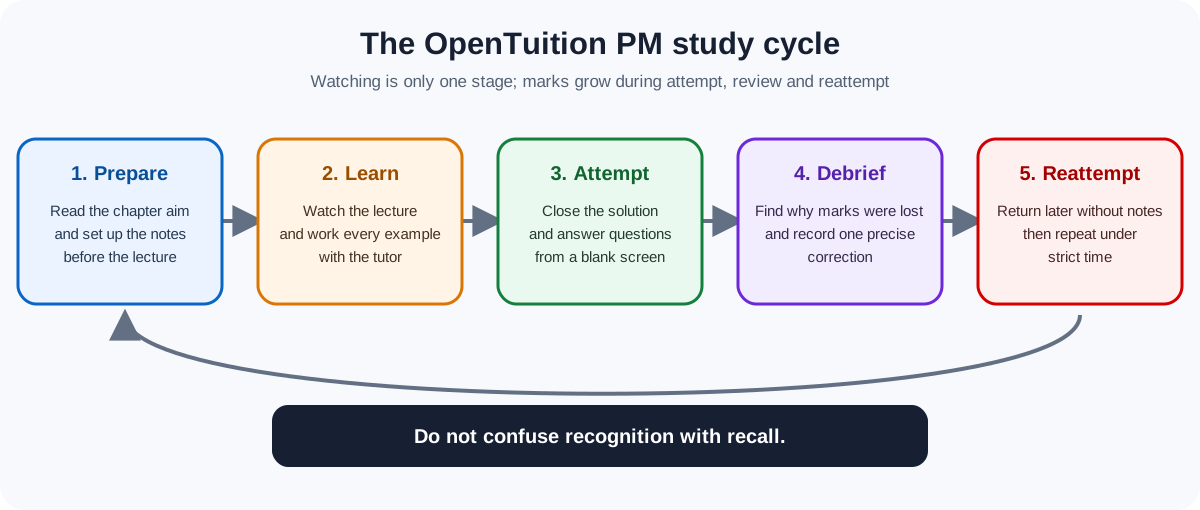
Step 1: Prepare with the notes
Open the relevant chapter in the free PM notes. Read the chapter objectives, scan the headings and identify the examples that will be completed in the lecture. Do not try to memorise the chapter before the teaching begins.
Step 2: Learn with the lecture
Watch the matching PM lecture with the notes beside you. Pause before the tutor completes an important step and try it yourself. Add short annotations explaining the reason for a step, an assumption or a common trap. Copying everything the tutor says is not useful revision.
Step 3: Attempt without support
Use the PM practice questions after the chapter. Close the solution and lecture. Attempt the question from a blank page or spreadsheet. If you look at the first line of the answer, you have tested recognition rather than recall.
Step 4: Debrief the attempt
Mark the work and identify the exact reason for every material loss of marks:
- knowledge: you did not know the rule or technique;
- selection: you knew several methods but chose the wrong one;
- requirement: you answered only part of the instruction;
- application: your discussion was generic rather than linked to the scenario;
- spreadsheet: workings, labels, formulae or rounding were unclear; or
- time: you knew the work but could not produce it quickly enough.
An error log should contain the correction you will make, not just the topic name. Write, for example, “I included an unavoidable fixed cost in a make-or-buy decision” rather than merely “relevant costing”.
Step 5: Reattempt later
Return to the question several days later and attempt the weak requirement again without the answer. Later in your course, reattempt it under strict timing. Improvement is demonstrated by a better independent answer, not by understanding the published solution when it is in front of you.
6. Learn calculations as management tools
For every calculative technique, prepare a one-page method sheet containing five things:
- Purpose: what decision or performance question does the technique address?
- Inputs: which figures are relevant and which should be excluded?
- Method: what is the logical sequence of workings?
- Meaning: how should the result be interpreted?
- Limitations: what assumptions, uncertainty or behavioural effect could weaken the conclusion?
Examples of this approach include:
- Target costing: do not stop at calculating a cost gap. Explain how value engineering, product design and supplier relationships might close it, and recognise the risk of harming quality.
- Throughput accounting: identify the bottleneck, calculate return per bottleneck hour and explain why improving a non-bottleneck may not improve total throughput.
- Relevant costing: justify why a cash flow changes because of the decision. A cost is not relevant merely because it appears in the accounting records.
- CVP: calculate the required measure, then discuss sensitivity to sales mix, selling price, variable costs, fixed costs and the assumptions of the model.
- Variances: calculate accurately, then suggest plausible causes, connections between variances and appropriate investigation. Avoid presenting speculation as fact.
- ROI and residual income: calculate both, then discuss whether the measures encourage decisions consistent with the organisation's objectives.
If you cannot explain a result in plain language to a manager, you have not finished learning the technique.
7. Build narrative marks deliberately
Written PM answers are not essays. They are collections of relevant, developed points. A useful structure for an applied point is:
- Observation: identify the important result, trend or issue.
- Meaning: explain why it matters or what may be causing it.
- Implication: connect it to an objective, risk, decision or management action.
For example, “customer complaints increased” is only an observation. A developed answer would compare that movement with a relevant service or quality measure, explain the possible operational significance and identify what management should investigate. The scenario determines the point; a memorised paragraph does not.
When practising narrative requirements:
- use a heading that mirrors the requirement;
- write one developed idea per paragraph;
- use names, objectives and data from the scenario;
- distinguish evidence from a possible explanation;
- answer the verb used - “identify”, “explain”, “discuss” and “evaluate” require different depth; and
- stop when the marks and time have been used.
8. Prepare for Sections A and B: breadth plus disciplined workings
Sections A and B represent 60 marks and can test the whole syllabus. Question spotting is therefore dangerous. You need enough coverage to attempt every topic and enough practice to recognise when a familiar technique is presented in an unfamiliar way.
For objective questions:
- read the requirement and every answer option carefully;
- perform the calculation rather than selecting an option that merely looks plausible;
- watch units, signs, time periods and whether the question asks for a total, percentage or rate;
- for a case question, identify which scenario facts apply to each item;
- do not let one difficult two-mark item consume the time needed for several attainable items; and
- practise mixed sets, because a real exam will not announce the chapter before each question.
Use PM flashcards for definitions, assumptions and quick retrieval, but never treat them as a substitute for calculations or scenario questions.
9. Prepare for Section C: this is where method becomes performance
Each Section C question is worth 20 marks and should receive approximately 36 minutes. Practise the complete routine until it becomes normal.
Read the requirements before the scenario
For each requirement, identify:
- the instruction verb;
- the subject or technique;
- the organisation or perspective;
- every separate task joined by words such as “and”; and
- the mark allocation.
Then read the scenario to find the information needed for those tasks. This is more efficient than highlighting everything and deciding later whether it matters.
Use the spreadsheet as a working paper
Set out one logical calculation per labelled row or section. Use cell formulae rather than typing separately calculated results. Follow any template and rounding instruction exactly. Clear workings make the method visible and reduce the risk of transcription and rounding errors.
If an early number is wrong, do not abandon the question. Continue consistently, show the method and interpret the result you obtained. Valid subsequent work may still earn marks.
Answer every part of the requirement
A common PM requirement combines a calculation with explanation, discussion or analysis. The written part is not optional. If the requirement says “calculate and explain the implications”, a perfect calculation answers only part of the question.
Analyse rather than restate
Repeating that revenue fell, costs rose or a ratio changed does not by itself explain performance. Compare the result with a target, prior period, competitor, market movement or organisational objective. Then explain the significance and any connection with other measures.
10. Turn examiner feedback into a checklist
The latest available ACCA PM examiner's report at the time of review highlights recurring lessons that should directly shape your practice:
- Read the exact requirement. Candidates can perform the technique but lose marks by missing a second task or discussing the wrong effect.
- Apply the answer. Generic knowledge does not earn the same credit as analysis linked to the organisation and its circumstances.
- Show workings. Clear spreadsheet formulae and labels help the marker follow partially correct work.
- Follow presentation instructions. Units, templates and specified decimal places matter.
- Add insight. In performance measurement, do not merely repeat a calculated movement. Explain its significance and link related indicators.
- Use the software. Typing an isolated final number creates avoidable transcription and rounding risks.
Use examiner reports after attempting the related question, not as reading material in isolation. First produce your answer, then compare it with the published solution and examiner observations. Convert each observation into one behaviour you will use in the next question.
11. A realistic ten-week PM study plan
This plan assumes regular weekly study and should be adapted to your available hours. Keep at least one short cumulative review session every week so earlier topics do not disappear while you study later ones.
| Week | Main work | Required output |
|---|---|---|
| 1 | Set up the CBE environment, read the syllabus and diagnose MA assumed knowledge. | A targeted MA repair list, study calendar and first error-log entries. |
| 2 | Information systems, data analytics and specialist costing techniques. | Chapter questions plus short explanations of the purpose and limitations of each costing method. |
| 3 | Relevant costing, CVP and short-term decisions. | Structured workings and applied recommendations, not calculation-only answers. |
| 4 | Limiting factors, pricing, make-or-buy, risk and uncertainty. | Mixed decision questions and a method sheet for each technique. |
| 5 | Budgeting systems, forecasting, learning curves and behavioural issues. | Questions combining calculations with evaluation of budgeting methods. |
| 6 | Standard costing, mix and yield, planning and operational variances. | Accurate calculations plus plausible, connected performance analysis. |
| 7 | Financial and non-financial performance measurement. | One complete timed Section C performance-measurement question. |
| 8 | Divisional performance, transfer pricing, public and not-for-profit contexts; revisit data and sustainability. | Mixed objective sets and one complete timed Section C decision/budget question. |
| 9 | Revision lectures, mixed question practice and targeted repair of the error log. | Two timed 20-mark questions plus mixed Sections A and B practice. |
| 10 | At least two full mock attempts in the Practice Platform, with complete debriefs. | A final weak-area list, reattempts and an exam-day time plan. |
If you have only six weeks, combine weeks 2 and 3, weeks 4 and 5, and weeks 6 and 7, but do not delete syllabus areas or remove the mock/debrief phase. A compressed plan requires more weekly hours; it does not make the exam smaller.
12. Use mocks to improve, not merely to predict
A mock score is useful, but the debrief is more valuable than the number. Review the attempt under five headings:
- Coverage: which marks were unavailable because the topic had not been learned?
- Technique: which marks were lost despite knowing the topic?
- Application: where did the answer ignore the scenario or fail to develop a point?
- Technology: where did navigation, spreadsheet use or presentation slow you down?
- Time: which requirements received too much or too little time?
Then schedule reattempts. Do not respond to every weak mark by rewatching lectures. If the knowledge was present but execution failed, the remedy is another question under improved conditions.
13. Your PM readiness gate
You are approaching exam readiness when you can honestly say:
- I have covered the whole syllabus and have no deliberately abandoned area.
- I can complete mixed objective questions without being told the topic first.
- I can produce a 20-mark performance-measurement response in about 36 minutes.
- I can produce a 20-mark decision-making or budgeting response in about 36 minutes.
- My spreadsheet workings are labelled, formula-driven and easy to follow.
- I explain my calculations using scenario facts and management objectives.
- I have completed and debriefed at least two full mocks in the CBE Practice Platform.
- My timed performance is consistently above the 50% pass mark, with a sensible margin rather than dependence on one favourable question.
No checklist guarantees a pass. Its purpose is to stop you booking the exam based only on hours watched or chapters read.
OpenTuition PM resources: what to use and when
- PM course hub: your starting point for the complete course.
- PM notes: the structured syllabus backbone and lecture examples.
- PM lectures: full teaching and worked explanations.
- PM practice questions: immediate chapter-level retrieval and application.
- PM revision lectures: exam-standard technique after the core teaching is complete.
- PM revision mock: timed practice and debriefing.
- PM flashcards: rapid retrieval of definitions, rules and assumptions.
- Ask the PM tutor forum: focused help after you have attempted the work yourself.
- PM AI tutor: additional guided practice and explanations.
Official ACCA resources to use alongside the course
- PM syllabus and study guide - confirm the exact syllabus applicable to your sitting.
- PM essentials - current exam overview and official study support.
- PM examiner's reports - recent marking observations and common weaknesses.
- Approaching PM constructed response questions - detailed official guidance on Section C.
- PM frequently asked questions - clarification of exam scope and CBE response expectations.
Final advice: start question practice early, show your workings, answer every part of the requirement and never leave a calculation uninterpreted. PM becomes manageable when you treat every technique as a tool for improving a business decision.