

ACCA Strategic Business Reporting (SBR) is not an exam of how many IFRS Accounting Standards you can recite. It is an exam of whether you can analyse a reporting problem, make and explain defensible judgements, calculate the necessary adjustments and communicate the consequences to the people who use financial and sustainability information.
That is why SBR can feel like a large step up from Financial Reporting (FR). At FR, knowing the correct treatment may be enough for many marks. At SBR, you must select the relevant principle from messy facts, apply it to an unfamiliar scenario, show how it changes the statements and explain why the result matters.
This is the SBR exam-pass study guide. It explains what to learn and how to approach the four compulsory questions, including the Q1 spreadsheet, ethics, current issues and stakeholder analysis. For the separate resource-by-resource workflow, see How to Study for ACCA SBR Using OpenTuition.
Reviewed 15 July 2026 for the SBR-INT syllabus and examinable documents applicable from September 2026 to June 2027. If you are entered for a jurisdictional variant, use that variant's current syllabus and examinable documents; the study and answer methods in this guide remain applicable.
1. Understand what SBR is really examining
A strong SBR answer connects six stages. You identify the economically important fact, select the relevant reporting principle, decide the accounting consequence, calculate where necessary, explain presentation or disclosure and then communicate what it means for the relevant stakeholder. Ethics runs through the chain because management incentives and professional pressures may affect the reporting decision.
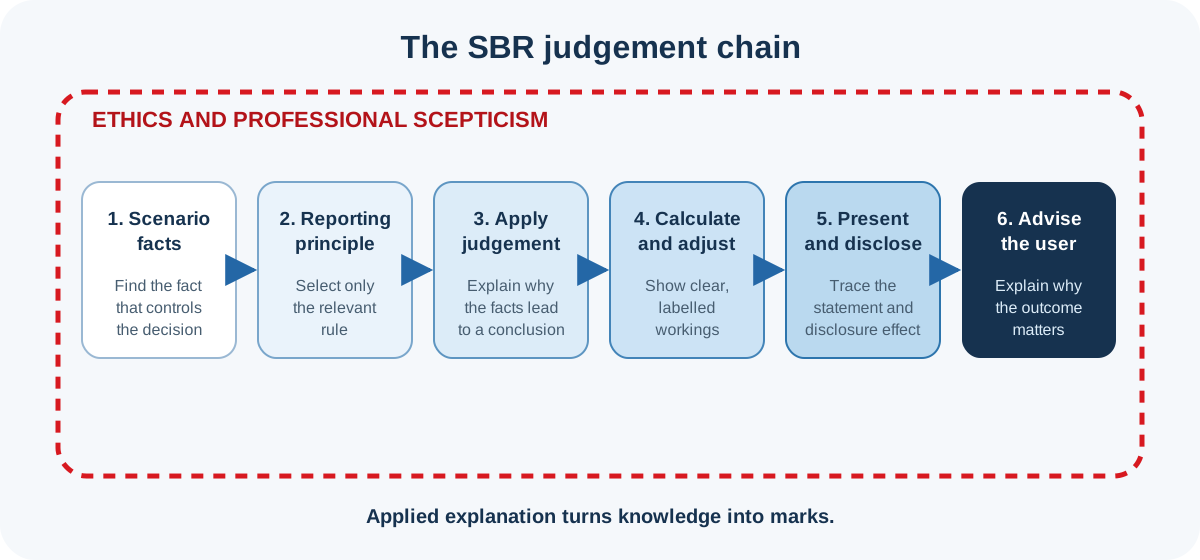
Do not begin an answer by emptying everything you remember about a standard. Begin with the requirement and the scenario. Ask: what decision must I make, which fact controls that decision, and who needs to understand the consequence?
SBR pass rule: technical knowledge opens the door, but applied explanation earns the marks. A correct standard name followed by generic notes is not a complete answer.
2. Know the exam structure and protect your time
SBR is a 3 hour 15 minute computer-based exam. All four questions are compulsory and the pass mark is 50%.
| Question | Typical focus | Marks | Time ceiling |
|---|---|---|---|
| Q1 | Group reporting plus other reporting issues; includes a pre-populated spreadsheet requirement | 30 | About 58 minutes |
| Q2 | Reporting implications and ethical implications in a contemporary scenario; includes 2 professional skills marks | 20 | About 39 minutes |
| Q3 | Any syllabus area, applied to scenario facts | 25 | About 49 minutes |
| Q4 | Any syllabus area, often with investor or other stakeholder focus; includes 2 professional skills marks | 25 | About 49 minutes |
The ceilings use the exam average of 1.95 minutes per mark and deliberately give half the time to each 50-mark section. Planning and reading must happen inside those limits. The latest examiner's report again warns that candidates who over-invest in Q1 often lose accessible marks in Q3 and Q4.
You do not have to answer the questions in numerical order. Starting with the question you understand best can settle you, but record a finish time for every question and obey it. A complete attempt containing concise applied points is usually safer than a polished first half followed by rushed or missing answers.
3. See the syllabus as five connected reporting capabilities
The official syllabus is organised into seven areas, including employability and technology skills. For study purposes, group the technical content into five connected capabilities.
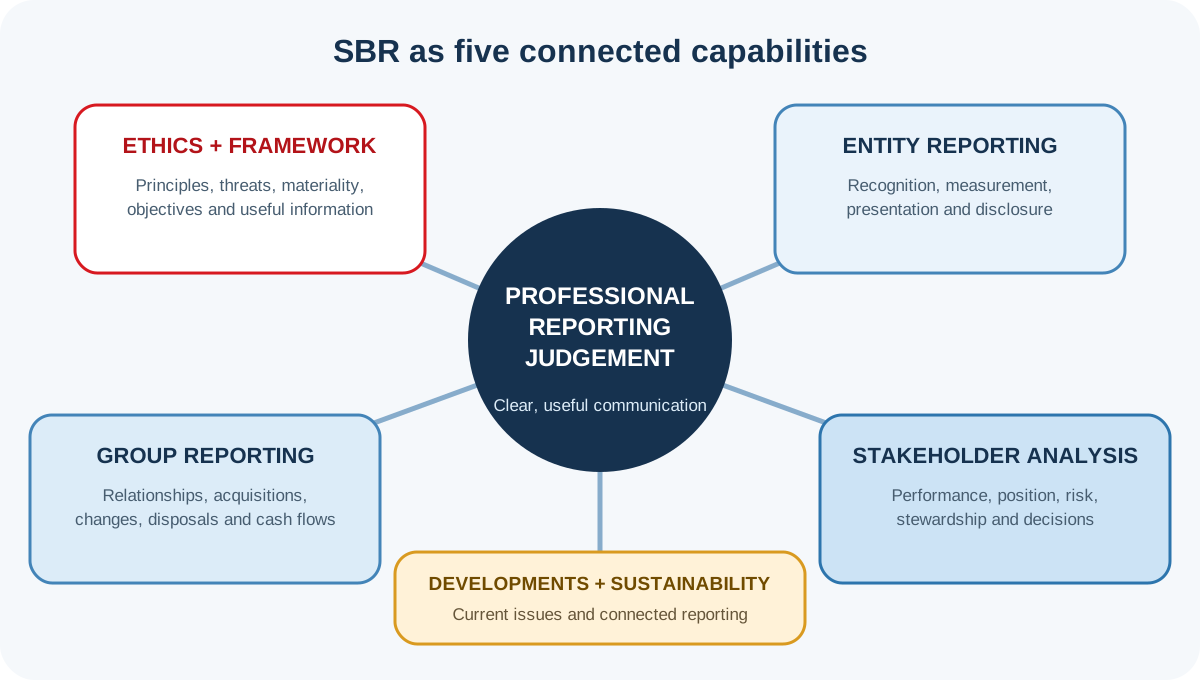
- Ethics and the framework: professional principles, ethical threats, the Conceptual Framework, materiality and the purpose and limitations of corporate reporting.
- Entity reporting: performance, assets, liabilities, financial instruments, tax, employee benefits, share-based payment, leases, revenue, foreign currency and presentation and disclosure.
- Group reporting: control, acquisitions, disposals, goodwill, non-controlling interests, changes in ownership, associates, joint arrangements, foreign operations and group cash flows.
- Stakeholder analysis: interpreting financial and non-financial information and evaluating how reporting choices affect investors and other users.
- Developments and sustainability: changes in reporting regulation, current issues, IFRS Sustainability Disclosure Standards and their usefulness to users.
The current examinable-documents list includes IFRS 18 Presentation and Disclosure in Financial Statements, IFRS 19 Subsidiaries without Public Accountability: Disclosures, and IFRS S1 and IFRS S2. Build your revision list from the current official document rather than an old standards checklist.
4. Make the step from FR knowledge to SBR judgement
FR knowledge remains essential, especially for groups and core standards, but SBR asks a different level of question. Upgrade each topic by adding judgement, disclosure and user impact.
| FR-style preparation | SBR-level preparation |
|---|---|
| State the recognition rule | Identify which scenario facts support or contradict recognition and explain the judgement. |
| Calculate an amount | Show the calculation, explain the treatment and trace the effect through the statements. |
| Prepare a group figure | Explain the group relationship, the accounting logic, the adjustment and any stakeholder consequence. |
| List disclosures | Select disclosures relevant to the scenario and explain how they improve useful information. |
| Quote a standard | Use the principle only as far as needed, then spend most of the answer applying it. |
For every standard, prepare a one-page active summary under seven headings: scope, recognition, initial measurement, subsequent measurement, presentation, disclosure and major judgements. Add an eighth heading: why would an investor or other stakeholder care?
5. Use OpenTuition as an active SBR study system
- Read the matching chapter in the free SBR notes.
- Watch the relevant SBR lecture, pausing before each conclusion.
- Close the notes and reconstruct the rule, judgement and statement effect.
- Attempt an exam-standard requirement in the ACCA Practice Platform.
- Compare it with the marking guide and examiner commentary; rewrite weak paragraphs.
- Record errors by cause: missing knowledge, wrong issue, poor application, weak explanation, spreadsheet error or time control.
Use the SBR flashcards for retrieval, not as a substitute for question practice. Use a current revision kit for breadth and the Ask the SBR Tutor forum when you cannot explain why a treatment follows from the facts.
6. Build answers in mark-earning units
Most SBR written marks can be approached as short, separate units. One well-developed unit usually contains:
- Principle: state the relevant rule or reporting objective briefly.
- Fact: identify the precise fact in the exhibit that makes the principle relevant.
- Application: explain the accounting conclusion or judgement.
- Effect: quantify where possible and identify the affected statement, disclosure or stakeholder decision.
For example, do not write only that a provision requires a present obligation, probable outflow and reliable estimate. Explain which event created the obligation, whether the entity has a realistic alternative, how the amount should be measured and where recognition changes performance and financial position.
Use headings that mirror the requirement. Put separate issues in separate paragraphs. A marker should be able to see each applied point without searching through a long essay.
7. Master the Q1 group and spreadsheet method
Q1 always contains group accounting and uses a pre-populated spreadsheet response option to adjust a draft consolidated financial statement. The spreadsheet element is normally worth 10 to 14 marks, so it is too important to leave until the final weeks.
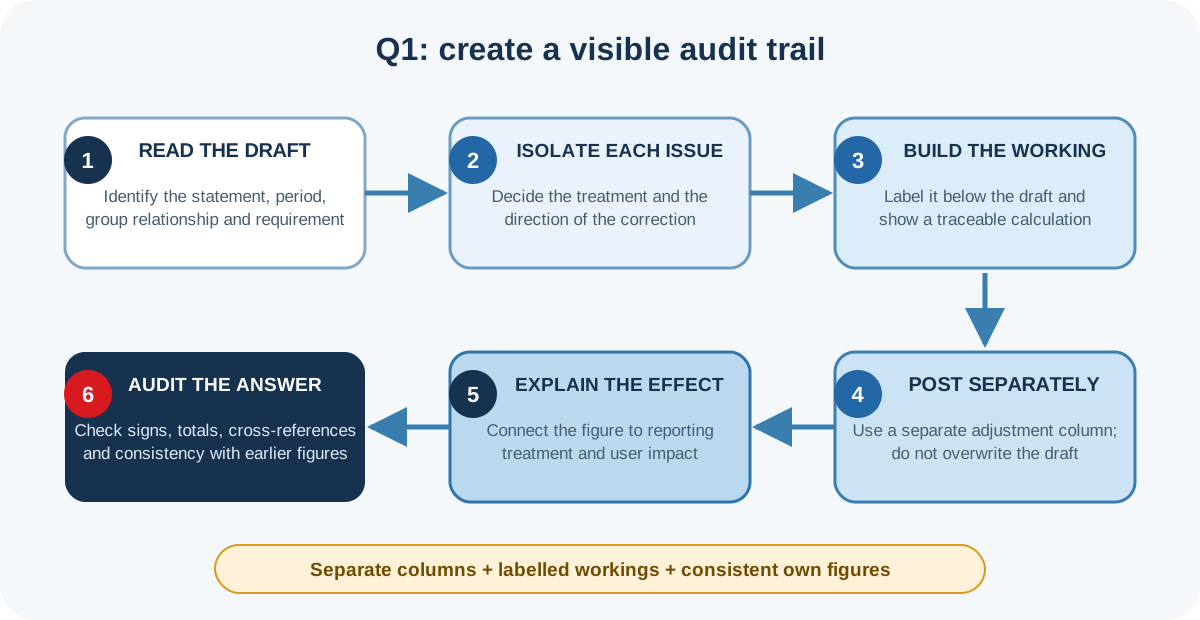
Practise in the ACCA Practice Platform until spreadsheet navigation is automatic. Put each adjustment in a separate column, keep detailed workings below the draft statement, label every working and cross-reference it to the adjustment. Do not overwrite original figures or hide several unexplained changes inside one number.
Pay particular attention to the direction of an adjustment. Before entering it, say aloud or write: increase expense, reduce asset, or the equivalent. Then check that the revised total follows the same direction.
If an earlier figure is wrong, continue consistently. The latest examiner's report confirms that own-figure credit may be available in a later part, but only if the working and logic can be followed.
8. Make group accounting a repeatable sequence
Group scenarios vary, but the control questions are stable:
- What is the relationship - subsidiary, associate, joint arrangement or financial asset - and on what date did it begin or change?
- What was recognised before the change, at the change date and afterwards?
- Which fair-value, consideration, net-asset, goodwill, NCI, exchange or recycling calculations are needed?
- Which group balances, transactions or unrealised profits must be eliminated?
- How does the treatment affect consolidated profit or loss, OCI, equity, financial position or cash flows?
Do not prepare one giant unlabelled calculation. Separate acquisition, post-acquisition movement, disposal and remaining-interest stages. This is especially important when an associate or subsidiary is disposed of but an investment remains, or when exchange differences accumulated in OCI must be considered.
Study group cash flows as a reporting problem, not just a layout. Be able to reconcile group changes, identify cash consideration and distinguish non-cash movements from cash flows.
9. Answer Q2 ethics with analysis and action
Q2 combines reporting implications with ethical implications in a contemporary scenario. The ethical requirement is not satisfied by listing the five fundamental principles or naming threats.
Use this sequence:
- Identify the reporting issue and pressure. Who wants which accounting result, and why?
- Connect the facts to principles and threats. Explain, for example, how bonus pressure creates self-interest and may threaten objectivity or integrity.
- Explain the consequence. What could be misstated, who could be misled and what professional duty is at risk?
- Recommend realistic action. Verify facts, document concerns, discuss them at the appropriate level, seek technical or ethical advice, use governance channels and consider further steps if the issue is not resolved.
Actions must fit the person's role and the facts. "Tell management" is weak if management created the pressure. "Resign immediately" is rarely a complete first response. Strong answers show escalation, evidence, safeguards and professional judgement.
The two professional skills marks reward relevant ethical principles and actions. Clear structure helps, but generic ethical prose does not.
10. Never give calculations without explanation
SBR contains numerical work, but it is predominantly a written exam. Examiner feedback repeatedly notes that calculations alone can make a requirement impossible to pass.
For each calculation:
- label the purpose and units;
- show a short, traceable working rather than one unexplained total;
- state the reporting principle that determines the calculation;
- explain the result using the scenario facts; and
- identify the statement line, disclosure or stakeholder implication.
Equally, do not calculate figures that the requirement does not ask for. The September/December 2025 report describes candidates spending time on an unrequested calculation even though no marks were available. Read the verb and scope before opening a spreadsheet.
11. Prepare Q3 and Q4 across the whole syllabus
Q3 and Q4 can examine any syllabus area. The latest report says Q3 is often the weakest question because candidates spend disproportionate study and exam time on Q1 and Q2, read the requirement poorly or are not prepared across the syllabus.
Build Section B practice sets that deliberately mix topics. A single scenario may connect classification, measurement, presentation, tax, impairment and stakeholder effects. Do not respond to a keyword while ignoring the facts: seeing "operating lease", for example, does not justify writing everything you know about lease accounting if the required treatment concerns a different party or issue.
At least one Section B question requires a stakeholder perspective. Q4 contains the remaining two professional skills marks and is likely to assess communication in an investor-focused context. Discuss effects on performance, financial position, cash flows, risk, comparability, stewardship and the quality of information - not merely whether a ratio rises or falls.
12. Turn financial information into stakeholder insight
A stakeholder discussion should explain the economic meaning behind the number. Use this progression:
- Movement: identify what changed and by how much.
- Cause: connect the movement to the transaction, accounting treatment or business event.
- Consequence: explain what it suggests about performance, liquidity, solvency, risk or management stewardship.
- Limitation: consider estimates, classification choices, non-recurring items, missing comparatives or information outside the statements.
- Decision relevance: state why the conclusion matters to the named user.
Use the stakeholder named in the requirement. An equity investor, lender, employee and regulator do not have identical information needs. Professional skills marks depend on relevance as well as clarity.
13. Keep current issues and sustainability current
Current developments are part of the syllabus, not an optional final chapter. For the present exam year, preparation should include IFRS 18, IFRS 19, IFRS S1 and IFRS S2, plus the current-issues themes identified in the syllabus and technical articles.
For sustainability reporting, understand the general requirements in IFRS S1 and the climate-related disclosures in IFRS S2. Be able to discuss investor-focused material information, connections with the financial statements, governance, strategy, risk management, metrics and targets. Study the high-level differences between the ISSB Standards and European Sustainability Reporting Standards to the depth required by your current syllabus.
Do not paste a memorised sustainability summary. Answer the exact requirement - treatment, materiality, connectivity or disclosure usefulness.
14. Convert examiner feedback into a revision checklist
- Apply; do not copy. Repeating exhibit wording or pre-learned standard notes earns little without analysis.
- Read the whole requirement. The verb, reporting period, entity perspective and requested output all control the answer.
- Show a spreadsheet audit trail. Separate adjustment columns and labelled workings make your reasoning visible.
- Explain every important number. Narrative marks often exceed calculation marks.
- Use the correct perspective. Lessor versus lessee, parent versus group, and preparer versus investor can change the whole answer.
- Recommend practical ethical actions. Framework-based analysis must lead to scenario-specific steps.
- Prepare all four questions. Do not allow confidence in groups to conceal weak Section B coverage.
15. A ten-week SBR study plan
| Week | Main focus | Required output |
|---|---|---|
| 1 | Framework, ethics, materiality and answer method | Write short applied paragraphs and one full ethics requirement. |
| 2 | Performance, presentation, revenue and tax | Complete mixed recognition, measurement and disclosure requirements. |
| 3 | Assets, impairment, provisions and events | Practise calculations followed by statement and stakeholder effects. |
| 4 | Financial instruments, leases, employee benefits and share-based payment | Complete timed multi-standard scenarios. |
| 5 | Core groups: acquisitions, goodwill, NCI and associates | Build labelled workings and explain each adjustment. |
| Week | Main focus | Required output |
|---|---|---|
| 6 | Advanced groups: disposals, ownership changes, foreign operations and cash flows | Complete a Q1-style group scenario and spreadsheet adjustment. |
| 7 | Interpretation, investor analysis and professional skills | Write two timed stakeholder-focused answers. |
| 8 | IFRS 18, IFRS 19, sustainability and current issues | Answer technical-article and exam-standard requirements. |
| 9 | Integrated Q1 and Q2 practice | Complete both within a 97-minute Section A ceiling and review the audit trail. |
| 10 | Full CBE mocks and targeted repair | Complete at least two full timed exams, classify every lost mark and reattempt weak areas. |
If you have longer, stretch each technical week and add more questions; do not postpone timed practice. From week one, every study session should finish with output you produced yourself.
16. Know when you are exam-ready
You are ready when you can:
- attempt all four questions within 195 minutes;
- navigate the Practice Platform spreadsheet without losing time;
- identify the issue before naming the standard;
- combine calculations with concise applied explanations;
- write ethical recommendations that fit the scenario;
- explain reporting effects from an investor or other specified stakeholder perspective; and
- score a safe pass across several full mocks rather than relying on one strong topic.
Use the OpenTuition SBR revision sessions, the Buckfastleigh spreadsheet exercise and the Staverton spreadsheet exercise alongside ACCA Practice Platform mocks. After each attempt, rewrite the weakest requirement while the diagnosis is still fresh.
17. SBR resources to use
- OpenTuition ACCA SBR home
- Free SBR notes
- Free SBR lectures
- SBR flashcards
- SBR revision sessions
- Ask the SBR Tutor forum
- OpenTuition AI Tutor for SBR
- ACCA SBR-INT syllabus and study guide: September 2026 to June 2027
- Latest ACCA SBR examiner's report: September/December 2025
- ACCA FR and SBR examinable documents: September 2026 to June 2027
- ACCA SBR essentials on one page
- ACCA guidance on the SBR Q1 spreadsheet format
- ACCA guidance on maximising SBR Section B marks
The SBR pass formula: know the principle, find the decisive fact, apply professional judgement, show the reporting effect and explain why it matters - within a disciplined time limit.