

ACCA Financial Reporting (FR) is where accounting stops being a collection of isolated rules and becomes a reporting system. You must identify the correct accounting treatment, calculate it accurately, present it in the financial statements and explain what the resulting information means.
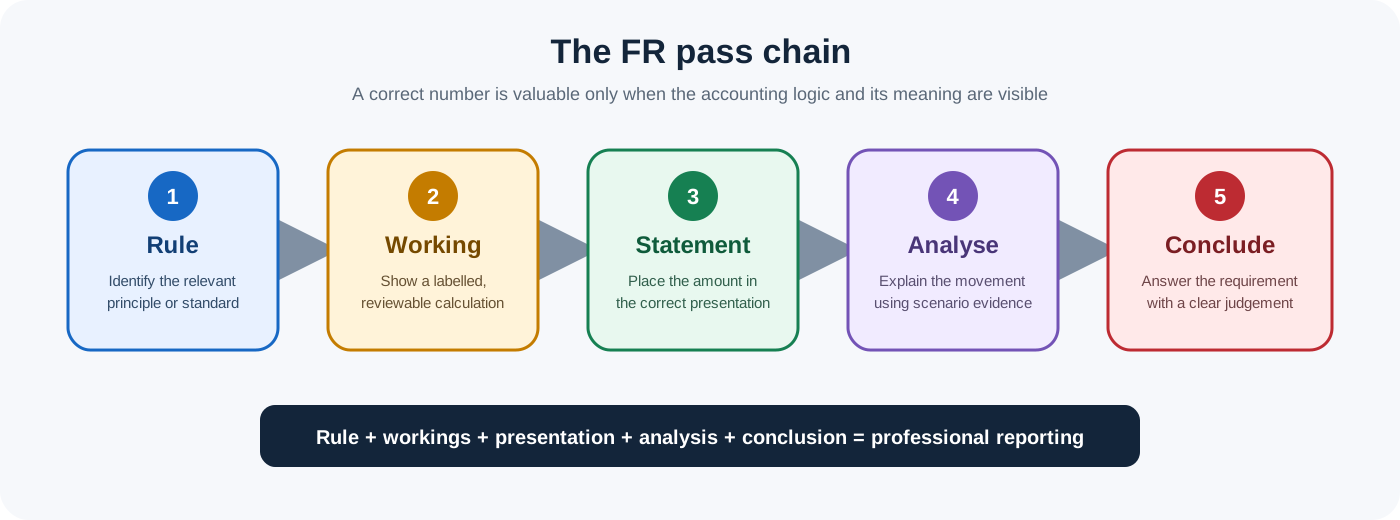
That is why students who only memorise standard summaries often struggle. FR rewards connected knowledge: the rule must lead to a transparent working, the working must lead to the correct statement treatment, and an interpretation answer must lead to a judgement that addresses the stakeholder in the scenario.
This is the FR exam study guide. It explains how to build the knowledge and exam technique needed for a pass. For the separate resource-by-resource workflow, see How to Study for ACCA FR Using OpenTuition.
Reviewed 15 July 2026 for the ACCA FR syllabus applicable from September 2026 to June 2027.
1. Understand what FR is really examining
FR develops the Financial Accounting (FA) foundation to Applied Skills level. You are no longer dealing only with basic transaction recording and straightforward statements. You must apply IFRS Accounting Standards to adjustments, prepare financial statements for single entities and simple groups, and analyse financial information for users.
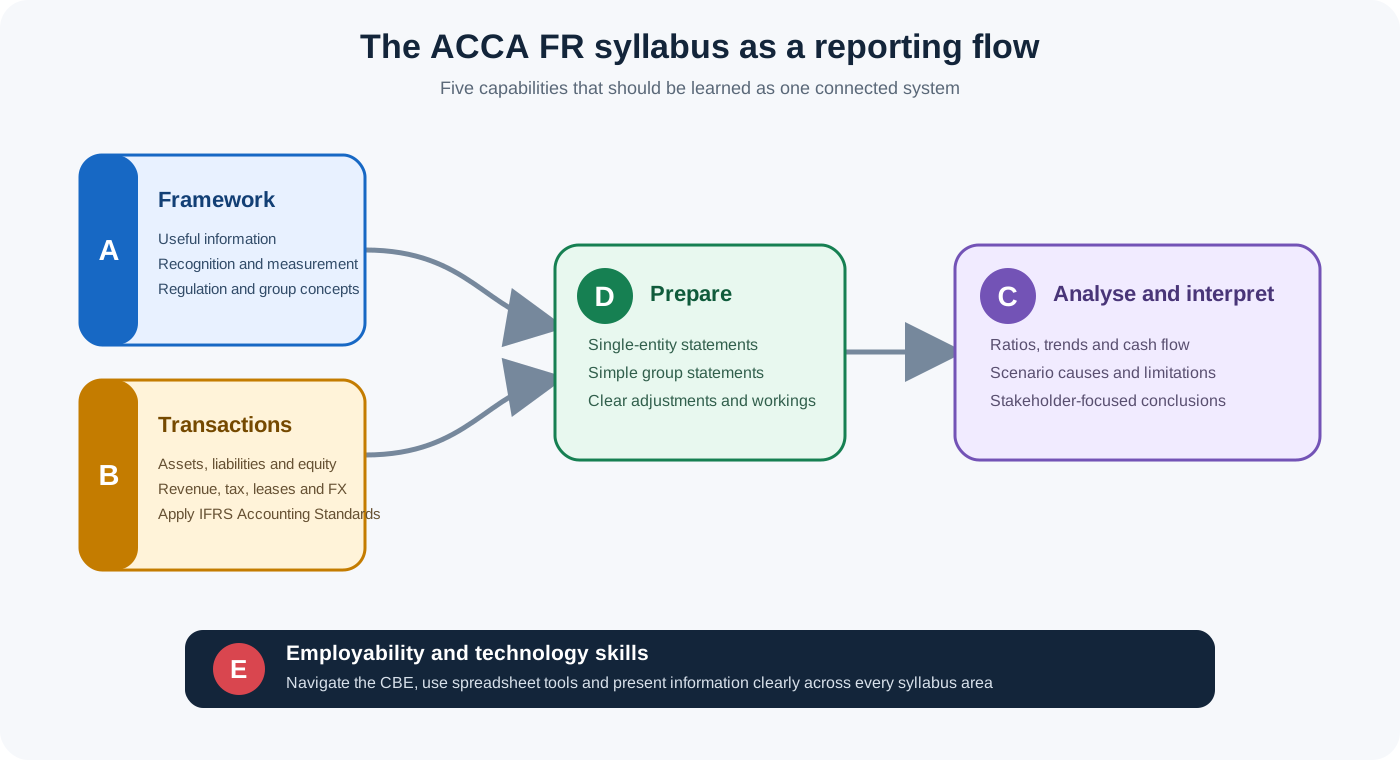
The current syllabus contains five connected capabilities:
A. The conceptual and regulatory framework
This area covers why a conceptual framework is needed, the characteristics of useful financial information, recognition and measurement, regulation and the basic concepts behind group accounts.
How to study it: treat the framework as the logic beneath the standards. For each principle, ask what information it helps users obtain and how it affects recognition, measurement or presentation. Do not learn definitions without being able to apply them to a short scenario.
B. Accounting for transactions in financial statements
This is the technical core of FR. It includes tangible and intangible non-current assets, impairment, inventories and agriculture, financial instruments, leases, provisions and events after the reporting period, taxation, reporting financial performance, revenue, government grants and foreign currency transactions.
How to study it: organise every topic around the same questions: What is the item? When is it recognised? How is it initially measured? What happens afterwards? Where does the effect appear in the financial statements? What scenario fact could change the treatment?
C. Analysing and interpreting financial statements
You must calculate and interpret ratios and trends, consider the needs of users, recognise the limitations of financial statements and discuss factors that make comparisons unreliable. The syllabus also includes not-for-profit and public sector contexts.
How to study it: do not memorise generic ratio commentary. Learn to connect a movement to business evidence, explain its consequence and reach a stakeholder-focused conclusion. A ratio is the start of an answer, not the answer itself.
D. Preparing financial statements
You must prepare and present financial statements for a single entity and for a simple group. This involves processing several accounting adjustments together, using the current statement formats and maintaining control over a set of connected workings.
How to study it: use a consistent pro forma and working structure. Practise until you can place an adjustment into the correct working and statement without rebuilding your method from memory in every question.
E. Employability and technology skills
FR is a computer-based exam. You are expected to navigate information, use the spreadsheet and word-processing tools efficiently, and present calculations and explanations clearly. These skills must be practised in the CBE environment.
Study rule: never learn an accounting treatment as a disconnected journal entry. Know the principle, the calculation, the financial statement effect and what the result communicates to a user.
2. Know the exam before planning your study
FR is a three-hour computer-based exam. All questions are compulsory and the pass mark is 50%.
| Section | Structure | Marks | What this means for study |
|---|---|---|---|
| A | 15 objective test questions worth 2 marks each | 30 | You need accurate, broad knowledge across the entire syllabus. |
| B | 3 case questions, each containing 5 objective test items worth 2 marks | 30 | You must apply several related rules to information in a shared scenario. |
| C | 2 constructed response questions worth 20 marks each | 40 | You need complete statement workings and developed interpretation in the spreadsheet and word processor. |
The Section C questions examine preparation and interpretation of financial statements for either a single entity or a group. Sections A and B can test any syllabus area. Questions can combine several standards in one scenario and may ask whether management's proposed treatment is appropriate.
A sensible time plan
With 180 minutes for 100 marks, the basic rate is 1.8 minutes per mark. A useful section control is:
- 54 minutes for Section A;
- 54 minutes for Section B; and
- 72 minutes for Section C - approximately 36 minutes for each 20-mark question.
This does not mean every two-mark question takes exactly 3.6 minutes. Some will be faster and others slower. Protect the time needed for Section C, answer every objective test item and move on when one small question is absorbing time without producing marks.
3. Repair the FA foundation before building FR on top
ACCA identifies underpinning FA knowledge as an important factor in FR success. Weak double entry and statement knowledge create a hidden problem: you try to learn a new standard while also trying to remember how the accounting system works.
Before starting the main FR course, check whether you can still:
- apply debits and credits without relying on a memorised phrase;
- process accruals, prepayments, depreciation and irrecoverable debts;
- correct errors and understand their effect on profit and net assets;
- prepare a basic statement of profit or loss and statement of financial position from a trial balance;
- distinguish capital from revenue expenditure;
- understand the relationship between profit, retained earnings and equity; and
- calculate basic accounting ratios.
Test these skills using short questions from a blank spreadsheet. If you cannot begin, repair the topic using the relevant OpenTuition FA material. If the method is sound but you make a small error, record it and continue. Do not delay FR for weeks by passively rereading an entire FA course.
Consolidation does not replace double entry. Group accounts become much easier when you can see which balances belong to the parent, which belong to the subsidiary and why an adjustment changes group profit or net assets.
4. Learn FR in an order that builds a reporting system
The OpenTuition course gives you a complete teaching route. The following study stages explain how the capabilities develop:
| Study stage | Main focus | Capability you are building |
|---|---|---|
| Foundation | FA diagnostic, framework and presentation | Understand what financial statements are trying to communicate. |
| Transaction rules | Assets, liabilities, equity, income and expenses | Select and apply the relevant accounting treatment. |
| Single entity | Trial balance adjustments and complete statements | Integrate several standards into one reporting process. |
| Groups | Acquisition analysis, goodwill, NCI and consolidation adjustments | Prepare simple group statements without double counting. |
| Interpretation | Ratios, trends, cash flows, limitations and stakeholder needs | Turn reported information into a supported business judgement. |
| Integration | Mixed objective tests and timed Section C questions | Apply the whole syllabus under CBE conditions. |
Question practice belongs inside every stage. Do not finish all the lectures and then discover whether you can answer questions. Learn a manageable block, attempt questions without support, diagnose the exact weakness and reattempt later.
5. Use OpenTuition as an active FR study system
OpenTuition provides the teaching, notes, questions and revision support, but passing depends on what you produce yourself. Watching a tutor complete a consolidation can feel comfortable because each step makes sense when it is shown. The exam asks whether you can choose and perform those steps independently.
Prepare with the notes
Open the relevant chapter in the free FR notes. Read the objectives and scan the pro formas or examples. Identify the rule being developed, but do not attempt to memorise the chapter before the lecture.
Learn with the lecture
Watch the matching FR lecture with the notes beside you. Pause before an important adjustment or consolidation working and try it yourself. Annotate why the treatment is correct, not merely what number was entered.
Attempt without the answer
Use the FR practice questions immediately after the topic. Close the solution and lecture. Work from a blank page or spreadsheet. Looking at the first line of the answer turns a recall test into a recognition exercise.
Debrief precisely
Classify each material loss of marks:
- principle: you did not know the recognition or measurement rule;
- classification: you placed an item in the wrong working or statement;
- calculation: the method was suitable but the arithmetic, sign, date or unit was wrong;
- integration: you knew an individual rule but did not apply it correctly within a full question;
- analysis: you stated a ratio movement without explaining its scenario cause or consequence;
- requirement: you missed a separate task, stakeholder or conclusion; or
- CBE technique: workings, formulae, labels or navigation were inefficient.
Your error log must record a correction. "I used the year-end subsidiary profit instead of time-apportioning post-acquisition profit" is useful. "Consolidation weak" is not.
Reattempt after a delay
Return to the weak requirement several days later without the answer. Later, attempt it under strict timing. Improvement is a better independent response, not a feeling that the published solution now looks familiar.
6. Learn accounting standards as decision rules
FR contains many standards, but a long list of disconnected rules is difficult to retain and apply. Use one standard template for every technical area:
- Scope and definition: what item or transaction are you dealing with?
- Recognition: when should it enter the financial statements?
- Initial measurement: what amount is recognised first?
- Subsequent treatment: what changes after recognition?
- Presentation: where does the effect appear?
- Scenario trigger: which fact changes the normal treatment?
For example, do not learn impairment as only a loss calculation. Know when there is an indication of impairment, how recoverable amount is determined, how a loss is allocated and what happens to profit and carrying amount. For a lease, distinguish the initial amounts from later finance cost and depreciation. For a provision, identify the obligation before attempting any measurement.
Create a compact rule sheet for revision, but build it from questions. Each time a question reveals a missing condition or common trap, add it. This produces a usable decision tool rather than a copied summary.
7. Master single-entity preparation through adjustments
A single-entity Section C question is not a memory test of a statement format. It is a control exercise involving a trial balance, several adjustments and a final presentation.
Use this method:
- Read the requirement and identify exactly which statement or extracts are required.
- Set up the pro forma before processing detailed adjustments.
- Read each note separately and identify the relevant accounting rule.
- Prepare a labelled working where the adjustment cannot be understood from one spreadsheet cell.
- Transfer the correct effect to the statement and mark the note as processed.
- Review signs, classifications, subtotals, units and unused information.
Practise the current IFRS 18-based presentation used in the examinable material. Do not rely on old IAS 1 formats copied from historic questions or notes. When using older questions for technique, check that the statement presentation and accounting rules remain current.
A pro forma is not decoration. It is a map. Set it up early so every adjustment has a destination and you can see which parts of the requirement remain unfinished.
8. Make consolidation a repeatable working system
Students often describe consolidation as a difficult topic when the real problem is an inconsistent method. Use the same logical working sequence in every group question, adapted to the requirement:
- draw the group structure and record ownership and acquisition dates;
- separate pre-acquisition from post-acquisition amounts;
- calculate net assets at the required dates;
- calculate goodwill and non-controlling interest using the method specified;
- calculate group retained earnings or group profit attribution where required;
- process fair value, impairment and intragroup adjustments; and
- transfer each working once into the consolidated statement.
For a consolidated statement of profit or loss, pay particular attention to the period of ownership. Performance is reported for a period, so a mid-year acquisition normally requires time apportionment. Do not apply proportionate consolidation to a subsidiary. Start with the parent and the appropriate subsidiary results, then process consolidation adjustments and attribution.
Learn why each adjustment exists. Intragroup balances and transactions are removed because the group cannot trade with itself. Unrealised profit is removed because the asset has not yet been sold outside the group. Goodwill is not simply a formula: it represents the acquisition calculation after identifying the consideration, NCI and identifiable net assets.
9. Turn ratio calculations into analysis
Interpretation remains a weak area because many answers stop at observations. "The operating margin decreased" usually earns little by itself. A developed point needs a comparator, a plausible explanation supported by the scenario and a consequence for the relevant user.
Use the following sequence for each important issue:
- Calculate: use the formula requested and show the working.
- Compare: identify the direction and size of the movement against the relevant prior period, competitor or benchmark.
- Explain: use a fact from the scenario to explain what may have caused it.
- Consequence: state why the matter affects performance, position, liquidity, risk or the stakeholder's decision.
- Conclude: answer the overall requirement, recognising important limitations or one-off effects.
Analyse several indicators together. Revenue growth may look positive, but falling margins, slower inventory movement and worsening receivable days may show that the growth is expensive or weakly controlled. A one-off gain can improve profit-based ratios without indicating sustainable operating performance. Debt maturity can matter as much as the gearing percentage.
Use separate headings for performance, position, specific additional requirements and conclusion. This helps you answer every part and makes the response easy to mark.
10. Prepare for Sections A and B: breadth and precision
Sections A and B are worth 60 marks and can cover the whole syllabus. You cannot safely omit a standard because it did not appear in a recent constructed response question.
For objective test practice:
- read whether the question asks for the correct or incorrect treatment;
- identify dates, ownership percentages, units and rounding instructions before calculating;
- read every option in multiple-response questions because more than one may be correct;
- calculate independently rather than selecting the closest-looking option;
- for a shared case, decide which facts apply to each separate item;
- answer every question, even if elimination is required; and
- practise mixed sets so the topic is not announced before the scenario.
Use FR flashcards to strengthen definitions, recognition criteria and rapid retrieval. They are a supplement to application questions, not a replacement for them.
11. Prepare for Section C: use the method that matches the task
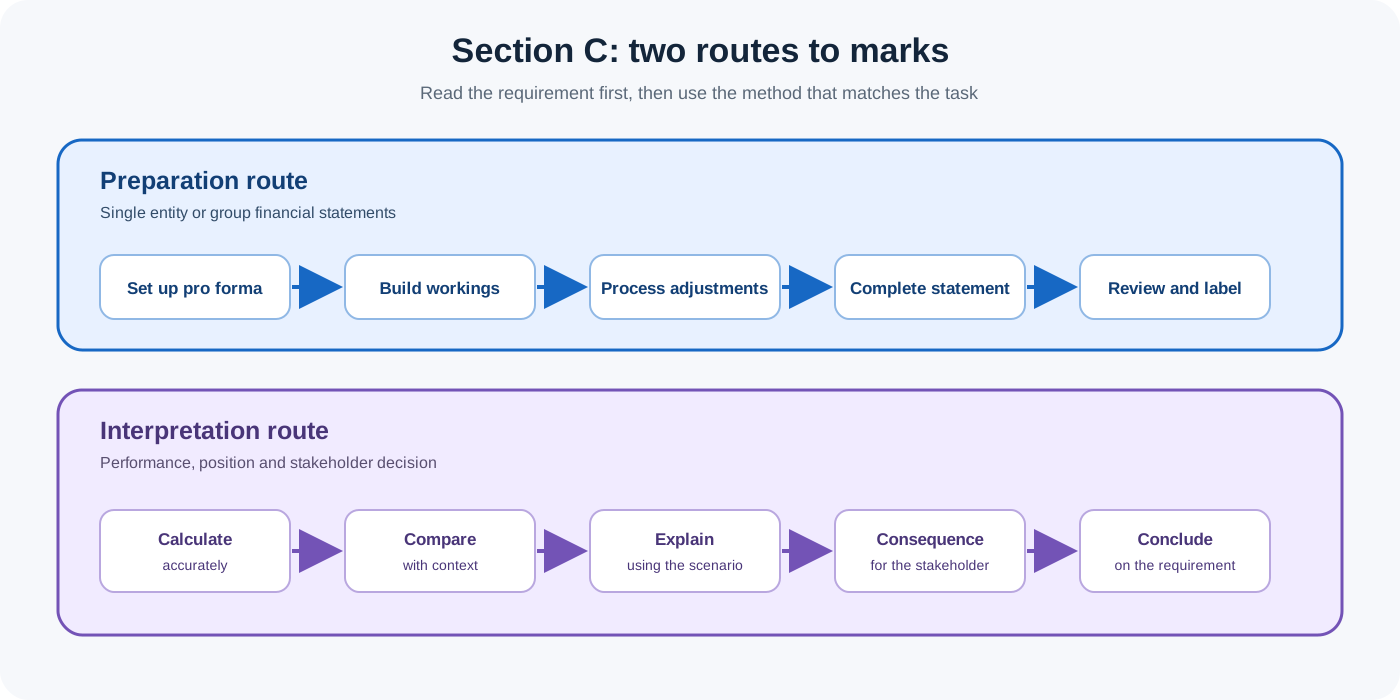
Each Section C question is worth 20 marks and should receive approximately 36 minutes. Read all requirements before the scenario. Identify the instruction verb, statement or stakeholder, separate tasks and mark allocation.
For a preparation requirement
Set up the requested pro forma, build labelled workings, process the adjustments systematically and transfer each figure to the statement. Use spreadsheet formulae so the marker can follow the method. If an early number is wrong, continue consistently: valid later work may still receive consequential credit when your workings are visible.
For an interpretation requirement
Use the requested ratio formula exactly, then build paragraphs around scenario evidence. Avoid explaining what a ratio means in general. The marker wants to know what this company's result means for the stated decision or stakeholder. Finish with a clear, supported conclusion under its own heading.
Use the CBE tools as working papers
Do not perform substantial calculations only in the calculator and type an isolated answer. Spreadsheet formulae, row labels and visible workings reduce transcription risk and allow method marks. Practise moving between exhibits, spreadsheet and word processor without losing your place.
12. Turn the latest examiner feedback into habits
The September/December 2025 examiner's report identifies lessons that should directly change your practice:
- Show full workings. A wrong final number with no working may earn nothing; a visible method can earn partial and consequential marks.
- Use the formula stated. If the requirement defines gearing, use that definition rather than a different version remembered from elsewhere.
- Follow dates carefully. Acquisition dates, time apportionment and the date of a fair value adjustment can change the whole consolidation.
- Study the whole syllabus. Weak performance on detailed lease questions showed the danger of guessing in an area that had not been learned.
- Use the scenario in interpretation. Generic ratio descriptions and statements that a result is merely "better" or "worse" do not constitute analysis.
- Answer additional tasks. If the requirement asks about control as well as performance and position, give it a separate heading and answer it.
- Give a supported conclusion. State the recommended choice and explain why the evidence supports it.
Read an examiner report after attempting the related question in the ACCA Practice Platform. Produce your answer first, compare it with the solution and report, then turn every relevant weakness into a behaviour for your next attempt.
13. A realistic ten-week FR study plan
This plan assumes steady weekly study. Keep one short cumulative review session each week so earlier standards remain active while you learn later topics.
| Week | Main work | Required output |
|---|---|---|
| 1 | Read the syllabus, set up the CBE environment and diagnose FA assumed knowledge. | A targeted repair list, study calendar and first error-log entries. |
| 2 | Framework, presentation and tangible and intangible non-current assets. | Rule sheets built from questions and accurate asset workings. |
| 3 | Impairment, inventory, agriculture and financial instruments. | Mixed objective questions and short accounting-treatment explanations. |
| 4 | Leases, provisions, events after the reporting period and taxation. | Labelled calculations showing the statement effect of each adjustment. |
| 5 | Revenue, grants, foreign currency and reporting financial performance. | Integrated adjustments and one timed mixed case. |
| 6 | Single-entity financial statement preparation. | At least two complete preparation questions using current formats. |
| 7 | Group concepts, acquisition analysis, goodwill, NCI and consolidated position. | A consistent set of consolidation workings completed without notes. |
| 8 | Consolidated performance and financial statement interpretation. | One timed group question and one developed analysis question. |
| 9 | FR revision lectures, mixed objective tests and error-log repair. | Two timed Section C requirements plus mixed Sections A and B practice. |
| 10 | At least two full CBE mock attempts with complete debriefs. | A final weak-area list, reattempts and an exam-day time plan. |
If you have six weeks, combine weeks 2 and 3, weeks 4 and 5, and weeks 7 and 8. Do not remove consolidation, interpretation or full mock practice. A compressed course requires more hours each week; it does not reduce the syllabus.
14. Use mocks to improve, not merely to obtain a score
A mock is useful only when the review changes your next attempt. Debrief it under five headings:
- Coverage: which marks were unavailable because the topic had not been learned?
- Rule selection: where did you apply the wrong recognition, measurement or consolidation treatment?
- Working control: where were dates, signs, units, labels or transfers unreliable?
- Analysis: where did you make an observation without using scenario evidence or explaining a consequence?
- Time and software: where did navigation or inefficient spreadsheet use prevent an answer?
Schedule targeted repair and then reattempt weak requirements. Use the OpenTuition FR revision mock exam and the ACCA Practice Platform. At least one final mock should be completed in a single uninterrupted three-hour sitting.
15. Your FR readiness gate
You are approaching exam readiness when you can honestly say:
- I have covered every syllabus area rather than abandoning difficult standards.
- I can explain the recognition, measurement and presentation logic behind common adjustments.
- I can prepare current single-entity statement formats under time pressure.
- I can produce acquisition, goodwill, NCI and group workings without copying a model answer.
- I can complete both types of Section C response in approximately 36 minutes.
- My spreadsheet contains labelled formulae and workings rather than isolated final numbers.
- My interpretation paragraphs use scenario evidence and explain consequences.
- I answer every separate task and provide a supported conclusion where required.
- I have completed and debriefed at least two full CBE mocks.
Readiness is demonstrated by independent timed output, not by the number of lectures watched or pages highlighted.
OpenTuition FR resources: what to use and when
- FR course hub: your starting point for the complete course.
- FR notes: the structured syllabus backbone and worked illustrations.
- FR lectures: full teaching and worked explanations.
- FR practice questions: immediate chapter-level retrieval and application.
- FR revision lectures: exam-standard technique after the main course.
- FR revision mock: timed practice and debriefing.
- FR flashcards: rapid retrieval of rules, definitions and assumptions.
- Ask the FR tutor forum: focused help after you have attempted the work.
- AI Tutor: additional guided practice and explanations.
Official ACCA resources to use alongside the course
- FR syllabus and study guide: confirm the exact syllabus applicable to your sitting.
- FR essentials: official exam overview and examining-team priorities.
- Latest FR examiner's report: detailed observations on candidate performance and common errors.
- FR examinable documents: confirm the reporting standards and documents examinable in your session.
- FR examiner reports: use reports with their related questions in the Practice Platform.
Final advice: practise producing complete, reviewable work. In FR, knowledge becomes marks when the rule, working, presentation and conclusion can all be followed by another accountant.