

Need more practice with ratios and audit risk? Use our complete Analytical Procedures for ACCA AA guide for corrected calculations, planning interpretation, substantive analytics and scenario-specific auditor responses.
ACCA Audit and Assurance (AA) is not an exam about reciting International Standards on Auditing or writing long essays. It asks whether you understand the audit process and can apply that understanding as a professional member of the audit team, in the role specified by the scenario.
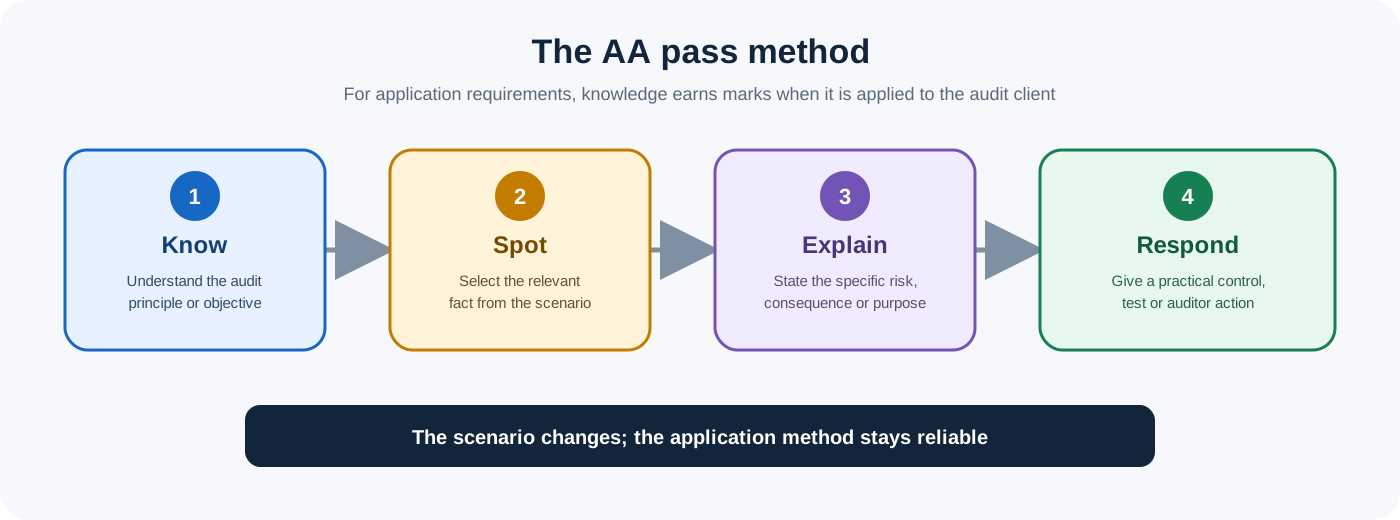
Knowledge is essential, but it is only the starting point. For scenario-based requirements, you must spot the relevant fact, explain its audit significance and give a practical response, control, test or procedure. Clear application earns more than a polished paragraph that could have been written about any company. For a standalone knowledge requirement, answer the exact knowledge requested and do not force scenario facts into the answer.
This is the AA exam study guide. It explains how to learn the syllabus and turn that learning into marks. For the separate resource-by-resource workflow, see How to Study for ACCA AA Using OpenTuition.
Reviewed 16 July 2026 for the ACCA AA syllabus applicable from September 2026 to June 2027.
1. Understand what AA is really examining
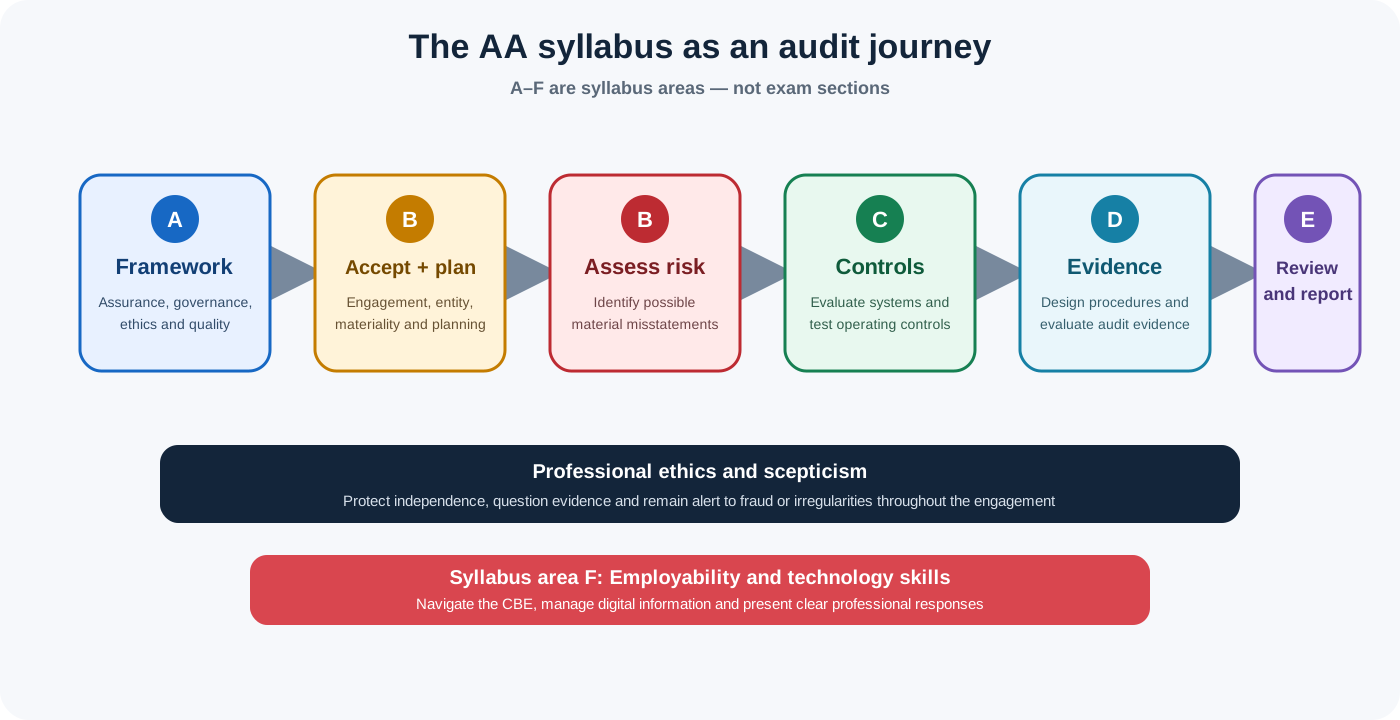
AA follows an audit engagement from acceptance and planning through risk assessment, controls, evidence, final review and reporting. It also examines the professional framework that makes assurance valuable: ethics, independence, governance, professional scepticism and appropriate reporting.
The official syllabus contains six connected capabilities. Learning them as one audit journey is easier than treating them as separate chapters.
Keep syllabus areas and exam sections separate. The letters A–F below are ACCA syllabus areas. The AA exam itself has only Section A and Section B; there is no exam Section C.
Syllabus area A: Audit framework and regulation
This area includes the purpose of assurance, external audit, corporate governance, quality management, professional ethics and the ACCA Code of Ethics and Conduct. You must understand why assurance is needed, what reasonable and limited assurance mean, and why an auditor's independence and the audit firm's quality management matter to users.
Learn the five elements of an assurance engagement: a three-party relationship, an appropriate subject matter, suitable criteria, sufficient appropriate evidence and a written assurance report. These elements help you distinguish assurance from compilation, advice and other non-assurance services.
How to study it: connect every principle to the confidence of the intended user. For ethics, identify the threat, explain why objectivity may be affected, and select an appropriate safeguard or action. For governance and quality management, identify the deficiency, explain its consequence and recommend a practical correction that protects audit quality.
Syllabus area B: Planning and risk assessment
This covers accepting and continuing engagements, the auditor's objectives, understanding the entity and its environment, assessing audit risks, fraud, laws and regulations, planning, materiality and audit documentation.
How to study it: learn the planning sequence, then practise applying it. A client fact becomes useful only when you can explain the possible financial statement effect and what the auditor should do in response.
Keep overall materiality and performance materiality distinct. Overall materiality is used in planning and evaluating the financial statements as a whole. Performance materiality is set below overall materiality to reduce the probability that aggregated uncorrected and undetected misstatements exceed overall materiality.
Syllabus area C: Internal control
You must understand internal control systems, evaluate control deficiencies, recommend controls, describe tests of controls and explain the role and scope of internal audit.
How to study it: follow transactions through common cycles such as purchases, sales, payroll, cash and inventory. For every control, ask which error or fraud it prevents or detects, who performs it, what evidence it leaves and how the external auditor could test whether it operated.
Know the five components of internal control: the control environment, the entity's risk assessment process, the monitoring process, the information system and communication, and control activities. Understand how general IT controls support systems and access, program changes and computer operations, while information-processing controls address particular transactions and data.
Syllabus area D: Audit evidence
This area includes assertions, sufficient appropriate evidence, audit procedures, sampling, the audit of specific balances and transactions, automated tools and techniques, the work of others and not-for-profit organisations.
How to study it: design procedures from the assertion and the scenario. State what the auditor will do, which document, record, asset or third party is involved, and what the result will confirm. Lists of vague verbs are not enough.
Separate assertions for classes of transactions and events during the period from assertions for account balances at the period end. The first group includes occurrence, completeness, accuracy, cut-off, classification and presentation. The second includes existence, rights and obligations, completeness, accuracy, valuation and allocation, classification and presentation.
For sampling, learn why a sample is used, how it is selected and how exceptions affect further work. For automated tools and techniques, understand practical uses such as analysing complete populations or testing programmed controls, together with limits involving data quality, access and the auditor's continuing responsibility for judgement.
Syllabus area E: Review and reporting
This includes subsequent events, going concern, written representations, final review and the independent auditor's report.
How to study it: use a decision process. Establish the accounting or audit issue, assess the available evidence, decide whether the financial statements require action, then consider materiality, pervasiveness and the correct effect on the auditor's report.
Syllabus area F: Employability and technology skills
AA is a computer-based exam. You need to navigate exhibits, highlight relevant facts and present concise professional responses. The exam is mostly narrative, but efficient use of the CBE workspace still matters. AA does not award a separate block of professional skills marks; these digital and communication skills help you present technically relevant answers efficiently.
Study rule: do not memorise a model answer as a block of prose. Learn the audit reasoning that allows you to construct a fresh answer for the client in front of you.
2. Know the exam before planning your study
AA is a three-hour computer-based exam. ACCA provides an additional 10 minutes before the exam to read the instructions. All questions are compulsory and the pass mark is 50%.
| Section | Structure | Marks | What this means for study |
|---|---|---|---|
| A | 3 case-based questions, each containing 5 objective test items worth 2 marks | 30 | You need broad knowledge and careful application across the syllabus. |
| B | 1 constructed response question worth 30 marks and 2 constructed response questions worth 20 marks each | 70 | You must control a substantial scenario and write concise, specific points across several audit tasks. |
Section B predominantly examines planning and risk assessment, internal control and audit evidence, although other syllabus areas can be included. Section A covers a broad range of topics. Question spotting is therefore unsafe.
A sensible time plan
With 180 working minutes for 100 marks, the basic rate is 1.8 minutes per mark:
- 54 minutes for Section A;
- 54 minutes for the 30-mark Section B question; and
- 36 minutes for each 20-mark Section B question.
Use the mark allocation to control the length of your answer. If a requirement asks for six matters, plan six strong points and stop. Producing ten rushed points does not compensate for leaving another requirement unanswered.
Not every written requirement needs scenario application. If a requirement asks for a stated number of knowledge points, answer that knowledge precisely and use the marks to control the number and depth of points. Apply scenario facts only when the requirement or context calls for them.
3. Repair the FA foundation that AA assumes
ACCA specifically identifies Financial Accounting (FA) knowledge as an important foundation for AA. Audit procedures are designed to test accounting balances, transactions and disclosures. If you do not understand the accounting, it is difficult to identify the possible misstatement or choose relevant evidence.
Before the main AA course, check whether you can still:
- understand the purpose and basic content of the main financial statements;
- apply accruals, prepayments, depreciation and irrecoverable debt principles;
- distinguish capital from revenue expenditure;
- explain inventory count and valuation basics;
- understand provisions and contingent liabilities at the level assumed from FA;
- calculate common profitability, liquidity and efficiency ratios; and
- identify whether a simple error overstates or understates profit, assets or liabilities.
Use a short diagnostic rather than rereading the whole FA course. Repair the topics that prevent you from explaining audit risks and procedures, then continue AA. Keep strengthening the accounting foundation through scenario questions.
If you write that "the accounts may be wrong" without identifying the balance, direction of misstatement or relevant assertion, the missing problem may be accounting knowledge rather than audit knowledge.
4. Study AA in the order an audit develops
The OpenTuition course provides a complete teaching sequence. It also helps to understand the purpose of each stage:
| Study stage | Main focus | Capability you are building |
|---|---|---|
| Purpose and conduct | Assurance, external audit, governance, ethics and quality management | Understand why the engagement and the firm's work can be trusted. |
| Acceptance and planning | Engagement acceptance, entity knowledge, materiality, fraud, laws and documentation | Accept appropriate work and plan it around the client and risks. |
| Systems | Internal control cycles, deficiencies and internal audit | Evaluate how the organisation prevents and detects errors and fraud. |
| Evidence | Assertions, procedures, sampling and specific audit areas | Design work that produces sufficient appropriate evidence. |
| Completion | Subsequent events, going concern and representations | Resolve outstanding issues before the opinion is formed. |
| Reporting | Opinion, modifications and additional reporting sections | Communicate the audit conclusion correctly. |
Do not postpone question practice until reporting. Learn a manageable block, attempt application questions, debrief the errors and continue. The final revision phase should integrate knowledge you have already used, not reveal for the first time whether you can write an applied answer.
5. Use OpenTuition as an active AA study system
AA can create a dangerous illusion of familiarity. A lecture explanation may make perfect sense, but the exam asks you to produce a specific point without the tutor choosing the issue for you.
Prepare with the notes
Open the relevant chapter in the free AA notes. Read the objectives and scan the headings. Identify where the chapter fits in the audit journey and which types of requirement it supports.
Learn with the lecture
Watch the matching AA lecture with the notes beside you. Pause when a scenario is introduced and try to identify the issue before the tutor explains it. Annotate the reason for the answer, not a complete script to memorise.
Attempt from a blank response
Use the AA practice questions immediately after the topic. Close the solution. For narrative requirements, write complete points rather than thinking that you would know what to say in the real exam.
Debrief the exact weakness
Classify each material loss of marks:
- knowledge: you did not know the audit principle or accounting treatment;
- selection: you chose an irrelevant fact or procedure;
- application: the point was generic rather than connected to the client;
- development: you identified an issue but did not explain its consequence;
- role: you gave management an action when the requirement asked for an auditor response;
- procedure: the action, source or purpose was missing;
- requirement: you missed the verb, number of points or a separate task; or
- time: you knew the material but wrote too much to finish the exam.
Write the correction in your error log. "I gave a control recommendation instead of a test of control" is useful. "Controls question poor" is not.
Reattempt after a delay
Rewrite the weak requirement several days later without the answer. Later, attempt a new question of the same type under time pressure. This proves that you learned the method rather than the wording of one solution.
6. Build answers according to the requirement
AA contains recurring requirement types, but they do not ask for the same thing. Learn a separate structure for each one.
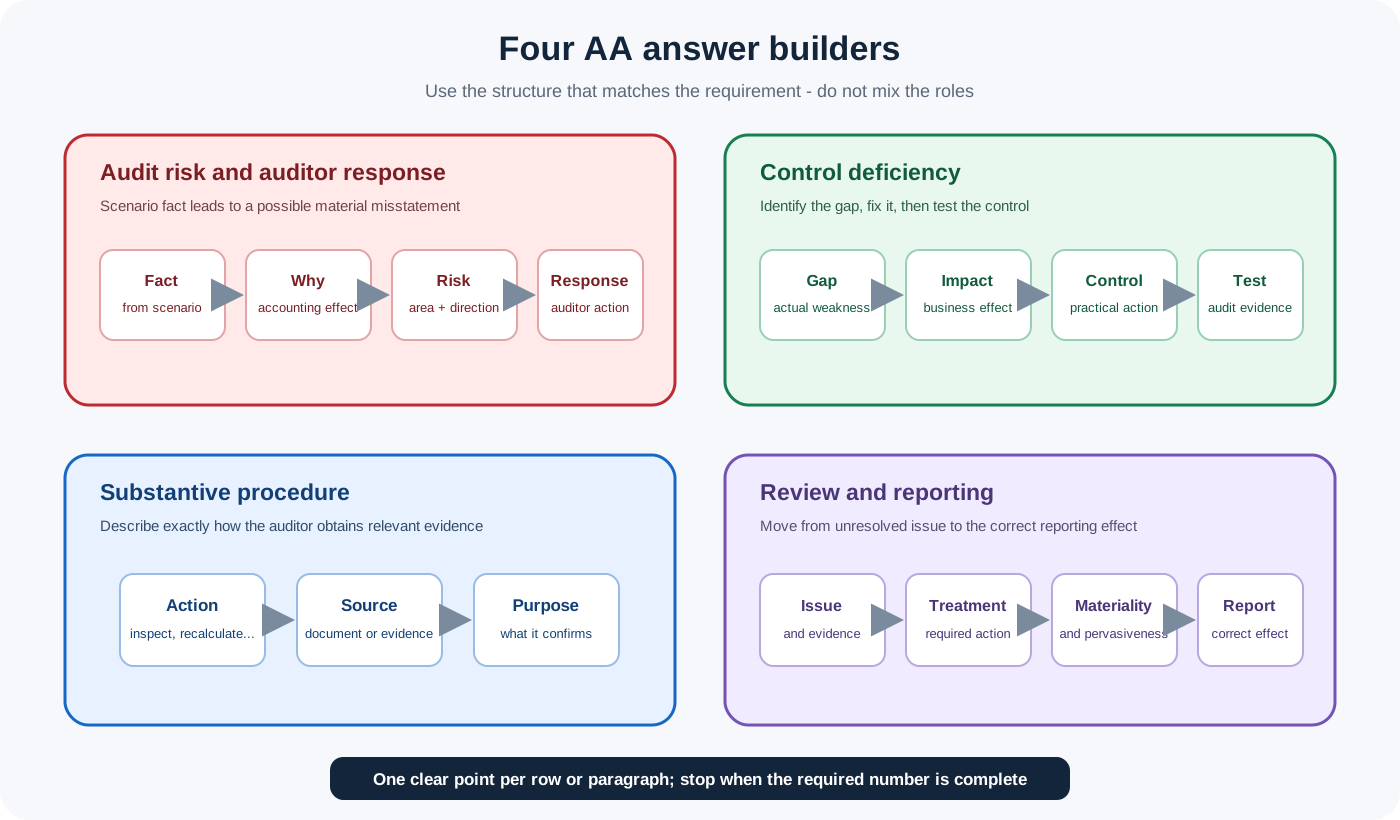
Use one clear row or paragraph for each point. Headings that mirror the requirement can make a long response easier to control. Tables can work well for risk and control questions if each cell contains a complete, developed point rather than fragments.
7. Master audit risk questions
Audit risk is the risk that the auditor expresses an inappropriate opinion when the financial statements are materially misstated. It is a function of the risks of material misstatement - comprising inherent risk and control risk - and detection risk.
A business risk affects the company's objectives, but it is not automatically an audit risk. In a scenario-based audit risk requirement, connect the fact to a possible material misstatement in a specific financial statement area, assertion and direction, or to a specific component of audit risk. Do not merely copy an operational problem from the scenario.
Build each risk point in four stages:
- Fact: identify the precise scenario event or condition.
- Accounting effect: explain the treatment that should occur or why the fact creates uncertainty.
- Audit risk: name the financial statement area and the likely direction of misstatement or relevant assertion.
- Auditor response: give a specific auditor action that addresses that risk.
For example, if routine repairs have been included in asset additions, explain that expenditure which does not create the required future economic benefits may have been capitalised. Property, plant and equipment and profit may therefore be overstated. A relevant response could include inspecting a sample of additions to invoices and supporting descriptions to assess whether the expenditure is capital or revenue in nature.
An auditor response does not always need the full detail expected in a substantive-procedures requirement, but it must be specific enough to address the identified risk. Do not hedge by saying a balance may be either over or understated when the facts indicate a direction. Do not give a management response such as "the company should correct its system" when the requirement asks what the auditor should do. Use ratios together with narrative facts where they point to the same risk; do not claim two separate risks for one possible misstatement.
8. Master internal control questions
A control requirement may ask for four linked elements. Keep them distinct:
- Deficiency: identify the actual control gap, not a neutral sentence copied from the scenario.
- Implication: explain the specific error, fraud or business consequence that could result.
- Recommendation: give management a practical action that fully addresses the gap.
- Test of control: describe what the auditor will do to obtain evidence that the recommended control operates effectively.
If goods received are compared only with a supplier's delivery note, the weakness may be that the goods are not checked against an authorised purchase order or inspected for quality. A suitable control would specify who compares the goods received record with the approved order and records the quality check. A test of control would inspect a sample of records for evidence of those checks and follow up exceptions.
"Ensure the control is performed" is an objective, not a complete recommendation. "Check the control" is not a described test. Choose evidence that actually proves the control operated. A signed review, authorised exception report or matched document may be stronger evidence than simply asking whether someone normally performs the task.
Remember the purpose distinction: a test of control evaluates whether a control operated effectively. A substantive procedure is designed to detect material misstatements at assertion level. Even where the auditor plans to rely on controls, substantive procedures remain necessary for material areas.
9. Write substantive procedures that could actually be performed
Vague procedures are one of the most avoidable sources of lost marks. Build each procedure using:
- a precise audit action such as inspect, observe, recalculate, reperform, confirm, compare, trace, agree or inquire;
- a clear source such as an invoice, contract, goods received note, bank statement, board minute, external confirmation or physical asset; and
- a purpose explaining the balance, transaction, disclosure or assertion being tested.
For example, "inspect invoices" is incomplete. "For a sample of property additions, inspect supplier invoices and agree the amount and nature of the expenditure to the non-current asset register to support cost and classification" is capable of being performed and evaluated.
Direction matters. Tracing from source documents into the accounting records often helps test completeness. Selecting recorded items and vouching them back to evidence often helps test occurrence or existence. A receivables confirmation may support existence and rights, but it does not by itself resolve valuation; reviewing post-year-end cash receipts and disputed balances may be more relevant to recoverability.
Use evidence quality thoughtfully. Independent external evidence may be more reliable than internally generated evidence, but relevance still matters. An impressive procedure aimed at the wrong assertion does not answer the requirement.
10. Learn review and reporting as decisions, not paragraphs
Do not reduce this area to memorising report wording. Work through the audit decision:
- What event, condition or unresolved misstatement exists?
- What accounting treatment or disclosure is required?
- What evidence has the auditor obtained, and what further work is necessary?
- Is the matter material? If relevant, is it pervasive?
- Does management amend the financial statements or provide adequate disclosure?
- What opinion or additional reporting section is appropriate?
For a material misstatement that is not pervasive, the opinion is qualified. If it is material and pervasive, an adverse opinion may be required. If the problem is an inability to obtain sufficient appropriate evidence, the corresponding possibilities are a qualified opinion when material but not pervasive, or a disclaimer when material and pervasive.
An emphasis of matter paragraph does not itself modify the opinion. It draws attention to a matter appropriately presented or disclosed in the financial statements that is fundamental to users' understanding. It cannot replace a required modification or the specific reporting required for a material uncertainty related to going concern.
For the September 2026 to June 2027 AA syllabus, ISA 570 (Revised 2024) is examinable. Where the auditor's opinion is not modified in relation to going concern and no material uncertainty has been identified, the auditor's report includes a separate Going Concern section. It states that management's use of the going concern basis is appropriate, that no material uncertainty has been identified, and that the auditor's conclusion is not a guarantee that the entity will continue as a going concern.
If the going concern basis is appropriate and a material uncertainty is adequately disclosed, the auditor gives an unmodified opinion and includes a separate Material Uncertainty Related to Going Concern section. If disclosure of the material uncertainty is inadequate, the opinion is qualified or adverse depending on pervasiveness. If use of the going concern basis itself is inappropriate, the auditor expresses an adverse opinion. Key audit matters, emphasis of matter and going concern reporting are not interchangeable labels.
For subsequent events, start with the accounting treatment under IAS 10, then describe the auditor's responsibilities and procedures under ISA 560. The latest examiner report emphasises that review and reporting includes more than auditor's report modifications: subsequent events, going concern, written representations and finalisation all require preparation.
11. Prepare for Section A: broad coverage and careful reading
Section A contains three case-based sets and is worth 30 marks. It can test the audit framework, ethics, assurance levels, planning, controls, evidence, completion and reporting in compact scenarios.
For objective test questions:
- read the case before deciding which fact applies to each item;
- watch whether the question asks for one answer or several selections;
- distinguish an assurance engagement from a non-assurance service;
- distinguish reasonable from limited assurance and positive from negative expression;
- read dates and roles carefully, especially for acceptance, subsequent events and reporting;
- calculate ratios and materiality where required, including the final answer and correct unit;
- answer every item, using elimination if necessary; and
- practise mixed sets so you cannot rely on the chapter title as a clue.
Use AA flashcards for definitions, ethical threats, assertions and rapid retrieval, but not as a substitute for scenario application.
12. Prepare for Section B: plan concise, applied points
Read every requirement before reading the scenario in detail. Identify:
- the instruction verb;
- the number of matters requested;
- each separate task joined by words such as "and";
- whether the action belongs to management, internal audit or the external auditor; and
- the mark allocation and time limit.
Then read the complete scenario once to understand the client. On the second reading, highlight evidence for the requirements and select the strongest points. Do not begin typing after the first obvious fact and then discover that later facts would have produced better answers.
Use concise headings and one developed point per paragraph or table row. An explanation normally needs a reason or consequence. A recommendation must be an action. A procedure must say how it is performed. Stop when the required number of points and time have been used, then move to the next requirement.
13. Turn the latest examiner feedback into habits
The September/December 2025 AA examiner's report highlights behaviours that should directly shape your practice:
- Practise application. Candidates who know definitions but have not written timed scenario answers are unlikely to convert enough knowledge into marks.
- Read the exact requirement. Explaining why an auditor understands controls is different from defining internal control or listing documentation methods.
- Choose the required number of strong points. Long scenarios often contain more risks or deficiencies than requested.
- Identify the complete audit risk. Use the scenario, relevant accounting treatment, financial statement area and direction or assertion.
- Give auditor responses, not management responses. The action must help the auditor address the identified risk.
- Make controls practical. Recommendations should state who performs the action and how; tests must produce evidence that the control operated.
- Distinguish tests of control from substantive procedures. Mixing them loses otherwise attainable marks.
- Describe procedures fully. Include the source and purpose rather than writing "check" or an audit objective.
- Prepare all of review and reporting. Subsequent events remains a core area and should not be displaced by studying only opinions.
Use examiner reports after attempting the related questions in the ACCA Practice Platform. Produce your answer first, compare it with the solution and report, then write one corrective behaviour for your next attempt.
14. A realistic ten-week AA study plan
This plan assumes regular weekly study. Include a short cumulative review every week so earlier knowledge remains available while you move through the audit.
| Week | Main work | Required output |
|---|---|---|
| 1 | Read the syllabus, diagnose FA knowledge, and study assurance, audit, governance and quality management. | A targeted FA repair list, assurance comparison and quality-management deficiency practice. |
| 2 | Ethics, acceptance, objectives, planning, materiality and documentation. | Applied ethics and engagement-acceptance questions. |
| 3 | Understanding the entity, fraud, laws and audit risk. | At least two audit-risk scenarios using complete risk and response points. |
| 4 | Internal controls in sales, purchases, payroll, cash and inventory cycles. | Deficiency, implication and recommendation tables. |
| 5 | Tests of controls, internal audit and corporate governance application. | Control tests that produce evidence and are not substantive procedures. |
| 6 | Assertions, evidence, sampling, automated tools and the work of others. | Assertion-focused procedure practice and mixed objective tests. |
| 7 | Substantive procedures for major balances and transaction classes. | Timed procedure requirements using action, source and purpose. |
| 8 | Subsequent events, going concern, representations, final review and reporting. | Decision-based completion and reporting questions. |
| 9 | AA revision lectures, mixed Section A sets and timed Section B questions. | Targeted reattempts of every recurring error-log category. |
| 10 | At least two full CBE mock attempts with complete debriefs. | A final weak-area list and a tested exam-day time plan. |
If you have only six weeks, combine weeks 1 and 2, weeks 4 and 5, and weeks 6 and 7. Do not omit review and reporting or remove full mocks. A shorter calendar requires more weekly study time; it does not make the syllabus smaller.
15. Use mocks to improve, not merely to obtain a score
After each mock, review the attempt under five headings:
- Coverage: which marks were unavailable because the topic had not been learned?
- Application: where did the answer remain generic or copy scenario facts without audit significance?
- Role and method: where did you confuse management actions, auditor responses, tests of controls and substantive procedures?
- Requirement control: where did you miss the verb, number of points or a separate task?
- Time: which answers were too long, too late or left incomplete?
Schedule repair and reattempt the weak requirements. Use the OpenTuition AA revision mock and the ACCA Practice Platform. At least one final mock should be completed in a single uninterrupted three-hour sitting.
16. Your AA readiness gate
You are approaching exam readiness when you can honestly say:
- I have covered every syllabus area, including the audit framework and final review.
- I can distinguish reasonable and limited assurance and identify the parties to an engagement.
- I can turn a scenario fact into a specific audit risk and practical auditor response.
- I can distinguish a control deficiency, recommendation, test of control and substantive procedure.
- My procedures contain an action, source and audit purpose.
- I understand how accounting treatment affects audit risk and subsequent-events questions.
- I can use materiality and pervasiveness to determine the reporting effect.
- I can produce the requested number of concise, applied points within the time available.
- I have completed and debriefed at least two full CBE mocks.
Readiness is demonstrated by independent timed answers, not by the number of model solutions you have read.
OpenTuition AA resources: what to use and when
- AA course hub: your starting point for the complete course.
- AA notes: the structured syllabus backbone and audit frameworks.
- AA lectures: full teaching and applied explanations.
- AA practice questions: chapter-level retrieval and scenario application.
- AA revision lectures: exam-standard technique after the main course.
- AA revision mock: timed practice and debriefing.
- AA flashcards: rapid retrieval of definitions, assertions and audit principles.
- Ask the AA tutor forum: focused help after you have attempted the work.
- AI Tutor: additional guided practice and explanations.
Official ACCA resources to use alongside the course
- AA syllabus and study guide: confirm the exact syllabus applicable to your sitting.
- AA essentials: official exam overview and examining-team priorities.
- Latest AA examiner's report: detailed observations on candidate performance and common errors.
- AA technical articles: official explanations of important and challenging areas.
- AA examiner reports: use reports with their related questions in the Practice Platform.
Final advice: AA rewards disciplined relevance. For an application requirement, use the client fact, explain why it matters and give the action that the named person should take. For a standalone knowledge requirement, answer the exact knowledge requested without forcing in scenario detail.