

Analytical procedures are not simply ratio calculations. They are a way of asking whether the financial statements make sense when figures are compared with each other, with prior periods, with budgets and with what the auditor knows about the business.
In ACCA Audit and Assurance (AA), the calculation is usually the easy part. The marks—and the audit value—come from explaining why a movement matters, identifying the possible financial-statement risk and giving an auditor’s response that would obtain evidence.
This guide is for the September 2026 to June 2027 AA syllabus. It covers analytical procedures at planning, as substantive procedures and during the final overall review; key ratios; a fully recalculated supermarket example; and the link from movement to audit risk and response.
Reviewed 16 July 2026 against the current AA syllabus, official ACCA analytical-procedures guidance and the September/December 2025 examiner’s report.
1. Know the three different uses
Students sometimes write that analytical procedures are “used throughout the audit” and stop there. AA requires you to distinguish their purpose at each stage.
ISA 315 (Revised 2019) requires analytical procedures as part of the auditor’s risk assessment. ISA 520 governs their use as substantive procedures and requires an analytical review near the end of the audit.
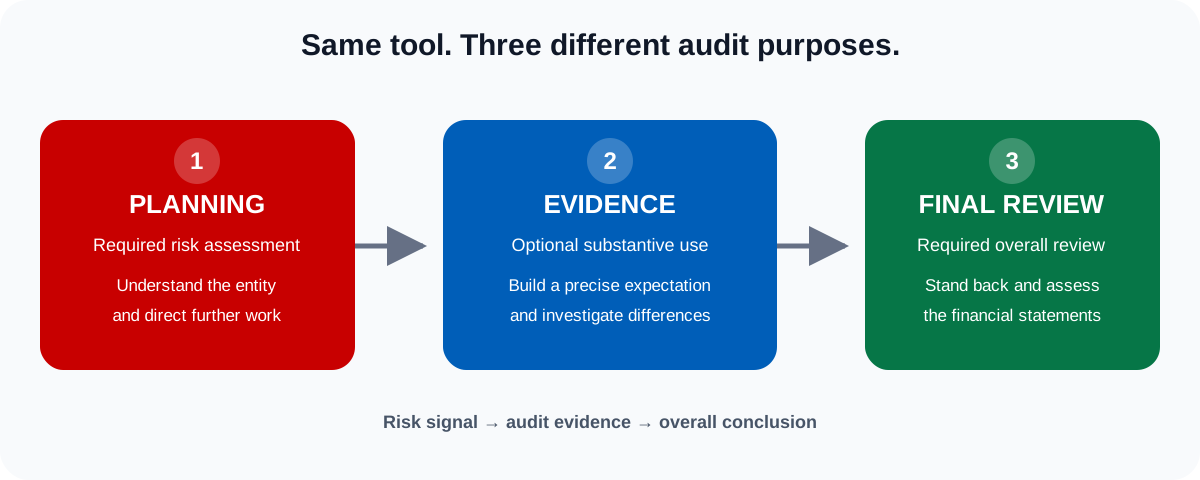
The technique may look similar at each stage, but its objective and required precision are different.
Stage | Purpose | Key AA point |
|---|---|---|
Planning and risk assessment | Understand the entity and identify unusual transactions, balances or relationships that may indicate risks of material misstatement. | Required as part of risk assessment. The result helps determine the nature, timing and extent of further audit procedures. |
Substantive analytical procedures | Obtain audit evidence by comparing a sufficiently precise independent expectation with the recorded amount. | Optional: use them when suitable for the assertion and more effective or efficient than, or useful alongside, tests of details. |
Final overall review | Help the auditor conclude whether the financial statements as a whole are consistent with the auditor’s understanding of the entity. | Required near the end of the audit. An unexplained inconsistency may require risks to be reassessed and additional work performed. |
A final analytical review is not a replacement for substantive work that should already have been completed. Equally, a planning comparison identifies where evidence may be needed; it is not itself proof that a balance is misstated.
2. Use more than last year’s financial statements
Useful expectations and comparisons may come from:
prior-year and prior-month financial information;
budgets, forecasts and management accounts;
industry data and comparable entities;
relationships between financial figures, such as revenue and receivables;
non-financial data, such as units sold, floor space, headcount, occupancy or production hours; and
the auditor’s understanding of changes in products, prices, capacity, financing and operations.
Non-financial information can be particularly powerful. If store floor space rises by 30% but revenue rises by only 5%, the relationship may reveal poor performance, a late opening date or a possible completeness problem. Before relying on the comparison as substantive evidence, however, the auditor must assess whether the non-financial data is reliable.
3. Turn a movement into an audit response
Use the OpenTuition RATIO questions whenever a movement looks unusual:
Reason: what genuine business event could explain it?
Artefact: could it arise from timing, an unsuitable denominator, a change of accounting policy or poor-quality data?
Test: what evidence would confirm or contradict the explanation?
Implication: which balance, transaction class, disclosure or assertion could be misstated?
Other information: is the explanation consistent with budgets, minutes, operational data and the rest of the financial statements?
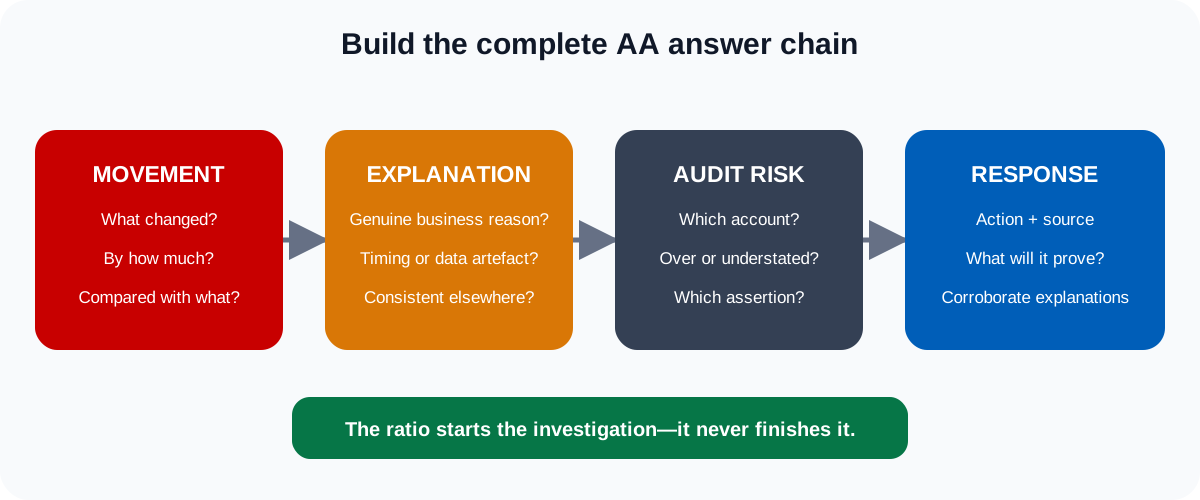
A ratio is the starting signal. A complete AA point follows the signal through to a specific evidence-producing response.
Do not write out the mnemonic for marks. Use it silently to produce a scenario-specific answer. “Receivable days increased” is an observation; “the longer collection period may indicate an insufficient loss allowance, overstating receivables, so review the aged listing and test subsequent receipts” is an audit point.
4. Learn the ratios—but choose the correct denominator
Ratio | Formula | Important audit caution |
|---|---|---|
Gross profit margin | Gross profit ÷ revenue × 100 | Product mix, discounts, purchase prices, wastage, cut-off and inventory valuation can all affect it. |
Operating profit margin | Operating profit ÷ revenue × 100 | Do not call this “net profit margin” if the numerator is operating profit. |
Return on capital employed | Operating profit ÷ capital employed × 100 | A closing capital balance may distort the ratio if major investment occurred late in the year. |
Asset turnover | Revenue ÷ capital employed | It is a number of times, not a percentage. |
Current ratio | Current assets ÷ current liabilities | Interpret it in the context of the industry and operating cycle. |
Quick ratio | (Current assets − inventory) ÷ current liabilities | Removing inventory is more helpful where inventory is slow-moving or uncertain. |
Receivables collection period | Receivables ÷ credit revenue × 365 | Total revenue is only a proxy if credit revenue is unavailable. |
Inventory holding period | Average inventory ÷ cost of sales × 365 | Closing inventory is only a proxy if average inventory is unavailable or seasonality matters. |
Payables payment period | Trade payables ÷ credit purchases × 365 | Cost of sales is only a proxy when credit purchases are unavailable. |
Gearing | Long-term debt ÷ equity × 100 | Other valid definitions exist; state and apply one consistently. |
Interest cover | Operating profit ÷ finance costs | Consider loan timing, variable rates and whether all interest has been accrued. |
If an exam requirement asks only for ratios, provide the final answers in the requested format. The September/December 2025 examiner’s report notes that six ratios carried only half a mark each and should have taken just over five minutes; formulas were not required and a calculation without a final answer earned no credit.
5. Worked example: understand Ocset Co first
Ocset Co is a supermarket business. That context changes the interpretation: most sales may be for cash, inventory turns quickly, and supplier credit can fund a significant part of the operating cycle.
$m | 20X9 | 20X8 | Movement |
|---|---|---|---|
Revenue | 54,327 | 47,198 | +15.1% |
Gross profit | 4,218 | 3,230 | +30.6% |
Operating expenses | 1,012 | 780 | +29.7% |
Operating profit | 3,206 | 2,450 | +30.9% |
Property, plant and equipment | 30,538 | 23,890 | +27.8% |
Inventory | 2,669 | 2,430 | +9.8% |
Receivables | 1,798 | 1,311 | +37.1% |
Cash | 4,742 | 2,148 | +120.8% |
Non-current borrowings | 14,170 | 8,602 | +64.7% |
Current borrowings | 4,060 | 2,085 | +94.7% |
Before calculating a ratio, this comparison already raises useful questions. How were the new assets funded? When were they brought into use? Why did receivables grow much faster than revenue in a mainly cash business? Why hold substantially more cash while short-term borrowing nearly doubled?
6. Corrected ratio schedule
Ratio | 20X9 | 20X8 | Movement |
|---|---|---|---|
Gross profit margin | 7.8% | 6.8% | Improved by about 1.0 percentage point |
Operating profit margin | 5.9% | 5.2% | Improved by about 0.7 percentage points |
Operating expenses/revenue | 1.9% | 1.7% | Higher |
ROCE | 11.8% | 12.0% | Slightly lower |
Asset turnover | 2.0 times | 2.3 times | Lower |
Current ratio | 0.73 | 0.63 | Improved, but below 1 |
Quick ratio | 0.52 | 0.37 | Improved |
Receivables collection period* | 12.1 days | 10.1 days | Longer |
Inventory holding period* | 19.4 days | 20.2 days | Slightly shorter |
Payables payment period* | 62.1 days | 60.4 days | Slightly longer |
Gearing | 109.0% | 72.8% | Substantially higher |
Interest cover | 6.7 times | 9.8 times | Lower |
*Total revenue, closing inventory and cost of sales have been used as proxies because credit revenue, average inventory and credit purchases are not provided. State such limitations when they matter to the interpretation.
7. Profitability: do not celebrate before you audit
The gross profit margin rose from 6.8% to 7.8%, while gross profit increased much faster than revenue. Genuine explanations could include a better product mix, lower purchase prices or reduced wastage. Audit risks could include:
inventory being overvalued, understating cost of sales and overstating profit;
purchase invoices or accruals being omitted, understating liabilities and cost of sales;
revenue recorded before control passed to customers; or
cut-off errors around the year end.
The response should test the explanation: compare margins by product, store and month; inspect supplier agreements and purchase prices; attend the inventory count; test inventory valuation and cut-off; and select revenue transactions around year end to appropriate dispatch or sales records.
Operating expenses rose by 29.7%, faster than revenue, increasing the expense-to-revenue ratio. Investigate which expense categories caused the movement. Expansion and start-up costs may explain it; inappropriate capitalisation, omitted accruals or a restructuring obligation may create different risks.
8. Working capital: use the business model
Receivables
Receivables rose by 37.1% and the collection period increased from 10.1 to 12.1 days. Because a supermarket normally makes many cash sales, total revenue is an imperfect denominator. The movement could reflect a new credit-card operation or wholesale customers—but it may also indicate slower collection and an insufficient expected credit loss allowance.
Obtain the aged receivables listing; compare it with the prior year; test subsequent cash receipts; investigate old or disputed balances; confirm selected balances where appropriate; and recalculate the loss allowance using supportable assumptions.
Inventory
Inventory days fell slightly despite revenue growth. This may show efficient replenishment and lower wastage. It could also be an artefact of the date on which the year end falls, seasonal purchasing or inventory being omitted from the count.
Attend the physical count, perform two-way test counts, test movements and cut-off, inspect the condition of perishable goods and compare cost with post-year-end selling prices where relevant.
Payables
Payables days increased only slightly, from 60.4 to 62.1. That may be consistent with normal supplier terms or stronger bargaining power. It does not remove the completeness risk.
Perform a search for unrecorded liabilities using post-year-end payments, unmatched goods-received notes, supplier statements and invoices received after year end. Review correspondence for disputes, lost discounts or interrupted supplies.
9. Financing and liquidity: connect the evidence
Long-term borrowings rose 64.7%, current borrowings rose 94.7% and gearing increased from 72.8% to 109.0%. Interest cover fell from 9.8 to 6.7 times. These facts are consistent with debt-financed expansion, but the auditor should consider:
whether all loans and finance costs are complete and accurately recorded;
whether borrowings are correctly classified between current and non-current;
whether security and covenant disclosures are complete;
whether a covenant breach makes debt repayable on demand; and
whether repayments, interest and expansion commitments create going-concern pressure.
Obtain direct lender confirmations, inspect loan agreements and board approval, recalculate interest and accruals, check classification against repayment terms, review covenant calculations and challenge cash-flow forecasts using sensitivity analysis.
The current and quick ratios improved, but a ratio below 1 is not automatically a going-concern problem for a supermarket with fast inventory turnover and cash sales. Interpret it with forecasts, facilities, supplier terms and post-year-end trading.
Cash more than doubled while current borrowing nearly doubled. This may be explainable by separate banks, timing or restrictions on cash, but it deserves investigation. Confirm all bank balances and facilities directly, inspect reconciliations, test transfers around year end and assess whether balances can legally be offset.
10. Non-current assets and returns
Property, plant and equipment rose by 27.8%, but revenue rose by 15.1%. Asset turnover fell and ROCE slipped slightly even though profit margins improved. If major stores or equipment were acquired late in the year, the closing capital employed includes the investment while profit includes little of its benefit. The ratios may therefore be distorted by timing rather than poor performance.
Inspect major additions and supplier invoices, confirm authorisation, physically inspect selected assets, distinguish capital expenditure from repairs, recalculate depreciation from the date available for use and consider impairment indicators for underperforming assets.
11. Design a genuine substantive analytical procedure
“Compare with last year and investigate differences” may earn limited credit, but it is not automatically a sufficiently rigorous substantive analytical procedure. A strong procedure follows this sequence:
Assess suitability. Is the relationship predictable and relevant to the assertion?
Test data reliability. Consider source, controls, comparability and whether financial and non-financial data has been audited or independently checked.
Develop an independent expectation. For example, expected payroll from independently verified headcount, pay rates, starters, leavers and authorised increases.
Set an acceptable difference. Decide the threshold that can pass without investigation, considering materiality and the required assurance.
Compare expectation with the recorded amount. Calculate the full difference.
Investigate significant differences. Obtain management’s explanation and corroborate it with evidence; enquiry alone is not enough.
Conclude and document. Decide whether sufficient appropriate evidence has been obtained or further tests of details are necessary.
Substantive analytics work best for large populations with stable, predictable relationships. A detailed reasonableness test can be more persuasive than a simple prior-year comparison.
12. Write the AA answer the marker can reward
For a planning-risk requirement, use a short chain:
Evidence: state the movement and relevant scenario fact.
Risk: explain the possible accounting problem.
Impact and assertion: identify what could be overstated, understated or incorrectly disclosed.
Auditor’s response: give a practical procedure that addresses that specific risk.
The latest AA examiner’s report confirms that ratios should be used together with scenario information. A longer collection period plus extended customer terms may indicate overvaluation of receivables; those are not two separate risks. The report also warns that responses must help the auditor reach a conclusion—not tell management how to run the business.
Weak answer | Better AA answer |
|---|---|
Receivable days increased, so receivables are risky. Discuss with management. | Receivables rose 37.1% while revenue rose 15.1%, and collection increased from 10.1 to 12.1 days. Slower recovery may mean the loss allowance is insufficient, overstating receivables. Review the aged listing, test subsequent receipts and recalculate the allowance using historical default and current customer information. |
Gearing increased. Check the loan. | Gearing rose from 72.8% to 109.0% and interest cover fell. Borrowings or finance costs may be incomplete or incorrectly classified, and covenant breaches may affect presentation and going concern. Obtain lender confirmation, inspect repayment and covenant terms, and recalculate accrued finance costs. |
13. Common mistakes to remove from your answers
Repeating the calculation in words without explaining a possible cause.
Treating every adverse-looking ratio as proof of going-concern uncertainty.
Ignoring the business model, seasonality or limitations in the denominator.
Giving several pieces of evidence that lead to the same risk as separate points.
Writing a management recommendation instead of an auditor’s response.
Using vague procedures such as “check invoices” without stating which invoices and why.
Calling enquiry sufficient evidence without corroboration.
Using a final review to compensate for substantive procedures that were never performed.
14. Continue studying with OpenTuition
Core learning: free AA notes and free AA lectures
Practice and revision: AA practice questions, revision mock and revision lectures
The OpenTuition analytical-procedures rule: calculate accurately, compare intelligently, challenge the explanation, identify the possible misstatement and design a response that produces evidence.