
External Influences on Organisational Performance

1 Introduction

The business environment has been changing rapidly in recent years due to factors such as:
Increased competition
Globalisation
Privatisation
Technology in general; information technology; the Internet
Rapid changes in customer requirements
New approaches to manufacturing e.g. just-in-time; dedicated cells.
2 Government influences
Government policies and decisions can affect organisations in the following ways:
Environmental protection
The level of public expenditure
Incentive schemes (eg to set up businesses in certain areas)
Exchange rates
Interest rates
Tax rates
Consumer and employee protection legislation
Legislation on restrictive practices (eg industries protecting themselves)
Monopolies and merger legislation.
Michael Porter has identifies seven ways in which a government can affect the structure of an industry:
Capacity expansion eg encouraging new businesses
Demand eg more government spending can increase demand
Divestment and exit from industries
Control of emerging industries
Entry barriers to products (quotas and tariffs)
Competition policy
New product adoption eg how approval is given.
3 Fiscal and monetary policy
These are the two economic tools that governments use to regulate the economy
3.1 Fiscal policy
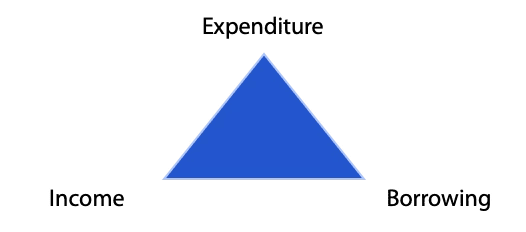
The government balances income, expenditure and borrowing. Income arrises mainly from taxation. If the government wants to spend more it either has to increase its income from taxes or it must borrow more.
The financial crisis has shown that many governments had created very high borrowings and to reduce these, particularly in Europe, austerity measures had to be introduced and governments were forced to reduce their expenditure.
In most Western countries, government expenditure is about 40 - 50% of all expenditure, so governments policies and spending decisions have a very powerful effect on organisations
3.2 Monetary policy
This approach to economic control attempts to manage the supply of money. This can be done through:
Interest rates.
Money supply (eg governments ‘printing’ money).
Reserve requirements (what proportion of money deposited by customers may banks lend to other customers).
Credit controls (eg if a person is buying an item on credit, what is the minimim deposit they must give)
4 The limitations of traditional management accounting techniques
You have studied traditional management accounting techniques, such as variance analysis, for earlier examinations.
It has however been argued that in today’s environment they are less than adequate. Listed below are some examples of areas where traditional management accounting is criticised.
Absorption of overheads
Traditional product costing tends to be absorption costing, absorbing the overheads on a labour hour basis. In a modern environment, with more automation and a higher proportion of fixed costs, an activity based costing approach is more appropriate.
Process costing
The traditional approach to cost accounting in a manufacturing business involves accounting for costs process by process as raw materials are transformed into finished goods.
In the modern environment with just-in-time systems there is very little work-in-progress and the conventional process costing approach involves a great deal of work but gains little. A backflush costing approach would be more appropriate.
Designing costs out of production
The focus of traditional management accounting tends to be on reducing costs at the production stage, whereas most costs tend to be determined at the design stage. Therefore a product lifetime costing approach is needed.
Over-focusing on production costs
Many costs are driven by customers (such as service delivery costs and discounts), but traditional management accounting tends to focus on production costs. It may not therefore be realised that the company is trading with some customers at a loss. A customer profitability analysis approach would be more appropriate.
Variance analysis
Traditional variance analysis tends to focus on direct costs rather than on overheads, whereas in most businesses overheads are more controllable than direct costs.
Labour costs
Often more like fixed costs than their conventional treatment as variable
5 Customer profitability analysis (CPA)
CPA is an application of Activity Based Costing techniques to customers.
Traditionally, ABC is applied to products but in a modern business environment in which it is vital that organisations respond promptly to the demands of customers, analysis on the basis of customers can provide vital management information.
The approach is exactly the same as the ‘normal’ activity based approach, except that we attempt to identify the profitability of each type of customer.
We can then identify unprofitable types of customer and attempt to persuade them to alter their buying behaviour so they become profitable customers.
This approach also identifies where we should focus our cost reduction efforts.
Vilnius Ltd manufactures components for the heavy goods vehicle industry.
The following annual information regarding three of its key customers is available.
X | Y | Z | |
Gross margin | 897,000 | 1,070,000 | 1,056,000 |
Orders placed | 200 | 320 | 700 |
Sales visits | 80 | 100 | 140 |
Invoices raised | 200 | 320 | 700 |
The company uses an activity based costing system and the analysis of customer-related costs is as follows.
Sales visits | $420 per visit |
Order processing | $190 per order placed |
Despatch costs | $350 per order placed |
Billing and collections | $97 per invoice raised |
Using customer profitability analysis, how would the customers be ranked?
Show answerHide answer
5.1 Customer profitability statement
There is no set format for the statement, but it would normally be similar to the one below.
$’000 | $’000 | ||
|---|---|---|---|
Revenue at list prices | 100 | ||
Less: discounts given | 8 | ||
Net revenue | 92 | ||
Less: cost of goods sold | 50 | ||
Gross margin | 42 | ||
Less: customer specific costs | 28 | ||
financing costs: | |||
credit period | 3 | ||
customer specific inventory | 2 | ||
33 | |||
Net margin from customer | 9 |
Frodo Ltd supplies shoes to Sam Ltd and Gollum Ltd. Each pair of shoes has a list price of $50 and costs Frodo Ltd $25. As Gollum buys in bulk it receives a 10% trade discount for every order for 100 pairs of shoes or more. Sam receives a 15% discount irrespective of order size, because that company collects the shoes, thereby saving Frodo Ltd any distribution costs. The cost of administering each order is $50 and the distribution cost is $1,000 per order. Sam makes 10 orders in the year, totalling 420 pairs of shoes, and Gollum places 5 orders of 100 pairs each.
Which customer is the most profitable for Frodo Ltd?
Show answerHide answer
6 Activity-based costing and activity-based management
Traditional accounting for production overheads lumps them together and then usually absorbs them on a labour hour or machine hour basis. This is a very crude approach.
Modern manufacturing techniques are much more automated than previously and this increases the proportion of manufacturing costs that are fixed (whereas there is lower proportion of costs from direct labour). It is therefore that fixed costs are accounted for as accurately as possible.
Activity based costing tries to identify what activities causes costs (the cost drivers) then accounts for the fixed costs on the appropriate bases.
Product A | Product B | |
|---|---|---|
Demand (units) | 1,000 | 200 |
Unit cost card | $ | $ |
Marginal cost | 50 | 80 |
Fixed cost | 30 | 60 |
Total absorption cost | 80 | 140 |
Mark-up (50%) | 40 | 70 |
Selling price | 120 | 210 |
Investigation shows that 1/3 of fixed costs relate to batch set-up costs and 2/3 relate to time in the factory. Each unit of B takes twice as long to make as a unit of A. Product A is made in batches of 500 units; Product B in batches of 100 units.
Recalculate the data using an activity based costing approach.
Show answerHide answer
Activity-based management (ABM) is a method of identifying and evaluating activities that a business performs using activity-based costing to carry out a value chain analysis or a re-engineering initiative to improve strategic and operational decisions in an organisation. Activity-based costing establishes relationships between overhead costs and activities so that overhead costs can be more precisely allocated to products, services, or customer segments. Activity-based management focuses on managing activities to reduce costs and improve customer value.
Operational ABM is about “doing things right”, using ABC information to improve efficiency. Those activities which add value to the product can be identified and improved. Activities that don’t add value are the ones that need to be reduced to cut costs without reducing product value.
Strategic ABM is about “doing the right things”, using ABC information to decide which products to develop and which activities to use. This can also be used for customer profitability analysis, identifying which customers are the most profitable and focusing on them more.
7 Value analysis
Value analysis is the examination and assessment by an organisation of a product’s features to ensure that its cost is no greater than is necessary to carry out its functions.
The product’s functions are again determined by customers and the company must examine the factors affecting the cost of a product or service in order to attempt to reduce costs whilst still delivering the required standard of quality and reliability.
Note that some costs are associated with a product’s functional and some with its esteem value. Luxury and cheap products might carry out the same function but the styling or quality of the luxury product might be essential in the eyes of consumers. It is important for the manufacturer damages neither function nor esteem value when trying to reduce costs.
A value added activity is one which adds value to the customer’s perception of a product or service, whereas a non-value added activity is one that does not add value in the eyes of the customer.
Costs that do not add value to the product should be targeted for elimination. However, this is not always the case – the removal of some non-value added activities (such as quality control) could add further costs.
A further classification is the breakdown of activities between core (such as time spent with potential customers), support (such as travelling time to customers), and discretionary (such as correcting accounting errors).
Effective cost management is about reducing or eliminating costs spent on non-core activities.
8 Dedicated cells
Many production lines involve many separate processes – for example, cutting, painting, drilling. The traditional approach is often to have teams of people for each separate process. The material is cut in one process by one team of people, then moves to the next process where it is painted by another team of people, and so on.
This ‘production line’ approach does mean that each team becomes very skilled at their particular task, which can lead to efficiency savings.
However, a downside of this approach is that employees lose motivation and lose concern for quality, because they do not feel any responsibility for the final product (and in fact often will not even see the finished product).
A potential remedy for this is the ‘dedicated cell’ approach. Here the workforce is split into small teams comprising workers skilled at each of the various functions. For example one team might comprise one cutter, one painter, and one driller.
Each team is therefore responsible for all aspects of the production up to the finished product. Each member of the team feels more responsibility to other members of their team, and for the overall quality of the finished product.