
Discounted Cash Flow Techniques


1 Introduction
Most of this chapter should be revision for you. It is however extremely important and so make sure that you revise it properly.
Of the few new items in this chapter, the most important is Modified Internal Rate of Return and you should make sure that you learn the technique involved.
2 Net present value calculations
Here is a list of the main points to remember when performing a net present value calculation. After we will look at a full example containing all the points.
Remember it is cash flows that you are considering, and only cash flows. Non-cash items (such as depreciation) are irrelevant.
It is only future cash flows that you are interested in. Any amounts already spent (such as market research already done) are sunk costs and are irrelevant.
There is very likely to be inflation in the question, in which case the cash flows should be adjusted in your schedule in order to calculate the actual expected cash flows. The actual cash flows should be discounted at the actual cost of capital (the money, or nominal rate). (Note: alternatively, it is possible to discount the cash flows ignoring inflation at the cost of capital ignoring inflation (the real rate). We will remind you of this later in this chapter, but it is much less likely to be relevant in the examination.)
There is also very likely to be taxation in the question. Tax is a cash flow and needs bringing into your schedule. There are two ways of dealing with tax (both giving the same end result). One way is to calculate the tax on the operating cash flows (an outflow) and then calculate the tax saving on the tax allowable depreciation (an inflow). The alternative is to subtract the tax allowable depreciation (capital allowances) to get the taxable profit. Then calculate the tax on the taxable profit, but then add back the capital allowances, because they are not a cash flow. For this exam, the second way is generally preferable for two reasons: firstly is is very common in the exam for the examiner to state that an investment is needed each year of an amount equal to the tax allowable depreciation for the maintenance of non-current assets - in which case we do not add back the tax allowable depreciation. Secondly, if there is a taxable loss, then there is no tax in that year but the loss is carried forward and subtracted from future taxable profits.
You are often told that cash is needed to finance additional working capital necessary for the project. These are cash flows in your schedule, but they have no tax effects and, unless told otherwise, you assume that the total cash paid out is received back at the end of the project.
Rome plc is considering buying a new machine in order to produce a new product.
The machine will cost $1,800,000 and is expected to last for 5 years at which time it will have an estimated scrap value of $1,000,000.
They expect to produce 100,000 units p.a. of the new product, which will be sold for $20 per unit in the first year.
Production costs p.u. (at current prices) are as follows:
Materials | $8 |
Labour | $7 |
Materials are expected to inflate at 8% p.a. and labour is expected to inflate at 5% p.a..
Fixed overheads of the company currently amount to $1,000,000. The management accountant has decided that 20% of these should be absorbed into the new product.
The company expects to be able to increase the selling price of the product by 7% p.a..
An additional $200,000 of working capital will be required at the start of the project.
Capital allowances: 25% reducing balance
Tax: 25%, payable immediately
Cost of capital: 10%
Calculate the NPV of the project and advise whether or not it should be accepted.
Show answerHide answer
3 Internal rate of return

One problem with decision making using the Net Present Value is that the Cost of Capital is at best only an estimate and if it turns out to be different that the rate actually used in the calculation, then the NPV will be different. Provided that the NPV remains positive then the project will still be worthwhile, but if the NPV were to become negative that the wrong decision will have been made.
The Internal Rate of Return (IRR) is that rate of interest at which the NPV of the project is zero (i.e. breakeven).
In order to estimate the IRR we calculate the NPV at two different rates of interest, and then approximate between the two assuming linearity. (In fact, the relationship is not linear and so any estimate will only be approximate)
For the project in example 1, calculate the Internal Rate of Return.
Show answerHide answer
4 Problems with the use of the internal rate of return
Although the IRR is the ‘breakeven’ rate of interest for the project, and as such can be useful when we are not certain of the Cost of Capital for the company, it does have many drawbacks.
It is only a relative measure of wealth creation, it can have multiple solutions, and it does effectively assume that the cash flows produced by the project are re-invested at the IRR if it is used to choose between investments.
A possible better measure is the Modified Internal Rate of Return (MIRR).
5 Modified internal rate of return
The MIRR is quicker to calculate than the IRR and effectively assumes that the cash flows are re-invested at the Cost of Capital.
There are several ways of calculating it, but the method suggested by the examiner is to calculate the Present Value of the ‘investment phase’ (the flows in the years when the company is investing in the project); to calculate the Present Value of the ‘return phase’ (the flows in the years when the project is generating returns) and then to use the following formula (which is provided for you in the examination):
where: | PVR = the PV of the return phase |
PVI = the PV of the investment phase | |
n = the life of the project in years | |
and, | re = the cost of capital |
We will illustrate the calculation of the MIRR using the previous example.
For the project in example 1, calculate the MIRR.
Show answerHide answer
The MIRR is usually lower than the IRR, because it assumes that the proceeds are re-invested at the Cost of Capital. However in practice the proceeds are often re-invested elsewhere within the firm. It does however have the advantage of being much quicker to calculate than the IRR.
6 Foreign investment appraisal
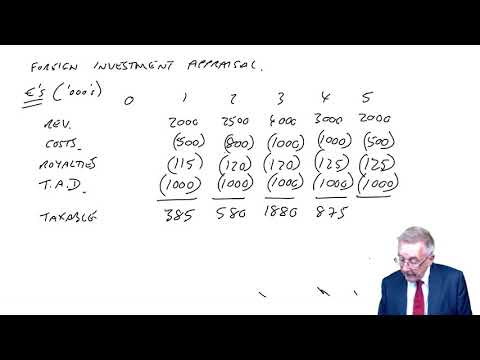
One way in which the examiner can create more work in a NPV question is for it to be a company investing in a project in another country - the other country using a different currency. Although there are not really any extra techniques involved, we will work through an example in order to illustrate the approach needed.
James plc, a company in the U.K, is considering investing in a project in Oblivia, a country that uses the Euro.
They have prepared the following forecasts over the 5 year planning horizon:
Year | 1 | 2 | 3 | 4 | 5 |
Revenue (€‘000’s) | 2,000 | 2,500 | 4,000 | 3,000 | 2,000 |
Operating costs (€‘000’s) | 500 | 800 | 1,000 | 1,000 | 500 |
In addition. the subsidiary will pay royalties to James plc of £100,000 per year.
Tax in Oblivia is 20%, payable immediately, and tax allowable depreciation is at the rate of 20% p.a. straight line. An amount equal to the amount of the tax allowable depreciation is required each year for the maintenance of non-current assets.
The initial investment in the operation is €5,000,000 and there is no residual value at the end of the planning horizon.
All net cash surpluses will be remitted to the U.K. each year. The tax rate in the UK is 25%, payable immediately, and a double taxation treaty exists between the U.K. and Oblivia.
The forecast exchange rates are as follows (€’s per £):
Year | |
0 | 1.10 |
1 | 1.15 |
2 | 1.20 |
3 | 1.20 |
4 | 1.25 |
5 | 1.25 |
James plc’s cost of capital is 15%.
Calculate the NPV of the project and advise whether or not it should be accepted.
7 Inflating perpetuities

Although the majority of investment appraisal questions are over a fixed time period as in the previous examples, it is reasonably common to be required to calculate the present values of cash flows continuing into perpetuity. We can use the ‘growth model’ formula given on the formula sheet in order to deal with this.
Watch the timing when a perpetuity starts later than year 1. The growth model gives a value one year before the first cash flow it uses, so in Example 6 below the flows from year 4 onwards (7,000 × 1.05 ÷ (0.20 − 0.05) = 49,000) are valued at time 3 and must still be discounted for three years. Apply growth only as the question states it: a figure already given for next year is not grown again, and flows that stay the same after the last forecast year have no growth at all.
Cash flows have been forecast at $5,000 p.a. in perpetuity, inflating at 4% p.a..
The cost of capital is 20%.
Calculate the present value of the cash flows.
This example was perhaps a little bit too easy, and so to introduce a common ‘complication’, let us look at another example.
Cash flows have been forecast as an actual $5,000 in the first year; an actual $6,000 in the second year; and an actual $7,000 in the third year, thereafter inflating at 5% per year.
The cost of capital is 20%.
Calculate the present value of the cash flows.
8 Multi-Period Capital Rationing

Capital rationing is the situation when the company has several projects that they wish to invest it, but only have a limited amount of capital available for investment.
You will remember that when there is limited capital in only one year (single-period capital rationing) then we rank the projects based on the NPV per $ invested (the profitability index).
However, it is more likely in practice that investment is needed in more than one year and that capital is rationed also in more than one year. This situation is known as multi-period capital rationing and the solution requires using linear programming techniques. The current syllabus limits multi-period capital rationing to discussion only, so you will not be required to solve or to formulate the problem in the exam. The example that follows shows how the problem would be formulated, to explain the technique (the recorded lecture, made for an earlier syllabus, says that you may be asked to formulate it).
Paris plc is has three projects available for investment with the following cash flows and NPV’s (at a cost of capital of 10%):
Year | A | B | C |
0 | (5,000) | (8,000) | (6,000) |
1 | (4,000) | 2,000 | (6,000) |
2 | 8,000 | 6,000 | 4,000 |
3 | 4,000 | 5,000 | 12,000 |
NPV at 10% | +976 | +2529 | +862 |
The projects are infinitely divisible (note: this means we can invest in any fraction of a project and that all the cash flows (and therefore the NPV) will also be this fraction of those above).
Paris plc has cash available for investment as follows:
Year 0 | $14,000 |
Year 1 | $5,000 |
You are required to formulate the linear programming model necessary to decide how best to invest the capital available. Any capital not used in Year 0 may be put on deposit for one year and earn interest at 7%.
As stated earlier, you will not be expected to solve the problem (it cannot be solved graphically because there are more than 2 variables, and therefore would need a more advanced technique).
Also, you should remember that there are two reasons why capital may be limited:
Hard capital rationing – which is where the company is unable to borrow more, and
Soft capital rationing – which is where the company can borrow more, but has chosen to limit the amount it is prepared to borrow.
The formulation of the problem is the same, whatever the reason for the capital rationing.
9 Free cash flows
The free cash flow is the cash available for distribution to lenders (shareholders and debt lenders).
When appraising a project (as in the first example in this chapter) the net cash flow that we calculated each year is the free cash flow.
However, it is also possible to use NPV techniques in exactly the same way to arrive at the value of the company and for this we need to estimate the net cash flows (or free cash flow) each year from the company as a whole.
In this situation we are more likely to be given the forecast profits of the company (as opposed to forecasts of each individual cash flow) in which case we can estimate the free cash flows as follows:
Free cash flow = | Earnings before interest and tax (EBIT) | ||
less: | tax on EBIT | ||
plus: | non-cash items (depreciation) | ||
less: | cash required for capital expenditure | ||
less | (or plus): | working capital changes | |
We will look at an example of this in a later chapter when we consider the valuation of a company.