
Exchange Rate Determination

1 Introduction
In this chapter we consider what factors are involved in the determination of foreign exchange rates, and also the different types of exchange rate system.
Most of this chapter is only for written questions, but in addition we look at how (in theory) we may attempt to predict future exchange rates – a topic which can form part of a calculation question.
2 Influences on exchange rate
Rates of inflation in different countries
Interest rates in different countries
Economic and political prospects
The balance of payments
Importantly, expectations concerning changes to the above will affect the exchange rate before changes actually occur.
3 Government approaches to exchange rate management
3.1 Fixed exchange rate systems
The government and the monetary authorities operate in the foreign exchange markets to ensure that the rate of exchange remains fixed.
This approach reduces the currency risk faced by companies and hence encourages a higher level of international trade.
However, keeping the exchange rate fixed places constraints on government policy.
3.2 Floating exchange rate systems
Under this approach the government has no obligation to maintain the rate of exchange and leaves its determination to market forces.
Free floating exchange rates
Here, the exchange rate is left entirely to market forces. However, governments do not like to leave it entirely up to market forces due to the effect of the exchange rate on other economic factors. More common is managed floating.
Managed floating
Under this approach the government allows the exchange rate to fluctuate between very large bands but intervenes if the currency looks like moving outside of these bands.
From 1944 to 1971, a system of fixed exchange rates existed (known as the Bretton Woods system). This collapsed in 1971 and most countries moved to a system of floating exchange rates. The G7 group of countries now operate to manage their exchange rates and attempt to endure reasonable stability.
4 Predicting future exchange rates
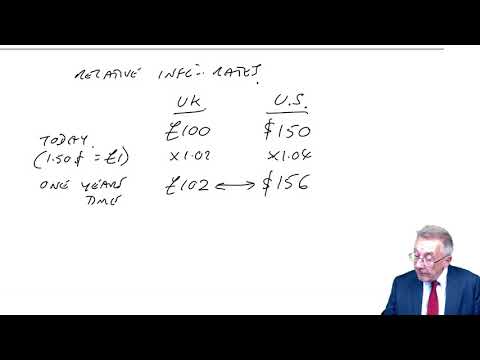
One important influence on exchange rates is the relative inflation rates between two countries.
The Purchasing Power Parity theory uses inflation rates to predict the future movement in exchange rates. It states that identical goods should sell at the same price when converted into the same currency. As the local currency prices changes with inflation then the exchange rate should change to keep the relative price the same.
The above can be expressed as a formula that gives the percentage change in the spot rate as:
The exchange rate is currently $/£ 1.70
The inflation rate in the US is 5% p.a. and in the UK is 2% p.a..
What will the exchange rate be in:
one years time
two years time
Show answerHide answer
The exchange rate is currently ¥ / £ 2030
The inflation rate in Japan is 4% p.a. and in the UK is 8% p.a..
What will the exchange rate be in:
one years time
two years time