
The Valuation of Debt Finance, the Macaulay Duration and the Modified Duration


1 Introduction
In your previous studies you have seen what factors determine the market price of debt finance (bonds). In this chapter we will revise this and also look at how future changes in interest rates effect the market prices.
2 The valuation of debt
In theory, the market value of debt will be determined by the returns that investors expect to receive, and the rate of interest that they require – it will be the present value of the expected receipts discounted at the investors’ required rate of return.
Value debt from the investor's side. The receipts are the gross interest — no tax is deducted, because the tax relief on interest belongs to the company, not the lender — and the redemption amount including any premium, discounted at the investors' required pre-tax return, not at the coupon rate and not at the company's after-tax cost of debt. The answer is per $100 nominal, as in Example 1 below, so scale it up to the total nominal value in issue before using it as the market value of debt in a gearing, WACC or beta calculation.
A company has 8% bonds in issue, redeemable in 5 years time at a premium of 10%.
The investors’ required rate of return is 10%.
Calculate the market value of the bonds (for a nominal value of $100)
Show answerHide answer
3 The redemption yield
You have also seen before that in the case of quoted debt, we can calculate the return that investors are receiving from a bond by effectively ‘working backwards’. If we know the market value and we know the expected receipts, then we can calculate the return to investors by working out the internal rate of return (this is known as the gross redemption yield).
A company has 8% bonds in issue, redeemable in 10 years time at a premium of 10%.
The market value (for $100 nominal) is currently $91.61.
Calculate the redemption yield.
Show answerHide answer
(Note that in this example we calculated the gross return to the investor. The cost of debt to the company would be different because we would then take into account the tax relief on the interest payments.)
4 Comparing bonds
In the previous two examples, the bonds were both giving the same return to investors (gross redemption yield). This clearly need not be the case, and the gross redemption yield will be a factor for investors when choosing between different bonds.
However, since the bonds in both our examples are giving the same return, it is tempting to say that potential investors would be indifferent between them.
There is however one big problem in that interest rates may change in the future, and if they do change then investors’ required returns will change, which will in turn effect the market price of the bonds.
Although required returns would change for all potential investments, the extent of the change in the market value will differ depending on the length of life of the bond.
For each of the bonds in the two previous examples, calculate the new market value (for $100 nominal) if the gross redemption yield were to change to 15%. Hence calculate the %’age change in the market values of each.
Show answerHide answer
5 The Macaulay Duration

The Macaulay duration measures the average time it takes for a bond to pay its interest and principal.
The calculation is as follows:
Calculate the present value of the cash flows, and add them up.
Multiply the present value of each cash flow by the time period, and add them up.
Divide the result from (b) by the result from (a)
A company has 8% bonds in issue, redeemable in 5 years time at a premium of 10%. The current market value is $98.63 (for $100 nominal)
Calculate:
the gross redemption yield, and
the Macaulay duration
Show answerHide answer
If you look again at this example, the following should be clear for each of the variables:
Time to maturity: as the time to maturity increases, the Macaulay duration will also increase
Coupon rate: as the coupon rate increases, the Macaulay duration decreases
Yield to maturity (or gross redemption yield): as the yield to maturity increases, the Macaulay duration decreases
Calculate the Macaulay duration for the bond in Example 2.
Show answerHide answer
6 The Modified Duration
The Modified Duration measures the sensitivity of the market value of a bond to changes in interest rate.
It is calculated by dividing the Macaulay duration by (1 + gross redemption yield).
Calculate the modified duration for the bonds in Example 4
Show answerHide answer
The equation linking modified duration (D), and the relationship between the change in interest rates (∆i) and change in price
or value of a bond or loan (∆P) is given as follows: ∆P = [–D x ∆i x P]
(P is the current value of a loan or bond and is a constant)
The size of the modified duration will determine how much the value of a bond or loan will change when there is a change in interest rates. A higher modified duration means that the fluctuations in the value of a bond or loan will be greater, hence the value of 3.94 means that the value of the loan or bond will change by 3.94 times the change in interest rates multiplied by the original value of the bond or loan.
7 Limitations of the modified duration
Duration is only useful in assessing small change in interest rates. This is because although as interest rates increase, bond prices will fall (and vice versa) the relationship is non-linear. In fact, the relationship between the changes in bond values and changes in interest rates is in the shape of a convex curve.
8 Project Duration
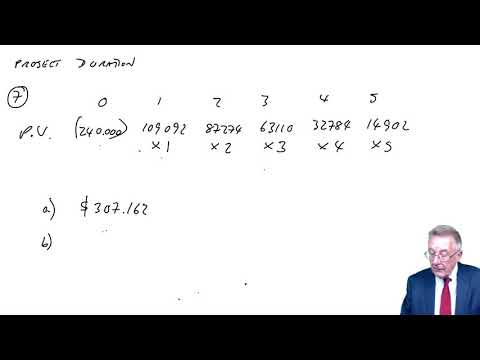
Although this chapter is primarily concerned with bonds, we can calculate the duration of a project using exactly the same was as we calculated the Macaulay Duration for a bond.
Lola plc is considering a project which requires an initial investment of $240,000. Projected cash flows, discounted at Lola’s cost of capital of 10% are as follows:
Year | 0 | 1 | 2 | 3 | 4 | 5 |
Present Value | (240,000) | 109,092 | 87,274 | 63,110 | 32,784 | 14,902 |
Calculate the project duration.
The project duration is a measure of the average time over which a project delivers it’s value, and has the same duration as a project that delivers 100% of its cash inflows over the same period. The lower the duration the lower the risk of the project. This method looks at the cash flows over the whole life of the project, unlike the payback period which only considers the flows during the payback period.