


Strategic Professional exams are not tests of how much technical material you can type. They test whether you can use technical knowledge as a professional: identify what matters, analyse evidence, exercise judgement, communicate for the stated audience and make defensible recommendations.
This guide covers Strategic Business Leader (SBL), Strategic Business Reporting (SBR) and the four current Options—Advanced Financial Management (AFM), Advanced Performance Management (APM), Advanced Taxation (ATX) and Advanced Audit and Assurance (AAA). It updates OpenTuition’s original Options guide for today’s CBE formats and professional-skills marking.
2027 transition: the final session for the current Strategic Professional exams is June 2027. Redesigned Strategic Professional exams begin in September 2027, when students will need one Option rather than two. Current students should use ACCA’s Transition Tool for their own passes and expected progress; do not delay a well-prepared exam merely because the future structure is different.
The current Strategic Professional route
Under the current ACCA Qualification, students complete both Essentials—SBL and SBR—and choose two Options from AFM, APM, ATX and AAA. The Options should reflect your underpinning knowledge, career direction, variant availability and genuine interest, not an online claim that one paper is “easy”.
All current Strategic Professional exams are computer based, all questions are compulsory, and each exam is three hours 15 minutes.
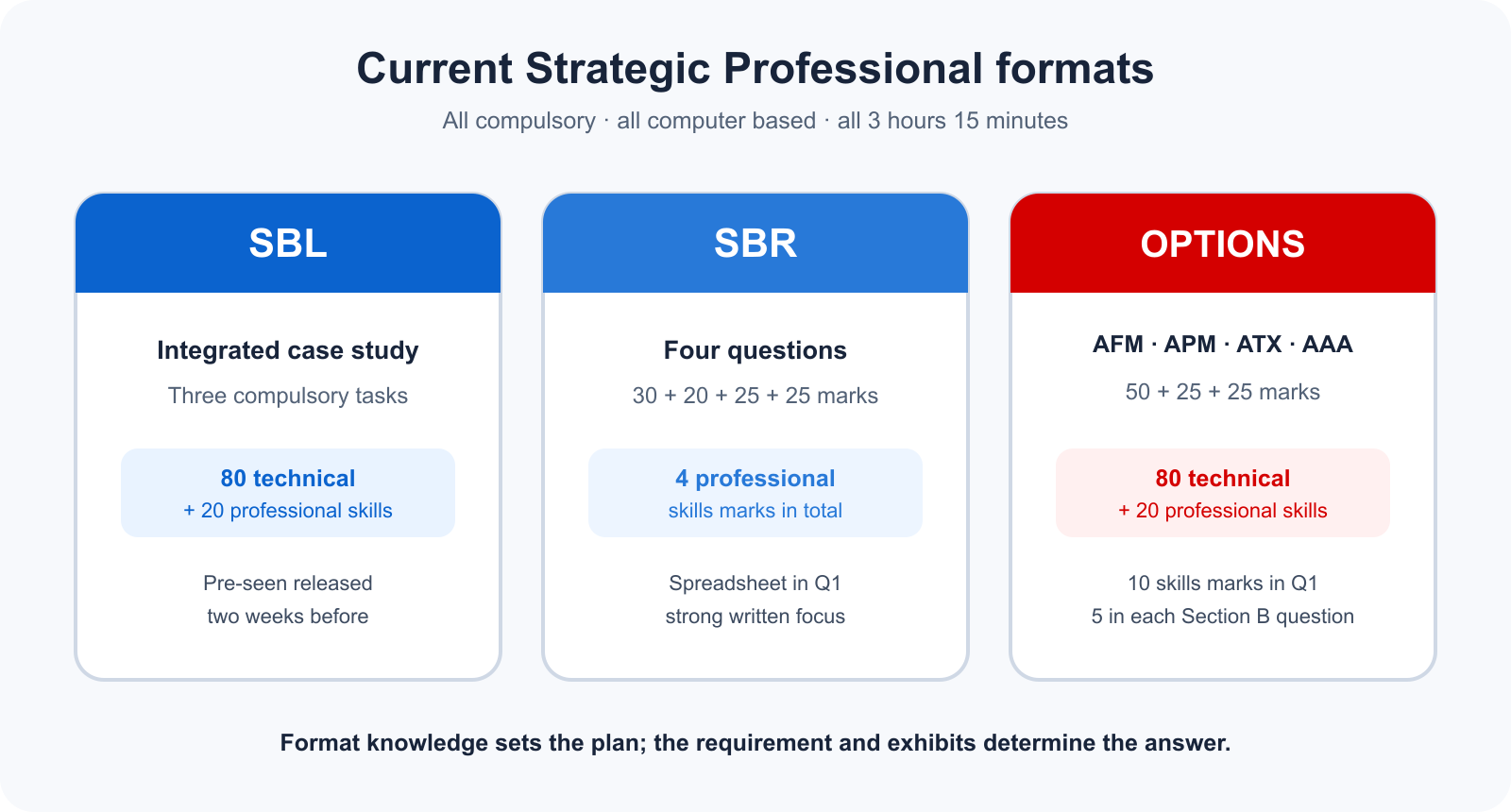
Figure 1: Current formats at a glance. Always confirm the latest syllabus and specimen for the booked exam.
| Exam | Current format | Professional skills |
|---|---|---|
| SBL | One integrated case with three compulsory tasks; 80 technical marks | 20 marks across analysis, commercial acumen, communication, evaluation and scepticism |
| SBR | Section A: 30 + 20 marks; Section B: 25 + 25 marks | 4 marks: two linked to the ethics requirement and two in Section B |
| AFM, APM, ATX, AAA | Section A: one 50-mark case; Section B: two 25-mark questions | 20 marks: 10 in Section A and 5 in each Section B question |
The average is 1.95 minutes per mark, but planning, reading and professional communication are part of earning the marks. Do not treat all 195 minutes as typing time.
Start with the requirement, role and audience
Before reading every exhibit in detail, identify:
- Role: who are you—finance director, adviser, auditor, consultant or another professional?
- Audience: who will use the response, and what do they already understand?
- Purpose: what decision, action or conclusion must your answer support?
- Verb: must you analyse, evaluate, assess, explain, discuss, advise, justify or recommend?
- Format: report, briefing note, email, memo, slides, calculation or another deliverable?
- Marks: how much depth, time and breadth can the requirement justify?
These are not presentation extras. They determine which facts are relevant, how critical the answer should be and what a professional conclusion looks like.
Plan before typing
A plan should be short and functional. It is not a second answer hidden in the scratchpad.
- Convert marks into a time limit.
- Create headings that follow the requirement.
- Assign relevant exhibit facts and technical ideas to those headings.
- Decide the calculation route and where assumptions are needed.
- Identify the likely conclusion or recommendation, while remaining willing to change it as analysis develops.
Then type. If the plan contains ten points for a five-mark requirement, prioritise; if it contains one point for a ten-mark requirement, return to the exhibits.
Build professional marks into the technical answer
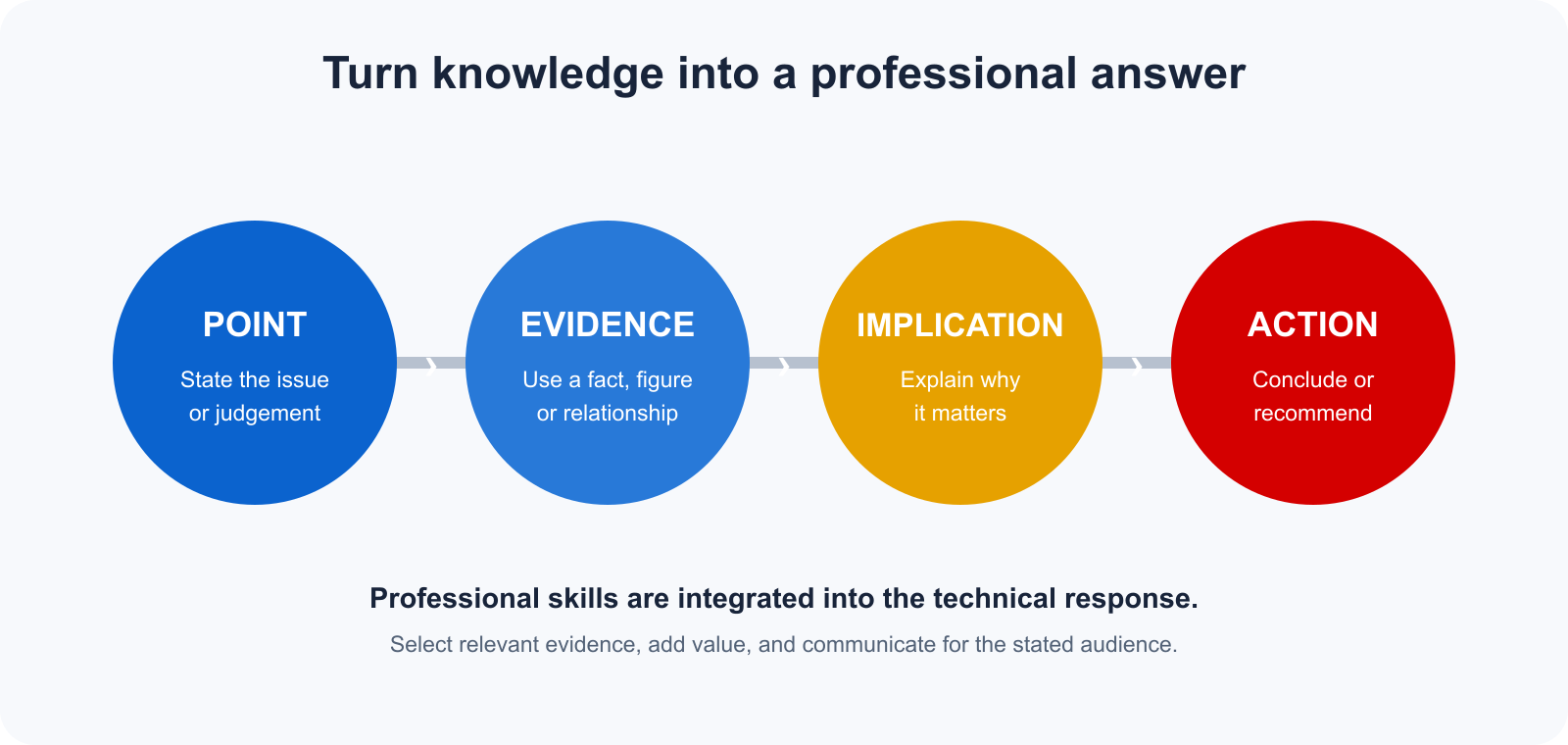
Figure 2: Professional skills are demonstrated through the quality of the technical response, not in a separate paragraph.
A strong developed point usually contains four elements:
- Point: state the issue, treatment or judgement directly.
- Evidence: use a specific fact, figure or relationship from the exhibits.
- Implication: explain why it matters to the organisation, client, stakeholders or engagement.
- Action: where required, conclude, recommend or state the next step.
Not every sentence needs all four elements, but an answer made entirely of technical assertions or copied exhibit facts will not demonstrate professional judgement.
What the professional skills look like
Analysis and evaluation
Break information into its significant parts, connect causes and effects, compare alternatives, weigh evidence and reach a reasoned judgement. Quoting a ratio or restating a fact is not analysis until you explain the relationship and consequence.
Commercial acumen
Recognise the organisation’s business model, constraints, stakeholders and practical environment. Advice should be implementable. A technically ideal solution that ignores cash, systems, regulation, people or timing may be commercially weak.
Communication
Use the requested format, a logical structure and language appropriate for the audience. Be concise without reducing the answer to note form. Put the most decision-useful information first and make conclusions easy to find.
Scepticism
Question the completeness, bias and reliability of evidence. Distinguish fact from assumption and identify when more information is needed. Scepticism is reasoned challenge, not automatic distrust.
SBL evaluation
SBL also identifies evaluation separately: weigh arguments, consequences and evidence to support a balanced conclusion. The skill should be visible in the answer rather than announced by writing “this demonstrates evaluation”.
Use exhibits without copying them
- Read the requirement first so each exhibit has a purpose.
- Note which requirement each exhibit is likely to support.
- Extract the relevant fact in a few words; do not paste or paraphrase whole paragraphs.
- Add value: explain the cause, risk, consequence, limitation or decision.
- Cross-check figures and dates between exhibits. Contradictions may be deliberate and significant.
- Close or resize windows as you work so the screen remains usable.
Numerical requirements: method plus meaning
Before starting a complex calculation, picture the route from inputs to decision. Use the spreadsheet to make that route visible.
- Use clear titles, labels and units.
- Separate assumptions and alternative scenarios.
- Show intermediate workings so method marks are available.
- Cross-reference important results into the narrative answer.
- Check reasonableness, signs, scale and direction.
- If an earlier figure is wrong, continue consistently rather than rebuilding the entire answer at the expense of other marks.
- Interpret the result and answer the decision or advisory requirement.
Strategic Professional exams rarely reward a calculation as an end in itself. The value is usually in what the figure means and what should be done.
Writing and presentation
- Use headings that match the tasks and create a logical flow.
- Write short professional paragraphs, usually one developed idea per paragraph.
- Use tables only where a genuine comparison or direct relationship exists.
- Avoid undefined abbreviations, casual language and note-form fragments.
- Do not repeat the scenario. Select facts and explain their significance.
- Give a recommendation when asked, and make it consistent with your analysis.
- Stop at the time limit. Relevance and coverage beat an overlong first answer.
Exam-specific priorities
SBL
The pre-seen material is released two weeks before the exam. Learn the organisation, industry, business model and obvious stakeholder context, but do not try to predict requirements or prepare generic answers. In the exam, new exhibits and tasks control the response. SBL offers 20 professional-skills marks across five areas, so role, audience, format and commercial practicality are central.
SBR
Explain the accounting treatment, judgement and reporting effect; do not hide behind standard numbers or paragraph references. Written answers carry substantial weight. Practise ethics, investor or stakeholder focus and the pre-formatted spreadsheet in Question 1. SBR has four professional-skills marks rather than the 20-mark model used in SBL and the Options.
AFM
Show advanced calculations clearly, then discuss assumptions, uncertainty and non-financial factors. Recommendations must follow from your figures and commercial analysis. Do not spend so long perfecting a valuation or hedge that discussion requirements are left thin.
APM
Analyse performance in the context of strategy. Avoid reproducing models or calculating every possible measure. Explain whether information is relevant, reliable and capable of driving the desired behaviour, then recommend improvements that fit the organisation.
ATX
Use the exact variant and examinable period. Identify triggers, plan only the calculations needed and produce concise, practical advice for the client or firm. Make assumptions and ethical issues explicit. Tax knowledge must be precise, but the final response must also be usable.
AAA
AAA assumes strong SBR-level reporting knowledge; ACCA recommends attempting and passing SBR before AAA. Apply professional scepticism and be specific. For a risk, explain the scenario cause and likely misstatement or engagement consequence. For a procedure, state the action, evidence or source and purpose. Generic lists do not demonstrate senior audit judgement.
How to choose the current Options
| Option | Strong underpinning | Good fit when you enjoy or use | Practical warning |
|---|---|---|---|
| AFM | FM | Valuation, investment, financing and risk | Quantitative strength must be matched by advice and evaluation |
| APM | PM | Strategy, performance systems and business analysis | Model knowledge without scenario application scores poorly |
| ATX | TX in the relevant variant | Tax planning and client advice | Check variant availability and the correct examinable period |
| AAA | AA plus SBR-level reporting | Audit, assurance and professional judgement | Take SBR first as the strong default; generic procedures are not enough |
Do not choose from one session’s pass rates. Pass rates reflect the candidate population as well as exam difficulty and do not reveal which paper fits your knowledge or career. Consider:
- recent strength in the underpinning Applied Skills exam;
- current work experience and intended career direction;
- interest strong enough to sustain extensive question practice;
- variant and session availability;
- the 2027 transition result shown by ACCA’s tool.
Plan for the September 2027 redesign
The final current Strategic Professional exam session is June 2027. From September 2027, the redesigned level contains two Essentials and one Option. ACCA says current progress will receive credit where an equivalent element exists and provides a Transition Tool for personal planning.
If you have passed one current Option but still need SBL or SBR, the future one-Option requirement may affect priority. However, ACCA encourages students to continue progressing rather than create unnecessary delay. Compare the value of a current attempt, the risk of waiting, expiry rules, employer plans and the exact transition credit shown for you.
Do not use this article as a personal transition calculation. Run your expected passes through ACCA’s Transition Tool and check again after every result.
Make the Practice Platform part of study
Practise in the ACCA CBE Practice Platform early enough to improve, not only in the final weekend. You should be able to:
- navigate requirements and multiple exhibits without losing your place;
- use word-processing and spreadsheet tools efficiently;
- build headings and answer plans quickly;
- complete a full exam to time;
- self-mark using marking guides and sample answers;
- identify missed professional skills as well as missed technical points.
Model answers are deliberately comprehensive. Compare your requirement coverage, application, logic and professional judgement; do not expect to reproduce every sentence.
The final weeks
- Finish syllabus learning early enough to make question practice the dominant activity.
- Complete recent exam-standard questions across the syllabus, not only favourite topics.
- Attempt at least two full timed mocks in the Practice Platform.
- Debrief technical marks, professional skills, structure and time separately.
- Repeat weak requirements rather than rereading everything.
- Confirm the exact syllabus, examinable documents, variant, identification and exam arrangements.
Exam-day control
- Write finish times for every task or question.
- Read the requirement, role and audience before opening every exhibit.
- Plan briefly, then type under clear headings.
- Use scenario evidence and explain why it matters.
- Keep mark-worthy workings in the response workspace.
- If stuck, state a reasonable assumption and continue.
- Move on at the deadline and secure coverage across all compulsory requirements.
- Use any final review for omissions, headings, conclusions and incomplete answers—not wholesale rewriting.
Frequently asked questions
How much time should I spend planning?
Enough to identify the requirement, time, headings, principal exhibit points and calculation route. The exact minutes vary by task. Planning is useful only when it improves the final answer and protects time.
Should I write a separate paragraph for professional skills?
No. Demonstrate them through relevant analysis, evidence, challenge, commercial judgement, structure and communication in the technical answer.
Why does a technically correct answer underperform?
It may not answer the verb, use the scenario, address the audience, explain implications or reach the required conclusion. Strategic Professional rewards applied professional judgement, not isolated knowledge.
Should I choose the Option with the highest pass rate?
No. Choose from underpinning knowledge, career relevance, interest, variant availability and transition position. Published pass rates do not measure your personal probability of success.
Should I take SBR before AAA?
Yes, as the strong default. AAA relies on SBR-level financial reporting knowledge, and ACCA recommends attempting and passing SBR first.
Official sources and next steps
- ACCA current qualification structure
- ACCA SBL format and professional skills
- ACCA SBR format and professional skills
- ACCA AFM format and professional skills
- ACCA APM format and professional skills
- ACCA ATX format and professional skills
- ACCA AAA format and professional skills
- ACCA future qualification FAQs and Transition Tool
- OpenTuition free ACCA notes, lectures, tests and tutor forums
This guide was reviewed on 15 July 2026. ACCA can change syllabuses, formats, variants and transition arrangements. Check myACCA and the linked official pages before booking.